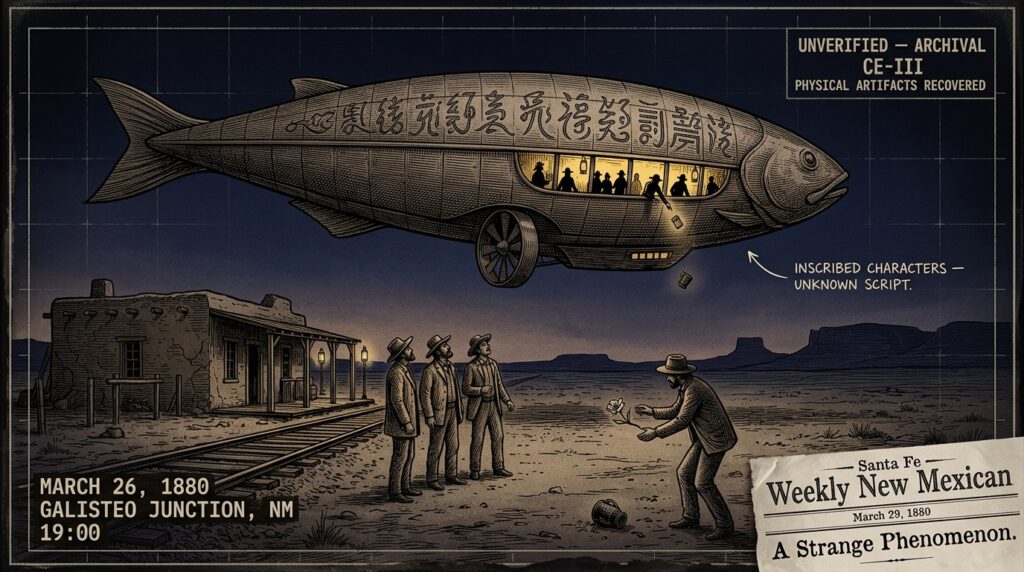
Galisteo Junction (Lamy), New Mexico Territory — March 26, 1880, 19:00. Three or four witnesses observe a monstrous fish-shaped fan-propelled vessel with eight to ten singing human occupants overhead; hull covered in elegantly inscribed characters; occupants drop a silk-wrapped flower and a cup of peculiar workmanship. Reported in the Santa Fe Weekly New Mexican, March 29, 1880. Documented by Jacques Vallée in Passport to Magonia — sixteen years before the Great Airship Wave.
THINK ABOUTIT UFO | UAP | ENTITY ENCOUNTER REPORT
1880: Lamy, New Mexico Encounter
On the evening of March 26, 1880, at Galisteo Junction — the small New Mexico railroad stop that would later be named Lamy — three or four people looked up and saw something that the Santa Fe Weekly New Mexican of March 29 described as a balloon of monstrous size, fish-shaped, propelled and directed by a fan. It was overhead and moving, and aboard it were eight to ten people — human in appearance, speaking a foreign language, singing, as if at a party. Elegantly drawn characters covered the exterior of the vessel. Before it rose and departed eastward at speed, the people aboard tossed things down: a beautiful flower wrapped in silk-like paper bearing characters that reminded the witnesses of designs on Japanese tea chests. In the morning a cup was found — the witnesses had seen it thrown but couldn’t locate it in the darkness — of very peculiar workmanship, entirely different from anything used in the United States. This is sixteen years before the Great Airship Wave of 1896–1897 and sixty-seven years before the Air Force gave it a name. The Santa Fe Weekly New Mexican speculated it was from Asia. Jacques Vallée documented it in Passport to Magonia. The archive holds the core sighting — the vessel, the occupants, the inscribed characters, the physical artifacts — and sets aside the newspaper’s follow-up explanation as period press embellishment.
Date: March 26, 1880
Sighting Time: 19:00
Day/Night: Night — evening
Location: Galisteo Junction (later named Lamy), Santa Fe County, New Mexico
Urban or Rural: Rural — remote railroad junction
No. of Entity(‘s): 8–10
Entity Type: Human-type occupants — described as normal human beings
Entity Description: Eight to ten people visible aboard the vessel; described as normal human beings in appearance; speaking a foreign language not recognized by witnesses; singing and conversing as if at a social gathering or party; tossed items down to the witnesses before departure; no physical contact with the ground
Hynek Classification: CE-III (Close Encounter III) — animate beings associated with the craft observed by multiple witnesses; physical artifacts exchanged
Duration: Not precisely recorded — long enough for sustained observation, artifact tossing, and departure sequence; vessel rose and departed eastward at fast speed
No. of Object(s): 1
Description of the Object(s): A balloon of monstrous size; fish-shaped; propelled and directed by a fan mechanism; exterior covered in elegantly drawn characters not recognized by witnesses; moved overhead, hovered or slowed sufficiently for occupants to toss items to ground witnesses, then rose and departed eastward at fast speed
Shape of Object(s): Fish-shaped
Size of Object(s): Monstrous — exact dimensions not recorded
Color of Object(s): Not recorded
Distance to Object(s): Overhead — close enough for occupants to toss items and for witnesses to observe human figures and hear singing; exact distance not recorded
Height & Speed: Overhead altitude not recorded; departed eastward at fast speed after the encounter
Number of Witnesses: 3–4
Special Features/Characteristics: Exterior of vessel inscribed with elegantly drawn characters not recognized by witnesses; occupants tossed a beautiful flower wrapped in silk-like paper bearing unknown characters; characters on the paper reminded witnesses of Japanese tea chest designs; a cup of very peculiar workmanship — entirely different from anything known in the United States — found the following morning at the site; witnesses had seen it thrown but could not locate it in the darkness; physical artifacts reportedly put on public display; sixteen years before the 1896–1897 Great Airship Wave; documented by Jacques Vallée in Passport to Magonia as a genuine pre-airship-wave case
Case Status: Insufficient Data — three or four witnesses, contemporaneous newspaper documentation, physical artifacts reported but not preserved in any known collection; Santa Fe Weekly New Mexican follow-up “explanation” regarding a China-to-America airline is period press embellishment inconsistent with any known aviation history and dismissed here as sensationalism
Source: Santa Fe Weekly New Mexican, March 29, 1880; Vallée, Passport to Magonia #6; FSR 65:3
Summary/Description: Three or four witnesses at Galisteo Junction, New Mexico observe a monstrous fish-shaped vessel propelled by a fan overhead at evening on March 26, 1880. Eight to ten human-type occupants are visible, speaking an unknown language and singing. The exterior bears inscribed characters. Occupants toss down a flower wrapped in silk paper with unknown characters and a cup of peculiar workmanship. The vessel rises and departs eastward at speed. Documented in the Santa Fe Weekly New Mexican, March 29, 1880; documented by Vallée in Passport to Magonia.
Related Cases: 1896 Oakland California airship — November 2, Great Airship Wave begins | 1897 Leroy Kansas Alexander Hamilton — fish-shaped craft with inscribed characters on hull | 1897 Hot Springs Arkansas — occupants spoke with witnesses | 1865 Cadotte Pass Montana — craft with hieroglyphic inscriptions | 1880 Coney Island New York — aerial entity same month
DETAILED REPORT
Galisteo Junction in March 1880 was nothing more than a railroad stop on the Atchison, Topeka and Santa Fe Railway — a few buildings in the high desert south of Santa Fe, where the spur line turned toward the capital. It would later be renamed Lamy, after Archbishop Jean-Baptiste Lamy, the historical figure behind Willa Cather’s Death Comes for the Archbishop. In 1880 it was simply a junction, remote, functional, and about as far from sensationalist newspaper culture as it was possible to get in New Mexico Territory.
The three or four people who witnessed the encounter on the evening of March 26 were at the junction in the ordinary course of their business — railroad workers, travelers, or local residents. What appeared overhead was, by their account, enormous. Fish-shaped. Propelled not by natural wind but by a fan mechanism — an explicitly mechanical description at a time when no fan-propelled aerial vehicle existed in any American or European inventory. The exterior of the vessel bore inscribed characters that were elegant and clearly deliberate — decorative or communicative markings of a sophistication that ruled out any improvised construction.
Eight to ten people were visible aboard. They were human in appearance — normal human beings, in the witnesses’ description — but speaking a language that no one at Galisteo Junction could identify, singing as if at a celebration. The encounter had the quality of passing over an outdoor party at altitude rather than a secret or threatening intrusion. The occupants noticed the witnesses below or simply chose to acknowledge the ground, and they tossed things down.
Two physical artifacts are documented. The first was recovered immediately: a beautiful flower wrapped in what the witnesses described as silk-like paper bearing unknown characters — characters that reminded them of designs they had seen on Japanese tea chests. This is a specific comparative reference from people who had almost certainly encountered imported Japanese goods through the railroad trade, and the comparison implies the script was East Asian in visual character without being identifiable as Japanese. The second artifact was not found until morning: a cup of very peculiar workmanship, entirely different from anything used in the United States, located at the site after witnesses had seen it thrown but failed to find it in the darkness. The cup and flower were reportedly put on display — publicly exhibited — at the junction station.
The Santa Fe Weekly New Mexican reported the sighting on March 29. One week later the same newspaper published a follow-up claiming that a wealthy young Chinese man who had visited the station had identified the dropped items as belonging to his fiancée, who was aboard the first flight of a China-to-America airline. This follow-up is period press sensationalism of a type common in Gilded Age newspapers — the implausible resolution invented to explain the inexplicable. No China-to-America airline existed in 1880. No Chinese aviation program of any kind was documented in 1880. The follow-up is not corroborated by any secondary source. Vallée, who documented the case in Passport to Magonia, does not treat the follow-up as credible. The archive retains the core March 29 sighting account and notes the follow-up for completeness while explicitly flagging it as embellishment.
What remains is: a fish-shaped fan-propelled monstrous vessel overhead at a New Mexico railroad junction in 1880, with human-type occupants singing in an unknown language, inscribed characters on the hull, and two physical artifacts dropped to the ground — one recovered immediately, one found the next morning. Sixteen years before the Great Airship Wave. Sixty-seven years before Roswell. The record has it documented.
RESEARCHER’S NOTES
The Galisteo Junction Vessel — 1880 New Mexico’s Pre-Airship-Wave Contact and the Problem of the Follow-Up Story
- Pre-Airship-Wave Significance: The Galisteo Junction encounter of March 26, 1880 predates the Great Airship Wave of 1896–1897 by sixteen years. It shares key features with the 1897 wave cases: a large mechanically described aerial vessel, visible occupants, apparent awareness of ground observers, and physical artifact exchange. Its documentation by Vallée places it in the analytical pre-cursor context that establishes the airship-wave phenomenon as not beginning in 1896 but having precedents extending back at least to 1880 and, with the Lamy case, into rural New Mexico Territory.
- The Follow-Up Story — Press Fabrication: The newspaper’s one-week-later “China-to-America airline” explanation is implausible on its face. No Chinese aviation program of any kind was documented in 1880. Transatlantic flight would not be achieved until 1919. The elegant structural parallel between the follow-up story and classic “Man In Black” confiscation narratives — a stranger appears, claims knowledge of the mysterious artifacts, removes them from public scrutiny — has been noted by researchers. Whether the follow-up represents deliberate suppression, editorial invention, or a genuine encounter with a plausible-looking stranger, it cannot be treated as factual without corroboration that does not exist.
- Physical Artifacts: The flower, silk paper, and cup represent the most tangible physical evidence in this case. Their reported public display at the junction station implies they were real objects that multiple people examined — not a private claim by a single witness. Their current location is unknown; no museum or archive has been identified as holding them. The cup’s description — of very peculiar workmanship, entirely different from anything used in the United States — is consistent with either an Asian origin or something outside the witness’s frame of reference entirely.
- Inscribed Characters Pattern: The exterior inscriptions on the Galisteo Junction vessel continue a pattern that runs through the 1865 Cadotte Pass Montana crash (hieroglyphics), the 1897 Aurora Texas crash (hieroglyphics on the pilot’s body), and the 1897 Leroy Kansas Alexander Hamilton affidavit (inscribed characters on the hull). Across three decades and multiple states, craft-associated inscriptions in unknown scripts appear consistently in the American anomalous record.
The people at Galisteo Junction watched the fish-shaped vessel pass over and caught what came down from it and found the cup the next morning and put everything on display, and that is the last reliable record of what became of the physical evidence. The newspaper explained it a week later with a story about Chinese airlines that no one who knew anything about aviation in 1880 could have taken seriously for a minute. Vallée took the original sighting seriously enough to put it in Passport to Magonia. The archive takes it seriously enough to separate the sighting from the fabricated explanation and hold each one honestly. Something monstrous and fish-shaped moved over the New Mexico high desert at seven in the evening on March 26, 1880, and its crew sang in an unknown language and dropped a flower wrapped in silk, and the archive notes that sixteen years later the airship wave would make this kind of report an American national conversation — and that the airship wave is not where it started.