An F-82 crew saw an amber light match its turns over Johnson Air Base on February 1, 1951
THINK ABOUTIT UFO|UAP SIGHTINGS REPORT
1951: An amber light shadows an F-82 night fighter through three turns over Johnson Air Base, Japan
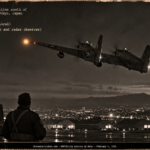
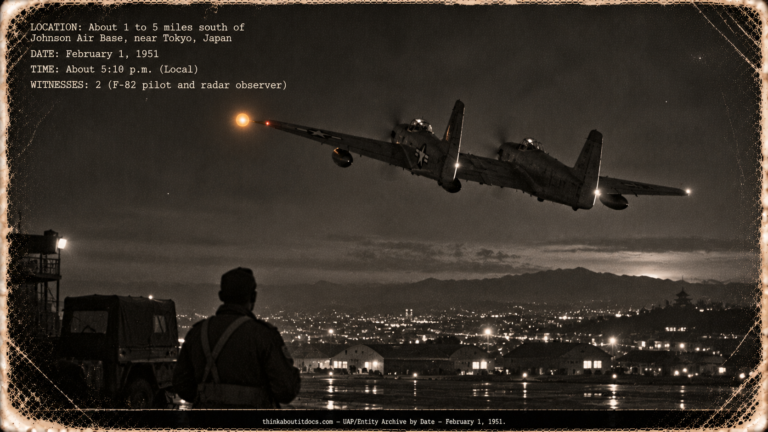
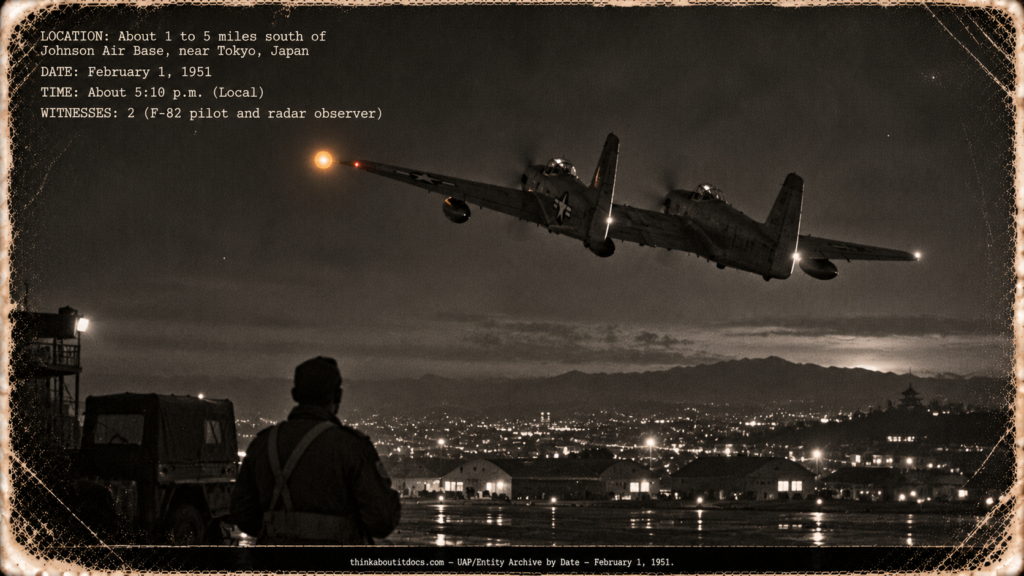
On the evening of February 1, 1951, an F-82 night fighter of the 339th Fighter (All-Weather) Squadron took off from Johnson Air Base, near Tokyo, on airborne alert. About a mile south of the base, at 6,000 feet, the pilot and radar observer saw an amber light larger than a wing-tip light off the left wing.
When the F-82 turned left, so did the light. Through three or four full 360-degree turns it held station off the wing tip, then jumped to the two o’clock high position, dropped ahead, reversed toward the aircraft very slowly and climbed out of sight. The crew said the light appeared to have complete control of its movement. A weather balloon was released an hour later, and Air Force intelligence leaned toward balloon and star, but Blue Book’s card lists an unidentified remainder.
Date: February 1, 1951
Sighting Time: About 5:10 p.m. local (1710)
Day/Night: Night (clear, no moon)
Location: About 1 to 5 miles south of Johnson Air Base (35°51’N, 139°25’E), near Tokyo, Japan
Urban or Rural: Suburban airspace near a military base
No. of Entity(‘s): 0
Entity Type: None observed
Entity Description: Not Applicable
Hynek Classification: NL (Nocturnal Light)
Duration: Not reported
No. of Object(s): 1
Description of the Object(s): An amber light larger than a wing-tip light; no silhouette was ever visible.
Shape of Object(s): Not discernible (light only)
Size of Object(s): Larger than a wing-tip light; no actual size could be estimated
Color of Object(s): Amber
Distance to Object(s): Close enough to appear off the wing tip; not estimated
Height & Speed: At the F-82’s altitude (6,000 to 8,000 feet) while pacing it; later climbed slowly and steeply out of sight
Number of Witnesses: 2 (the pilot and radar observer of the F-82; names redacted)
Special Features/Characteristics: Matched the aircraft through three or four 360-degree left turns; changed position suddenly; reversed course toward the aircraft; the crew said it seemed in complete control; no silhouette was ever seen
Case Status: Project Blue Book card: split evaluation, with the rising portion Probably Balloon and the remainder Other (Unidentified); Air Force intelligence report evaluation B-4
Source: Project Blue Book record card; Air Intelligence Information Report INT-OI-U/AO-1-51 (Headquarters 314th Air Division, February 21, 1951); Berliner
Summary/Description: An F-82 crew on airborne alert saw an amber light match its left turns three or four times, jump position, reverse toward the aircraft and climb out of sight. A weather balloon released an hour later, internal reflections and bright stars were offered as partial explanations; Blue Book listed the remainder as unidentified.
Related Cases: February 1951 UFO sightings archive | Ladd AFB, February 26, 1951
Detailed Report
This report is based on the Air Intelligence Information Report prepared by the 314th Air Division headquarters in Japan on February 21, 1951, with a sketch of the sighting by the crew, and on the Project Blue Book record card. The source line lists the pilot and radar observer of the F-82, both lieutenants; their names are redacted.
The report says that at about 1710 local time on February 1, 1951, an F-82 of the 339th Fighter (All-Weather) Squadron, attached to the 6162nd Air Base Wing at Johnson Air Base (35°51’N, 139°25’E), took off to fly airborne alert. About one mile south of Johnson, heading 090 degrees at 6,000 feet, the crew sighted an amber light that appeared larger than a wing-tip light at their eleven o’clock position, level with them.
The F-82 turned left and the light appeared to turn left too. Through three or four 360-degree turns to the left, the light appeared to stay off the left wing tip. Suddenly it moved to the two o’clock high position while the aircraft, now at 8,000 feet, was still turning. The pilot leveled off on a heading of 180 degrees; the light looked smaller and was at twelve o’clock. Then it appeared to reverse its course and head toward the F-82, very slowly and high, as if ascending vertically, until it became too small to see. The F-82 was then about five miles south of Johnson at 200 knots indicated airspeed. Both crew members said that “at all times the light appeared to have complete control of its movement” and that they never saw a silhouette. The weather was clear with no moon, and they had seen another aircraft approaching the base before sighting the light.
The report records that the base’s meteorological section released a weather balloon at 1815 local on February 1; it was visible for ten minutes, rose to 11,000 feet and drifted 11,300 yards from the release point, and observers watching it saw no aircraft near it. The tactical control center had good radar contact with the F-82 and saw no other blip, and a check found no other aircraft in the area.
The reviewing officer’s comment suggests that a balloon released at that time of day would be a type fitted with a candle or electric light, visible to 30,000 feet, and that the sudden change of the light from nine o’clock level to two o’clock high may be attributed to the crew losing sight of the light and sighting a bright star, which might have faded behind haze. The report notes that the position of the aircraft when the crew lost the light and the position of the balloon when its observers lost it were approximately the same. The 314th Air Division concurred in the evaluation of the 6162nd Air Base Wing’s intelligence officer. The Blue Book card divides its conclusion: the rising portion probably a balloon, and the remainder unidentified, noting the possibility of internal reflections as the object stayed off the wing tip through three 360-degree turns.
One point in the file deserves care. The crew’s sighting is placed at about 1710 and the balloon’s release at 1815, about an hour later, so the balloon that is offered as an explanation for the final rising light was not in the air when the crew first saw it. The report does not address the gap.
The Hynek classification is NL (Nocturnal Light). The object was a light at night with no silhouette and no physical effects or entities reported.
Researcher’s Notes
A Light That Followed Three Turns: Balloon, Star, Reflection or Something Else?
- Classification: NL is the clear fit. The crew never saw a shape, so size and distance are unknown. The comparison to a wing-tip light is the only scale reference.
- The Balloon Explanation: The balloon was released at 1815, roughly an hour after the sighting began at 1710. The report equates the end positions of the two but does not explain how a balloon not yet released could account for the early part. Blue Book limited the balloon to the final rising portion, which is why the card is split.
- Internal Reflections: The card suggests internal reflections to explain the light staying off the wing tip through three turns. A reflection would explain a light that moved with the aircraft. It does not explain the sudden jump to two o’clock high or the reversal, which the card leaves as the unidentified portion.
- Radar: Ground radar followed the F-82 and saw no other target, which cuts against a second aircraft but says nothing about a small light at low altitude. The aircraft’s own radar results are not recorded.
- Date and Time: The report states February 1 at 1710 local. The record card’s GMT field is hard to read in the scan, and the report’s own local-time designation is what the page uses.
- Witness Quality: The two crew members were trained night-fighter flyers, and the report notes they saw no silhouette at any time, an honest limit on what they could say.
The Johnson Air Base case is a classic short-range night light: no shape, no size, only behavior. A pilot and radar observer saw an amber light that matched three left turns and then made moves they judged deliberate. Air Force intelligence offered balloon, star and reflection for parts of it, and Blue Book kept the remainder as unidentified.
“…at all times the light appeared to have complete control of its movement.”
Air Intelligence Information Report INT-OI-U/AO-1-51, 314th Air Division, on the crew’s account of the February 1, 1951 sighting