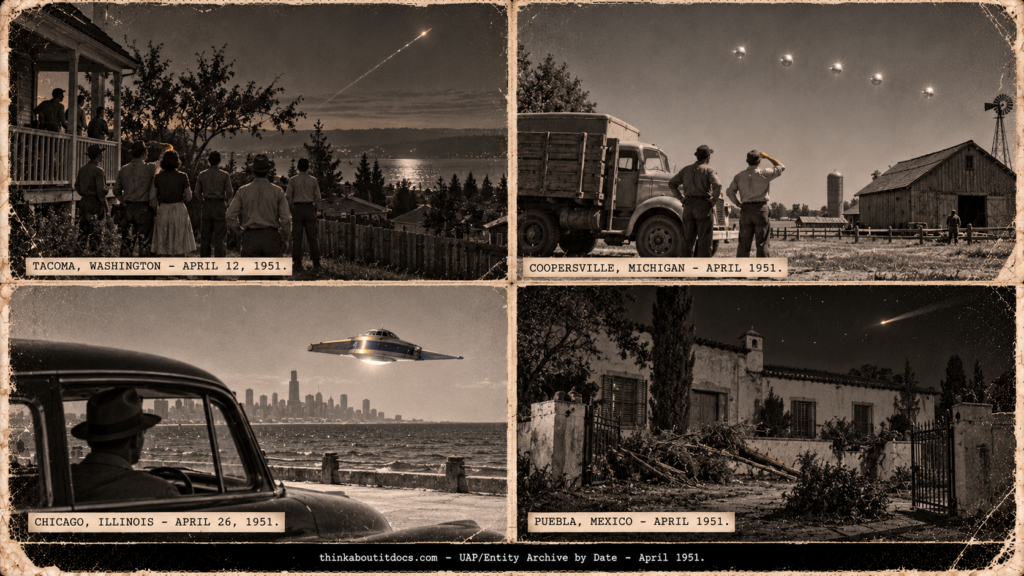
April 1951: Tacoma, Coopersville, Chicago and Puebla.
1951: April UFO|UAP & Entity Sightings Archive
April 1951 is a quiet month by count and a good one by documentation: seven entries, led by a Tacoma, Washington sighting that nine people, Air Force personnel and a teacher among them, watched from a house near Point Defiance while a light dimmed, shot straight up and vanished in silence. Around it, this April 1951 UFO sightings archive holds a Los Alamos oblong object, a silver globe formation over Michigan farmland, a Yellow Sea radar track, a Missouri farmer’s two-mile trail and a Chicago driver’s hovering silver craft. One older story completes the month: the disappearance of a man called John Copper from a villa in Puebla, Mexico.
Date: April 1951 (about April 8)
Location: Puebla, Mexico
Time: Night
Summary: According to Peter Kolosimo, a man calling himself “John Copper,” who claimed British nationality, arrived in Puebla in the summer of 1944 at about age 21. He rented a villa, described himself as an optician doing private photographic research, asked for complete privacy, and was rarely seen in seven years, though he kept a deposit of $78,000 at a local bank. Shortly before he vanished he told a grocer that his servant, a man named Antonio, had left three days earlier and not returned. When the owner, worried about unpaid rent, called the police roughly two months later, they found the house in total disarray: Copper, his optical equipment and every piece of paper were gone, though most personal belongings remained and every drawer and armoire had been searched. The British consulate reportedly had no record of him. Investigators noted the garden looked as if a heavy machine had crossed it, with trees broken, fences down and grass flattened over a wide area, and a neighbor reported a “comet” descending over the villa on the night of April 8.
Source: Peter Kolosimo, “Sombra en las Estrellas”
Source Status: Single-source retelling; no police report, consulate record or neighbor’s statement has been located. The retelling gives April as the month of the disappearance but places the discovery about two months later.
Date: April 1951 (day not recorded)
Location: About 3 miles north of Coopersville, Michigan
Time: About 4:00 p.m.
Summary: A delivery crew taking equipment to a farm saw four silver, jewel-like objects moving in a tight group eastward under a cloudless sky. They sparkled like globes, made no smoke, flash or sound of motors, traveled very rapidly, and were out of sight in about five minutes. The witnesses could not judge size or altitude.
Source: Project Blue Book record card; witness letter to the Office of War Information
Source Status: Blue Book evaluation: Insufficient Data, with the comment “Possible A/C sighting or balloons.” The letter says “last April,” so it was written later, in a year the released copy does not show. The card lists 1600Z while the letter says about 4 p.m. local; the letter’s time is used.
Date: April 1, 1951
Location: Los Alamos, New Mexico
Time: Not recorded
Summary: A Los Alamos employee reported an oblong, bright object moving slowly in both horizontal and vertical directions.
Source: Project Twinkle Final Report (incident log)
Source Status: Logged as Insufficient Data; no time, duration or further detail survives in the log.
Date: April 12, 1951
Location: Northwest of Point Defiance, Tacoma, Washington
Time: 7:40 p.m. PST (1940; 0340Z on April 13)
Summary: Nine people at a house in Tacoma, Air Force personnel from McChord and a civilian teacher among them, watched a single light fly from the southwest to the northeast, descending, then turn left to the northwest and fly straight and level for about 30 seconds as its lights slowly dimmed. It then shot straight up and vanished. It gave off periodic bursts of light, trailed a silver, cigar-shaped stream of light 200 to 300 feet long, and made no sound. It was in view for two and a half to three minutes under unlimited ceiling and visibility. See the Detailed Report.
Source: Project Blue Book record card; Air Intelligence Information Report IR-85-51 (Headquarters MATS, May 14, 1951)
Source Status: Blue Book evaluation: Possibly Aircraft. The report calls the witnesses completely reliable and says their information was confirmed by other sources, which it does not name. Witness names are redacted in the released file.
Date: April 14, 1951
Location: Yellow Sea (the catalog header and summary give different latitudes, 27°09’N and 37°09’N, both at 123°20’E)
Time: 1:22 p.m. local (1322)
Summary: Radar tracking of an unidentified target at an estimated 3,755 mph.
Source: Jan Aldrich; Far East Air Forces intelligence report (Project 1947 Korean radar catalog)
Source Status: Evaluated by FEAF as radar interference. The catalog entry is a single line of detail with no witness, track length or sketch.
Date: April 23, 1951
Location: Gerald, Missouri
Time: 8:30 to 9:00 a.m. CST
Summary: An elderly retired farmer who lived just east of town saw a bright, shining object cross the sky slowly from south to north, leaving a white trail he estimated at two miles long. He could not judge its altitude or speed. He asked the local newspaper to report it to the authorities, and the editor wrote to the FBI in St. Louis, saying the trail looked like a contrail that slowly dissipated.
Source: Project Blue Book record card; letter from the editor of The Gerald Journal to the FBI, forwarded by Headquarters Fifth Army
Source Status: Blue Book evaluation: aircraft contrails. The editor wrote that the witness was not a publicity seeker and that no one else in the community reported the object. The letter adds that the witness had reported a meteor or comet the Tuesday before, which the editor said gave him cause to wonder.
Date: April 26, 1951
Location: Lakefront at Cermak Road, Chicago, Illinois
Time: About 5:25 p.m.
Summary: A driver heading south at Canal Street and 23rd Street saw a bright, silver-colored object with blue and black trim around its center and a very short wing spread. He wrote that it hung practically at a standstill for about 30 seconds at about 1,000 feet, then moved north out of sight. He called it “another of the mystery airplanes.”
Source: Project Blue Book record card; witness letter to Headquarters Fifth Army, April 27, 1951
Source Status: Blue Book evaluation: Was Aircraft. The card gives the altitude as 100 feet; the letter says 1,000. Fifth Army headquarters said it did not plan an investigation, and Air Materiel Command acknowledged the letter on May 7, 1951. The writer’s wording implies earlier sightings that are not in the file.
EXECUTIVE SUMMARY
One Well-Documented Case, Three Explained, and a Vanished Man
April 1951 holds seven entries and none carries a Blue Book Unidentified evaluation. The best-documented case is Tacoma, with nine witnesses, a signed Air Force intelligence report and a Blue Book card that says only Possibly Aircraft. Three entries are explained: the Gerald, Missouri trail as aircraft contrails, the Chicago hovering craft as an aircraft, and the Yellow Sea radar track as radar interference. Two carry Insufficient Data: the Coopersville silver globes and the April 1 Los Alamos object.
The month’s most dramatic story rests on the thinnest ground. The Puebla disappearance survives through one book, with no police report, consulate record or neighbor’s statement located, and its own dates conflict. The Tacoma file is the opposite: an intelligence report that lists the witnesses’ units, gives the object’s headings and duration, and records its periodic bursts of light, slow dimming and vertical departure.
“The witnesses are considered completely reliable and their information is confirmed by other sources.”
— Air Intelligence Information Report IR-85-51, Headquarters MATS, May 14, 1951, on the April 12, 1951 Tacoma sighting