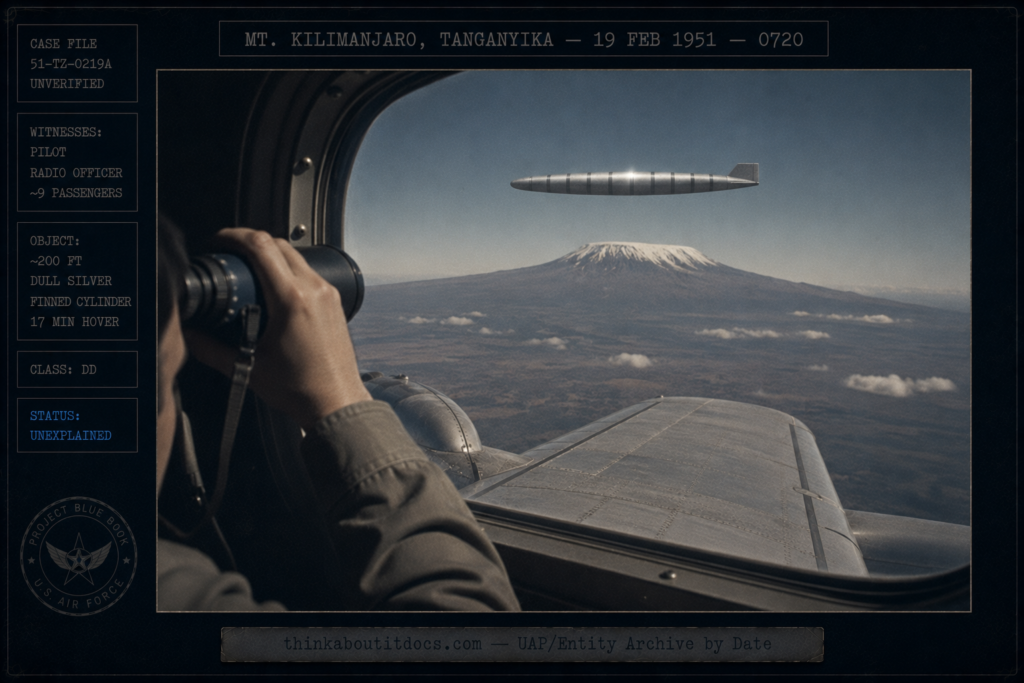
The February 19, 1951 Kilimanjaro sighting — an EAA crew and passengers watched a 200-foot finned cylinder hover for 17 minutes; Capt. Bicknell had the passengers sign a statement. Logged Unexplained. (thinkaboutitdocs.com — UAP/Entity Archive by Date)
THINK ABOUTIT UFO|UAP SIGHTINGS REPORT
1951: A bullet-shaped object hangs motionless above Mount Kilimanjaro for 17 minutes
At 7:20 on the morning of February 19, 1951, the radio officer of an East African Airways Lodestar pointed out a bright, star-like object apparently hanging motionless about 10,000 feet above Mount Kilimanjaro. Capt. J. Bicknell, the pilot, watched it for three minutes before telling the passengers, and then the whole aircraft took turns at it with binoculars for about 17 minutes.
It looked like a dull silver bullet, more than 200 feet long by the captain’s estimate, with vertical bands along its length and a square-cut vertical fin at one end. Then it began to rise and move east and was lost at an estimated 40,000 feet. Passengers took still and color motion pictures. The only known still shows a blurred spot, and the man holding the motion-picture film reportedly vanished.
Date: February 19, 1951
Sighting Time: About 7:20 a.m. (the flight took off at about 7:00 a.m.)
Day/Night: Day (clear, bright morning)
Location: Over Mount Kilimanjaro, Tanganyika (now Tanzania), on a flight from Nairobi
Urban or Rural: Rural (in flight over mountainous terrain)
No. of Entity(‘s): 0
Entity Type: None observed
Entity Description: Not Applicable
Hynek Classification: DD (Daylight Disc)
Duration: About 17 minutes stationary, then about 3 minutes of visible movement
No. of Object(s): 1
Description of the Object(s): A dull silver, metallic, bullet-shaped object with vertical bands at regular intervals along the body, a square-cut vertical fin at one end, a sharp outline, no portholes, mounts or gun pods and no visible means of propulsion.
Shape of Object(s): Bullet-shaped with a vertical fin at one end
Size of Object(s): Over 200 feet long (Capt. Bicknell’s estimate)
Color of Object(s): Dull silver; like a bright white star to the naked eye
Distance to Object(s): Not estimated; it appeared very distant but sharply outlined
Height & Speed: About 10,000 feet above Kilimanjaro when first seen, stationary for 17 minutes, then climbing east to an estimated 40,000 feet; Bicknell calculated about 60 miles in 3 minutes, roughly 1,000 mph
Number of Witnesses: About 12 (the pilot, radio officer and nine passengers)
Special Features/Characteristics: Absolutely stationary for 17 minutes; sharp outline in clear air; no vapor trail; climbed and moved east at the end; passengers took still and color motion pictures
Case Status: Project Blue Book card: Other (Insufficient Data for Evaluation); photographs noted as taken but not in the file
Source: U.S. Consulate Nairobi despatch to the State Department (March 1951); Nairobi Sunday Post (February 25, 1951, and the following Sunday), as summarized by the Australian Flying Saucer Bureau; Project Blue Book record card
Summary/Description: The pilot, radio officer and passengers of an East African Airways Lodestar saw a bullet-shaped, finned metallic object apparently stationary above Mount Kilimanjaro for about 17 minutes before it climbed rapidly eastward. Nairobi radio suggested a weather balloon, a possibility the captain rejected. Passengers photographed it; the only known still is a blurred spot. The U.S. Consulate forwarded the account to Washington.
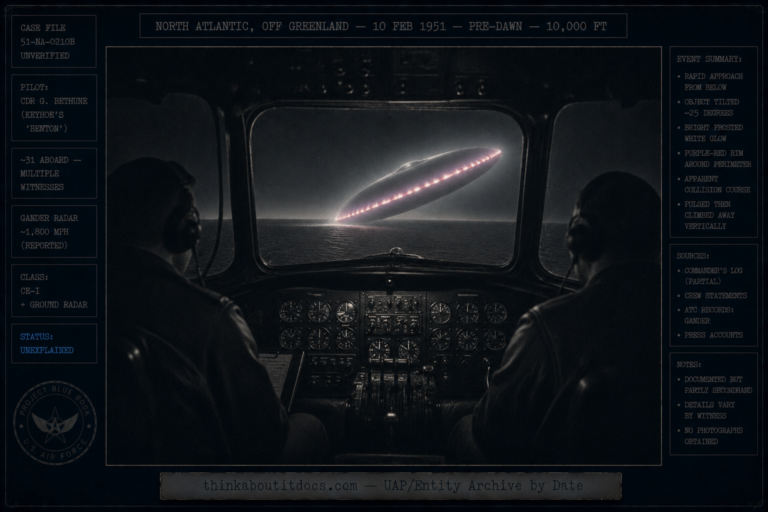
Related Cases: February 1951 UFO sightings archive | Bethune encounter, February 10, 1951
Detailed Report
This report is built from the U.S. Consulate’s despatch to the State Department, a Project Blue Book record card, and a summary by the Australian Flying Saucer Bureau of the Nairobi Sunday Post’s coverage. The consulate reported what it called the first flying saucer observed in East Africa, seen on the morning of February 19, 1951 by the crew and passengers of an East African Airways Lodestar flying from Nairobi.
According to the press account, the regular Monday morning Lodestar left Nairobi West Airport at 7:00 a.m. with nine passengers and a crew of two. At 7:20 the radio officer, D. W. Merrifield, drew the attention of the captain, J. Bicknell, to a bright, white-star-like object apparently motionless about 10,000 feet above Kilimanjaro. Bicknell’s first reaction, he said later, was to say nothing. After three minutes with the object still in view, he told the passengers. One passenger studied it through a powerful pair of field glasses while the radio officer called Eastleigh, the Nairobi airfield, with a description.
Eastleigh’s reply suggested a drifting meteorological balloon. The consulate’s despatch adds that Nairobi radio checked whether a French Constellation flying from Eastleigh to Tananarive on a similar course could have been mistaken for the object. That aircraft was cruising at about 17,500 feet and no more information was available. Bicknell found the longer he examined the object, the less it resembled a balloon: it was dull silver, marked at regular intervals along its length by vertical bands, and its outline was sharp and unobscured by haze. He estimated it at over 200 feet long, bullet-shaped, with a square-cut vertical fin at one end.
It stayed absolutely stationary for 17 minutes while passengers took turns with the field glasses and began taking photographs. Then it started to move eastward, slowly at first and rising, until it was lost at an estimated 40,000 feet. In the 3 minutes of visible movement Bicknell calculated it covered about 60 miles, which implies about 1,000 mph. There was no vapor trail and no visible means of propulsion. To the naked eye some passengers said it looked like a bright star; through binoculars its shape was clear, and several passengers said it had three distinct stripes along the body and looked metallic.
The consulate reported that two Americans aboard took pictures, one a still and one a color motion picture, and that the consulate tried and failed to reach the first before he left for Zanzibar the next morning. Later enquiries by the Australian Flying Saucer Bureau found that the only known public photograph shows a blurred spot, and that a motion picture film taken by another passenger was reported to be quite clear, but that the man with the film was “supposed to have disappeared.” The Blue Book card notes that photographs were taken but are not in the file.
The Hynek classification is DD (Daylight Disc). The object was a well-defined metallic body in full daylight, with no physical traces, effects or entities reported.
Researcher’s Notes
A Metallic Object, Seventeen Minutes, and a Missing Film
- Classification: DD fits a defined metallic body seen in clear daylight. The bullet shape and tail fin are structural details seen through binoculars at an unknown distance.
- Balloon and Aircraft: Nairobi suggested a weather balloon and the radio check named a French Constellation at about 17,500 feet. Bicknell rejected the balloon. The file does not say whether a balloon release was checked. A mirage was also suggested and rejected by the radio officer, who noted mirages are rarely seen without cloud.
- Photographic Evidence: Photographs and a color film were reported, but the only known still is a blurred spot and the film cannot be traced. Nothing in the file allows independent analysis. This is the weakest link in an otherwise well-corroborated sighting.
- Discrepancies: The consulate gives the flight’s destination as Dar es Salaam, the press account as Mombasa. Both sources say passengers, not the captain, took the photographs, and both describe a bullet with a fin rather than a cigar.
- Witness Quality: The witnesses were two airline crew members and nine passengers. The Sunday Post editorial noted the report came “from responsible airline officials and nine ordinary travellers” and not from a few isolated individuals.
- Later Accounts: The press summary notes that LIFE magazine published a sketch of the object in early 1952 that resembled a lipstick tube lying on its side. The AFSB summary was written years after the event.
The Kilimanjaro sighting is one of the earliest African aircraft cases with a crew-and-passenger witness base: twelve people, 17 minutes, binoculars, a radio check and a consular report. Its photographs have not survived, so the account rests on testimony, which is consistent across the sources reviewed. Blue Book recorded it as Insufficient Data.
“If this report had come from a few isolated individuals it would soon be discounted. But it came from responsible airline officials and nine ordinary travellers.”
Nairobi Sunday Post, as quoted in the Australian Flying Saucer Bureau summary of the February 19, 1951 Kilimanjaro sighting