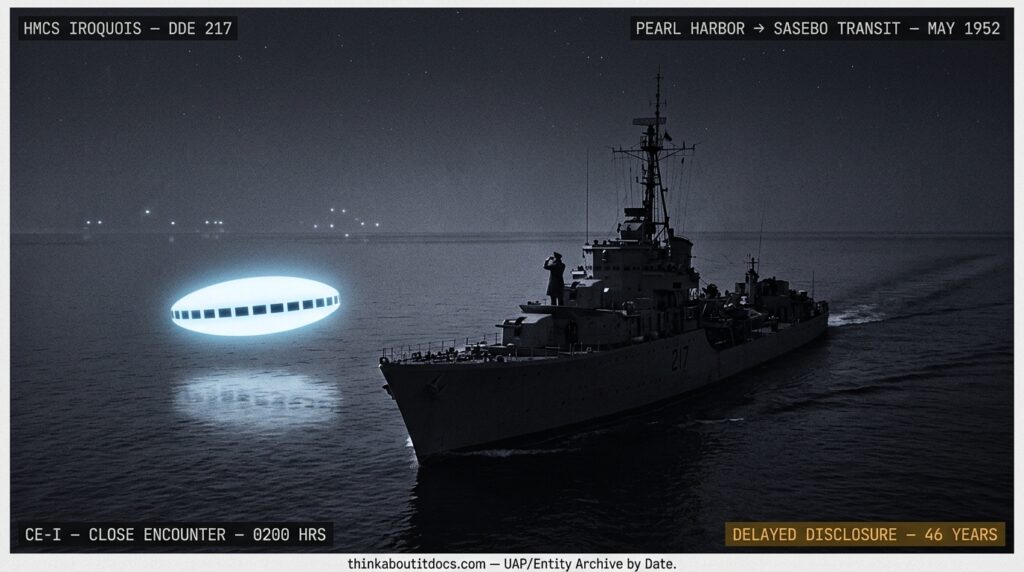
Reconstruction — Lt. George MacFarlane observes a glowing oval disc with black windows from the bridge of HMCS Iroquois, approximately 100 nautical miles west of Pearl Harbor, May 1952.
THINK ABOUTIT UFO|UAP SIGHTINGS REPORT
1952: Canadian Naval Officer Has Close Encounter In Hawaiian Waters
In May 1952, a Canadian naval officer aboard HMCS Iroquois witnessed a brightly glowing oval disc with approximately two dozen large black windows pace his destroyer at close range for fifteen minutes during a nighttime transit west of Pearl Harbor — then watched it vanish instantly and in total silence. Lieutenant George R. MacFarlane, who retired as a Commander in the Royal Canadian Navy, did not report the encounter for forty-six years, having deliberately falsified the ship’s log to read “meteorites” on a wartime deployment to Korea.
This case stands on the credibility of a named, career military officer whose service aboard HMCS Iroquois is independently verified through Canadian naval records and photographic archives. The corroborating watch officer, Lieutenant Doug Tutte, independently observed and concealed the same phenomena on the subsequent watch. MacFarlane’s voluntary admission of the cover-up, the verifiable operational timeline, and the absence of any conventional match for the close-range structured object together make this one of the better-documented delayed-disclosure naval encounters in the record.
Date: May 1952 (between approximately May 15–31, based on transit timeline)
Sighting Time: 0100–0300 (first watch); phenomena continued into the 0400–0800 watch under Lt. Doug Tutte
Day/Night: Night
Location: Pacific Ocean, approximately 100 nautical miles west of Pearl Harbor, Hawaii (en route to Sasebo, Japan)
Urban or Rural: Open Sea
No. of Entity(‘s): None observed
Entity Type: Not Applicable
Entity Description: Not Applicable
Hynek Classification: CE-I (Close Encounter I) — Structured object observed at close range; no physical interaction or trace evidence
Duration: Approximately two hours total (0100–0300); close-range disc observation lasted approximately 15 minutes
No. of Object(s): Multiple — two initial single lights; subsequent formations of up to 30+ lights; one structured disc at close range
Description of the Object(s): The close-range object was disc- or oval-shaped, emitting a bright white glow from its entire body that nonetheless did not prevent direct observation. A band of approximately two dozen large, closely spaced, completely black rectangular windows ran around the visible side. The object held perfect station with the ship at low elevation off the port bow, making no sound at any time. Earlier objects included single fast-moving white lights with halo effects (in mist) and massed formation lights in quarter-line groups of three to six, appearing and disappearing instantaneously.
Shape of Object(s): Oval / disc-shaped (close-range object); point lights (distant formations)
Size of Object(s): Not precisely estimated; large enough for individual windows to be counted and examined through binoculars
Color of Object(s): Bright white glow (disc body); completely black windows
Distance to Object(s): Initial lights estimated at approximately one mile; close-range disc at low elevation off port bow, within CE-I range (detail observed through binoculars implies under 500 feet)
Height & Speed: Initial lights at approximately 30 degrees elevation, moving at rapid speed. Close-range disc at low elevation, matching ship speed (approximately 14 knots) with perfect stationkeeping. Formation lights appeared stationary to slowly shifting, visible to the horizon.
Number of Witnesses: Multiple — Lt. George R. MacFarlane (primary, Officer of the Watch), signalman on watch, bridge lookouts; Lt. Doug Tutte (subsequent watch, independent observation)
Special Features/Characteristics: Object maintained exact pace with a warship for 15 minutes without detectable propulsion or sound. Body glowed brightly but did not impair direct vision. Windows were uniformly black with no visible interior detail even under binocular examination. Both watch officers independently failed to follow standard notification procedures (calling the captain) — behavior both found inexplicable and discussed as possible external cognitive influence. Both officers independently falsified the ship’s log. Formation lights appeared and vanished instantaneously.
Source: Commander George R. MacFarlane RCN (Ret.), letter to Gavin McLeod, UFO*BC (March 6, 1998); follow-up telephone interviews by McLeod; original published at ufobc.ca
Summary: During a nighttime transit approximately 100 miles west of Pearl Harbor, the Officer of the Watch aboard HMCS Iroquois observed two initial fast-moving single lights, then massed formations of up to 30+ lights on the port side, and finally a close-range oval disc with a bright white body and approximately two dozen large black windows. The disc paced the ship silently for roughly fifteen minutes before vanishing instantly. The subsequent watch officer independently witnessed similar phenomena. Both officers concealed the sightings, logging them as meteorites.
Case Status: Unexplained
Related Cases: 1952: Scientist Reports Sighting Disc | 1950–1959 UFO/Entity Sightings by Date
Detailed Report
In the spring of 1952, HMCS Iroquois — a Tribal-class destroyer of the Royal Canadian Navy, not a “pocket cruiser” as sometimes informally described — departed Halifax on April 21, transited the Panama Canal on April 30, and proceeded westward toward the Korean theater via Pearl Harbor, arriving at Sasebo, Japan on June 12. The ship was under the command of Commander William Landymore RCN. During the Pearl Harbor-to-Japan transit leg, sometime in May 1952, Lieutenant George R. MacFarlane was serving as Officer of the Watch on the midnight-to-0400 watch.
MacFarlane’s account, delivered in a detailed letter to UFO*BC investigator Gavin McLeod in early 1998 and followed up with telephone interviews, describes a multi-phase encounter. The ship was proceeding on a westerly course at approximately 14 knots under a thin layer of overhead mist, with warm temperatures and no wind. At approximately 0100, a single white light appeared on the port bow at roughly 30 degrees elevation and an estimated mile’s distance, moving rapidly from right to left with a halo effect from the mist. MacFarlane assumed it was a low-flying aircraft, though it did not register on the Sperry navigational radar and there were no military aircraft scheduled for the area. The air defense radar was offline for a major maintenance routine. A second similar light appeared shortly after from the same direction, also at high speed and also undetected by radar. The mist then dissipated and the sky cleared.
MacFarlane noted these first two incidents were distinct from what followed, recording them only for completeness. Beginning around 0200, a qualitatively different phenomenon emerged: numerous lights appeared on the port (southern) side, most in formation — typically quarter-line groups of three, five, or six. They appeared and disappeared instantaneously. At one point MacFarlane counted more than thirty. He discussed them with the signalman on watch, who agreed they were inexplicable.
The encounter then escalated. One object appeared suddenly at close range on the port bow at a low elevation. MacFarlane described it as disc- or oval-shaped, its body emitting a very bright glow, with a band of approximately two dozen large, closely spaced, completely black windows running around the visible side. Despite the brightness, he could look directly at the object without difficulty. It maintained perfect station with the ship — matching speed and heading precisely — for at least fifteen minutes. MacFarlane scanned it with binoculars, attempting to see into the windows, but observed nothing within them. The object then vanished instantaneously. No sound was made at any point. Remaining distant lights on the port side also disappeared by 0300.
MacFarlane then realized he had failed to notify the captain or debrief any of the watch crew at other stations — conduct he described as completely unlike his normal practice, which left him deeply disturbed. He made the deliberate decision to log the sightings as “many meteorites.” At 0400 he turned the watch over to Lieutenant Doug Tutte without mentioning the objects.
Tutte did not read the log until he wrote up his own watch record at 0800. At breakfast he asked MacFarlane about the meteorite entry and wanted to know what they looked like. Tutte then described his own similar experience during the 0400–0800 watch — and revealed that he, too, had failed to call the captain, for the same reasons, and had also logged his sightings as meteorites. The two officers discussed the possibility that they had been under some form of external influence that inhibited standard reporting behavior, but agreed to say nothing further for fear of professional ridicule on a wartime deployment.
MacFarlane noted that the bridge lookouts, when challenged, confirmed seeing the lights but had not reported them because they classified them as neither ships nor aircraft — they simply called them “funny lights.” The formations were visible as far as the horizon on the port side.
MacFarlane disclosed these events in 1998 at an advanced age, stating he felt a duty to create a record and was no longer concerned about ridicule. He noted he had never seen similar phenomena before or since, and suggested the ship’s log — held at the National Archives of Canada — would confirm the meteorite entries for the relevant dates. His letter states the destination of the transit was “Guam,” though Canadian naval records document the route as Pearl Harbor to Sasebo, Japan, with no mention of a Guam stop — likely a minor memory error after 46 years.
Researcher’s Notes
The Iroquois Disclosure — A Career Officer’s Forty-Six-Year Silence and What the Naval Record Confirms
- Source Chain and Witness Verification: Commander George R. MacFarlane RCN (Retired) is a verified historical figure. The Nauticapedia article on the HMCS Iroquois Korean deployment credits photographs to “the MacFarlane collection,” independently confirming his presence aboard the ship. His account was collected by Gavin McLeod of UFO*BC — a long-running British Columbia research organization whose investigators also contributed to MUFON — via a letter dated March 6, 1998, followed by telephone interviews. The original report is archived at ufobc.ca/Beyond/iroquois.htm. The version circulating via Rense.com is a secondary repost. MacFarlane’s rank at the time of the sighting (Lieutenant) and the commanding officer (Commander William Landymore RCN, not named in the letter but independently confirmed) are consistent with naval records.
- Operational Timeline and Corrections: Canadian naval records confirm HMCS Iroquois departed Halifax April 21, 1952, transited Panama April 30, and arrived Sasebo, Japan on June 12, 1952 “by way of Pearl Harbor.” A May transit through Hawaiian waters fits this schedule precisely. The previous version of this page contained two factual errors requiring correction. First, it stated four crew members were killed during the Korean deployment; the documented record shows three killed (two immediately, one dying of wounds) and ten wounded during the October 2, 1952 shore battery engagement near Songjin. Second, it stated Iroquois completed “three tours of duty”; the documented record shows two tours (June–November 1952, and June 1953–January 1954). The ship was a Tribal-class destroyer (DDE 217), not a “pocket cruiser” as MacFarlane colloquially described it in his letter.
- The Reporting Delay and Concealment: The 46-year gap between event and disclosure is the central evidentiary weakness. MacFarlane is transparent about why: in 1952, flying saucer reports were both ubiquitous and stigmatized, and a junior officer on a wartime deployment had strong professional incentives to stay silent. Both he and Tutte actively falsified the ship’s log. MacFarlane also candidly admits to behavior he found inexplicable — his failure to follow standard watch procedures — which the two officers discussed as possible external cognitive influence. This admission cuts both ways: it demonstrates honesty about uncomfortable details, but introduces a subjective element that cannot be evaluated at this remove. Lt. Doug Tutte is named as a corroborating witness but was believed dead by the time MacFarlane reported. The ship’s log at Library and Archives Canada could theoretically confirm the “meteorite” entries, though this would verify only the cover story, not the underlying observations.
- Mundane Candidates and 1952 Context: The initial two single lights could represent conventional military aircraft operating without radar contact — though MacFarlane noted no scheduled flights in the area. The massed formations of 30+ lights appearing and disappearing instantaneously have no straightforward conventional explanation. The close-range structured disc — oval, self-luminous, banded with black windows, maintaining exact stationkeeping in complete silence for fifteen minutes — has no match in 1952-era conventional technology. The sighting occurred during a year of intense global UFO activity: the January 1952 Wonsan-Sunchon UFO incident over Korea (B-29 crews reporting orange globes), the July 1952 Nash-Fortenberry formation sighting over Chesapeake Bay, and the July 1952 Washington D.C. radar-visual events all fall within the same twelve months. No USAF Blue Book file exists for this case — it was a Canadian military vessel and was never reported through official channels.
The MacFarlane account is what a delayed-disclosure case looks like when the witness is credible and forthcoming: a named career officer with a verifiable service record, a corroborating second witness, a voluntary admission of professional misconduct in concealing the sighting, and a close-range observation that has no identified conventional explanation. The forty-six-year silence cost the case its best chance at institutional investigation, but MacFarlane’s transparency about why he stayed silent — and what he and Tutte did to cover their tracks — is itself a data point about the professional environment that suppressed military UFO reporting throughout the Cold War era. The ship’s log at Library and Archives Canada remains an untapped primary source.
Source & Media
Canadian Naval Officer Has Close Encounter In Hawaiian Waters
As reported to Gavin McLeod
Witness: George R. MacFarlane, Commander Royal Canadian Navy Retired
Early this year I received a letter from Commander MacFarlane stating his interest in relating an experience he had while serving with the Royal Canadian Navy. I sent a letter in reply assuring him that we were most interested in receiving his report either written or by way of interview. I was pleased to receive his letter [and] have followed up with telephone interviews.
MacFarlane’s ship the Iroquois was considered to be a “pocket cruiser”. She entered service on November 30, 1942 and served with distinction during the Second World War. When war broke out in Korea, the Iroquois was refitted for anti-submarine warfare. The Iroquois first arrived in Korea in June of 1952, where it completed three tours of duty before returning to Canada in December of 1954. Four of the Iroquois ship’s company were killed and ten were wounded. These young men were to be the only Canadian naval casualties of the conflict.
At the time of the sighting, MacFarlane had the rank of Lieutenant.
Commander George R. MacFarlane’s letter follows:
This is an account of a sighting of flying saucers that I saw when travelling from Pearl Harbour, Hawaii to Guam in the Canadian Destroyer H.M.C.S. Iroquois in May 1952. The ship left Pearl Harbour around 1800 [6 PM] and proceeded on a westerly course at about 14 knots. I was the Officer of the watch on the bridge, having taken over the watch at 2400 [midnight]. The ship was in three watches and proceeding under normal routine conditions. There was a thin layer of mist overhead; the stars were not visible. The temperature was warm and there was no wind.
At about 0100, I saw a single white light on the port bow at about 30 degrees elevation at a visual estimated range of about a mile. It moved from right to left at a rapid rate. It had a halo around it due to the mist. I assumed it to be a low flying aircraft. It did not appear on the Sperry Navigational radar. The air defence radar was not in service due to a major maintenance routine. I thought it unusual to see a low flying aircraft which at this time was about 100 miles from Hawaii. There were no military aircraft listed on the operational schedule for this area.
A short time later another light appeared from the same direction, passing at high speed. It was not picked up on the navigational radar either, which was not surprising as the radar detection lobe covers the surface but not the sky. By now the mist had dissipated and the sky was clear.
These two incidents were not similar to subsequent sightings. They are recorded only to give a complete picture of events.
At about 0200 I saw the first of many strange lights in the sky. The vast majority were in formation, usually quarter line, and all appeared on the port side [toward the south]. Many were in groups of three, some in groups of five or six. They appeared and disappeared instantly, at the same speed a computer screen operates.
They moved from time to time and the numbers changed frequently. At one time I counted more than thirty. I recall discussing the possible identity of these lighted objects with the signalman on watch with me. He thought they were very strange .
Suddenly one of these objects appeared at close range on our port bow at a low elevation. It was disc shaped and consisted of a very bright light with black windows running around the whole side which was visible to us. It maintained perfect station on us for at least fifteen minutes. I scanned the object with binoculars attempting to see into the windows but saw nothing. I counted the windows and recall there were about two dozen. They were very large and close together and completely black. Although the body of the object glowed very brightly, it did not prevent me from looking directly at it. The object appeared more oval in shape than round.
And then suddenly it was gone. There was no sound made at any time. There were still some objects visible far off on the port side. They also had disappeared by 0300.
It was at this time that I realised that I hadn’t informed the captain nor anyone else. I did not debrief any of the watch who were at other stations. It was conduct so unlike my usual practice that I was left quite disturbed.
It must also be remembered that in 1952 there were a multitude of sightings of flying saucers; so many in fact that many doubted the truth of such sightings. A young naval officer certainly didn’t want to be included with that group.
The problem then was what to enter in the ship’s log! I decided to state that many meteorites had been sighted during the watch. At 0400 I turned the watch over to Lieutenant Doug Tutte without mentioning the flying objects. He did not read the ship’s log until he wrote up the record of his watch at 0800.
We met at breakfast. He said that I hadn’t mentioned seeing meteorites on the turnover and wanted to know what they looked like. Eventually he described a similar experience and we discussed the subject at length. He also had failed to call the captain, and for similar reasons he also reported sighting many meteorites during the watch in the log.
Lieutenant Tutte was a very reliable and professional officer; and yet he couldn’t explain why he also did not call the captain. After some considerable discussion we concluded that there was a possibility that we were under some sort of hypnotic control from the objects. We didn’t want to be the subject of ridicule and, fearing the reaction of the captain, we agreed to say no more about the night’s activities.
It was very weird.
None of these lights had been reported by the lookouts whom, when challenged, all replied that their sector was clear except for those “funny lights”. They had not reported them because they were neither ships nor aircraft. These groups [of lights] were visible as far as the horizon on the port side. We were on our way to fight a war in Korea!
I have forgotten the names of the signalman and lookouts on that strange night and I believe that Doug Tutte is now dead, so there is no proof that I have of the events that I described. The ship’s log will be in the National Archives, which will confirm the dates of the Meteorite Sightings.
Why have I written this account at this late date? A feeling of guilt or a sense of duty? Probably because I think it is important that it be recorded, and that I am now old enough not to worry about being ridiculed.
Finally, I have never seen any flying objects since. It must be noted that they acted in a non threatening manner. I presume that they were just inquisitive.
George R. MacFarlane Commander Royal Canadian Navy Retired