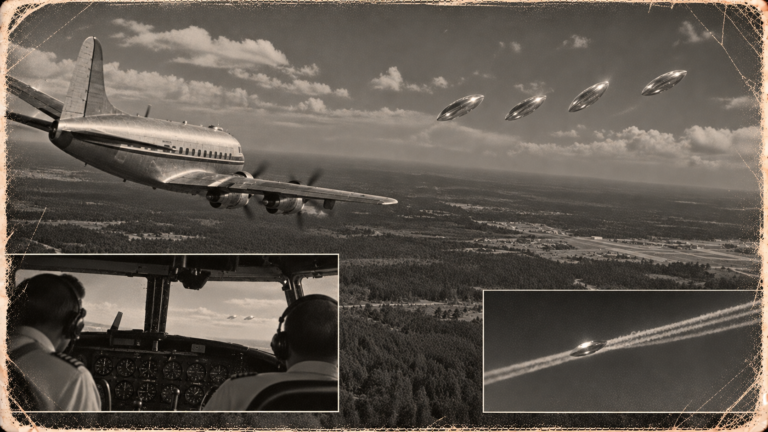
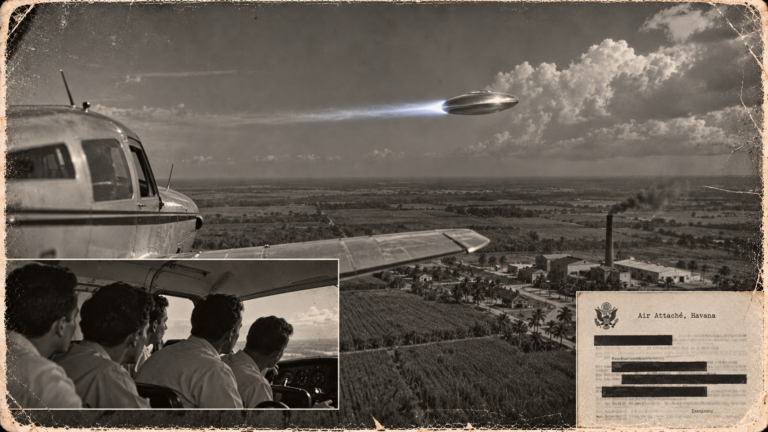
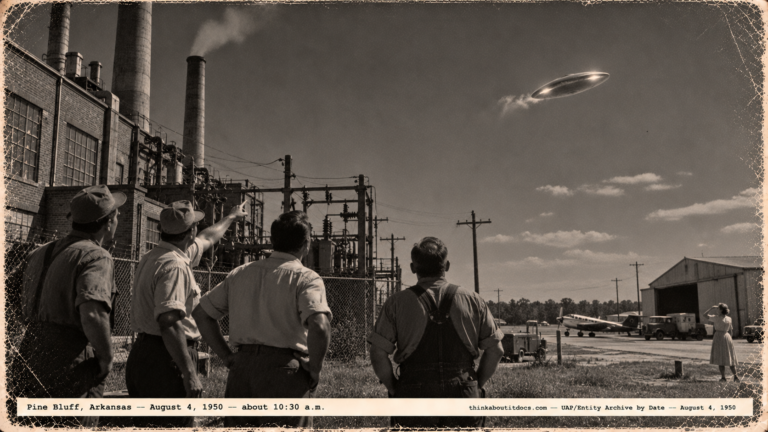
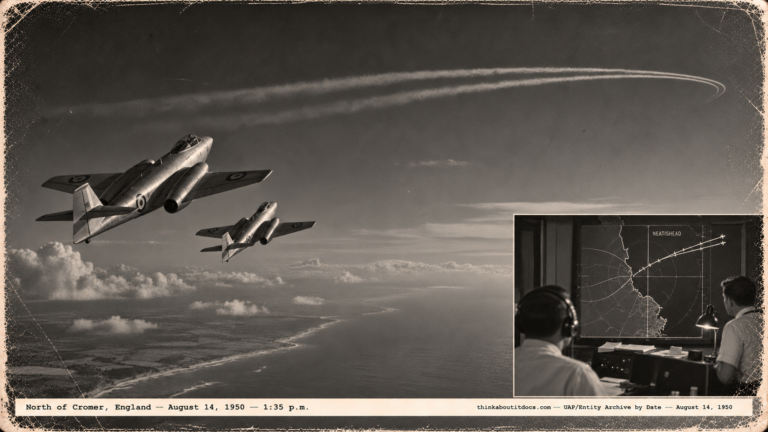
Archival rendering of the April 25, 1952 San Jose, California sighting reported by two credentialed scientists and documented by Dr. James E. McDonald.
THINK ABOUTIT UFO SIGHTINGS REPORT
1952 San Jose, California Scientists’ UFO Sighting:
The Wobbling Disc and the Black Spheres
On the morning of April 25, 1952, two credentialed scientists — a biochemist and a bacteriologist, both employed by a private San Jose company — watched a small metallic disc wobble directly over their heads for several minutes before it suddenly stopped, climbed rapidly, and appeared to rendezvous with one of three much larger black spherical objects hovering silently at 10,000 feet. One of the witnesses started to call it in to Moffett Field, then hung up rather than risk professional ridicule. The case survives today because he changed his mind and gave a full account to physicist Dr. James E. McDonald.
Date: April 25, 1952
Sighting Time: Approximately 11:00 a.m. to 11:15 a.m.
Day/Night: Day
Location: San Jose, California
Urban or Rural: Urban
No. of Entity(s): Not Applicable
Entity Type: Not Applicable
Entity Description: Not Applicable
Hynek Classification: DD — Daylight Disc. A metallic or whitish object observed in daylight.
Duration: Approximately 15 minutes
No. of Object(s): 4 total — 1 small silvery disc and 3 large black round objects (see Researcher’s Notes: this site’s legacy field data listed the three large objects as “triangles,” an entry error not supported anywhere in the source narrative, which consistently describes them as round)
Description of the Object(s): A small metallic-looking disc tilted at roughly 20 degrees, rotating around a vertical axis with a pronounced wobble, seen at low altitude; separately, three much larger black spherical objects hovering motionless at high altitude under cloud cover
Shape of Object(s): Disc (small object); round/spherical (three high-altitude objects)
Size of Object(s): Disc approximately 4–5 feet in diameter and 1.5 feet thick; the three black objects estimated at roughly 100 feet in diameter
Color of Object(s): Disc metallic/silvery; the three high-altitude objects black
Distance to Object(s): Disc estimated at approximately 50 feet away, roughly 40–50 feet overhead; the three black objects were at an estimated altitude of about 10,000 feet
Height & Speed: Disc: approximately 40–50 feet altitude, moving at an estimated 8–10 mph before a rapid climb; black objects: hovering motionless at approximately 10,000 feet before departing at unstated but apparently high speed
Number of Witnesses: 2 (identified in source material only as Dr. W, a biochemist, and Dr. Y, a bacteriologist, both employed by the same private company)
Special Features/Characteristics: Witnesses were credentialed scientists; disc exhibited a distinctive wobbling, water-meter-like oscillation with no sound or exhaust of any kind; disc’s rapid climb toward the NNE coincided with one of the three black objects departing the formation on a converging course, both vanishing into cloud cover together; witness Dr. W began an official report to Moffett Field but hung up before completing it, citing fear of professional ridicule
Case Status: Unexplained
Source: NICAP; interview conducted by Dr. James E. McDonald; case features and analysis by Richard Hall
Summary/Description: Directly over a building across the street from a company parking lot was a small, metallic-looking disc, tilted at about a 20 degree angle and rotating around a vertical axis, wobbling like the motion of a disc in a water meter. The distance was estimated at about 50 feet, and the disc appeared to be 4–5 feet in diameter. Two credentialed scientists watched it maneuver for roughly 15 minutes before it climbed rapidly and appeared to rendezvous with one of three much larger black objects hovering at high altitude.
Related Cases: None documented
Detailed Report
Richard Hall’s case notes characterize this as a scientist sighting distinguished by disc-shaped morphology, oscillatory motion, and what the primary witness described as extraordinary implied propulsion. Dr. W, a biochemist, and Dr. Y, a bacteriologist, both employed by the same private company, were driving to their office at about 11:00 a.m. on April 25, 1952, when Dr. Y noticed something overhead that appeared to be moving against the wind. The two pulled into the company parking lot and got out to look.
Directly over a building across the street, they observed a small, metallic-looking disc tilted at approximately 20 degrees and rotating around a vertical axis, wobbling in a manner Dr. W compared to the motion of a disc inside a water meter. Estimated at about 50 feet away and roughly 40–50 feet overhead, the disc appeared 4–5 feet in diameter; its wobble allowed the witnesses to judge its thickness at approximately 1.5 feet as it passed directly above them, continuing to rotate and wobble throughout. Neither witness detected any sound or exhaust emission. The disc moved in a slow arc, an estimated 8–10 mph, before curving near some railroad yards and making a distinct turn back toward the witnesses’ position.
At this point Dr. Y noticed something else in the sky, which Dr. W then also observed: a black object at high altitude, hovering motionless beneath an overcast layer later estimated at about 10,000 feet. It was round, apparently much larger than the silvery disc — on the order of 100 feet in diameter. As the two watched, two more identical black objects appeared to drop out of the cloud cover into position alongside the first, and the three “jittered around like boats in a stream,” in Dr. W’s description. Around this same time, the small disc had approached again, still moving slowly. It abruptly stopped spinning, hung motionless for a moment, then climbed rapidly toward the NNE, in the general direction of Mt. Hamilton. Simultaneously, one of the three black objects broke formation and headed in the same direction; the climbing disc and the departing black object appeared to be on a converging course before both vanished into the overcast together.
The two remaining black objects held their position for roughly another minute. One then moved off to the north and out of sight; the other ascended directly into the cloud layer and disappeared, ending the incident at approximately 11:15 a.m. Both witnesses returned immediately to their offices and separately dictated accounts of the sighting for a permanent record. Dr. W subsequently placed a call to Moffett Field intending to file an official report, but while on hold waiting for someone to take his account, he reconsidered the risk of professional ridicule and hung up; no report was filed with the Air Force or any other agency at the time.
Hall’s case file records the sighting’s special significance as resting on the combination of scientifically trained observers, a documented instance of the “ridicule factor” suppressing an official report, and the witnesses’ own stated reaction. Both described the experience as deeply disturbing; Dr. W concluded the objects had used “some propulsion method not in the physics books,” and stated he had remained troubled by the sighting long afterward, drawing an analogy to historical instances of less technologically advanced civilizations faring poorly upon contact with more advanced ones. The complete account, including the witnesses’ full names and professional identifications, was retained in Dr. McDonald’s personal files rather than published openly, consistent with his standard practice for scientist witnesses concerned about exposure.
RESEARCHER’S NOTES
The San Jose Scientists’ Sighting — 1952 and the Ridicule Factor
- Object-shape data corrected. This site’s legacy field data described the three large high-altitude objects as “triangles.” The full source narrative, in every instance, describes them as round or spherical — approximately 100 feet in diameter, hovering under an overcast layer. No triangular object appears anywhere in the account. The field data above has been corrected to round/spherical, flagged here rather than silently changed elsewhere in the record.
- Strong source chain. This case comes through Dr. James E. McDonald, a University of Arizona atmospheric physicist known for personally interviewing scientist and professional witnesses, and through Richard Hall’s NICAP case compilation. Both were serious, credentialed investigators within the civilian ufology research community, lending this account more procedural rigor than most anonymous or secondhand 1950s reports.
- The ridicule factor, documented in the witness’s own behavior. Dr. W’s decision to hang up on Moffett Field rather than complete an official report is a directly observed instance of what ufology researchers call the “ridicule factor” — professional witnesses self-censoring credible observations out of fear of career or reputational damage. This case is unusual in that the suppression itself, not just the sighting, is documented as part of the record.
- Multi-object synchronized behavior is the strongest evidentiary element. The apparent coordination between the ascending disc and the departing black sphere — two objects of very different size and altitude appearing to move on a converging course simultaneously — is harder to explain via simple misidentification than either object would be in isolation. This kind of correlated multi-object behavior is relatively rare in the broader case record.
- Geographic proximity to Moffett Field is notable but not evidentiary. San Jose sits close to Moffett Naval Air Station, an active military aviation and later aerospace-testing site throughout this period. Proximity alone does not establish a military-origin explanation for the sighting, but it is a relevant geographic detail worth noting for readers considering conventional aircraft or balloon explanations, none of which were confirmed in the source material.
This remains one of the better-documented scientist-witness cases from 1952: two independent professional observers, a detailed and internally consistent account, a directly recorded instance of self-censorship due to ridicule fear, and multi-object behavior that resists easy conventional explanation. It stands here as Unexplained, not because it lacks scrutiny, but because the scrutiny it has received has not resolved it.
“…it utilized some propulsion method not in the physics books.” — Dr. W, biochemist, describing the April 25, 1952 San Jose sighting to Dr. James E. McDonald