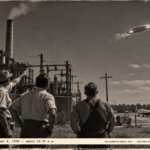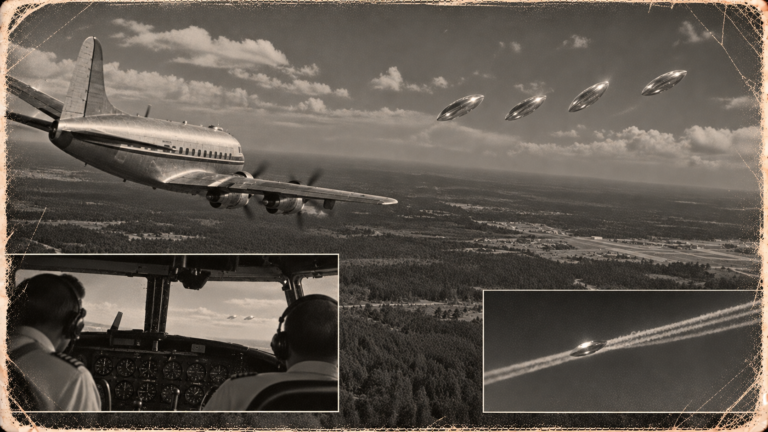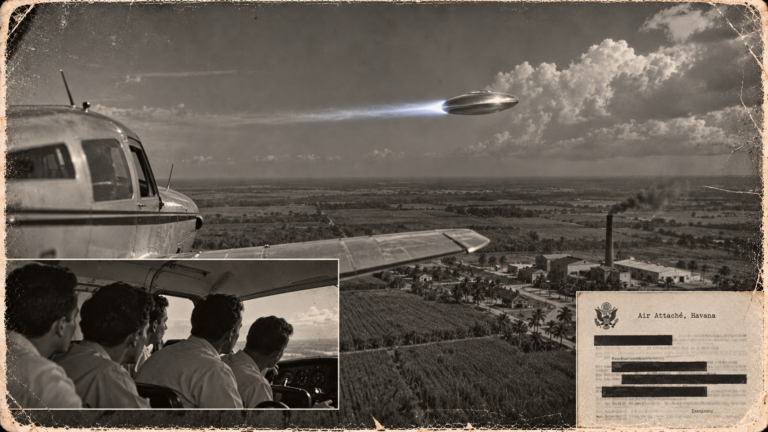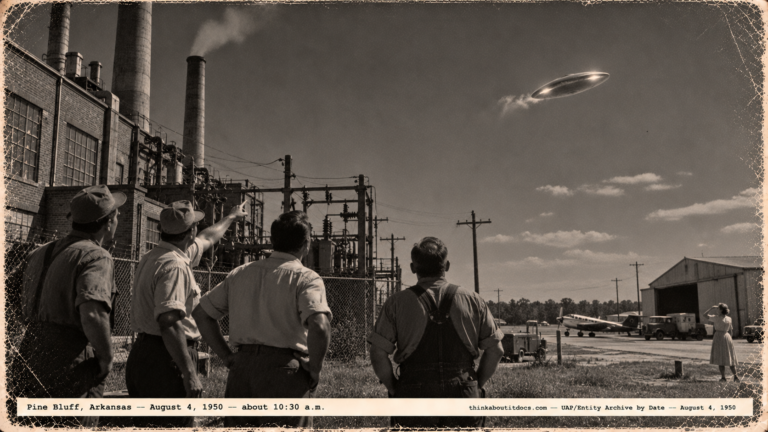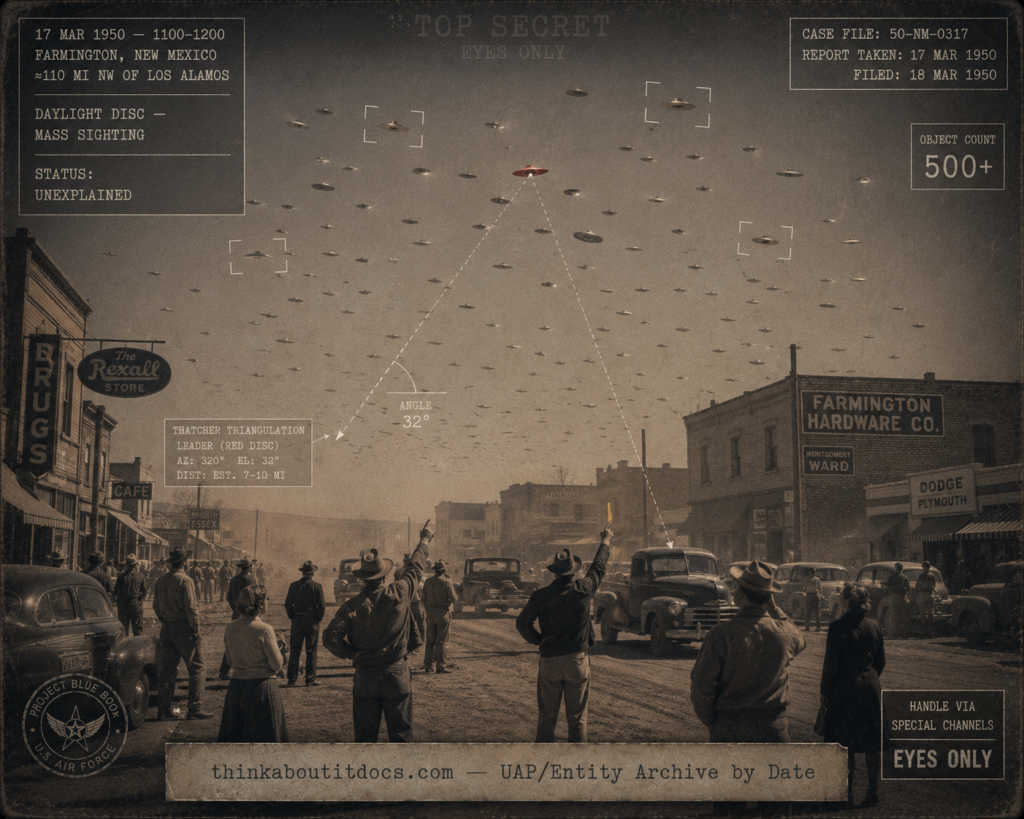
March 17, 1950, Farmington — half the town watches the "armada" through a dust storm. The lone red object was called the leader. The balloon explanation later collapsed: no Skyhook was ever launched that week.
THINK ABOUTIT UFO | UAP SIGHTING REPORT
1950: The Farmington UFO Armada
For three days running in March 1950, always between eleven and noon, the sky over Farmington filled with what hundreds of residents — perhaps half the town — swore were flying saucers: silvery discs by the score, darting, halting, and “playing tag” at impossible speeds, led on the biggest day by a single red object that moved faster than the rest. The witnesses were not cranks but a former Army Engineers captain, the head of the local Soil Conservation office running a triangulation, and a wartime B-29 tail gunner who said flatly that nothing man-made moved like that. The tidy explanation offered later — fragments of a burst Skyhook balloon — would have settled the matter, except for one inconvenient fact a serious investigator uncovered two decades on: there was no Skyhook balloon launched anywhere near New Mexico that week. Farmington remains exactly what it was in 1950 — a town that saw something, and a record that still cannot say what.
Date: March 17, 1950 (the principal mass event; saucers were reported over Farmington on three consecutive days, roughly March 15–17)
Sighting Time: Between 11:00 a.m. and noon (main wave); a second wave near 3:00 p.m.
Day/Night: Day
Location: Farmington, New Mexico (approximately 110 air miles northwest of the Los Alamos installation)
Urban or Rural: Urban (town center; witnesses lined Main Street)
No. of Entity(‘s): 0
Entity Type: None reported
Entity Description: N/A — no occupants or entities involved
Hynek Classification: DD (Daylight Disc)
Duration: Roughly one hour for the main late-morning wave; intermittent across three days
No. of Object(s): Multiple — estimates ranged from “several” to more than 500; one larger red object described as the apparent “leader”
Description of the Object(s): Silvery, disc-shaped objects with no vapor trail, no engine noise, and no visible windows or markings; one red object, reported bigger and faster; objects maneuvered erratically — darting, “playing tag,” making right-angle turns, and appearing to rush head-on before veering sharply
Shape of Object(s): Disc (objects appeared to fly “sideways, on edge, and at every angle,” which witnesses said made the saucer shape easy to read)
Size of Object(s): Wildly inconsistent — Marlow Webb judged the naked-eye apparent size as roughly that of a dinner plate (about eight inches); another estimate put one object at about twice the size of a B-29 (see notes on this discrepancy)
Color of Object(s): Silvery / metallic; one red
Distance to Object(s): Altitude estimates varied — about 15,000 feet (Boddy), up to 20,000 feet (headline), and as low as ~2,000 feet on Thatcher’s triangulation assumption
Height & Speed: Estimated ~1,000 mph (Harold Thatcher’s triangulation, assuming a B-29-sized object); John Bloomfield estimated roughly ten times jet speed; reported altitudes 2,000–20,000 feet
Number of Witnesses: Hundreds — described as roughly half the town’s population; numerous named witnesses
Special Features/Characteristics: First widely reported mass “flying saucer” flight; formation and erratic “tag” maneuvering; right-angle turns and head-on near-misses; a single red “leader”; no trails, noise, or markings; high winds and a dust storm in progress, reducing visibility; town occurred 110 miles from Los Alamos; a “cotton fuzz” explanation was floated by a state patrolman and emphatically denied by witnesses
Case Status: Unexplained (unresolved; leading conventional explanations either fail on the record or remain unconfirmed — see notes)
Source: Farmington Daily Times, March 18, 1950 (“Huge ‘Saucer’ Armada Jolts Farmington”); later investigated by Dr. James E. McDonald (atmospheric physicist, University of Arizona) in the late 1960s; Skyhook explanation associated with Donald Menzel and the Air Force; modern research by independent investigator David Marler
Summary/Description: Over three consecutive days in mid-March 1950, peaking on March 17, hundreds of Farmington residents reported large numbers of silvery discs maneuvering at high speed over the town, led on the main day by a single red object. Named witnesses included credible professionals, and one ran a rough triangulation yielding roughly 1,000 mph. Proposed explanations — ruptured Skyhook balloon fragments, windblown cotton, and St. Patrick’s Day inebriation — each face serious objections; notably, no Skyhook balloon launch could be documented for the period. The case remains formally unresolved.
Related Cases: The broader March 1950 wave across the American Southwest, Mexico, and Central America (documented by David Marler) | other “mass flight” reports later attributed to windblown debris or balloon fragments | the nuclear-installation proximity thread (Los Alamos, ~110 miles) | the 1950 Steep Rock Lake matter (a contrasting case from the same flap year, retained as a documented hoax)
Full Report
The Farmington armada arrived not as a single event but as the climax of three consecutive mornings of reports. The Farmington Daily Times of March 18, 1950, opened its front-page account by noting that for the third day in a row flying saucers had been reported over the town, each day between eleven and noon — a regularity that is itself one of the case’s more revealing features. On the principal day, three callers first alerted the paper just before noon; within the hour the office was deluged, and along Main Street people stood pointing upward while traffic slowed to avoid the sky-gazers. The paper recorded that roughly half the town remained convinced it had watched spacecraft or some strange aircraft, with counts running from a handful to more than five hundred. Conditions, importantly, were poor: high winds and a dust storm were in progress, hampering clear vision — a detail that bears on every estimate the witnesses offered.
The witnesses were not a fringe. Clayton J. Boddy, 32, business manager of the Farmington Times and a former Army Engineers captain who had served in Italy, watched what he estimated as some five hundred objects at perhaps 15,000 feet. His account was corroborated by two visiting grocers from Antonito, Colorado, the brothers Joseph and Francis Kelloff, who described formation flight, and by local men Bob Foutz and John Burrell. Edward Brooks, 24, a wartime B-29 tail gunner, said with a gunner’s confidence that the maneuvering simply could not be that of any modern aircraft. John Bloomfield estimated the objects moved perhaps ten times faster than jets and repeatedly made sharp right-angle turns, with one passing another and the rear object instantly leaping into the lead. Marlow Webb judged their naked-eye apparent size at about that of a dinner plate and noted they flew at every conceivable angle, which he felt confirmed the disc shape. Across all the scores of accounts, no one reported a vapor trail, engine noise, windows, or markings — and a second, smaller mass sighting was logged around three o’clock that afternoon, north of town.
The single most-cited data point came from Harold F. Thatcher, head of the Farmington unit of the Soil Conservation Service, who attempted a rough triangulation on one object. By his calculation, had the object been the size of a B-29 it would have been roughly 2,000 feet up and traveling more than 1,000 miles per hour. Thatcher was careful about his own standing — he disclaimed being a professional engineer while noting he supervised engineers and could work a rough triangulation — and he was emphatic on one point: what he sighted was not cotton. A “cotton fuzz floating in the air” explanation had been circulated by State Patrolman Andy Andrews, who attributed it to several residents; those residents then denied having said any such thing, and Thatcher acknowledged seeing actual cotton drifting that day while insisting it was not what he had measured.
The explanations advanced afterward have not worn well. The most durable is the claim — associated with the skeptic Donald Menzel and echoed in the Air Force’s handling — that a high-altitude Skyhook research balloon had ruptured, possibly launched from Holloman, scattering shiny plastic fragments that the wind carried over Farmington. The theory has two structural problems. First, it addresses only March 17 and ignores the sightings on the days before and after. Second, and more seriously, when the atmospheric physicist Dr. James E. McDonald investigated the case in the late 1960s — interviewing witnesses roughly seventeen years on — he pursued the balloon claim to its source through an Office of Naval Research contact who reviewed Skyhook launch records and found none in the relevant window; the nearest launch was reportedly out of Minnesota, terminating over Michigan. McDonald, a rigorous investigator with no patience for loose claims, concluded the objects could not be dismissed as cotton, atmospheric plasma, or balloon fragments — but neither could he say what they were. The “St. Patrick’s Day moonshine” gibe, leaning on the March 17 date, never deserved serious weight against daytime mass observation by sober, named professionals over three days.
What remains is a genuinely unresolved case rather than a solved or a fraudulent one. The honest reading must hold two facts at once: the conventional explanations on offer fail or cannot be confirmed, and the raw observations are poor — gathered through a dust storm and high winds, with size estimates spanning from eight inches to twice a bomber, and with erratic “tag” and right-angle behavior as consistent with small windblown reflective material misjudged at unknown distance as with anything structured. Modern researcher David Marler has since placed Farmington inside a much larger March 1950 wave spanning the Southwest and into Mexico and Central America, which deepens the mystery without resolving it. The case neither collapses into a tidy debunk nor rises to demonstrated craft; it sits, documented and open.
Researcher’s Notes
The Armada That Outran Its Explanation — Farmington 1950 and the Limits of a Bad Day’s Data
- Classification — DD is correct, but mind the size paradox: Daylight Disc is the right call: a daytime mass observation of disc-shaped objects at distance, no occupants, no close-approach effects. No entity or close-encounter class applies. The classification caveat worth recording is the irreconcilable size data. Marlow Webb’s naked-eye “dinner plate / eight inches” is an apparent size that, for a genuinely distant high-speed craft, is incompatible with Thatcher’s “twice a B-29” and the 15,000–20,000-foot altitude figures. Small apparent size plus erratic darting is exactly the signature of small objects relatively nearby — which is precisely what windblown debris or gossamer would present. The DD label describes what was seen; it should not be read as endorsing the literal “huge craft at altitude” interpretation, which the internal numbers do not support.
- Source chain — strong primary, and the investigation that broke the debunk: The primary source is solid and contemporaneous: the Farmington Daily Times of March 18, 1950, with multiple named, locatable witnesses. The decisive secondary work is Dr. James E. McDonald’s late-1960s investigation, which is what elevates this above a newspaper curiosity — McDonald is the one who ran the Skyhook claim to ground and found no launch on record for the period. That finding is the single most important fact in the file, because it removes the explanation most often used to close the case. The Skyhook theory traces to Donald Menzel and the Air Force’s preferred framing; independent researcher David Marler’s modern work supplies the wider-wave context. Source fidelity here means stating plainly that the standard debunk is contradicted by the launch record, not repeating it as settled.
- Pattern context — wave behavior and the contagion signature: Two patterns matter. First, Marler’s documentation of dozens of similar Southwest/Mexico/Central America reports in the same March 1950 window means Farmington was not isolated — it was the loudest node of a regional wave, which argues for a common environmental or atmospheric trigger as readily as for anything exotic. Second, the case carries an unmistakable social-contagion signature: the same town, the same hour, three days running, with the press itself (“the office was deluged”) amplifying each day’s reports into the next. The Los Alamos proximity (110 miles) places it in the nuclear-installation thread this archive tracks, but proximity is not causation. The archive explicitly declines the exotic speculation attached to this case elsewhere online — the “Nazi Antarctic fleet” reading and similar — as unsupported invention of exactly the kind that turns a real anomaly into noise.
- Physical evidence and evidentiary weight — documented, degraded, unresolved: There is no photograph, no recovered fragment, no instrumented record — only testimony, and testimony gathered under a dust storm and high winds. That combination is the crux: the conventional explanations fail (Skyhook on the launch record, cotton on Thatcher’s denial, moonshine on the sober daytime professionals), yet the data are too poor and too contaminated by poor visibility and crowd dynamics to sustain a strong anomalous claim. McDonald — who wanted to find a real anomaly and was qualified to judge atmospheric ones — could neither dismiss nor explain it, which is the most honest verdict available. The case is therefore logged Unexplained in the strict sense: not satisfactorily accounted for, not demonstrated to be craft. The most parsimonious unconfirmed reading remains high-altitude windblown reflective material amplified by media and crowd attention — a hypothesis the file holds open rather than asserts.
The record’s honest final position on Farmington is that it deserves neither the debunker’s dismissal nor the believer’s certainty. Something genuinely happened over that town for three mornings in March 1950 — too many credible people, too consistent a story, for nothing at all. But the explanation most often used to close the book, the ruptured Skyhook balloon, does not survive contact with the launch records, and the explanations that remain are too poor to satisfy while the data themselves are too poor to vindicate. A serious atmospheric physicist looked hard and came away unable to say. So the archive says the same, precisely: Farmington is Unexplained — a real event, badly seen, never solved, and worth far more as an honest open question than as anyone’s tidy answer.

HUGE ‘SAUCER’ ARMADA JOLTS FARMINGTON
Crafts Seen By Hundreds – Speed Estimated at 1000 MPH, Altitude 20,000 feet
For the third consecutive day flying saucers have been reported over Farmington. And on each of the three days their arrival here was reported between 11 and noon.
Three persons called the Daily Times office to report seeing strange objects in the air just before noon.
Persons along Main Street once again could be seen looking skyward and pointing.
High winds and a dust storm prevented clear vision.
Fully half of this town’s population still is certain today that it saw space ships or some strange aircraft — hundreds of them zooming through the skies yesterday. Estimates of the number ranged from & quotes several to more that 500. Whatever they were, they caused a major sensation in this community, which lies only 110 air miles northwest of the huge Los Alamos Atomic installation.
The objects appeared to play tag high in the air. At times they streaked away at almost unbelievable speeds. One witness did a triangulation sighting on one of the objects and estimated its speed at about 1,000 miles an hour, and estimated its size as approximately twice that of a B-29.
Farmington citizens stood in the streets yesterday watching the first reported mass “flying saucer” flight ever sighted. Traffic was slowed to avoid hitting sky gazers. The office of the Farmington Daily Times was deluged with calls from persons who saw the objects.
A Red Leader
Scores described the objects as silvery discs. A number agreed they saw one that was red in color — bigger and faster, and apparently the leader.
Clayton J. Boddy, 32, business manager of Farmington Times and a former Army Engineers captain in Italy, was one of those who saw the startling objects.
Boddy was on roadway when all of a sudden I noticed a few moving objects high in the sky.
“Moments later there appeared what seemed to be about 500 of them,” Boddy continued. He could not estimate their size or speed, but said they appeared to be about 15,000 feet high.
Boddy’s account was confirmed by Joseph C. and Francis C. Kelloff, retail grocers from Antonito, Colo., who were in Farmington to inspect the site of a proposed new store, and by Bob Foutz and John Burrell of Farmington. The Kelloffs said the objects appeared to be flying in formation.
One of the most impressive accounts came from Harold F. Thatcher, head of the Farmington unit of the Soil Conservation service. Thatcher made a triangulation on one of a number of flying craft, He said if it had been a B-29 it would have been 2,000 feet high and traveling more than 1000 miles per hour.
Knows Engineering
“I’m not a professional engineer,” Thatcher said, “but I have engineers working under me and I know how to work out rough triangulation on an object.”
Thatcher emphatically denied an earlier report that the objects could have been small pieces of cotton fuzz floating in the atmosphere.
“It was not cotton,” he said, “I saw several pieces of cotton fuzz floating around in the air at the time, but I was not sighting on any cotton.”
The “cotton” report was started by State Patrolman Andy Andrews, who quoted several Farmington Residents as asserting it was cotton they saw. The residents denied Andrew’s report.
The first reports of flying saucers were noted a few minutes before 11 a.m. yesterday. For a full hour thereafter people deluged the Times with reports of the objects.
A second large scale sighting occurred at 3 p.m. At that time, Mrs. Wilson Jones, 27, and Mr. Roy Hicks, 33, housewives reported seeing objects to the north of Farmington, flying in perfect formation. Others reported the same sight.
Johnny Eaton, 29, a real estate and insurance salesman, and Edward Brooks, 24, an employee of the Perry Smoak garage, were the first to report the red-colored sky object.
Not Airplanes
Brooks, a B-29 tail gunner during the war, said he was positive the objects sighted were not airplanes. “The very maneuvering of the things couldn’t be that of modern aircraft,” he said.
John Bloomfield, another employee of Smoak’s garage, said the objects he saw traveled at a speed that appeared to him to be about 10 times faster than that of jet planes. In addition, he said the objects frequently made right-angle turns.
“They appeared to be coming at each other head-on,” he related. “At the last second, one would veer at right angles upward, the other at right angles downward. One saucer would pass another and immediately the one to the rear would zoom into the lead.”
Marlow Webb, another garage employee, said the objects to the naked eye appeared to be about eight inches in diameter as seen from the ground. He described them as about the size of a dinner plate.” “They flew sideways, on edge and at every conceivable angle,” he said. “This is what made it easy to determine that they were saucer-shaped.” None of the scores of reports told of any vapor trail or engine noise. Nor did anyone report any windows or other markings on the craft.
In general Farmington accepted the phenomenon calmly, although it was reported some women employees of a laundry became somewhat panicky.