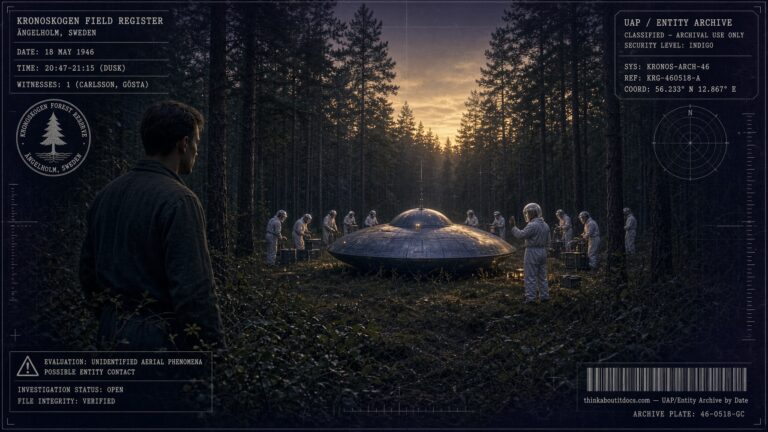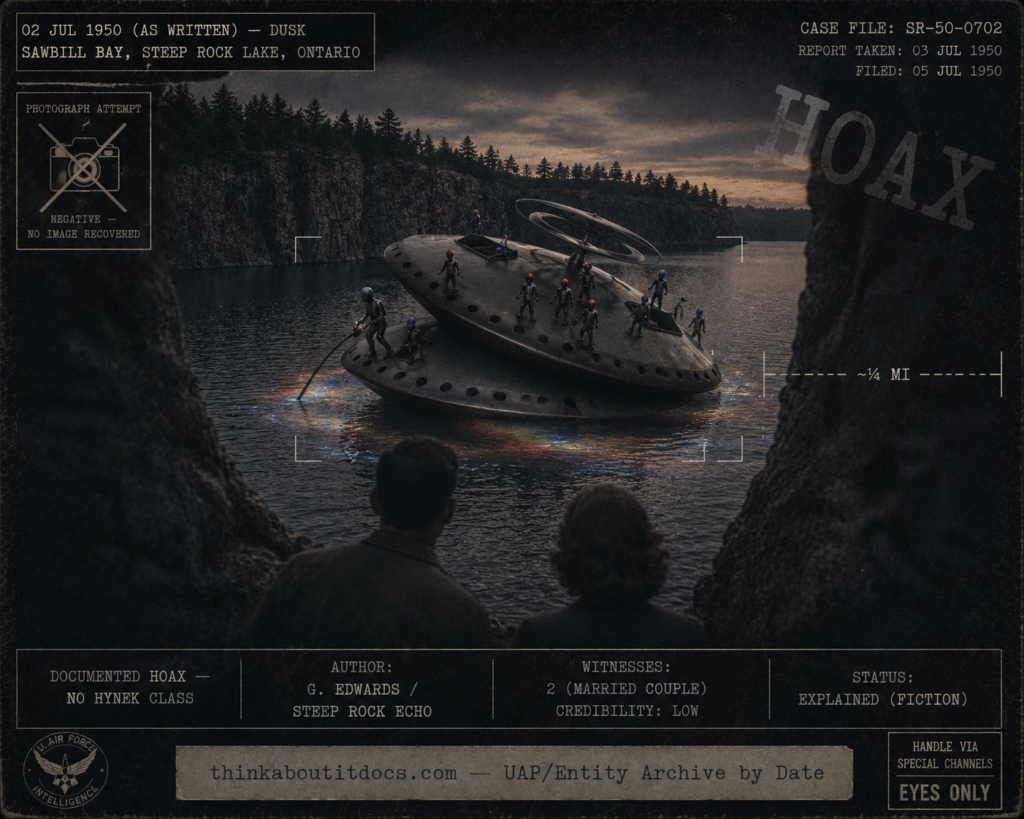
As written, July 2, 1950, Sawbill Bay — the famous twin-saucer and its ten faceless "automatons." The catch: the whole scene was a company-magazine satire by mine employee Gordon Edwards.
THINK ABOUTIT UFO | UAP | ENTITY ENCOUNTER REPORT
1950: Steep Rock Lake, Ontario, Canada Encounter
For a quarter of a century this was one of the most charming “little men” cases in the literature — ten faceless automaton-figures in red and blue caps, walking the canted hull of a double-saucer on Sawbill Bay, working a vivid green suction hose while a rotating hoop swept a ray toward a couple hidden in a rock cleft. It was reprinted by Harold Wilkins, cited by Bloecher, the Lorenzens, and Vallée, and immortalized in Frank Edwards’ bestselling Flying Saucers — Serious Business. And it was fiction from the first word: a company-newsletter spoof written by a Steep Rock mine employee named Gordon Edwards to entertain his coworkers and gently mock the saucer craze. The record absorbed the joke as a genuine close encounter and carried it for twenty-five years. That, not the saucer, is the case worth studying.
Date: July 2, 1950 (date of the fictional event as written; the satire was published in The Steep Rock Echo, September 1950)
Sighting Time: Dusk (as written)
Day/Night: Night (dusk drawing into dark, as written)
Location: A cove in Sawbill Bay, Steep Rock Lake, near Atikokan, Ontario, Canada
Urban or Rural: Open country / remote lake
No. of Entity(‘s): 10 (as written — fictional)
Entity Type: Humanoid automatons (as written — fictional; no genuine entities)
Entity Description (as written, fictional): Ten figures roughly 3 feet 6 inches to 4 feet tall, all identical in size; faces described as blank, featureless surfaces; an “operator” on a small raised stand wore a red skull cap (or red paint), the others blue caps; gleaming metallic covering over the chest, darker covering on arms and legs; they moved like automata rather than living beings, never turning around but merely changing the direction of their feet, the leg on the higher side of the tilted hull appearing shorter so as to compensate for the slope
Hynek Classification: None — documented hoax (hoaxes carry no Hynek classification). [Page previously listed CE-III; corrected — see notes.]
Duration: Multiple alleged episodes over roughly three weeks (as written)
No. of Object(s): 1 (as written)
Description of the Object(s) (as written, fictional): Two saucers joined rim-to-rim, one inverted atop the other, resting on the water; black port-like holes around the edge spaced about four feet apart; open hatches on top; a hoop-shaped object about eight feet up rotating from a central position and projecting an apparent ray; a vivid green hose or suction nozzle worked by the figures; the surrounding water left tinged red-blue-gold; departed with a rush of wind and a flash of red-blue-gold, northward, faster than the eye could follow
Shape of Object(s): Disc (twin-saucer)
Size of Object(s): Estimated 48 feet across; about 15 feet thick at center, 12 feet at the edges; tilted near 45 degrees (as written)
Color of Object(s): Shiny / metallic (as written)
Distance to Object(s): About a quarter-mile, closing to roughly 1,200 feet (as written)
Height & Speed: Rose to about 8 feet above the water, then departed at impossible speed northward (as written)
Number of Witnesses: 2 primary (the unnamed author and his wife); a later episode adds a friend — all fictional characters in the narrative
Special Features/Characteristics: Faceless automaton occupants; camber-compensating gait on a tilted hull; green suction hose apparently drawing from or discharging into the lake; rotating hoop/ray; red-blue-gold water discoloration; repeated failed photography attempts (the signature self-justifying device of the hoax)
Case Status: Explained — deliberate hoax/satire (authored by Steep Rock employee Gordon Edwards)
Source: Originally published in The Steep Rock Echo (company magazine of the Steep Rock Iron Company), edited by B. J. Eyton, September 1950 (reprinted October 1950); popularized by Harold T. Wilkins, by Frank Edwards in Flying Saucers — Serious Business (1966), and in Fate magazine; exposed as fiction by APRO investigator Robert Badgley (mid-1970s) and documented as a hoax by Jerome Clark (The UFO Encyclopedia)
Summary/Description: A first-person account published in a Canadian iron-mine company magazine described a fisherman and his wife watching a twin-saucer craft land on Sawbill Bay at dusk on July 2, 1950, crewed by ten small faceless automaton-like figures who worked a green hose and a rotating ray before departing at high speed; follow-up episodes had the narrator and a friend repeatedly failing to photograph the object. The tale was reprinted and cited as a genuine occupant case for decades. It was, in fact, a satire written by a mine employee, Gordon Edwards, to amuse readers and lampoon flying-saucer belief, and is now documented as a hoax.
Related Cases: Other satire/hoax cases laundered into the record as fact; the genuine spring 1950 northwestern-Ontario flap (Atikokan / Steep Rock / Fort William–Port Arthur sightings noted by editor Eyton, a separate and unrelated matter); the recurring “failed photograph” motif common to fabricated close-encounter tales
Full Report
The Steep Rock Lake story entered the world not as a sighting report but as an item in a workplace magazine. In September 1950, The Steep Rock Echo — the house organ of the Steep Rock Iron Company at Atikokan, Ontario, edited by B. J. Eyton — ran a first-person narrative by a senior mine employee describing an encounter that supposedly took place at dusk on July 2 of that year. The piece was written with evident literary care, and it is worth reading as what it is: a polished comic set-piece in the saucer-craze idiom of its moment.
As written, the narrator and his wife had beached their boat in a cliff-ringed cove on Sawbill Bay when the air began to vibrate, drawing the narrator to a cleft in the rocks. Through it he saw a large shining object resting on the water about a quarter-mile off — two saucers joined rim-to-rim, ports around the edge, hatches open on top. Moving over its surface were ten small figures, three and a half to four feet tall, identical, with blank featureless faces, red or blue skull caps, metallic chests and darker limbs, moving “like automata.” A hoop-shaped device rotated some eight feet above the hull, projecting what the couple took to be a ray; when it swung toward their cleft they ducked, supposing the rock shielded them. A deer wandered to the far shore and the apparatus appeared to swing toward it instead. One figure worked the nozzle of a vivid green hose, the air hummed, and the water was left tinged a strange red-blue-gold. The craft rose, flashed, and shot away northward faster than the eye could follow.
The narrative then supplies the detail that, in hindsight, is the tell. The narrator returns with a friend and cameras; they stake out the cove for three evenings, then patrol the bay for three weeks; when they finally encounter the saucer again, a cold wind numbs the narrator’s fingers, the boat see-saws too violently to focus, the figures spot them and vanish into the hatches, the green hose reels in “like green lightning,” and the craft departs before a single photograph can be taken. The engine then conveniently stalls and overheats. The repeated, elaborately motivated failure to obtain evidence is the classic structural signature of a fabricated close-encounter tale, and here it is deployed almost as a wink.
Editor Eyton appended a careful disclaimer — that he could neither verify nor disprove the story, that it had been written by a senior employee, and that, coincidentally, flying saucers had genuinely been reported around that time by mine workers and by residents of Atikokan and across the Fort William–Port Arthur district. That regional flap was real and is a separate matter; it lent the spoof a borrowed plausibility it did not earn.
From this obscure origin the story escaped into the wider literature. Harold T. Wilkins reproduced it in his saucer books; Ted Bloecher cited it in 1956, Nicholson in 1958, the Lorenzens in 1967, and Jacques Vallée in 1969; it ran in Fate; and Frank Edwards — no relation to the mine employee who wrote it — gave it mass circulation in his 1966 bestseller Flying Saucers — Serious Business. For roughly twenty-five years it was passed hand to hand as a genuine occupant case, almost always in summarized form, almost never checked. The unraveling came only in the mid-1970s, when Robert Badgley, a Scarborough, Ontario, member of the Tucson-based APRO, actually investigated. Through the mine’s personnel manager he established that the tale had been invented by a Steep Rock employee named Gordon Edwards purely to entertain readers and to satirize belief in little men from flying saucers. Eyton’s office, by one account, had been quietly amused to see the spoof presented in print as serious business. Jerome Clark subsequently documented the case as a hoax; Badgley and Clark are among the few who handled it correctly.
Researcher’s Notes
The Sawbill Bay Spoof — Steep Rock Lake 1950 and the Joke the Record Couldn’t Take
- Classification correction — CE-III to none: The page carried this as a Close Encounter of the Third Kind on the strength of its ten “occupants.” But classification presupposes an event, and there was no event — the account is admitted fiction. Under this archive’s standing rule, a documented hoax carries no Hynek classification at all, and we strike the CE-III accordingly. The Case Status moves to Explained, the explanation being deliberate authorship: a satirical short written for a company magazine. Every descriptive field is retained only as a record of what the fiction claimed, flagged “as written,” so the page documents the hoax accurately without dignifying it as a sighting.
- Source chain and the two Edwardses: The provenance is now fully traceable and the one apparent snarl resolves cleanly. The hoax was authored by Gordon Edwards, a Steep Rock Iron Company employee, and published in The Steep Rock Echo (September 1950, editor B. J. Eyton). It was popularized decades later by Frank Edwards, the well-known writer-broadcaster, in Flying Saucers — Serious Business (1966) — a different man who merely shared the surname. That coincidence has confused casual retellings; both names are correct and should be kept distinct. The transmission line runs Echo (1950) → Harold T. Wilkins → Bloecher (1956), Nicholson (1958), Frank Edwards (1966), the Lorenzens (1967), Vallée (1969), and Fate. One correction to the page’s own text: it states the hoax was verified “before 1967,” but Jerome Clark places Robert Badgley’s APRO investigation in the mid-1970s. The earlier date should be corrected.
- Pattern context — satire metabolized as fact, and the signal-in-noise lesson: This case is a clean specimen of a specific failure mode this archive tracks: not a mistaken sighting but a deliberate fiction that the literature laundered into the canon through uncritical recopying. For twenty-five years it propagated because each author trusted the last and none returned to the source. It belongs beside the broader “noise” problem of the early saucer era — the manufactured and the misfiled accreting around whatever genuine anomalies existed until the record can no longer tell them apart. The built-in failed-photograph device, the borrowed credibility of a real local flap, and the sheer narrative polish are exactly the features that should have prompted scrutiny and instead aided propagation.
- Evidentiary weight — zero, by authorship: There is nothing to weigh. The narrative is fiction by its author’s intent, established through direct investigation of the publishing organization. The only adjacent fact with any standing is editor Eyton’s note that real saucer reports circulated in the Atikokan / Fort William–Port Arthur district around that time — a separate 1950 flap that has no bearing on the fabricated cove encounter and must not be allowed to relegitimize it. The genuinely odd, almost endearing quality of the invention — faceless automatons compensating their gait for the hull’s camber, the green suction hose, the red-blue-gold water — is a tribute to Gordon Edwards’ imagination, not evidence of anything in the sky.
The record’s honest final position is unambiguous: Steep Rock Lake is a hoax, and a good-natured one, written to make miners laugh and to poke fun at a craze its author plainly found silly. The archive keeps it not as a sighting but as a cautionary exhibit — a reminder that the most quotable cases are sometimes the least examined, and that a satire told well enough will outrun its own punchline for decades if no one bothers to walk back to the source. Gordon Edwards built a small, clever fiction; the literature did the rest. Logged Explained, stripped of its borrowed Hynek class, and retained precisely so the next researcher need not be fooled the way twenty-five years of them were.