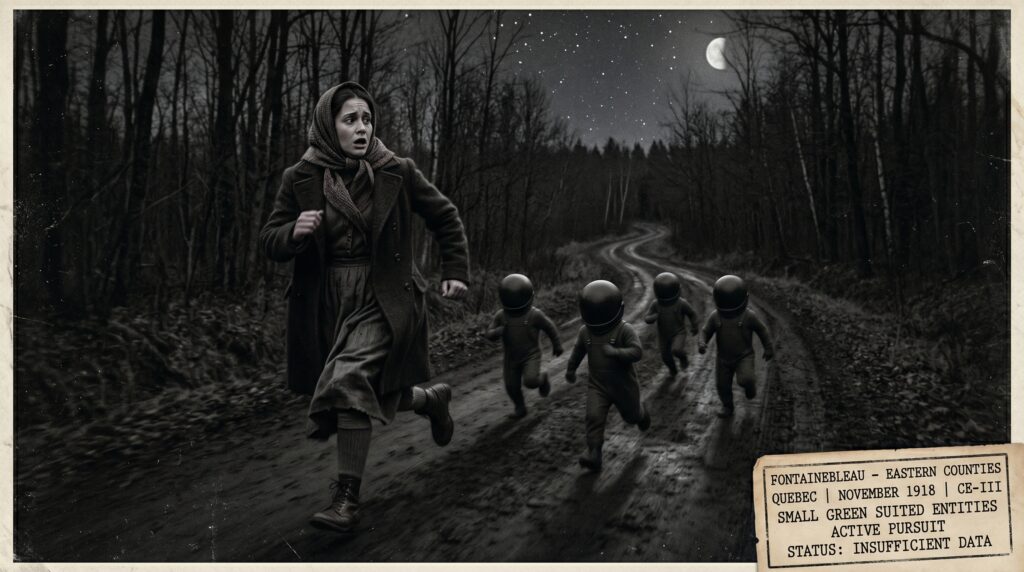
Fontainebleau, Eastern Counties, Quebec, November 1918 — Maria Dion was chased home from a dance by small green two-foot figures wearing helmets and overalls she later described as like astronaut suits — decades before pressurized flight suits existed. Her granddaughter confirmed the account and revealed her own ongoing UAP encounters with pre-event static in her hands. Source: Donald Cyr. Case status: Insufficient Data.
THINK ABOUTIT UFO | UAP | SIGHTING REPORT
1918: Fontainebleau, Quebec, Canada Encounter
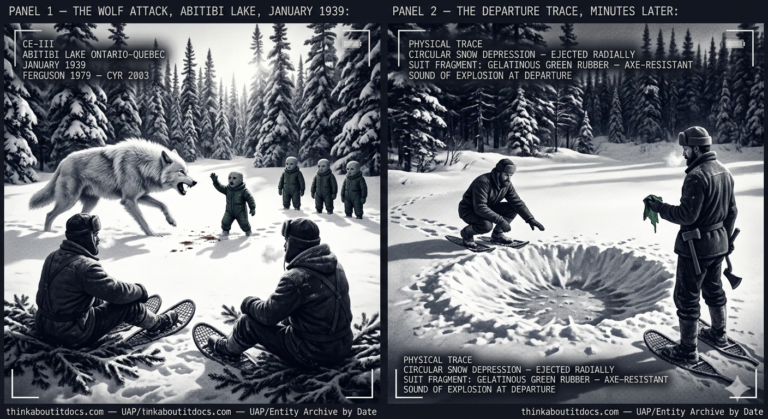
On an early November night in 1918 in the Eastern Counties of Quebec, eighteen-year-old Maria Dion was walking home from a dance when small green creatures no more than two feet tall began to chase her. They ran very fast despite their size. They wore helmets and overalls — she described them as dressed like our astronauts, except she said this in 1918, when the word astronaut did not exist and the concept of a pressurized suit was known only to deep-sea divers. She told the story to a young accordion player at a wedding in the 1950s, who told it to his son, who wrote it down — and when he published it, the granddaughter of Maria Dion found the account and recognized her grandmother. She reached out to say her grandmother was not alone. The static in her own hands before each UAP encounter had told her that for years.
Date: November 1918 — exact date not recorded
Sighting Time: Beginning of the night — shortly after a dance party ended
Day/Night: Night — early evening transitioning to night
Location: Fontainebleau, Eastern Counties, Quebec, Canada — near woods, on a road home from a social gathering
Urban or Rural: Rural — outside near woods, small Quebec village
No. of Entity(‘s): Several — exact number not recorded; described as small green creatures in the plural
Entity Type: Small humanoid — non-human; two feet in height; green coloration; suited and helmeted
Entity Description: Short figures approximately two feet tall. Green colored. Wore what the witness described as outfits like astronauts — helmets and overalls covering the entire body. Ran very fast despite their small stature. Actively pursued the witness. No communication or physical contact recorded. The witness’s initial interpretation was religious — she believed they were devils punishing her for dancing without parental permission. Her subsequent description of their clothing is the analytically significant detail: pressurized suit-like overalls and helmets described using the closest available cultural reference point, which in 1918 Quebec was not astronaut suits but was understood by the researcher and the granddaughter as exactly that.
Hynek Classification: CE-III (Close Encounter III) — close observation of animate non-human beings; active pursuit of the witness; no associated craft observed. Note: the absence of an associated craft does not preclude CE-III classification.
Duration: Sufficient for pursuit over a road distance — exact duration not recorded; long enough for the witness to observe the entities’ clothing and speed in detail while running
No. of Object(s): None observed — no craft recorded in the account
Distance to Object(s): Close pursuit range — entities chased the witness at close proximity; exact distance not recorded
Height & Speed: Ground level — entities ran on foot; moved very fast despite being approximately two feet tall; the speed discrepancy between their small size and high velocity is specifically noted by the witness
Number of Witnesses: 1 primary — Maria Dion, aged 18, Fontainebleau, Quebec, November 1918. Secondary transmission chain: Maria told the story to a young accordion player (the researcher’s father) at a wedding in the 1950s when she appeared to be in her late fifties or early sixties. The father told the story to his son (the researcher, Donald Cyr). Donald Cyr published the account. Maria Dion’s granddaughter then contacted Cyr after finding the account, confirmed the family identity, and disclosed her own ongoing UAP experiences.
Special Features/Characteristics: Suit and helmet description in 1918 — the entities wore fully enclosed overalls and helmets described by a rural Quebec woman in 1918 using the closest reference available to her; the description predates pressure suit technology, the word astronaut, and the concept of a fully enclosed flight suit by decades; the granddaughter’s contact after publication confirming the account adds a direct family corroboration link; the granddaughter’s disclosure of her own UAP experiences — including static in her hands before each encounter — establishes a multi-generational experiencer pattern within the same family; the guilt interpretation — Maria initially attributed the encounter to divine punishment for dancing — is a culturally authentic 1918 rural Quebec Catholic response to an inexplicable event and does not invalidate the physical description; the dance context places the event on one of the last nights of WWI — the Armistice was November 11, 1918
Case Status: Insufficient Data — third-hand transmission to the researcher with a subsequent direct family confirmation; suit description is culturally anachronistic in a way that argues against confabulation; multi-generational experiencer pattern in the same family is analytically significant
Source: Donald Cyr, Quebec UAP researcher
Summary/Description: In November 1918 in Fontainebleau, Quebec, eighteen-year-old Maria Dion was walking home from a dance party when several small green suited figures approximately two feet tall with helmets and overalls pursued her at high speed. She attributed the encounter to supernatural punishment at the time. She told the story decades later to an accordion player she met at a wedding, whose son documented and published it. Maria Dion’s granddaughter subsequently found the account and confirmed the family identity, disclosing that she too had experienced multiple UAP encounters with pre-encounter static in her hands. Source: Donald Cyr. Case status: Insufficient Data.
Related Cases: 1912: Contact Near Vancouver, British Columbia | 1914: Blida Algeria — Helmeted Entities | 1926: Bolton Lancashire — Three Suited Humanoids | Quebec Sightings Archive | Multi-Generational Experiencer Cases Archive
Detailed Report
The Small Green Cosmonauts of Fontainebleau — Quebec, Canada, November 1918 Source: Donald Cyr, Quebec UAP researcher
The account reached researcher Donald Cyr through his father, who had been playing accordion at a wedding in the 1950s. There he met an elderly woman — Maria Dion — who appeared to be in her late fifties or early sixties and whose comment to the young dancers that they were lucky to dance without problem led to her revealing what had happened to her when she had danced as a girl.
In November 1918, eighteen-year-old Maria Dion had been celebrating — dancing all night with friends in the small village of Fontainebleau in Quebec’s Eastern Counties. It was the beginning of the night when she set off to walk home, alone.
Suddenly small green creatures no more than two feet in height began to chase her. Despite their small size they ran very fast. She described their clothing as like our astronauts — helmets and overalls covering their entire bodies. She ran. She believed at the time that they were devils sent to punish her for having danced without telling her parents.
Cyr published the account, noting that observations made before 1947 tend to be filed under folklore — elves, fairies, little people. But the suit description gave him pause: she had described precisely what would later be called a spacesuit, using the only frame available to an eighteen-year-old rural Quebec Catholic in 1918.
A few months after publication, a woman contacted Cyr to say that Maria Dion was her grandmother. She asked how Cyr’s father had known her. The connection through the wedding in the 1950s was confirmed. The granddaughter provided additional information about Fontainebleau and confirmed the account’s accuracy.
She also disclosed something more: she too had experienced the UAP phenomenon on multiple occasions — and had foreseen UAP encounters before they happened. Her hands filled with static before each event. Her husband and other family members were also witnesses to the phenomenon. She was glad, she told Cyr, to learn she was not alone — and it was through finding the story of her grandmother that she understood her family’s experiences were part of a continuing pattern.
RESEARCHER’S NOTES
The Small Green Cosmonauts of Fontainebleau — Quebec 1918 and the Suited Entity in the Pre-Modern Archive
- The Suit Description as Temporal Anomaly: Maria Dion described her pursuers as wearing helmets and overalls — a fully enclosed pressurized suit configuration — in November 1918. The word astronaut did not enter common usage until the 1960s. Pressurized flight suits were not developed until the 1930s. Self-contained pressure suits as understood by the general public did not exist in 1918 rural Quebec. When Maria Dion described the entities’ clothing she was using the closest available reference point in her cultural vocabulary — and what she was describing, accurately, was exactly what would later be called a spacesuit. The anachronism of the description is not evidence against the account. It is evidence for it: a fabrication drawing on available cultural references in 1918 Quebec would produce devils in cloaks or fairy-tale small men, not helmeted overall-wearing figures with fully enclosed atmospheric containment. The suit description argues for a genuine observation of something Maria Dion had no cultural framework to accurately name.
- The Guilt Interpretation as Authentic Cultural Response: Maria Dion’s initial explanation — that the figures were devils punishing her for dancing without parental permission — is not a credibility problem. It is a culturally authentic 1918 rural Quebec Catholic response to an inexplicable event. The village priest and parents in that community actively discouraged dancing. An eighteen-year-old girl who had danced in secret and was then chased by unknown figures on the dark road home had an immediately available theological framework for the experience. The fact that the theological interpretation was Maria’s first response while the physical description of suits and helmets survived intact through decades of subsequent retellings is analytically significant — the physical details endured because they were genuinely observed, not because they were culturally generated.
- Three-Generation Transmission and the Granddaughter Confirmation: The account reached the archive through a three-step transmission — Maria to the accordion player in the 1950s, the accordion player to his son Donald Cyr, Cyr’s publication to the granddaughter’s recognition. The granddaughter’s unsolicited contact after reading the account, providing family details that confirmed the connection, constitutes an independent family corroboration that elevates this case above a simple oral transmission. She was not correcting the account or challenging it — she was confirming it and extending it with her own experience. The archive treats this as a genuine family corroboration.
- Multi-Generational Experiencer Pattern — The Static in the Hands: The granddaughter’s disclosure is the most extraordinary element of the case’s aftermath. She reported multiple personal UAP encounters, the ability to foresee them before they occurred, and a specific pre-encounter physical marker — static electricity in her hands — experienced repeatedly and confirmed by family witnesses. This pre-encounter physiological effect — static, tingling, or electromagnetic sensitivity before a UAP event — is documented across multiple experiencer cases in the archive. Its presence in a direct descendant of a pre-modern encounter witness, combined with the granddaughter’s statement that her family members are also witnesses, establishes a multi-generational experiencer lineage. The archive holds this family as a documented example of the pattern.
Maria Dion danced in November 1918 in a small Quebec village and walked home in the early night and something with helmets and green overalls chased her down the road. She thought it was punishment. It was not punishment. It was something wearing a suit in 1918 when no suit like that existed, running faster than its size should allow, on the last days of the First World War, in the Eastern Counties of Quebec. She told an accordion player at a wedding thirty-five years later. The archive received it decades after that. The granddaughter’s hands still fill with static before the encounters come.