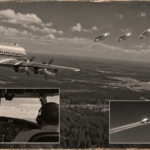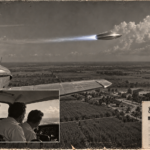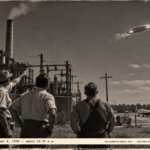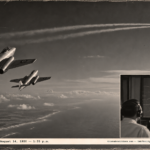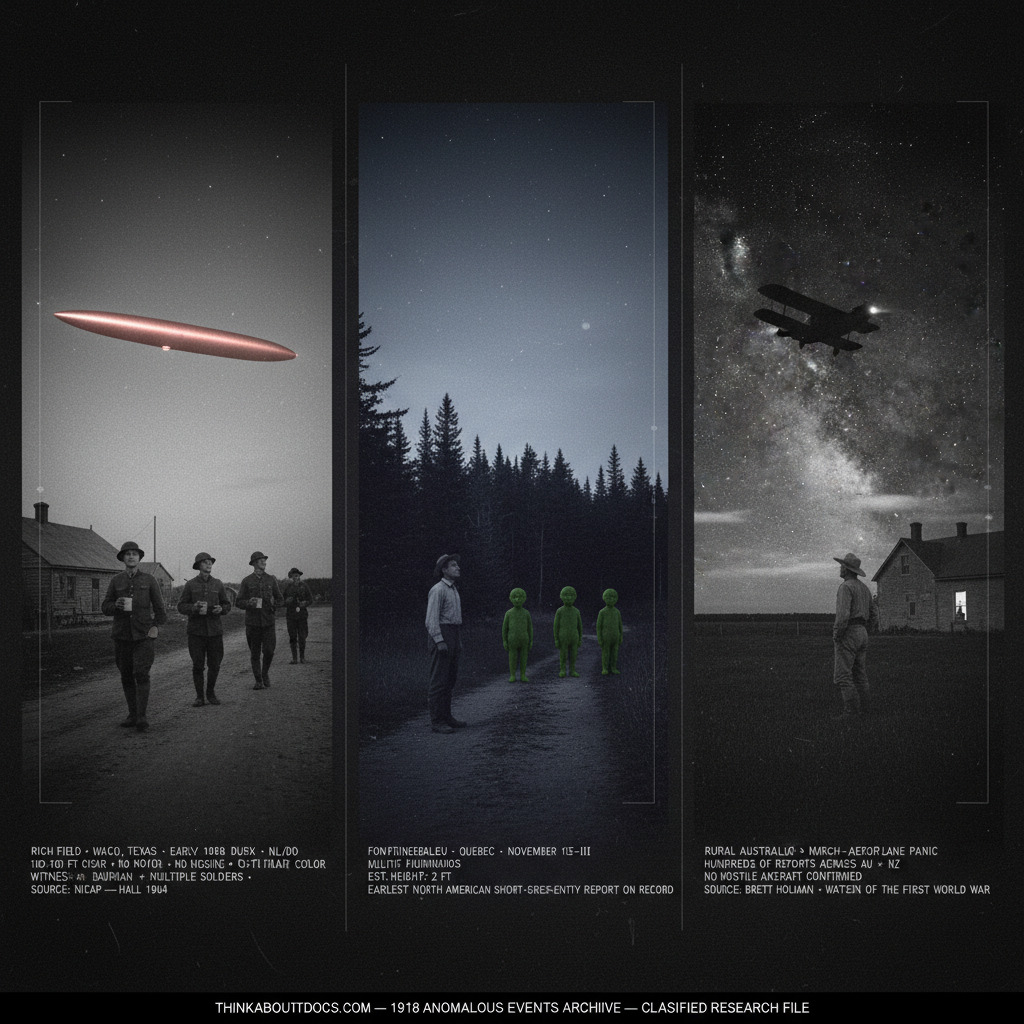
1918 anomalous events archive: Rich Field Waco Texas noiseless rose cigar sighting (early 1918, NICAP/Hall sourced), Fontainebleau Quebec CE-III green humanoid encounter (November 1918), and the 1918 Australia-New Zealand mystery aeroplane panic (hundreds of reports, government-investigated). Sources: Hall/NICAP 1964, individual report page, Brett Holman/Nigel Watson.
1918: UFO|UAP & Entity Sightings Archive
1918 is one of the thinnest years in this archive — not because anomalous events stopped happening, but because the final year of the First World War produced some of the most severe wartime censorship of the entire conflict, compounded by the catastrophic influenza pandemic that killed more people globally than the war itself. What survives entered the record through fragmentary channels: military logs, scattered local press, and later research cataloguing rather than systematic contemporary documentation.
The year’s anchor case is the November encounter at Fontainebleau, Quebec — multiple short, roughly two-foot-tall green humanoid figures in fitted uniforms, observed near a wooded area at nightfall, among the earliest documented reports of a body type that would recur with striking consistency across North American entity accounts for the next six decades. The Waco, Texas mess-hall sighting — correctly relocated here from this site’s 1917 archive, per NICAP and Hall’s dating — captures something official reporting rarely does: Edwin Bauhan’s own words that the soldiers experienced “the weirdest feeling of our lives.” The Australia and New Zealand mystery aeroplane panic of 1918, documented in peer-reviewed and published research by Brett Holman and Nigel Watson, is this year’s largest event by witness count and institutional response, and is included below.
Date: Early 1918
Location: Near Waco, Texas (Rich Field)
Time: Dusk
Hynek Classification: DD
Case Status: Insufficient Data
Summary: Soldiers leaving the mess hall at Rich Field watched a reddish, cigar-shaped object, roughly 100 to 150 feet long, pass directly overhead at about 500 feet altitude, moving silently from southwest to northeast with no visible motor, rigging, or windows. Witness Edwin Bauhan described the group’s reaction as “the weirdest feeling of our lives.” Correction: this case was previously listed with an uncertain “191?” date on this site’s 1917 archive; NICAP and Richard Hall’s cataloging both place it in early 1918, and it has been moved here accordingly.
Source: NICAP, UFO Evidence, 1964; Hall, Richard H.
Date: November 1918
Location: Fontainebleau, Quebec, Canada
Time: Beginning of night
Hynek Classification: CE-III
Case Status: Insufficient Data
Summary: Multiple short, roughly two-foot-tall, green-colored humanoid figures were observed near a wooded area, wearing what appeared to be fitted uniforms or suits. Full detail on this site’s dedicated report page. [Full Report]
Source: Individual report page linked
Date: 1918
Location: Big Rapids, Michigan
Time: Unknown — not recovered
Hynek Classification: Unclassified — no case content available
Case Status: Insufficient Data — entry content missing
Summary: This entry’s description was not recovered during this site’s restoration; only the source citation survives. Rather than invent a description, this entry is flagged as needing primary research to reconstruct or re-source before it can be published as a documented case.
Source: Eberhart, George M. A Geo-Bibliography of Anomalies, Greenwood Press, 1980 — citation survives; case content does not
Date: 1918
Location: Lismore, New South Wales, Australia
Time: Unknown
Hynek Classification: NL
Case Status: Insufficient Data
Summary: A luminous, cross-shaped (cruciform) object was seen hovering over the town. Note: this case appeared with an uncertain “191?” date on this site’s 1917 archive; an independent period catalog specifically places it in 1918, and it has been moved here accordingly.
Source: Unlisted; corroborated in an independent secondary catalog of pre-war sightings
Date: March 1918 onward
Location: Australia and New Zealand
Time: Various, predominantly night
Hynek Classification: NL
Case Status: Insufficient Data
Summary: Hundreds of reports of unidentified aircraft occurred across both countries beginning in March 1918, initially attributed to German naval raiders and investigated seriously by both governments — the largest documented anomalous aerial event of 1918 by both witness count and institutional response.
Source: Holman, Brett. “The Enemy at the Gates,” MHHV, 2021; Watson, Nigel. UFOs of the First World War, 2015 — documented in peer-reviewed and published academic and research literature
ARCHIVE NOTE — ENTRIES PENDING RECOVERY
This site’s earlier draft of the 1918 page referenced two further cases — La Porte, Indiana and Bolivia — as content that existed in the original archive but was lost during site restoration. Unlike the Big Rapids, Michigan entry above, neither of these even survives as a bare source citation; they exist only as names mentioned in the page’s introductory prose, with no recoverable detail. They are noted here as known gaps rather than published as cases, since there is nothing to publish. If source material for either can be located, they should be properly researched and added in a future session. Note: this site already has a separate, unrelated Bolivia case (the David Mendiola Vilchez octopus-limbed entity abduction) filed under 1914; whatever this missing 1918 Bolivia reference described, it does not appear to be the same event, though this cannot be confirmed without the original source.
RESEARCHER’S NOTES
The 1918 Archive — A Fixed Contradiction and Three Honestly-Flagged Gaps
- An internal contradiction has been corrected: this page’s own Executive Summary previously stated that the Australia/New Zealand mystery aeroplane panic was “omitted entirely” from the archive, while the case itself was already listed above that summary. The summary text had not been updated after the case was added. Both now agree.
- The Waco, Texas relocation from 1917 is now complete: flagged in this project’s 1917 correction pass, it’s properly filed here with its NICAP/Hall dating.
- Three genuinely missing entries are handled with graduated honesty rather than uniform treatment: Big Rapids, Michigan retains a real citation with no content, so it’s flagged as “content missing, source intact.” La Porte, Indiana and Bolivia have neither, so they’re noted as known gaps in a separate archive note rather than given false case-entry formatting that would imply more survives than actually does.
- This year’s thinness is itself worth stating plainly rather than papering over: two solid cases, one significant multi-witness event, and three acknowledged gaps is an honest picture of what 1918’s wartime censorship and institutional chaos left behind — not a failure of this archive’s research, but a real feature of the historical record for this specific year.
1918 will likely always be one of this archive’s thinner years, and that’s a fact about the historical record, not a flaw in the page. What matters is that the page says so honestly — flagging what’s missing instead of quietly filling gaps, and making sure the page’s own summary and its own case list actually agree with each other.
“Weirdest feeling of our lives.”
— Witness Edwin Bauhan, describing the reaction of multiple soldiers at Rich Field, Waco, Texas, upon observing a noiseless, reddish, cigar-shaped object pass overhead at 500 feet altitude, early 1918