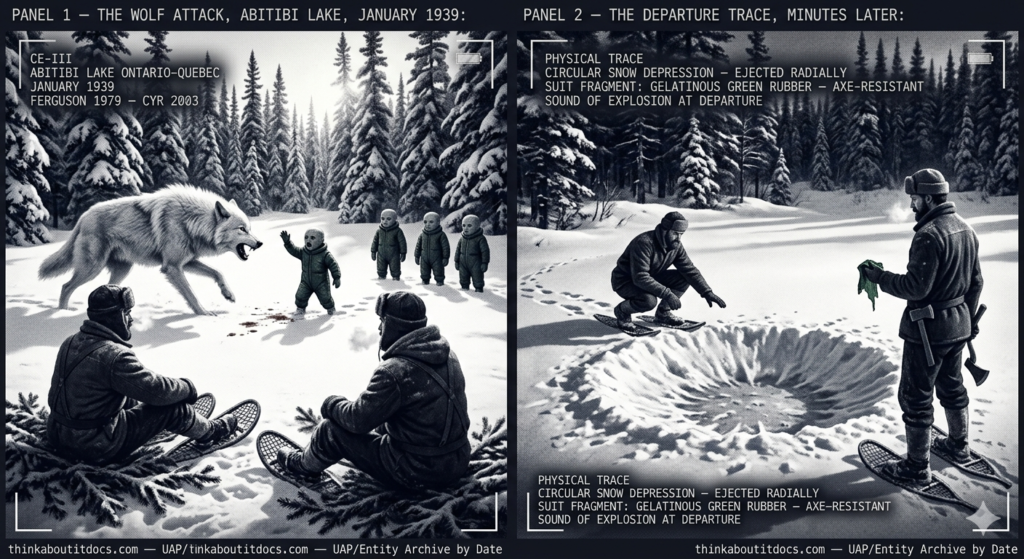
Abitibi Lake, Ontario-Quebec border, Canada, January 1939 — two lumberjacks observe six identical 80cm humanoids in dark-green puffy suits emerge from treeline behind a white wolf. One entity approaches the wolf without sinking in deep snow and is dismembered; brown blood, no breath vapour in -60°F. The remaining five collect all fragments in a bag and depart, their tracks ending at a circular snow depression with snow ejected radially outward. A suit fragment is recovered — gelatinous green rubber that cannot be cut with an axe. Source: Jean Ferguson, 1979; corroborated by Donald Cyr, 2003, who interviewed family members of both witnesses. Case Status: Unexplained. thinkaboutitdocs.com.
THINK ABOUTIT UFO | UAP | ENTITY ENCOUNTER REPORT
1939 or 1940: Abitibi Lake, Ontario – Quebec, Canada Encounter
On a brilliant -60°F January afternoon near Abitibi Lake on the Ontario-Quebec border in 1939 or 1940, two lumberjacks named Hormidas L. and Damase Landry stopped to rest in the snow, cutting fir branches to sit on. An enormous white wolf emerged from the treeline and sat 35 meters away — unusual enough behavior to hold their attention. Then, from the same treeline, at least six very small figures in dark-green puffy suits emerged in a group. Each stood about 80 centimeters tall. Their faces were flat and nearly featureless — small slanted eyes, ears like small inverted triangles, almost no chin, a nearly flat head. Their fingers were jointless. No condensation came from their mouths in air cold enough to kill an unprotected man in minutes. They were, Hormidas would later say, identical — as if manufactured in series. The white wolf bristled. One of the small figures walked toward it across the deep snow without snowshoes and without sinking. It raised a hand and spoke. The wolf lunged and tore the being apart — arms, legs, torso falling into the snow with no vapour and brown blood. Damase threw a branch and shouted; the wolf ran. The remaining five stood motionless over the pieces for five minutes. Then one produced a bag and collected every fragment. They walked back into the treeline too fast to follow. When the two men tracked them to where they had disappeared, they found a circular hollow in the snow — ejected outward like a basin — and heard what sounded like an explosion. Damase found a piece of the being’s suit: gelatinous green rubber that he could not cut in half with an axe.
Date: January 8th and 10th, 1939 or 1940 (probable year 1939 per Quebec ufologist Donald Cyr, 2003)
Sighting Time: Approximately 02:30 PM
Day/Night: Day — sunny, extremely cold at -60°F (-51°C)
Location: Abitibi Lake, Ontario–Quebec border, Canada
Urban or Rural: Remote — boreal forest, deep winter, frontier lumber territory
No. of Entity(‘s): At least 6
Entity Type: Small humanoid — possibly biological construct or non-human intelligent being
Entity Description: Approximately 80cm tall. Dark-green puffy suits. Small slanted eyes. Yellow skin described as resembling Asian complexion. Ears shaped like small inverted triangles. Very small chin. Almost flat heads. Weak limbs. Short jointless fingers. All identical in appearance — described as if manufactured in series. No condensation vapour from mouth in -60°F temperatures. Brown blood (not red). Walked through deep snow without snowshoes and without sinking. Moved faster than the lumberjacks could follow on snowshoes. Communicated among themselves in a language resembling Algonquin.
Hynek Classification: CE-III — Close Encounter of the Third Kind (animated beings in direct interaction with environment and witnesses; associated departure circle suggests proximate craft)
Duration: Approximately 10–15 minutes total (observation to departure)
No. of Object(s): 1 presumed (departure circle in snow — circular hollow with snow ejected outward, suggesting craft landing and departure site)
Description of the Object(s): Not directly observed. Inferred from circular depression in snow approximately the diameter of a landing circle, snow ejected radially outward to form a hollow basin, accompanied by a sound described as an explosion at departure.
Shape of Object(s): Circular footprint only
Size of Object(s): Not recorded
Color of Object(s): Not observed
Distance to Object(s): Treeline — approximately 35 meters initial entity emergence; two witnesses followed tracks to departure circle
Height & Speed: Not observed — departure inferred from sound and circular trace
Number of Witnesses: 2 — Hormidas L. and Damase Landry, lumberjacks
Special Features/Characteristics: No condensation breath in -60°F; no snowshoe sinking in deep snow; brown not red blood; beings identical to each other (possible biological construct); language resembling Algonquin; wolf interaction and entity dismemberment; remains systematically collected; circular snow depression departure trace; recovered fabric fragment — gelatinous green rubber unable to be cut with axe; corroborated by Quebec ufologist Donald Cyr (2003) who interviewed family members of both witnesses
Case Status: Unexplained
Source: Jean Ferguson, “Les Mystères de l’au-delà” (Enigmas of the Present Times), 1979; corroborated by Quebec ufologist Donald Cyr (2003)
Summary/Description: Two lumberjacks resting near Abitibi Lake in January 1939 or 1940 observed an enormous white wolf emerge from the treeline, followed by at least six identical 80cm humanoids in dark-green puffy suits with jointless fingers, yellow skin, triangular ears, flat heads, and no breath vapour in -60°F conditions. One entity approached the wolf without sinking in deep snow; the wolf dismembered it. The remaining five collected all fragments in a bag and departed into the treeline, their tracks ending at a circular snow depression suggesting a craft landing site. A sound like an explosion accompanied departure. Physical trace: fragment of the being’s suit recovered — gelatinous green rubber that could not be cut with an axe. Corroborated by Donald Cyr (2003) who interviewed family members of both witnesses.
Related Cases: 1937 Chashniki Belarus — flying helmeted dwarf with no breath vapour (Kuzovkin, 1982) | 1935 Nipawin Saskatchewan — suited humanoids near craft (Musgrave/FSR) | 1918 Fontainebleau Quebec CE-III — small suited beings (same Quebec regional research tradition)
DETAILED REPORT
The Abitibi Lake encounter of January 1939 or 1940 is one of the most narratively elaborate and physically specific pre-modern CE-III cases in the Canadian record, and it occupies an unusual position in the archive: a case of evident high strangeness that is internally consistent, regionally corroborated, and sourced to a named Quebec researcher whose work was independently verified by a second researcher twenty-four years later.
Jean Ferguson published the account in 1979 in his compilation of Quebec anomalous encounters. Ferguson was a regional storyteller and UFO researcher operating in the Quebec French-language research tradition — not a NICAP-tier organization, but a legitimate named author working from local sources. The two witnesses, Hormidas L. and Damase Landry, are named — Damase fully, Hormidas by first name only. Donald Cyr, a Quebec ufologist, independently located and interviewed family members of both witnesses in 2003 and confirmed the core details. This is not a single-source oral account; it is a two-researcher chain with family corroboration across a 24-year span.
The physical details of the case carry significant analytical weight. At -60°F no biological organism produces no breath condensation — a detail that at those temperatures is an absolute physiological fact, not a matter of degree. A human being exhaling at -60°F produces an immediately visible cloud of condensed vapour. The entities produced none. This is not a detail that could be accidentally inserted into a fabricated account without specific intent; it is either a faithful report of observed anomaly or a deliberate fictional insertion. Combined with the jointless fingers, the identical appearance of all six beings, the brown not red blood, and the inability to sink in deep snow without snowshoes, the entities’ physical properties form a coherent cluster of traits inconsistent with any known biological organism.
The wolf interaction is the case’s most dramatic and analytically interesting element. The white wolf’s initial presence — sitting in the snow 35 meters from the lumberjacks, apparently waiting — and the entities’ emergence from the same treeline shortly after suggests the wolf was either aware of or associated with the beings’ approach. The entity that walked toward the wolf did so without snowshoes across deep snow without sinking — a physical impossibility for any human-weight organism in January boreal forest conditions. The wolf’s attack produced dismemberment with brown blood and no vapour, and the systematic collection of all fragments by the remaining five beings is the detail that most clearly distinguishes this from a natural encounter. The beings were not distressed by the death of their colleague in a recognizably emotional way — they stood and observed for five minutes, then one produced a bag and collected every piece.
The departure trace is the physical anchor. The circular hollow in the snow with radially ejected material — described as a basin pressed into the ground — is consistent with a craft landing and vertical departure leaving a ground compression circle, exactly the trace type documented at Nipawin Saskatchewan in 1933 and 1935. The sound described as an explosion at departure is consistent with a rapid pressure change during vertical ascent. Damase’s recovery of the suit fragment — gelatinous green rubber that resisted axe-cutting — is the case’s most important physical evidence element and the one that, had it been retained and analyzed, would have made this one of the most significant physical trace cases in the pre-modern record. Its current whereabouts are unknown.
RESEARCHER’S NOTES
The Lumberjacks and the White Wolf — Abitibi Lake 1939 and the Quebec Pre-Modern Record
- Source Chain Assessment: Jean Ferguson (1979) as a regional Quebec author is a secondary source, not a primary field researcher. However, his publication of named witnesses, combined with Donald Cyr’s 2003 independent family corroboration, places this case in a stronger position than single-chain oral testimony. Two independent research engagements with the same case across 24 years, with family member confirmation of core details, is the evidentiary structure. The case is PLAUSIBLE rather than merely INSUFFICIENT DATA.
- The No-Vapour Detail as Diagnostic: The absence of condensation breath at -60°F is physiologically absolute. At that temperature, exhaled air at 37°C produces immediate and dense condensation — there is no atmospheric condition under which a warm-blooded organism at -60°F ambient temperature produces no visible breath. This detail is either an accurate observation of a non-warm-blooded organism or a biologically anomalous entity, or it is a fabricated detail inserted with specific intent. The latter requires that Ferguson or his source had the physiological knowledge to construct a meaningful anomaly — possible, but the detail is more consistent with faithful reporting.
- The Suit Fragment — A Lost Physical Evidence Lead: Damase Landry recovered a fragment of the dismembered being’s suit — described as gelatinous green rubber of a texture unlike any known material, unable to be cut with an axe. This is the pre-modern record’s most significant lost physical evidence item after the Nipawin Saskatchewan photographs. If it was retained by the Landry family, Donald Cyr’s 2003 family interviews would have been the logical moment to ask about it. The 2003 corroboration report does not address the fragment’s current location.
- Language Resembling Algonquin: The beings communicated among themselves in a language the witnesses described as resembling Algonquin — the language family of the Indigenous peoples of the Abitibi region. This is the only case in the pre-modern Canadian record where the entities’ language is described as resembling a local Indigenous language. Whether this reflects actual linguistic resemblance, a phonological coincidence, or a culturally contaminated description by witnesses familiar with the sound of Algonquin is unresolvable from available sources.
Two lumberjacks on snowshoes in a January boreal forest watched a white wolf and six identical 80cm beings in green suits interact until the wolf tore one apart — and then watched the others collect every fragment, walk to a circular snow depression, and disappear in what sounded like an explosion. Damase Landry kept a piece of the suit. He could not cut it with an axe. Jean Ferguson published it in 1979. Donald Cyr confirmed it with the families in 2003. The suit fragment’s location is unknown. The circular hollow in the Abitibi snow has been under boreal forest for eighty-five years. Case Status: Unexplained. The beings produced no breath vapour at -60°F and their blood was brown, and the archive records both of those facts because they were both observed.