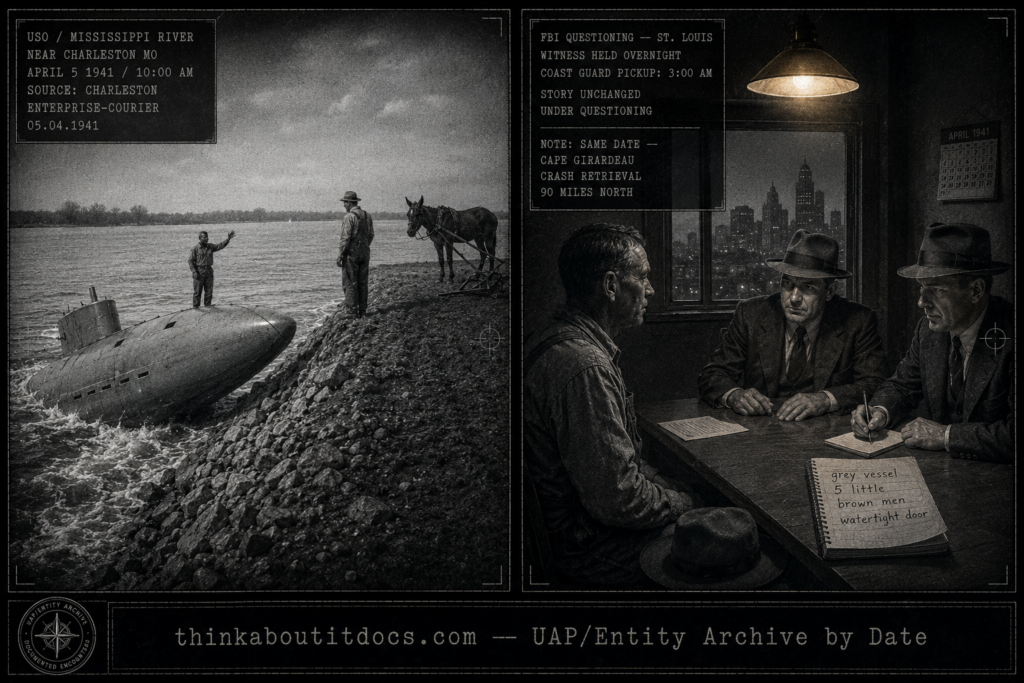
Mississippi River near Charleston, Missouri, April 5, 1941 — a Black farmer plowing near the levee watches a grey vessel surface from 40 feet of Mississippi River water and nose onto the rip-rapped bank. A man on deck waves him aboard. Inside: one man and five small brown figures escort him through the vessel for approximately 30 minutes, past a watertight door with a locking device and a deck gun. The vessel submerges on his departure. Sheriff Scott is called, then the State Highway Patrol and FBI. At 3 AM, Coast Guardsmen collect the farmer and transport him to St. Louis for additional FBI questioning. His story never changed. Source: Charleston Enterprise-Courier, April 5, 1941. Note: Same date as Cape Girardeau crash retrieval, 90 miles north. thinkaboutitdocs.com.
THINK ABOUTIT UFO | UAP | ENTITY ENCOUNTER REPORT
1941: Charleston, Missouri Encounter
On the morning of April 5, 1941 — the same date as the Cape Girardeau crash retrieval 90 miles to the north — a Black farmer plowing his field a few miles north and east of Charleston, Missouri, near the river side of the levee, looked up from his work at about 10 o’clock and saw something pushing its grey nose out of the murky Mississippi. The river was about 40 feet deep at that particular place. The vessel eased up onto the sloping rip-rapped bank. On its deck stood a Black man who waved to the farmer to come aboard. The farmer went. Inside he found one Black man and five little brown men who escorted him through the vessel — through at least one watertight door with a locking device he would later describe in detail, past a deck gun, and through a myriad of other features he could not account for. The whole affair lasted a half hour or perhaps longer, until the farmer heard his boss’s automobile approaching and said he had to leave. His hosts said they had to leave too. He went ashore. With a great churning of waters the grey vessel slipped beneath the waves and disappeared. The farmer reported it to his landlord at noon. The landlord called Sheriff Scott. Officers assembled and questioned the farmer at length. He could not be, and was not, shaken in his story. Word reached the FBI. At 3 o’clock Sunday morning a telephone voice asked the landlord where the farmer could be found. The farmer was picked up by Coast Guardsmen at the Mississippi-Illinois line and taken to St. Louis for additional FBI questioning. He disappeared from public record.
Date: April 5, 1941
Sighting Time: Approximately 10:00 AM
Day/Night: Day
Location: Mississippi River bank, a few miles north and east of Charleston, Mississippi County, Missouri, USA (river side of the levee)
Urban or Rural: Rural — farmland at the Mississippi River levee
No. of Entity(‘s): 6 (one man on deck who waved; one Black man inside; five small brown men inside)
Entity Type: Humanoid — mixed (one apparently human-appearing Black man; five small brown-skinned beings)
Entity Description: Deck figure — a Black man who waved the witness aboard. Interior — one Black man and five “little brown men” who escorted the witness through the vessel. No further physical description of the five brown figures recorded. Witness described interior details at length: watertight door locking mechanism, deck gun, numerous other features.
Hynek Classification: CE-III — Close Encounter of the Third Kind (animated beings observed in association with an anomalous vehicle; witness escorted through the interior). Note: Page lists CE-V (voluntary bilateral contact). This is incorrect. The contact was initiated by the beings — a figure on the deck waved the witness aboard. The witness responded to an invitation from the craft’s occupants, not the other way around. CE-III is the correct classification. CE-V requires human-initiated contact.
Duration: Approximately 30 minutes or longer
No. of Object(s): 1
Description of the Object(s): Grey submarine-like vessel. Surfaced from approximately 40 feet of water in the Mississippi River. Nosed up onto the sloping rip-rapped bank. Interior included: watertight door with locking device (described by witness in detail), deck gun, numerous instruments and features described as “a myriad of things.” Departed with “a great churning of waters” — submerged and disappeared.
Shape of Object(s): Submarine-shaped
Size of Object(s): Not precisely recorded — sufficient to accommodate at least six occupants plus interior compartments and navigational equipment
Color of Object(s): Grey
Distance to Object(s): Directly accessible from the river bank — witness walked aboard
Height & Speed: Surfaced from approximately 40 feet; departed by submerging
Number of Witnesses: 1 primary (farmer, name withheld — “prefers to remain anonymous”); landlord (reported secondhand); Sheriff Scott; State Highway Patrol officers; subsequently FBI and Coast Guard
Special Features/Characteristics: Contemporaneous newspaper coverage on the date of the event; vessel surfaced from and submerged back into the Mississippi River (USO — Unidentified Submerged Object); interior described in detail by witness including watertight door locking mechanism; FBI involvement and subsequent Coast Guard pickup of the witness at the Mississippi-Illinois line; witness taken to St. Louis for additional questioning; witness “disappeared” from public record for approximately 36 hours; same date as the Cape Girardeau crash retrieval 90 miles to the north; neither event apparently cross-referenced in 1941 press or official records
Case Status: Unexplained
Source: Charleston Enterprise-Courier (Mississippi County, Missouri), April 5, 1941 — contemporaneous newspaper account
Summary/Description: On the morning of April 5, 1941, a Black farmer near Charleston, Missouri watched a grey submarine-like vessel surface from the Mississippi River and ease onto the levee bank. A Black man on deck waved him aboard. Inside he found one Black man and five small brown figures who escorted him through the vessel for approximately 30 minutes. On his departure, the vessel submerged. He reported it to his landlord; the sheriff was called, then the State Highway Patrol and FBI. The witness was picked up by Coast Guardsmen overnight and taken to St. Louis for FBI questioning before returning. The account was reported contemporaneously in the Charleston Enterprise-Courier on the same day.
Related Cases: April 5, 1941 Cape Girardeau Missouri crash retrieval | 1936 Pacific Ocean steamer Maria | 1982 Trans-Baikal/Issyk Kul USSR — Soviet frogmen vs. underwater humanoids
DETAILED REPORT
The Charleston, Missouri encounter of April 5, 1941 is one of the most unusually sourced pre-modern CE-III cases in the American archive. Unlike virtually every other case in this era — which relies on retrospective testimony, family disclosure chains, or secondary research compilations — the Charleston account has a contemporaneous newspaper source: a regional Missouri daily reporting the event on the day it occurred, with named officials (Sheriff Scott), named institutions (State Highway Patrol, FBI, Coast Guard), and a witness whose testimony was assessed and found consistent under repeated questioning.
The Charleston Enterprise-Courier’s account is written in the slightly bemused tone of a regional paper covering something it cannot explain and is not entirely sure whether to take seriously — the Jean Valjean reference and the “so endeth this chapter” sign-off indicate editorial distance. But the facts it reports are precise: a specific location (a few miles north and east of Charleston, river side of the levee), a specific time (about 10 o’clock in the morning), a specific geography (the river approximately 40 feet deep at that place, a sloping rip-rapped bank), a specific duration (half an hour or perhaps longer), a specific witness response chain (landlord at noon, Sheriff Scott, State Highway Patrol, FBI notification, Coast Guard pickup at 3 AM, St. Louis questioning). These are the operational details of a genuine law enforcement and federal intelligence response — not a fabricated local story.
The institutional escalation is the case’s most analytically significant element. A farmer reporting a submarine on the Mississippi River would, in April 1941, have immediate national security implications. The United States was not yet at war — Pearl Harbor was eight months away — but was actively monitoring Axis submarine activity in Atlantic coastal waters. A submarine surfacing in the Mississippi at Charleston, Missouri — hundreds of miles from open water — would be simultaneously impossible by conventional naval assessment and a potential intelligence emergency requiring immediate federal response. The FBI’s involvement and the Coast Guard’s overnight collection of the witness for transportation to St. Louis are consistent with a serious federal response, not a dismissal of a crank report.
The witness’s account held under extended questioning by multiple law enforcement agencies. He described the watertight door locking mechanism, the deck gun, and numerous other interior features with sufficient specificity that officers could not shake his story. The five “little brown men” who escorted him through the vessel are the case’s most anomalous detail — no known 1941 submarine crew would have included beings described in those terms, and no conventional military or commercial submarine of any nation was operating in the Mississippi River interior in April 1941.
The date correspondence with the Cape Girardeau crash retrieval — April 5, 1941, 90 miles to the north — is the case’s most striking contextual detail. Whether both events on the same date in the same state represent connected activity, coincidence, or the result of date uncertainty in one or both accounts cannot be established from available sources. Neither contemporaneous account appears to reference the other, and neither Stringfield (working the Cape Girardeau case) nor the Charleston newspaper appears to have connected them. The archive holds both events on the same date and notes the correspondence.
RESEARCHER’S NOTES
The Grey Vessel on the Mississippi — Charleston 1941 and the April 5 Correspondence
- Source Chain Assessment: A contemporaneous regional newspaper account dated the same day as the reported event is among the strongest possible source types for a pre-modern case. The Charleston Enterprise-Courier’s April 5, 1941 article names specific officials, describes the law enforcement response chain with institutional accuracy, and records the witness’s account as received and corroborated under questioning. This is primary contemporaneous documentation. The source field on the page reads only “Charleston, April 5, 1941” — it should be updated to: Charleston Enterprise-Courier, April 5, 1941.
- Classification Correction — CE-V to CE-III: The CE-V classification requires human-initiated voluntary contact with extraterrestrials. The Charleston encounter was initiated by a figure on the deck of the vessel who waved the witness aboard — the contact was offered by the craft’s occupants and accepted by the witness. This is CE-III (entities associated with anomalous vehicle, boarding of interior). The witness’s acceptance of an invitation does not make it CE-V any more than accepting an invitation onto a stranger’s boat constitutes initiating contact with that stranger.
- The April 5 Date Correspondence: Both the Charleston USO encounter and the Cape Girardeau crash retrieval are dated April 5, 1941. Charleston and Cape Girardeau are approximately 90 miles apart, both in southeastern Missouri, both along the Mississippi River corridor. No contemporaneous connection between the two events was drawn in available sources. Possible interpretations: (1) the same anomalous activity in the southeastern Missouri/Mississippi River corridor on the same date; (2) date uncertainty in one or both accounts (the Cape Girardeau crash is dated to April 1941 with the exact date derived from family chronology — it may not be precisely April 5); (3) coincidence. This correspondence is the most underanalyzed element in either case and warrants explicit note in the archive.
- The USO Dimension: The vessel surfaced from approximately 40 feet of water in the Mississippi River and submerged on departure with “a great churning of waters.” This makes it a documented Unidentified Submerged Object — a craft operating both underwater and on the surface, with an interior capable of supporting multiple occupants, in a location (the Mississippi interior) where no conventional submarine had any operational access. The parallel with the 1936 Pacific Ocean steamer Maria encounter (vessel ascended from the ocean, similar boarding structure, similar occupant description involving a mixed crew) is the closest comparable case in the pre-modern archive.
The farmer near Charleston held his story through questioning by the Sheriff, the State Highway Patrol, and ultimately the FBI in St. Louis, and his account never changed: a grey vessel came up out of 40 feet of Mississippi River water at 10 o’clock on the morning of April 5, 1941, a man on the deck waved him aboard, five little brown men escorted him through the interior for half an hour, and then it went back under the water and disappeared. The Charleston Enterprise-Courier printed it the same day. The FBI took him to St. Louis. The vessel has not been explained. The five little brown men have not been identified. Case Status: Unexplained. Ninety miles to the north, on the same date, Reverend Huffman was being driven out to pray over three small bodies from a disc-shaped craft in a Missouri field. The archive records both events on April 5, 1941, and notes the correspondence without resolving it.
“Submarine” bobs up in Mississippi and takes aboard a negro farmer before disappearing
The article states that the Negro man went aboard the submarine and found one Negro man and five little brown men who escorted him through the ship. The whole affair lasted a half hour or perhaps longer.
The man was questioned by the State Highway patrol and later it was found out that the FBI had taken the Negro farmer to St. Louis for additional questioning. Jean Valjean is dead but his spirit apparently lives in the body of a Mississippi county Negro man, who farms a few miles north and east of Charleston on the river side of the levee. Officers of this county are not easily aroused about any normal procedure-not after major floods, roadside demonstrations and such, but a rush call from an entirely reliable farmer regarding the appearance and then the disappearance of a submarine in the Mississippi river-well, that’s enough to jar the eyeteeth out of most anyone.
The call came at noon Saturday. Officers of this county, augmented by members of the State Highway Patrol responded. The Negro man, who prefers to remain anonymous, was questioned at length. And this is his story: He was plowing near the river bank Saturday morning about 10 o’clock. Without any previous warning a submarine poked its grey nose out of the murky depths of the Mississippi (which is about 40 feet deep at that particular place) and eases up on the sloping rip-rapped bank. A negro man on the deck waved to our friend to come aboard. He went. There he found one Negro man and five little brown men who escorted him through the ship for tin fish or submersible or whatever it might have been.
Although questioned at length, the Negro stuck to his story, describing the interior of the locking device on the water tight door, the deck gun and a myriad of other things on the mysterious craft. After a pleasant half hour or maybe longer on board, so goes the story, the Negro heard the automobile of his boss approaching and said he had to be going. “Well, we have to go too,” replied his hosts, so he went ashore. With a great churning of waters the grey craft slipped silently beneath the waves and disappeared. So endeth this chapter.
+ + + The strange visit aboard an even stranger craft was duly reported when the landlord visited the farm at noon Saturday. He in turn reported to Sheriff Scott. Other officers were assembled. He could not be, and was not shaken in his story. Finally he was released, and a report of the matter was transmitted to FBI agents and to the Coast Guard, which incidentally has charge of patrolling inland as well as coastal waters. About 3 o’clock Sunday morning a telephone voice asked the landlord where the Negro might be found. Upshot of the conversation was that the Negro ended up in custody of Coast Guardsmen at the Mississippi-Illinois line.
He disappeared. The disappearance of the Negro informant was as complete as the evaporation of the alleged submarine. Not until Monday noon was the informant found-he had been taken to St. Louis for additional questioning by the FBI agents.