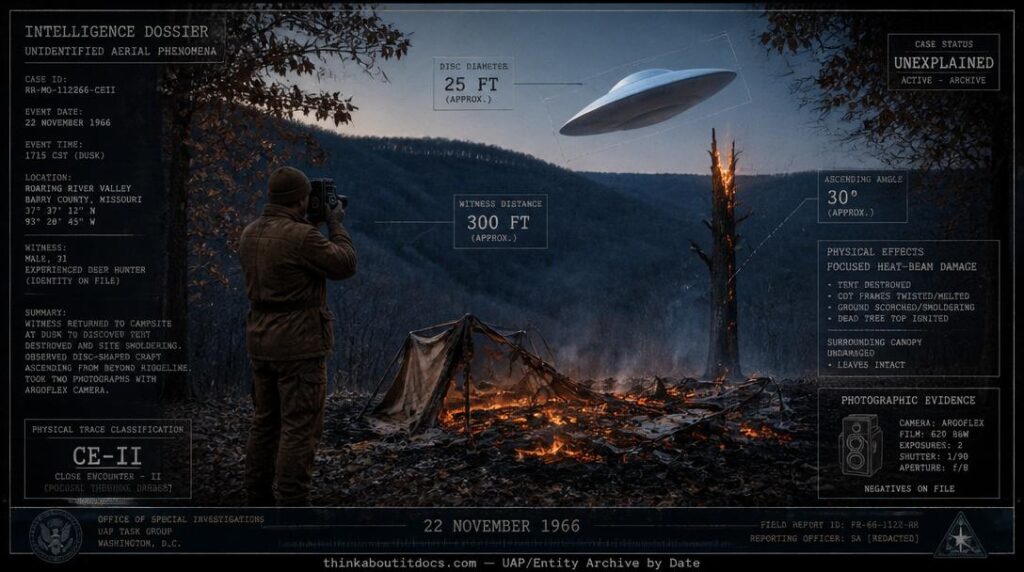
November 22, 1966 — Roaring River, Missouri. A 25-foot disc rises from an Ozark valley seconds after inflicting focused heat-beam damage on a hunting camp, melting aluminum cots while leaving surrounding dried leaves intact. Two photographs captured on 620-format Argoflex. CE-II classification. Unexplained.
THINK ABOUTIT UFO|UAP SIGHTING REPORT
1966: Roaring River, Missouri — Disc Photographed Over Campsite After Heat-Beam Damage
When a deer hunter returned to his campsite near Roaring River, Missouri on the evening of November 22, 1966, he found his tent still smoldering, his aluminum cots melted, and a dead tree burning fifteen feet away — all damage inflicted by what appeared to be a tightly focused heat beam that left the dried winter leaves on surrounding branches completely untouched. Seconds later, a low humming sound drew his attention to a disc-shaped craft rising from the valley beyond the burning tree, and he managed two photographs with his Argoflex camera before the object accelerated out of sight — producing what remains one of the few UFO cases in the record where photographic evidence, physical trace damage, and witness testimony converge in a single, tightly documented encounter.
Date: November 22, 1966
Sighting Time: 8:00 p.m.
Day/Night: Night
Location: Roaring River, Missouri (near Cassville)
Urban or Rural: Rural
No. of Entity(‘s): None observed
Entity Type: Not Applicable
Entity Description: Not Applicable
Hynek Classification: CE-II (Close Encounter II) — Observation of a UFO with associated physical effects on the environment
Duration: Approximately 20 seconds (visual observation of object)
No. of Object(s): 1
Description of the Object(s): Disc-shaped craft of aluminum color with a visible band around the center, reflecting sunlight as it departed
Shape of Object(s): Disc
Size of Object(s): Approximately 25 feet in diameter, 8 feet thick
Color of Object(s): Aluminum / metallic silver
Distance to Object(s): Approximately 300 feet
Height & Speed: Rose from ground level; accelerated to approximately 40 degrees above the horizon; humming intensified with speed
Number of Witnesses: 2
Special Features/Characteristics: Focused heat-beam damage to campsite — melted aluminum cots, smoldering tent and equipment, burning dead tree — while leaving surrounding dried winter leaves unaffected, indicating a tightly directed energy source; audible low humming that intensified with acceleration; visible equatorial band on craft; two photographs captured on 620-format Argoflex camera with coated Varex 75mm f/4.5 lens
Case Status: Unexplained
Source: B.J. Booth; Ted Phillips, Physical Traces Associated with UFO Sightings, 1975, p. 44; personal files
Summary/Description: Two deer hunters camping near Cassville, Missouri discovered their campsite destroyed by a focused heat source that melted aluminum cots and set equipment smoldering while leaving surrounding tree leaves intact. The returning witness observed a 25-foot disc-shaped craft rising from the valley, accompanied by a low humming that intensified as the object accelerated. He photographed the object twice with an Argoflex camera before it disappeared at speed. The narrow-beam thermal damage pattern, photographic evidence, and ground-trace effects make this one of the most evidentiarily dense CE-II cases of the 1960s.
Related Cases: 1971 Delphos, Kansas Landing Ring | 1973 Columbia, Missouri Physical Trace Event | 1964 Socorro, New Mexico (Zamora)
Detailed Report
On November 22, 1966, during deer season in the Ozarks near Cassville, Missouri, two hunters had established camp in the Roaring River area. When one of the men returned to the campsite, he was immediately alarmed by smoke rising from the camp and ran to investigate. What he found was systematic destruction: their 12-by-18-foot tent was smoldering, shoes and records were still smoking, and the aluminum cots inside the tent had been melted — not merely heated, but structurally deformed. One aluminum tent pole was singed but not burned through.
The damage pattern was analytically significant. The campsite sat beneath two trees whose dried winter leaves showed no damage whatsoever, indicating that the destructive force had been delivered as a narrow, directed beam rather than as radiant heat or open flame. This observation alone distinguishes the event from conventional fire or lightning strike, both of which would have ignited the overhead canopy. Approximately fifteen feet from the campsite, a dead tree had its top still burning.
At this point, the witness heard a low humming sound and, searching for its source, observed an unusual object rising from the valley just beyond the burning tree. He was able to photograph the object only seconds after it left the ground, managing a second photograph moments later. The entire visual observation lasted no more than twenty seconds. The object flew with apparent effortlessness, the humming intensifying as it gained speed. The witness’s last observation placed the object at approximately forty degrees above the horizon.
The witness subsequently walked the distance from his position to the area where the object had been, measuring approximately 300 feet. He estimated the craft at roughly 25 feet in diameter and about 8 feet in thickness, disc-shaped, aluminum-colored, and reflecting ambient light. He also noted what appeared to be a band around the center of the object.
The photographs were taken with a 620-format Argoflex camera equipped with a coated Varex 75mm f/4.5 lens. The shutter speed was set at 1/90 second and the aperture at f/8, giving a depth of field from 41 feet to infinity when focused at infinity. The two UFO exposures were positioned in the center of the roll, bracketed by ordinary camping photographs at the beginning and end — a detail that argues against fabrication, as it demonstrates the camera was in routine use throughout the trip.
Researcher’s Notes
The Roaring River Disc — Cassville, Missouri 1966 and the Convergence of Multi-Modal Evidence
- Classification Correction — CE-I to CE-II: The original page classifies this case as CE-I (Close Encounter of the First Kind). This is incorrect. The melted aluminum cots, smoldering equipment, burning dead tree, and directional heat-beam damage pattern constitute clear physical effects on the environment associated with the observed object, meeting the standard definition of CE-II (Close Encounter of the Second Kind). The Hynek CE-II classification requires physical interaction between the object and its surroundings, and this case delivers precisely that. The classification has been corrected accordingly.
- Photographic Evidence Assessment: The camera specifications — a 620-format Argoflex with a coated Varex 75mm f/4.5 lens shooting at 1/90 second and f/8 — are documented with unusual precision for a 1960s civilian case. The fact that the UFO photographs sit mid-roll between ordinary camping shots significantly reduces the probability of post-hoc fabrication. The optical specifications also establish that the images were taken under conditions capable of resolving a 25-foot object at 300 feet, lending technical credibility to the visual record. The case is cited in Ted Phillips’s foundational 1975 physical trace catalog, which applied rigorous inclusion criteria.
- Physical Trace Pattern — Directed Energy Signature: The most analytically significant element of this case is the thermal damage pattern. The selective destruction — melted aluminum, smoldering fabric, burning deadwood — occurring beneath dried winter leaves that showed zero thermal damage requires a focused, directed energy delivery mechanism. This is not consistent with lightning, campfire accident, or conventional incendiary devices. The pattern is consistent with a narrow-beam thermal source operating from a low altitude, and it places the case alongside the Delphos 1971 landing ring and the 1964 Socorro ground burns as one of the more physically documented CE-II events in the North American catalog.
- Geographic and Temporal Context: The November 1966 date places this event during one of the most active UFO flap periods in American history — the same month and year as the Point Pleasant, West Virginia incidents and the broader 1966 Midwest wave. The Ozark corridor of southwestern Missouri was not a recognized hotspot at the time, which actually strengthens the case: the witness had no cultural framework or local precedent to draw upon for a fabricated report. The rural, isolated setting and the witness’s immediate behavioral response — measuring distances, noting camera specifications, observing damage patterns — reflect the reactions of a practical outdoorsman rather than a sensation-seeker.
The Roaring River case sits in the archive as a compact, three-channel evidentiary package — photographs, ground traces, and testimony — all pointing in the same direction and none yet explained by conventional analysis. The damage pattern alone, with its selective thermal targeting beneath untouched foliage, would be difficult to reproduce deliberately in 1966 without specialized equipment. Until a prosaic mechanism is identified that accounts for all three channels simultaneously, the record holds this one as Unexplained.
Media