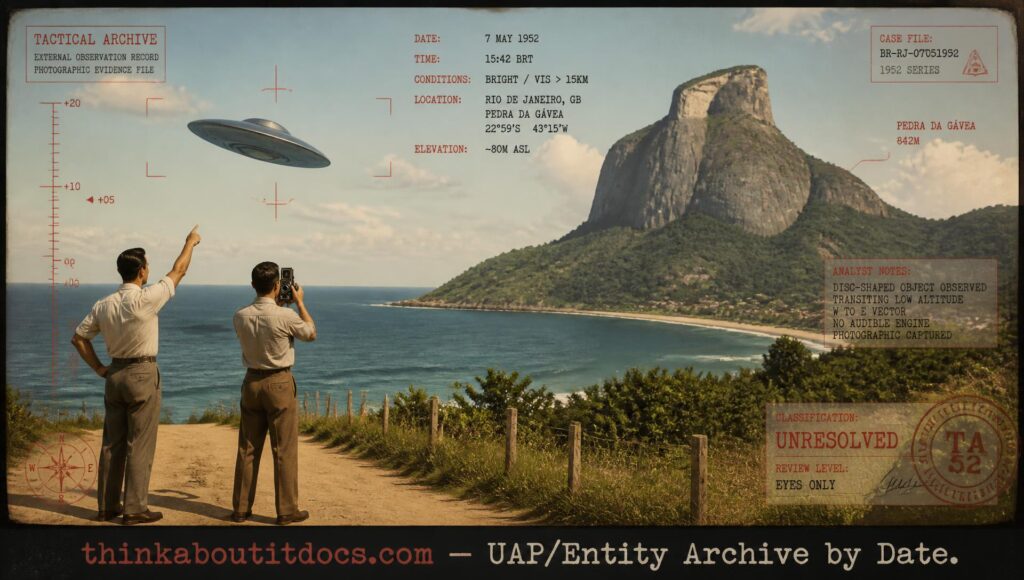
Barra da Tijuca, Brazil, May 7, 1952 — the disc circles Pedra da Gávea before departing out to sea.
THINK ABOUTIT UFO|UAP SIGHTINGS REPORT
1952: The Barra da Tijuca UFO Photos — Genuine Evidence or Hoax?
Two Brazilian newsmen photographed a silent, sea-gray disc as it circled a Rio de Janeiro landmark in broad daylight — producing what APRO once called one of the best UFO photo series on record, and what a University of Colorado analyst later cited as a textbook case of internally inconsistent “proof.”
Date: May 7, 1952
Sighting Time: Approximately 4:30 p.m.
Day/Night: Day
Location: Barra da Tijuca, near Punta da Marisco and Pedra da Gávea, Rio de Janeiro, Brazil
Urban or Rural: Rural/coastal — open hillside and beach terrain outside central Rio
Hynek Classification: DD (Daylight Disc) — metallic or whitish object seen in daylight
Duration: Viewed for slightly over one minute; all five photographs were taken within approximately 60 seconds
No. of Object(s): 1
Description of the Object(s): A sharply detailed, solid-looking disc that approached from the sea at high speed, circled the Pedra da Gávea rock formation, and then flew back out over the ocean
Shape/Size/Color of Object(s): A metallic or whitish flying disc, described in some accounts as gray-blue, that appeared to fly “sideways”; estimated in later photo analysis at roughly 50 meters in diameter and 5 meters in height
Distance to Object(s): Not precisely recorded, though witnesses reported it passing close enough overhead for detailed photographs
Height & Speed: Not numerically recorded; described by witnesses as approaching and departing at great speed, entirely silent, and leaving no smoke or exhaust trail
Number of Witnesses: Primary witnesses were Joao Martins (reporter and engineer) and Ed Keffel (press photographer); Brazilian Air Force investigators later located and corroborated accounts from roughly 40 additional people who had been in the vicinity that day
Special Features/Characteristics: Completely silent flight with no exhaust or vapor trail despite the claimed high speed; the object’s apparent sideways flight attitude; a deliberate circling maneuver around a fixed landmark rather than a simple straight-line pass; five surviving photographic exposures, an unusually large set for a case of this era.
Case Status: Disputed. The Brazilian Air Force’s own investigation concluded the photographs were genuine, though that finding wasn’t made public until 1959. U.S. Air Force Project Blue Book staff, after local informants reported seeing people staging fake UFO photographs in the area, filed the case as a suspected hoax. Independent photo analysis by Donald Menzel and Lyle Boyd (1963), later cited by William K. Hartmann for the University of Colorado UFO Project, identified a shadow-angle inconsistency between one photograph’s foliage and the object itself as evidence of fabrication. APRO’s own field investigators countered that the inconsistency was an optical illusion caused by dead branches partially shading the tree trunk in question, not proof of tampering. No resolution has been reached; both readings are preserved here rather than adjudicated.
Source: Ronald Story, “The Encyclopedia of UFOs,” pp. 41–45; NICAP (nicap.org/bdtrep-story.htm); Donald Menzel & Lyle Boyd, “The World of Flying Saucers” (1963); William K. Hartmann, University of Colorado UFO Project analysis; APRO Bulletin (Jim Lorenzen); contemporary O Cruzeiro magazine, May 24, 1952 issue
Summary/Description: On the afternoon of May 7, 1952, journalist Joao Martins and press photographer Ed Keffel were on assignment near Barra da Tijuca, outside Rio de Janeiro, when Martins spotted a fast-moving object approaching from the sea. Realizing it was flying in an unusual sideways attitude unlike any aircraft he recognized, Martins alerted Keffel, who captured five photographs in roughly sixty seconds as the disc-shaped object circled the Pedra da Gávea rock formation and departed back out over the ocean. The resulting images, published two and a half weeks later in O Cruzeiro magazine, became one of the most widely reproduced UFO photo sets of the era. The Brazilian Air Force’s own investigation, though not made public for seven years, concluded the photographs were genuine and located roughly forty corroborating witnesses. American investigators and later independent photo analysts reached a different, unresolved conclusion, centered on a disputed shadow inconsistency in one of the five frames.
Related Cases: Not Applicable
Detailed Report
Few UFO photo cases from the early 1950s carry as much surviving documentation, on both sides of the authenticity question, as Barra da Tijuca. The core account is straightforward: on the afternoon of May 7, 1952, O Cruzeiro magazine staffers Joao Martins and Ed Keffel were working near the coastal district of Barra da Tijuca, outside Rio de Janeiro, when Martins noticed an object approaching fast from over the water. His first assumption — an aircraft — didn’t hold up; the object appeared to be flying sideways, unlike anything in his considerable aviation knowledge. Keffel, camera ready, captured five exposures in about a minute as the object circled the distinctive Pedra da Gávea rock formation before heading back out to sea.
Martins later put his own credibility squarely behind the sighting in a signed statement, also endorsed by Keffel, stressing his professional background as both a journalist and an engineer with direct familiarity with known aircraft types, and stating plainly that he could not classify the object as any natural phenomenon or known aircraft. Both men maintained they sought no financial benefit from the story beyond their ordinary magazine salary, and Martins went on to describe years of subsequent, deliberately detached UFO research prompted by the incident.
The case’s authenticity question runs on two separate, only loosely connected tracks. The first is institutional: the Brazilian Air Force conducted its own investigation and reached a positive conclusion on the photographs’ genuineness, reportedly corroborated by interviews with roughly forty additional witnesses in the area — but this finding was kept out of public view for seven years, only surfacing in 1959 through Bank of Brazil official Fernando Cleto’s television program “The Enigma of Space,” drawing on his own long-running independent UFO research and cooperation with the Brazilian Air Force’s official flying-saucer investigation commission. Meanwhile, and separately, U.S. Air Force Project Blue Book staff working the case reportedly encountered local informants who claimed to have witnessed people staging fake UFO photographs in the same area, leading Blue Book to file the case as a probable hoax — a conclusion reached on witness testimony about staged photography elsewhere nearby, not on direct photo analysis.
The second track is purely photographic. Skeptics, beginning with Donald Menzel and Lyle Boyd’s 1963 book “The World of Flying Saucers” and later reinforced by William K. Hartmann’s analysis for the University of Colorado UFO Project, pointed to one of the five photographs in which the shadows falling across nearby foliage appeared to originate from a different direction than the light striking the object itself — a classic photographic hoax indicator. APRO director Jim Lorenzen directly disputed the geometry of this claim, noting that the sun would need to be in a position it never occupies at that latitude for the skeptics’ reading to hold, and adding that the hillside vegetation in question was complex enough that no single clean shadow pattern genuinely exists to measure. APRO’s own field investigators went further, reporting that dead branches partially obscuring the trunk of the specific palm tree in question created an optical illusion of mismatched shadow angles rather than genuine evidence of tampering. Neither side’s account has been definitively settled against the other.
RESEARCHER’S NOTES
Barra da Tijuca, Brazil — 1952 and the Limits of Photographic Proof
- Two contradictory official verdicts: This is a rare case where two separate national investigations — Brazilian Air Force and, indirectly, American Project Blue Book informants — reached opposite conclusions, neither fully explaining the other’s basis.
- The shadow dispute is genuinely unresolved, not settled: Both the skeptical (Menzel/Boyd, Hartmann) and defensive (APRO/Lorenzen) readings of the disputed photograph remain in the literature; this archive preserves both rather than picking a winner.
- Witness testimony vs. photo forensics as separate evidentiary tracks: The Blue Book hoax conclusion rested on secondhand claims about staged photography happening nearby, not on direct examination of the Keffel photographs themselves — a distinction often collapsed in later retellings of this case.
- Delayed disclosure matters: The Brazilian Air Force’s positive finding sat unpublished for seven years, surfacing only through one persistent independent researcher’s television program — a reminder that official conclusions and public availability of those conclusions are not the same thing.
- Scale of corroboration claimed: Roughly forty additional witnesses reportedly located and interviewed by Brazilian investigators would be unusually strong corroboration if verifiable in detail — but the surviving record describes this corroboration in summary rather than preserving the individual accounts themselves.
More than seventy years later, Barra da Tijuca remains exactly what it was in 1952: five photographs, two credible-seeming professionals willing to put their names behind them, and a shadow on a palm tree that two respected sides of the ufology debate still read in opposite directions.
“This case is presented as an example of photographs which have been described as incontrovertible evidence of flying saucers, yet which contain a simple and obvious internal inconsistency.”
— William K. Hartmann, University of Colorado UFO Project
Photographs


 — the disputed shadow photograph at the center of the authenticity debate