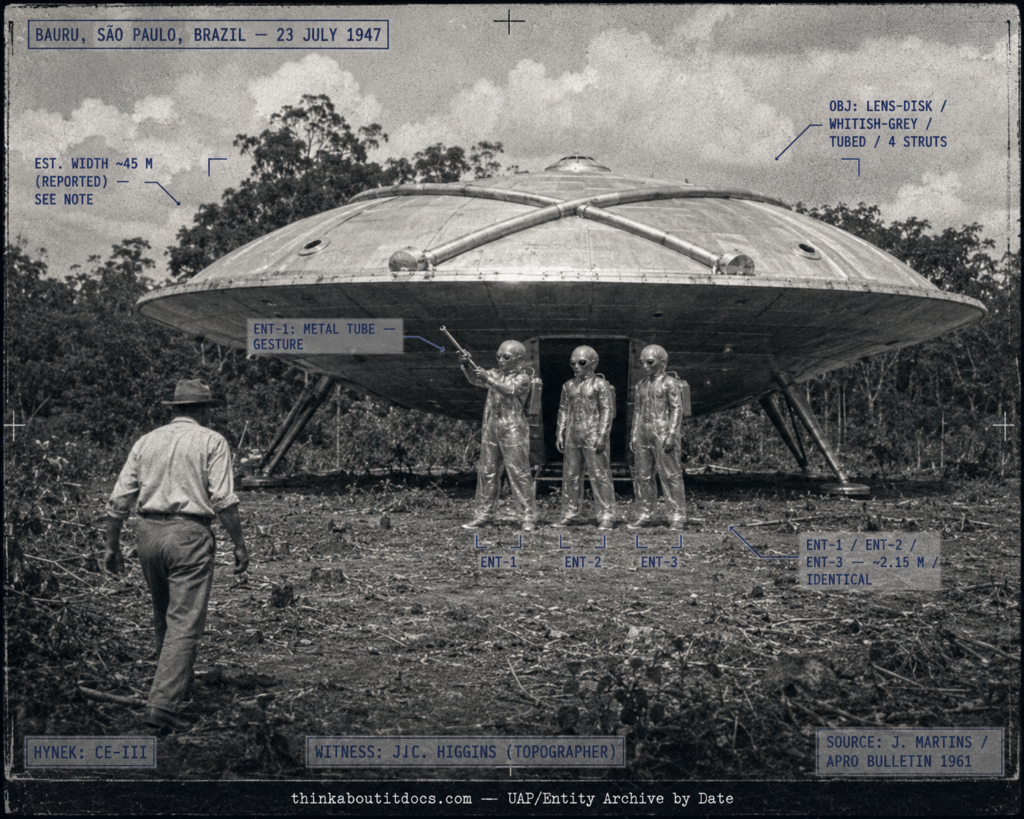
Topographer José C. Higgins meets three seven-foot beings beside a lens-shaped craft near Bauru, Brazil, July 23, 1947 — one of the earliest detailed CE-III encounters on record.
THINK ABOUTIT UFO|UAP | ENTITY ENCOUNTER REPORT
1947: 7 ft Aliens spotted in Brazil
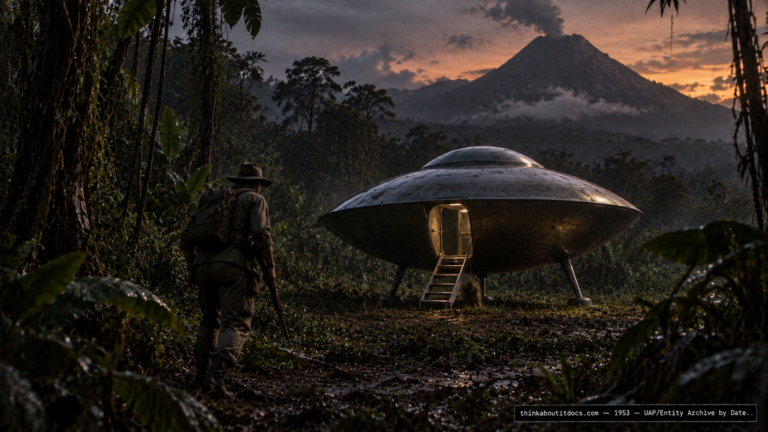
When the whistling started, Brazilian topographer José C. Higgins looked up to see a lens-shaped craft, gray-white and crossed with tubes, settle onto bent metallic legs about 150 feet away. Through a dark window two figures watched him; then a door opened beneath the rim and three nearly identical beings stepped out — close to seven feet tall, bald and bulky-headed, with large round eyes and long legs, sealed inside inflated transparent suits that bagged around them like clear plastic, metal boxes on their backs. One leveled a metal tube and motioned him toward the door. Higgins didn’t go. He showed them a photograph of his wife to explain he would not leave her, and — remarkably — they let him back away into the forest, where he watched them sketch a diagram of the solar system in the dirt, then play like children, leaping and hurling heavy stones, before re-entering the craft and lifting off. Recorded in July 1947, within weeks of Kenneth Arnold, it is one of the earliest fully detailed close encounters anywhere on Earth.
Date: July 23, 1947
Sighting Time: Unknown (daytime)
Day/Night: Day
Location: Near Bauru, state of São Paulo, Brazil
Urban or Rural: Rural
No. of Entity(‘s): 3 (plus 2 figures initially seen watching through a window)
Entity Type: Humanoid (tall humanoid)
Entity Description: Three near-identical beings, approximately 2.15 meters (about 7 ft) tall, with bald, bulky rounded heads, large round eyes, no eyebrows or facial hair, and proportionally long legs. Each was enveloped in an inflated, transparent suit resembling clear plastic, with a metal box on the back; beneath, garments resembling shirts and shorts that looked made of paper rather than cloth. Sex could not be determined; the witness perceived “a certain beauty” about them. They spoke an unknown language and tended to stay in shade.
Hynek Classification: CE-III (Close Encounter of the Third Kind) — close observation of animate beings associated with the object
Duration: Approximately 30 minutes (entities examined surroundings for about half an hour before departing)
No. of Object(s): 1
Description of the Object(s): A large lens-shaped (convex disk) craft with a surrounding rim/flange, gray-white metal, crossed by tubes running in several directions (the source of the whistling sound). Supported on metallic legs that flexed slightly. A dark glass window was visible, and a door opened beneath the rim. Reported dimensions: about 45 meters (≈150 ft) in diameter, roughly 15 ft high, with a 3-ft rim.
Shape of Object(s): Lens-shaped / disk
Size of Object(s): Approximately 45 meters (≈150 ft) in diameter; ~15 ft high; ~3-ft rim
Color of Object(s): Whitish-grey metal
Distance to Object(s): Landed approximately 150 ft from the witness
Height & Speed: Descended vertically with a whistling sound; landed; later took off after about half an hour. Speed not quantified.
Number of Witnesses: 1 (José C. Higgins)
Special Features/Characteristics: Whistling produced by tubes crossing the craft; flexing metallic landing legs; dark observation window; door beneath the rim; entities in inflated transparent suits with back-mounted boxes; a being directed the witness with a metal tube; communication by gesture and ground-drawing; a solar-system diagram drawn in the dirt (a central dot named “Alamo” for the sun, surrounded by 7 circles, with the seventh, “Orque,” indicated as their origin — interpreted as Uranus); entities later seen leaping and throwing large stones
Case Status: Unexplained
Source: João Martins, APRO Bulletin, May 1961
Summary/Description: Topographer José C. Higgins, hearing a whistling sound, watched a large gray-white lens-shaped craft descend on flexing metallic legs and land about 150 ft away near Bauru, São Paulo. Two figures were visible through a dark window; a door then opened and three near-identical beings about 7 ft tall emerged in inflated transparent suits with back-boxes. One directed him toward the craft with a metal tube. Through gestures Higgins asked their origin; one drew a sun (named “Alamo”) ringed by seven circles and indicated the seventh (“Orque,” taken as Uranus) and the craft. Higgins declined to enter, showing a photograph of his wife, and was allowed to withdraw to the forest, from which he observed the beings examining their surroundings for about half an hour — at one point leaping and throwing large stones — before re-entering and departing.
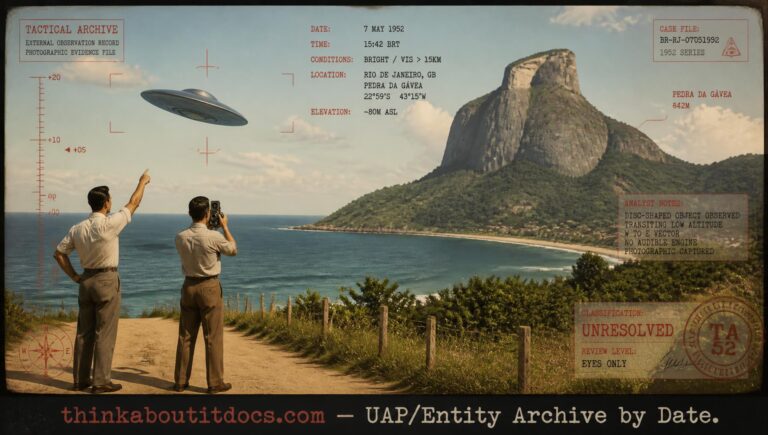
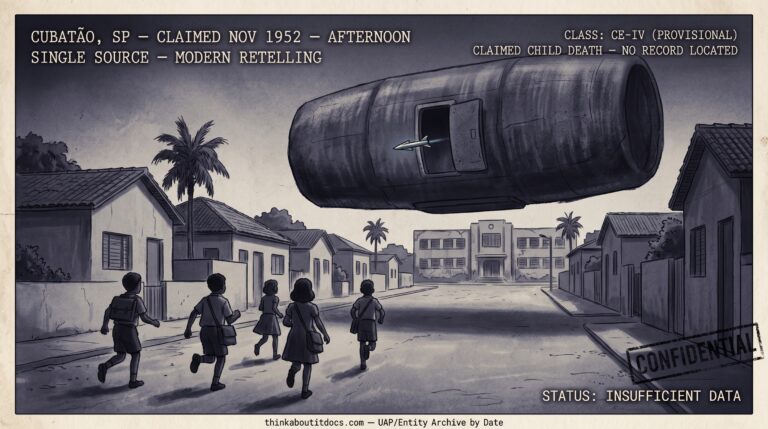
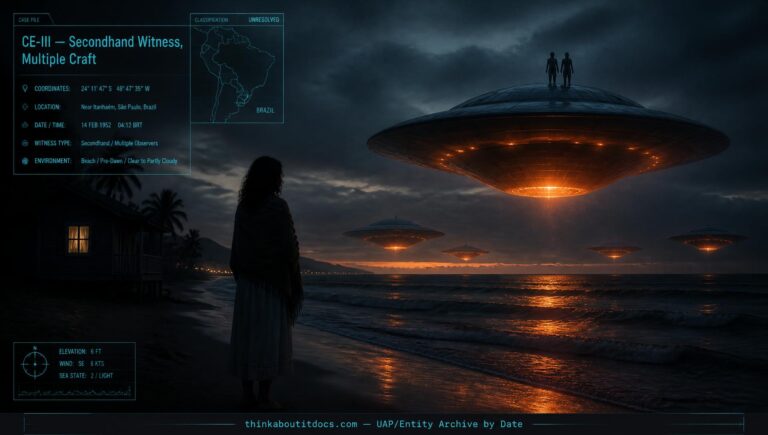
Related Cases: 1952 Contact in Angatuba Mountains, Paraná, Brazil | 1952 Cubatão, Brazil | 1952 Itanhaém Humanoid Sighting, Brazil
DETAILED REPORT
The Higgins encounter is among the earliest detailed close encounters of the modern era, dated July 23, 1947 — roughly a month after Kenneth Arnold’s sighting and at the leading edge of the global wave. The witness, José C. Higgins, was a topographer (some accounts place the event during survey work in the Bauru region of São Paulo state), which gives the case a witness with professional training in observation and measurement. The account reached the wider record through Brazilian journalist João Martins and was published in the APRO Bulletin in May 1961, later entering the standard close-encounter catalogs.
By the account, Higgins first heard a whistling sound and looked up to see a lens-shaped object with a surrounding flange descending. It landed about 150 feet away on flexing metallic legs. He described it as gray-white metal, roughly 150 feet in diameter and about 15 feet high with a 3-foot rim, its surface crossed in several directions by tubes from which the whistling emanated. Approaching, he saw two figures observing him through a black glass window. A door then opened beneath the rim, and three beings emerged. They were nearly seven feet tall and essentially identical to one another, with bald, bulky, rounded heads, large round eyes, no facial hair, and proportionally long legs. Each wore an inflated transparent suit that bagged around the body like clear plastic, with a metal box on the back and, beneath, garments resembling shirts and shorts that looked made of paper. They spoke an unfamiliar language and tended to keep to the shade.
The interaction that followed is what makes the case distinctive. One being pointed a metal tube at Higgins and gestured him toward the open door, through which he could see an inner door and the end of a pipe-like structure. Rather than comply, Higgins used gestures to ask where they had come from. One being drew a diagram on the ground: a central dot it called “Alamo” (the sun) ringed by seven circles, then pointed alternately to the seventh circle — named “Orque,” interpreted in the account as Uranus — and to the craft. Higgins, not wishing to be taken there, produced a photograph of his wife to indicate he did not want to leave her; the beings allowed him to withdraw. From the cover of the forest he watched them for about half an hour as they examined their surroundings and, at one point, behaved with startling levity — leaping into the air and throwing large stones, described as “playing like children.” They then re-entered the craft, and it took off.
As an evidentiary matter, the case is single-witness and reached publication fourteen years after the event, which are real limitations. There is no physical trace evidence on record and no contemporaneous 1947 documentation in the account as held; the chain runs through Martins and APRO in 1961. Against that, the witness was a professional observer, the testimony is highly specific and internally consistent, and the case has been retained across the major catalogs (APRO, Vallée’s compilations, HUMCAT) as a recognized early CE-III rather than a dismissed anecdote. The “Orque/Uranus” origin claim and the named alien words are the sort of contactee-adjacent detail that warrants caution, but they are presented here as reported content, not as established fact.
RESEARCHER’S NOTES
The Topographer’s Refusal — Bauru 1947 and the First Detailed CE-III of the Modern Wave
- Classification Assessment: CE-III is correct and secure. The case features extended close-range observation of animate beings in direct association with a landed structured craft, with interaction (the metal-tube gesture, the ground-drawing exchange) but no abduction and no claimed physiological effect, which keeps it within the third kind rather than CE-IV. The attempt to direct Higgins into the craft is notable as an early instance of the abduction-adjacent motif, but because he declined and was released, the encounter does not cross into CE-IV. The duplicated “CE-III … I (Close Encounter III)” string in the live template is a typo and should be cleaned to a single CE-III.
- Source Chain Assessment: The provenance is solid by the standards of an entity case but not contemporaneous. The account is anchored to a named, credentialed journalist (João Martins) and a recognized organizational publication (APRO Bulletin, May 1961), placing it in the documented secondary tier of our hierarchy. The fourteen-year gap between event (1947) and publication (1961) is the principal weakness, and there is no 1947 primary record in the account as held. The witness being a named professional (topographer José C. Higgins) strengthens credibility relative to the typical anonymous report. Locating any earlier Brazilian press coverage from 1947 would materially upgrade the chain.
- Pattern Context and Comparative Cases: The Higgins case is foundational to the South American — and specifically Brazilian — entity record, predating the dense 1952 Brazilian cluster (Angatuba, Cubatão, Itanhaém) by five years. Several of its elements recur throughout the later CE-III/CE-IV corpus: the directing of a witness toward a craft, communication by gesture and ground-drawing, the “cosmological diagram” motif (a star ringed by planetary orbits, with the home world indicated), and the inflated/transparent protective suits with back-mounted apparatus. The childlike stone-throwing play is an unusual, non-stereotyped detail that arguably cuts against pure fabrication. The “Orque = Uranus” origin claim is the most contactee-flavored element and should be weighed as the kind of specific-origin assertion that later became a hallmark of less reliable contactee literature.
- Physical Evidence and Evidentiary Weight: There is no physical or trace evidence on record — no photographs, no soil or landing-mark documentation, no second witness. The case rests entirely on Higgins’s detailed testimony. Its evidentiary strength is qualitative: the specificity of the craft description (lens shape, tubes producing the whistling, flexing legs, rim and window), the internal consistency of the entity description across the suits, boxes, and proportions, and the professional background of the witness. These do not amount to proof, but they place the case well above the anonymous single-paragraph reports of the period. On balance the phenomenon is not reducible to a conventional explanation from the record as held, which — combined with its standing in the major catalogs — supports an Unexplained status rather than Insufficient Data.
The Bauru encounter is a cornerstone of the early entity record: a richly detailed, professionally witnessed close encounter logged within weeks of the event that launched the modern era, and preserved across the field’s principal catalogs. It is not without weaknesses — a single witness, a fourteen-year gap to publication, no physical evidence, and an origin claim (“Orque/Uranus”) that carries a contactee flavor demanding caution. But the specificity, internal consistency, and the credibility of a topographer-witness lift it above the anecdotal, and nothing in the record reduces it to a conventional cause. The archive’s position is Unexplained — one of the earliest and most fully described CE-III cases on record, retained with confidence while the contactee-adjacent details are held at arm’s length as reported content rather than fact.