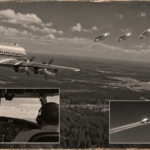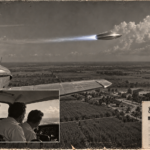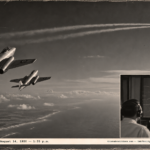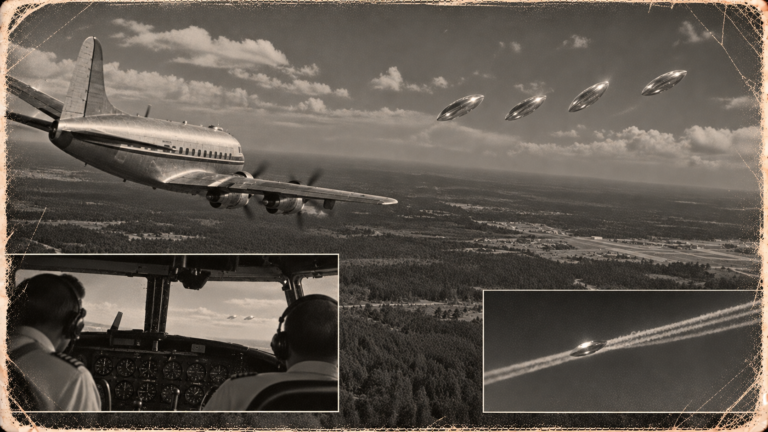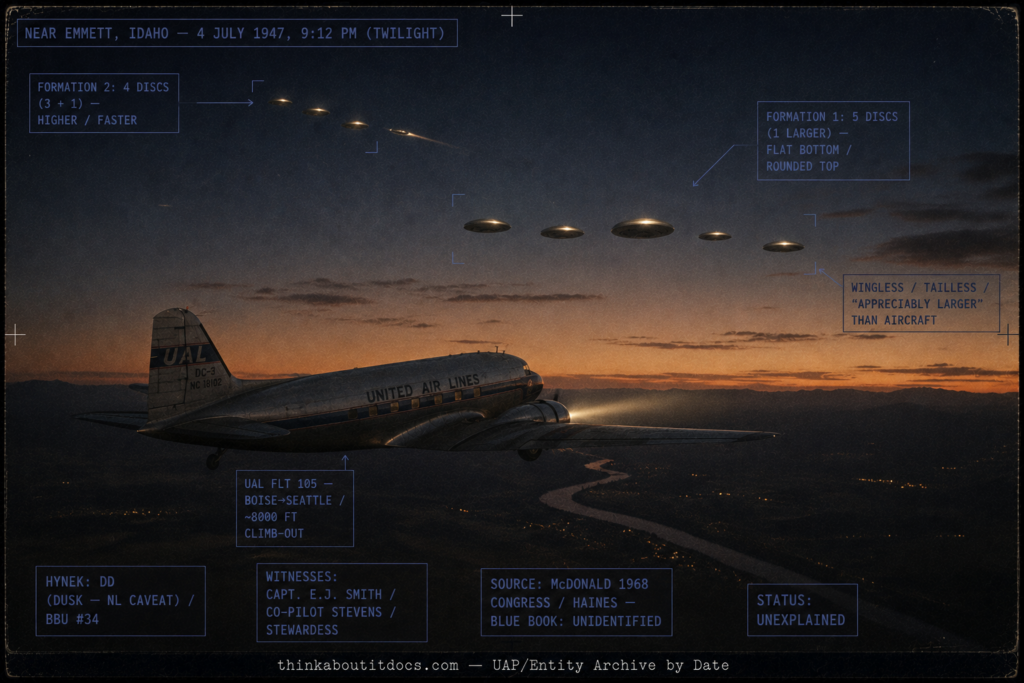
Nine wingless discs in two formations pace a United DC-3 over Idaho at dusk, July 4, 1947 — a multiple-witness aircrew case Blue Book listed as Unidentified.
THINK ABOUTIT UFO | UAP SIGHTING REPORT
1947: United Airlines Flight 105 pilots witness disc-shaped objects
“I’ll believe in those discs when I see them.” Captain Emil J. Smith said it as a joke, walking up the ramp at Boise on the evening of July 4, 1947, after someone mentioned the saucers that had been reported across the Northwest all day. Eight minutes after takeoff, climbing out over Emmett, Idaho in the last of the twilight, he had to eat the words. His co-pilot flipped on the landing lights, thinking the shapes ahead were aircraft — but against the dusk sky there were no wings and no tails on the five objects pacing them, one larger than the rest. They called a stewardess in for a third set of eyes, radioed the ground, and watched the formation spurt away to the west. Then a second group of four slid in ahead, higher and faster, and vanished the same way. Nine wingless craft in ten to twelve minutes, witnessed by a crew whose business was knowing what belongs in the sky. The Air Force would file it, simply, as Unidentified.
Date: July 4, 1947 (Blue Book Unidentified #34)
Sighting Time: 9:12 p.m. (departed Boise 9:04 p.m.; sighting ~8 minutes out)
Day/Night: Night (twilight/dusk)
Location: Over Emmett, Idaho (departed Boise, Idaho; en route to Seattle), observed from a United Air Lines DC-3 in flight
Urban or Rural: In the air (over rural Idaho)
No. of Entity(‘s): None reported
Entity Type: Not applicable — no occupants or entities observed
Entity Description: Not applicable
Hynek Classification: DD (Daylight Disc) per the live page, with a nocturnal caveat — the sighting occurred at dusk (9:12 p.m.), so it sits on the DD/NL boundary; structured objects observed against a twilight sky. Best logged as DD (dusk) with NL noted.
Duration: 10–12 minutes (total, across both formations)
No. of Object(s): 9 total — two successive formations of wingless discs (first formation of 5, one larger than the rest; second formation of 4, three in line and one off to the side)
Description of the Object(s): Wingless, tailless disc-shaped objects, “flat on the bottom, rounded on top,” with a perceptible but indefinable “roughness” on the upper surface. They held formation, then spurted ahead and disappeared westward at high speed. The second formation traveled at a somewhat higher altitude than the DC-3’s ~8,000 ft.
Shape of Object(s): Disc — flat-bottomed, rounded on top
Size of Object(s): Uncertain, but the crew’s general impression was that the objects were appreciably larger than ordinary aircraft
Color of Object(s): Not definitively stated (observed in silhouette/glint against twilight sky)
Distance to Object(s): Not precisely determined; ahead of and above the aircraft, close enough to be certain they were not conventional aircraft
Height & Speed: First formation near the DC-3’s altitude (~8,000 ft); second formation higher; departure speeds felt to be far beyond then-known aircraft speeds
Number of Witnesses: 3 — Capt. Emil J. Smith, co-pilot Ralph Stevens, and a stewardess (called in for confirmation); ground contact attempted with Ontario, Oregon CAA
Special Features/Characteristics: Two separate formations in succession; wingless and tailless; perceptible upper-surface “roughness”; landing lights initially switched on under the assumption they were aircraft; ground-confirmation attempted; high-speed departure; clear weather with no cloud phenomena; experienced aircrew witnesses; officially listed by the Air Force as Unidentified
Case Status: Unexplained
Source: Dr. James E. McDonald, statement to the U.S. House Committee on Science and Astronautics, Symposium on Unidentified Flying Objects, 1968 (based on McDonald’s direct interview with Capt. Smith); corroborating note from Dr. Richard Haines; photo credit Project 1947 / Jan Aldrich. Officially listed as a Project Blue Book Unidentified (BBU #34).
Summary/Description: On the evening of July 4, 1947, United Air Lines Flight 105, a DC-3 captained by Emil J. Smith with co-pilot Ralph Stevens, departed Boise at 9:04 p.m. for Seattle. About eight minutes out, over Emmett, Idaho, Stevens spotted five wingless disc-shaped objects ahead and initially switched on the landing lights, taking them for aircraft; against the twilight sky the crew saw the objects had neither wings nor tails. They summoned a stewardess as a third witness and radioed the Ontario, Oregon CAA for ground confirmation before the formation sped away westward. A second formation of four then moved in ahead at higher altitude and departed the same way. The total observation lasted 10–12 minutes in clear weather. Smith, who had publicly doubted the “flying saucer” reports days earlier, became a serious witness; the Air Force listed the case as Unidentified.
Related Cases: 1947 Kenneth Arnold sighting (~9 days prior; Smith later befriended Arnold) |1947 Maury Island incident (Smith was an informant/figure in the Tacoma meetings) | 1947 Disc Zooms Down Snake River Canyon, Idaho |; broader July 1947 nationwide disc wave (this case was the most-credited of ~85 reports published July 4, 1947)
DETAILED REPORT
This is among the strongest civilian aircrew sightings of the 1947 wave, and its strength lies in the quality of its witnesses and the discipline of the observation. United Air Lines Flight 105, a DC-3 bound from Boise to Seattle, lifted off at 9:04 p.m. on July 4, 1947. About eight minutes later, climbing out over Emmett, Idaho at roughly 8,000 feet in clear twilight, co-pilot Ralph Stevens caught sight of the first of two groups of objects ahead of the aircraft. His initial reaction was the trained one: assuming they were other aircraft, he switched on the DC-3’s landing lights. But as he and Captain Emil J. Smith studied the five objects against the fading sky, they realized none of them showed wings or tails.
The crew’s response was methodical rather than excitable. Recognizing the significance of what they were seeing, they called a stewardess forward to serve as an independent third witness, then radioed the Civil Aeronautics Administration station at Ontario, Oregon in an attempt to obtain ground confirmation. They watched the formation — five objects, one notably larger than the others — hold position ahead of them before it spurted forward and disappeared to the west at high speed. Almost immediately a second formation appeared: four objects, three in line with a fourth off to the side, traveling westward at a somewhat higher altitude than the airliner. These too passed quickly out of sight to the west at speeds the crew judged far beyond any then-known aircraft. Smith described the objects as “flat on the bottom, rounded on top,” with a perceptible but indefinable “roughness” on their upper surfaces, and stressed that while he could not be certain of their exact size or distance, his general impression was that they were appreciably larger than ordinary aircraft.
The case’s documentary backbone is Dr. James E. McDonald’s 1968 statement to the U.S. House Committee on Science and Astronautics, which drew on McDonald’s own interview with Smith. McDonald’s analysis is careful and worth preserving in its reasoning: the sighting occurred in clear weather with no cloud phenomena to confuse the observers; it spanned an unusually long 10–12 minutes; it was a multiple-witness event including two experienced aviators familiar with airborne devices; and it was made across a 1,000-foot altitude range during climb-out, with the objects seen well above the horizon — a geometry that, McDonald argued, entirely rules out optical or mirage phenomena. Dr. Richard Haines added that Smith was certain the objects were not reflections, smoke, fireworks, or airplanes. McDonald also noted the case’s historic standing: of roughly eighty-five UFO reports published in the press on July 4, 1947, this one was given far more credence than any other, precisely because of the witnesses’ caliber. United Airlines personnel who had known Smith for years vouched for his complete reliability, and Smith himself — notably — declined to speculate on what the objects actually were, having days earlier publicly dismissed the very “flying saucer” reports he now joined.
The honest limitations are modest. There is no photograph, no radar trace reproduced, and no recovered ground-confirmation log on the page; sizes and distances were explicitly uncertain by the crew’s own admission. But the case carries what most 1947 reports lack: multiple trained witnesses, a long duration, clear conditions, a contemporaneous attempt at ground verification, a credentialed scientific investigator’s direct interview, and — decisively — an official Air Force classification of Unidentified.
RESEARCHER’S NOTES
The Captain Who Ate His Words — Flight 105 over Idaho, 1947, and the Aircrew Case Blue Book Could Not Close
- Classification Assessment: The live page’s DD is defensible but needs a caveat. The sighting occurred at 9:12 p.m. in twilight, not daylight, placing it on the DD/NL boundary; the objects were structured discs perceived by shape against a dusk sky rather than as pure points of light, which leans DD, but the time of day warrants logging it as “DD (dusk), NL noted.” The Blue Book designation BBU #34 should be retained on the page. No Close Encounter category applies — there were no occupants, no close approach with physical effects, and no landing.
- Source Chain Assessment (Strong): This is a high-tier source chain. The primary documentation is Dr. James McDonald’s 1968 statement to a Congressional committee, based on his own interview with the named captain — a credentialed atmospheric physicist presenting to the U.S. House. It is corroborated by Dr. Richard Haines (a NASA-affiliated scientist who specialized in pilot sightings) and anchored by the case’s official Project Blue Book “Unidentified” listing. The witnesses are named, experienced, and independently vouched for. Photo provenance is credited to Jan Aldrich’s Project 1947, a respected archival effort. Under the archive hierarchy this sits firmly in the Primary/strong band — among the best-sourced entries of the 1947 run.
- Pattern Context: The case is woven into the central fabric of the 1947 wave and its key personalities. It occurred roughly nine days after Kenneth Arnold’s Mount Rainier sighting, and Capt. Smith subsequently befriended Arnold and became a figure in the Maury Island affair’s Tacoma meetings — making him a connective node across the three foundational Pacific Northwest cases of the summer. The two-formation, nine-object profile echoes the formation reports that dominated the wave (Arnold’s nine; the Utah B-17 nine). The “flat on bottom, rounded on top” morphology and the high-speed westward departure are consistent across numerous credible 1947 disc reports. Smith’s documented prior skepticism is an important credibility marker: this was not a primed believer but a working pilot who had openly mocked the reports the day he joined them.
- Physical Evidence and Evidentiary Weight: There is no physical evidence — no photograph of the objects, no preserved radar or CAA ground-confirmation record on the page. The weight rests entirely on multiple-witness testimony of high quality, captured by a rigorous scientific interviewer and ratified by an official Unidentified classification. McDonald’s geometric argument against optical explanations (long duration, climb-out altitude range, objects above the horizon, clear sky) is sound and materially strengthens the case against mundane atmospheric causes. Combined with the Blue Book verdict, the evidentiary weight supports an Unexplained status without strain. The case’s ceiling is set only by the absence of instrumented or photographic corroboration, not by any weakness in the testimony.
Flight 105 is the aircrew case the 1947 wave is lucky to have: a long, clear-weather, multiple-witness observation by experienced aviators who behaved like investigators in real time — flipping on lights, summoning a third witness, calling the ground — and a captain who had publicly scoffed at saucers that very week before nine wingless craft changed his mind. Documented through a credentialed scientist’s Congressional testimony, corroborated by a second researcher, and officially carried by the Air Force as Unidentified, it asks little of the reader’s credulity and withstands the obvious prosaic explanations. The archive keeps the DD classification with a dusk/NL caveat, retains the BBU #34 designation, affirms the strong McDonald/Haines/Blue Book sourcing, and assigns Case Status: Unexplained. It stands as one of the best-attested civilian aircrew sightings of the wave and a connective thread linking Smith to Arnold and Maury Island across the summer that began the modern era.
Full Report

Co-pilot Ralph Stevens, Kenneth Arnold, and Capt. Emil. J. Smith
(Credit: Project 1947, Jan Aldrich)
From Dr. James McDonald’s statement to the U.S. House of Representatives, Committee on Science and Astronautics, Symposium on Unidentified Flying Objects, 1968:
Only about a week after the now-famous Mt. Rainier sighting by private pilot Kenneth Arnold, a United Air Lines DC-3 crew sighted two separate formations of wingless discs, shortly after takeoff from Boise. The pilot, Capt. Emil J. Smith, now with United’s New York office. He confirmed the reliability of previously published accounts. United Flight 105 had left Boise at 9:04 p.m. About eight minutes out, en route to Seattle, roughly over Emmett, Idaho, Co-pilot Stevens, who spotted the first of two groups of objects, turned on his landing lights under the initial impression the objects were aircraft. But, studying them against the twilight sky, Smith and Stevens soon realized that neither wings nor tails were visible on the five objects ahead. After calling a stewardess, in order to get a third confirming witness, they watched the formation a bit longer, called Ontario, Oregon CAA to try to get ground-confirmation, and then saw the formation spurt ahead and disappear at high speed off to the west.
Smith emphasized to me that there were no cloud phenomena to confuse them here and that they observed these objects long enough to be quite certain that they were no conventional aircraft. They appeared “flat on the bottom, rounded on top”, he told me, and he added that there seemed to be perceptible “roughness” of some sort on top, though he could not refine that description. Almost immediately after they lost sight of the first five, a second formation of four (three in line and a fourth off to the side) moved in ahead of their position, again traveling westward but at a somewhat higher altitude than the DC-3’s 8000 ft.
These passed quickly out of sight to the west at speeds which they felt were far beyond then-known speeds. Smith emphasized that they were never certain of sizes and distances, but that they had the general impression that these disc-like craft were appreciably larger than ordinary aircraft. Smith emphasized that he had not taken seriously the previous week’s news accounts that coined the since-persistent term, “flying saucer.” But, after seeing this total of nine unconventional, high-speed wingless craft on the evening of 7/4/47, he became much more interested in the matter. Nevertheless, in talking with me, he stressed that he would not speculate on their real nature or origin. I have spoken with United Airlines personnel who have known Smith for years and vouch for his complete reliability.
Discussion. — The 7/4/47 United Airlines sighting is of historic interest because it was obviously given much more credence than any of the other 85 UFO reports published in press accounts on July 4, 1947. By no means the most impressive UFO sighting by an airliner crew, nevertheless, it is a significant one. It occurred in clear weather, spanned a total time estimated at 10-12 minutes, was a multiple-witness case including two experienced observers familiar with airborne devices, and was made over a 1000-ft. altitude range (climb-out) that, taken together with the fact that the nine objects were seen well above the horizon, entirely rules out optical phenomena as a ready explanation. It is officially listed as a Unidentified.
————————
From Dr. Richard Haines:
“Captain Smith stated that he knew what they saw were not reflections, smoke, fireworks, nor airplanes.”