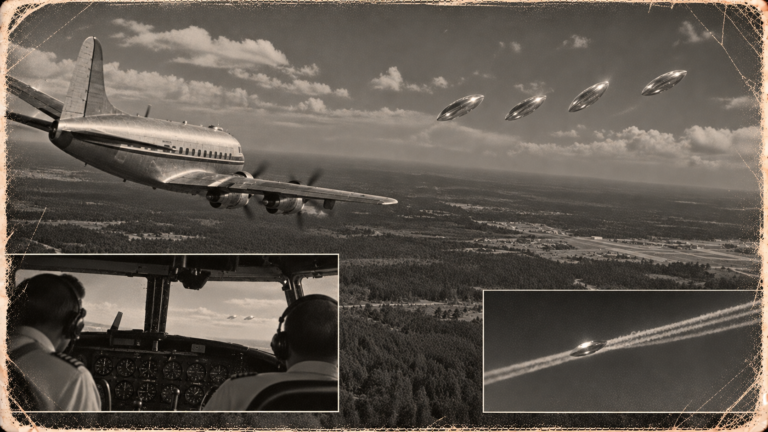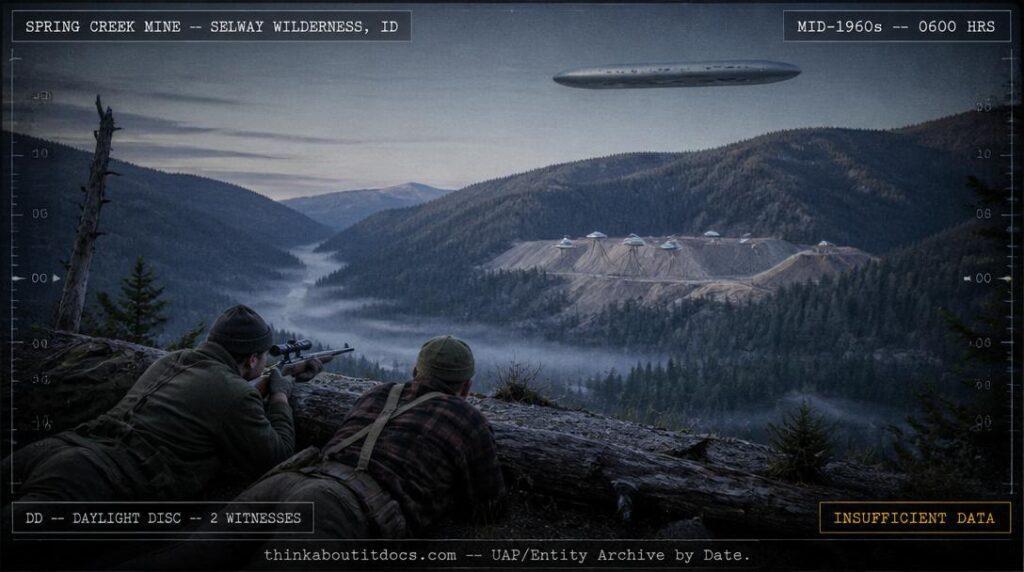
: Reconstruction — Buzz Montague and William Andrews observe four silvery discs probing slag piles at the Spring Creek Mine while a cigar-shaped mothership waits above, Selway Wilderness, Idaho, mid-1960s.
THINK ABOUTIT UFO|UAP SIGHTINGS REPORT
1965: Idaho ‘Mining UFOs’
In the remote Selway Wilderness of central Idaho, hunter Buzz Montague reported observing four silvery disc-shaped objects hovering over the ore dump of the Spring Creek Mine, each extending “hose-like devices” into the slag piles below. Above them, at approximately 1,000 feet, a larger cigar-shaped craft waited with four depressions on its underside. The discs rose one by one, docked with the mothership by fitting into those depressions, then detached and returned to the slag — repeating the cycle four times over a period Montague estimated at forty-five minutes to an hour. Observed through 10-power rifle scopes from across a valley, it was one of the most structurally detailed resource-extraction narratives in the mid-century UFO literature.
The date of this encounter is imprecise. Montague could not pinpoint the year or exact date of his initial solo sighting (“early 1960s”) nor the later two-witness observation with companion William Andrews (“fall of the middle 1960s”). The page title’s “1965” date is an approximation. The case was reported to APRO co-founder Coral Lorenzen by letter in 1967, but field investigation was delayed until approximately 1971 when APRO Staff Librarian Allen Benz relocated to Twin Falls, Idaho. The second witness, William Andrews, was never located.
Date: Mid-1960s (approximately 1964–1966; exact year and date unknown)
Sighting Time: Early morning (approximately 6:00 AM)
Day/Night: Day
Location: Spring Creek Mine, near Spring Creek Ridge, Selway Wilderness, Idaho
Urban or Rural: Remote wilderness — accessible only by trail
No. of Entity(‘s): 0 (no beings observed; transparent domes on discs noted but no figures described within)
Entity Type: Not Applicable
Entity Description: Not Applicable — transparent domes atop the disc-shaped objects were noted but no occupants described
Hynek Classification: DD (Daylight Disc) — Multiple metallic objects observed in daylight at extended range through optical magnification
Duration: Approximately 45 minutes to one hour
No. of Object(s): 5 — four small disc-shaped objects and one large cigar-shaped craft
Description of the Object(s): Four disc-shaped objects, silvery in color, each with a transparent dome on top. Four “hose-like devices” protruded from the top of each disc and were inserted into the mine’s slag piles, moving around as if probing or extracting material. One larger cigar-shaped craft hovered at approximately 1,000 feet altitude above the terrain, silvery in color with visible windows or ports. The underside of the cigar had four depressions into which the smaller discs fitted when docking — once seated, the depressions were no longer visible, creating a flush surface.
Shape of Object(s): Disc-shaped (4 smaller objects); cigar-shaped / elongated (1 larger craft)
Size of Object(s): Not precisely estimated; large enough for structural detail (domes, hoses, windows) to be resolved through 10-power rifle scopes at valley-crossing distance
Color of Object(s): Silvery (all craft)
Distance to Object(s): Across a valley from the witnesses’ bluff — exact distance not recorded but implied to be several hundred yards to a mile (observable detail through 10-power scopes)
Height & Speed: Discs hovered at slag-pile level (near ground) during probing operations, then elevated to approximately 1,000 feet to dock with the cigar-shaped craft. Mothership departed slowly toward the northwest while ascending. Individual disc transit between slag pile and mothership was rapid enough to be notable but not precisely timed.
Number of Witnesses: 2 — Buzz Montague and William Andrews (for the later sighting described in detail). Montague alone for the earlier sighting.
Special Features/Characteristics: Apparent resource collection or probing of mine slag piles using mechanical appendages. Disc-to-mothership docking system with flush-fitting depressions. Multiple docking/undocking cycles (4 round trips). Extended operational activity observed through magnified optics. Transparent domes on smaller craft.
Source: APRO Bulletin, Vol. 22, No. 2 (September/October 1973); field investigation by Allen Benz (APRO Staff Librarian, Twin Falls, Idaho); artist rendering by Brian James (APRO staff artist) based on correspondence with the witness
Summary: Two hunters camped on a bluff overlooking the Spring Creek Mine in Idaho’s Selway Wilderness observed four silvery discs with transparent domes hovering over the ore dump, extending hose-like devices into the slag piles. Above, a cigar-shaped mothership with four underside depressions waited at 1,000 feet. The discs cycled between the slag pile and the mothership four times over approximately 45 minutes before the entire formation departed to the northwest.
Case Status: Insufficient Data
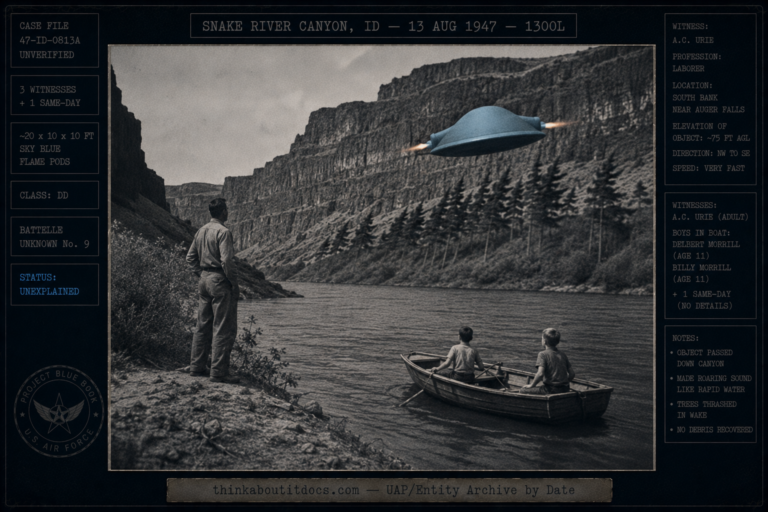
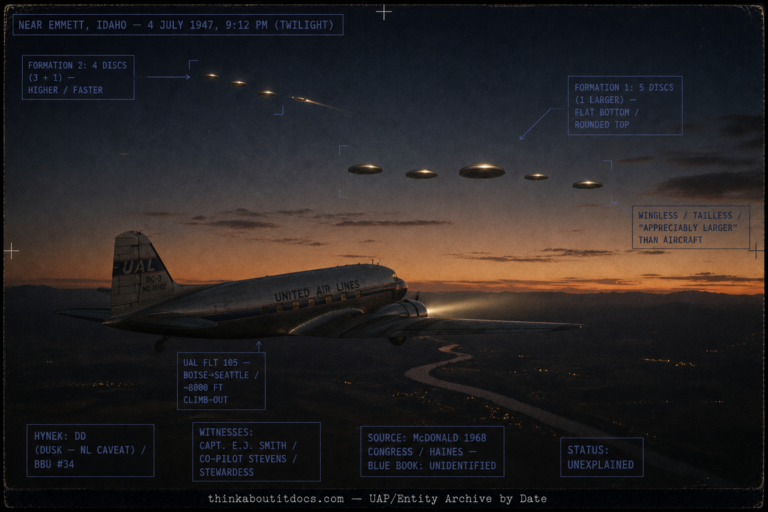
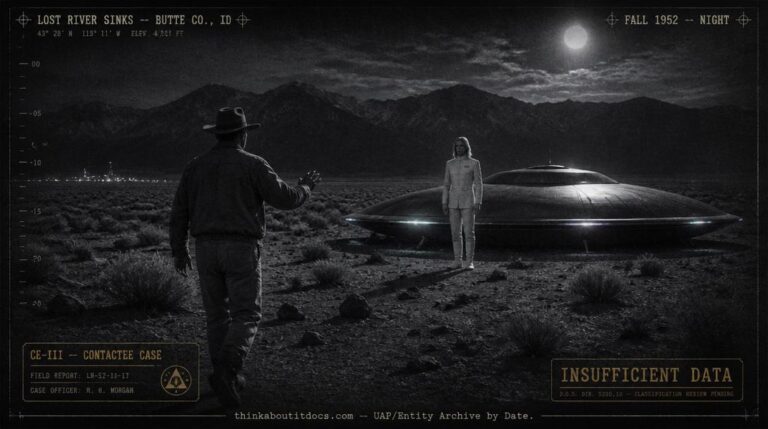
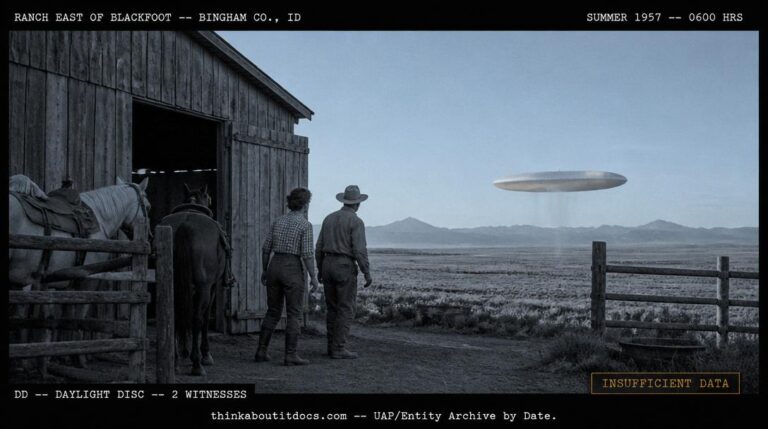
Related Cases: 1952: Lost River Sinks, Idaho | 1957: Blackfoot, Idaho Sighting | 1960–1969 UFO/Entity Sightings by Date
Detailed Report
The Spring Creek Mine is located near Spring Creek Ridge in what is now the Selway-Bitterroot Wilderness in central Idaho — one of the most remote and inaccessible areas in the contiguous United States. The Selway Wilderness (the original APRO article misspells it as “Sellway”) comprises over a million acres of rugged, roadless terrain in the Bitterroot Range. Access is by trail only, and the area has a long history of small-scale mining operations, including the Spring Creek mines.
Buzz Montague was a hunter who frequented the Spring Creek Mine area over a period of years. According to the account published in the APRO Bulletin, Vol. 22, No. 2 (September/October 1973), Montague first observed anomalous objects near the mine in the early 1960s — he could not pinpoint the year or exact date. His last and most detailed sighting occurred in the fall of the mid-1960s, in the company of his hunting companion William Andrews.
On the morning of the primary sighting, Montague and Andrews were camped on a bluff overlooking a valley, with the Spring Creek Mine and its ore dump visible across the valley. Awakening around 6:00 AM, they noticed a shiny spot on the ore dump. Using the 10-power telescopic sights on their rifles, they resolved the “shiny spot” into four separate disc-shaped objects hovering over the dump. Each disc was silvery in color and had a transparent dome on top. Protruding from the top of each disc were four hose-like appendages, which were inserted into the slag piles and appeared to be moving around — as if probing, sampling, or extracting material.
After a period of activity at the slag pile, the discs elevated one by one and ascended to approximately 1,000 feet, where the witnesses could now see a larger cigar-shaped craft hovering. This mothership was also silvery and had visible windows or ports along its hull. Its underside featured four depressions. As each disc reached the mothership, it fitted itself into one of these depressions — at which point the depression disappeared, creating a completely flush surface with no visible seam. After docking, the discs then detached and returned to the slag heap for another cycle. This sequence was repeated four times over a period the two men estimated at approximately forty-five minutes to one hour. Neither witness noted the exact time, being entirely absorbed in the observation.
After the fourth cycle, the discs remained docked and the cigar-shaped craft, now carrying all four, moved slowly to the northwest while ascending, eventually disappearing from view.
Montague wrote to Coral Lorenzen (APRO’s Secretary-Treasurer and co-founder) in 1967 after reading one of the Lorenzens’ books. APRO could not investigate immediately due to the absence of a field investigator in the area. When Allen Benz, APRO’s Staff Librarian, relocated to Twin Falls, Idaho — approximately eighteen months before the 1973 publication — he undertook the field investigation, contacting Montague and visiting the sighting location. APRO staff artist Brian James produced an artistic rendering of the scene based on detailed correspondence with Montague, with Montague approving every detail.
William Andrews, the second witness, could not be located — Montague himself did not know Andrews’ current whereabouts at the time of the investigation.
Researcher’s Notes
The Spring Creek Mining Operation — Selway Wilderness 1960s and the Limits of an Unreachable Witness
- Source Chain: This case has a legitimate organizational source chain: Buzz Montague → Coral Lorenzen (1967 letter) → Allen Benz field investigation (c. 1971–72) → APRO Bulletin publication (September/October 1973) → Brian James artist rendering. APRO (Aerial Phenomena Research Organization) was one of the two major civilian UFO research organizations of the era (alongside NICAP) and its Bulletin was a peer-level publication in the field. The account is reproduced on UFOEvidence.org and on thinkaboutitdocs.com from the original Bulletin text. The investigation included a site visit by Benz, which lends geographic credibility — the Spring Creek Mine and its slag dump are real features in the Selway Wilderness.
- Date Imprecision and Missing Witness: The most significant weakness is the inability to establish a firm date. Montague could not pinpoint the year or date of either sighting — “early 1960s” for the first, “fall of the middle 1960s” for the second. The page title’s “1965” is an editorial approximation. Without a date, the case cannot be cross-referenced against weather records, military flight schedules, or other reported sightings. The second witness, William Andrews, was never contacted by investigators — Montague had lost track of him. The case therefore rests entirely on Montague’s testimony, despite being nominally a two-witness event.
- The Resource-Extraction Narrative: The APRO Bulletin itself notes the natural inference that the objects were engaged in “mining operations” but cautions that the probing targets were slag piles — material from which commercially valuable ore had already been extracted. The Bulletin speculates that if the objects were conducting research, they may have been analyzing what had been removed rather than collecting raw material. This is an analytically honest observation that resists the temptation to over-interpret. The described mechanical behavior — hose-like appendages inserted into material, cyclic docking with a carrier craft, repeated operational runs — is unusually specific and mechanistic for a UFO report, either reflecting genuine observation of structured activity or an unusually detailed fabrication.
- Classification and Comparable Cases: DD is correct — the objects were observed in daylight through magnified optics. The transparent domes on the discs are noted but no occupants were described, so CE-III does not apply. The disc-to-mothership docking system described here has loose parallels in other multi-object cases where smaller craft appear to merge with or enter larger ones, but the flush-fitting depression mechanism is an unusual specific detail. The remote wilderness location, the hunting context, and the rifle-scope observation method are internally consistent and suggest the kind of incidental encounter that occurs when witnesses happen to be in the right place with the right equipment.

The Spring Creek Ridgecase is a frustrating near-miss in the evidentiary record: a detailed, structurally specific multi-object observation reported through a legitimate research organization with field investigation and a site visit — but undermined by an imprecise date, a single reachable witness, and a second witness who was never located.
The archive retains it as Insufficient Data rather than Unexplained, recognizing both the quality of the observational detail and the absence of the corroboration that would elevate it.