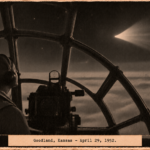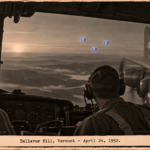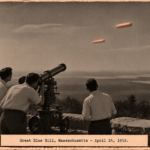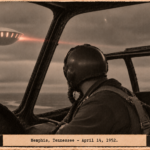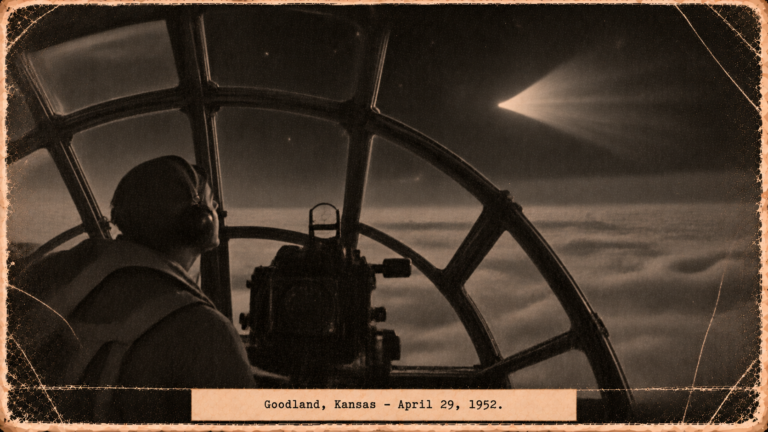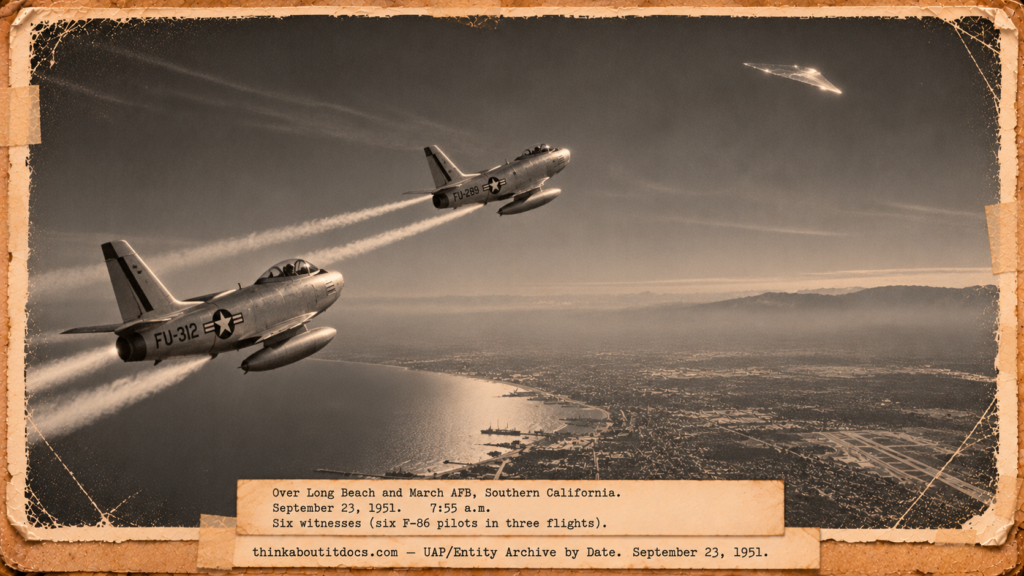
Southern California, September 23, 1951: F-86 pilots from George AFB chase a silver object they cannot reach.
THINK ABOUTIT UFO|UAP SIGHTINGS REPORT
1951: Six F-86 Jets Chase a Silver Object Over Long Beach and March AFB, California
On the morning of September 23, 1951, two F-86 Sabre jets scrambled from George AFB, California, and climbed toward a bright, silver object circling high above Long Beach. The pilots said it looked like a swept-wing aircraft, and as they struggled to reach it, it turned and passed over them. They ran short of fuel and broke off. A second flight of four F-86s took off to relieve them, split into two pairs, and found what looked like the same object over March AFB, holding a controlled orbit at about 50,000 to 55,000 feet. One pair climbed to 43,000 feet and stayed ten to fifteen minutes; the other trailed it through wide turns up to about 47,000 feet.
The March AFB UFO intercept involved six pilots, three failed attempts to close, and no help from radar, which never saw the object. The Air Force worked out that a radiosonde balloon released from Long Beach airport at 7:00 a.m. had been in the right place and rated the case a balloon. Its own report, however, said that one of the three intercepts “cannot be explained.”
Date: September 23, 1951
Sighting Time: 7:55 a.m. PDST (first sighting) through about 9:25 a.m.
Day/Night: Day
Location: Over Long Beach, California, then over the March AFB area, Southern California; pilots from George AFB
Urban or Rural: Urban to rural (coastal Los Angeles basin to the inland valley)
No. of Entity(‘s): Not Applicable
Entity Type: Not Applicable
Entity Description: Not Applicable
Hynek Classification: Daylight Disc (DD); a bright silver object seen at very high altitude, described variously as swept-wing and round
Duration: About 90 minutes across three intercept attempts
No. of Object(s): 1
Description of the Object(s): A bright silver object holding a left or right orbit at very high altitude. The first flight thought it was a swept-wing aircraft with about 45 degrees of wing sweep; the second thought it appeared to be a swept-wing aircraft; the third element said it looked round and silver. It was never seen on radar or from the ground.
Shape/Size/Color of Object(s): Swept-wing aircraft shape per two flights, round per the third; bright silver
Distance to Object(s): Not estimated; the F-86s could not climb to its altitude
Height & Speed: Estimated 50,000 to 55,000 feet; F-86s reached about 43,000 to 47,000 feet; the object held an orbit and moved off whenever pursued
Number of Witnesses: 6 (F-86 pilots in three flights from George AFB; names redacted in the file)
Special Features/Characteristics: Not detected by ground radar; not reported from the ground; the pilots carried external fuel tanks that limited their climb; a radiosonde balloon was released nearby at 7:00 a.m.
Case Status: Explained per Project Blue Book (record card: “Was Balloon”), though the Air Force special report says the third intercept “cannot be explained”
Source: Project Blue Book record card; Headquarters, March AFB special report; Air Force Form 112 intelligence report; Office of Special Investigations report; 27th Air Division (Defense) letters and pilot statements; Ruppelt, pp. 94-95
Summary/Description: Three flights of F-86 jets tried and failed to reach a silver, swept-wing-looking object orbiting at 50,000 feet or more over Southern California; the Air Force called it a radiosonde balloon but could not explain one intercept.
Related Cases: The September 10, 1951 Fort Monmouth and Sandy Hook cases; the August 1951 Larson AFB radar track
Detailed Report
The Three Intercepts
The Air Force’s special report on the incident says its first account, in Status Report Number 1, “proved to be incomplete and misleading.” The corrected account begins at about 7:00 a.m. PDST, when two F-86s were scrambled from George AFB on what was described as a routine mission. A ground controller vectored them to a point near Long Beach, and at about 7:55 the flight reported an unidentified object high at 12 o’clock, about 30 seconds out of Long Beach radio. The object appeared to be in a left orbit. Ground radar could not pick it up, but the pilots kept it in sight. It continued its left orbit and passed over the two aircraft. The pilots tried to zoom-climb after it, but could not reach its altitude and were short of fuel, so at about 8:10 the ground controller released them. They described it as bright silver, with an aircraft shape and wings swept about 45 degrees.
At about 8:00, four more F-86s took off from George AFB to relieve the first two, and split into two elements. The first element, Flight 2-A, was vectored toward March AFB, arriving at about 8:10, and sighted the object high at 1 o’clock. The pilots climbed steadily to about 43,000 feet, found the object near March, and judged that it was in a controlled orbit to the right and left at 50,000 to 55,000 feet. They stayed for ten to fifteen minutes before breaking off for fuel. The second element, Flight 2-B, saw the object soon after takeoff, apparently coming south, and made a series of climbing turns beneath it as they climbed toward about 47,000 feet while it flew a wide right turn. At about 9:25 they broke off. This flight reported the object looked round and silver.
No more intercepts were attempted. At no time was the object seen on a radar screen, and no one on the ground reported it, although the F-86s themselves were tracked continuously by radar. The special report notes that the jets could not reach the object’s altitude because they were carrying external fuel tanks.
The Balloon Analysis
The investigators found that a radiosonde balloon had been released from the Long Beach Municipal Airport at 7:00 a.m. PDST, and that the tracking equipment lost it at 7:47, eight miles from the airport on a bearing of 95 degrees true, at roughly 40,000 feet. Assuming a steady wind from 270 degrees at 30 knots above that altitude, they plotted where the balloon would have been: ahead of Flight 1 at the time of its sighting, and near March AFB when the second flight arrived. They noted that a balloon of that size could appear to be nearer than it was. The apparent orbiting could not be explained by the balloon itself, but the report suggested it could be an illusion from the relative motion between fast aircraft and a slow target. The report also says the possibility that the object was an experimental aircraft from a Southern California plant, naval air station or Edwards AFB was checked with negative results, and that no other balloons were released in the area.
The report could not apply the same explanation to every intercept. If the ground track reported by the leader of Flight 2-B was correct, the report says, it is very doubtful the flight was following a balloon, because they flew beneath the object for about seven and a half minutes and a wind shift of nearly 360 degrees above 60,000 feet would be needed. The special report concludes that it could not be said the object was “definitely” the Long Beach balloon, but that, assuming the orbiting was an illusion, “the unidentified object was very possibly a radiosonde balloon,” while “the third attempted intercept, the one in which the object was followed in a wide turn, cannot be explained.” The Blue Book card checks “Was Balloon.”
RESEARCHER’S NOTES
Why the March AFB Intercept Still Gets Cited
- Six trained pilots: Three separate flights flew within sight of the object over an hour and a half, all in daylight and good visibility, and each described a bright silver object at very high altitude.
- Unreachable altitude: The F-86s, burdened with external tanks, could not climb to 50,000 feet, so none got close enough to see detail, which is the weak point in any identification.
- The balloon candidate: A radiosonde balloon was released that morning from Long Beach and was lost to the tracker at about 40,000 feet; a plausible wind plot puts it near the first two sightings.
- What the balloon does not explain: The orbiting, the swept-wing impression and the long chase of Flight 2-B beneath the object are the parts the Air Force said it could not fully explain.
- No second sensor: No radar contact, no ground witness and no photograph exists, so the case depends entirely on pilots’ visual estimates of altitude, shape and motion.
The official verdict is balloon, and the balloon release is real and well placed. The report is candid that the explanation fits two of the three intercepts better than the third. Taken together, the March AFB case is a good example of what pilot reports can and cannot establish at 50,000 feet: six pilots saw something silver and bright and agreed on little else.
“The third attempted intercept, the one in which the object was followed in a wide turn, cannot be explained.”
— Special report, March Air Force Base, September 23, 1951