Hokkaido, Japan, December 28–29, 1952: the three-beam light.
THINK ABOUTIT UFO|UAP SIGHTINGS REPORT
1952: Chitose or Misawa AFB, Japan
A Three-Beam Light on Two Aircraft’s Radar
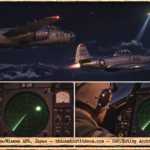
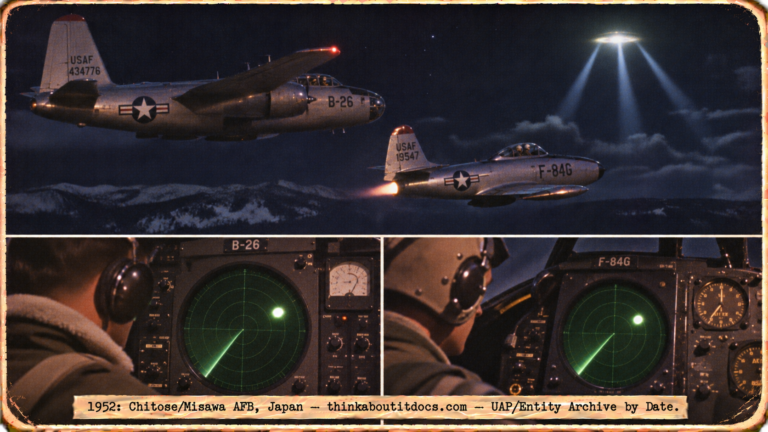
As the year 1952 wound down, a B-26 bomber crew and an F-84G pilot over Hokkaido, Japan both watched an object emitting three distinct beams of light — and both aircraft held it on their own airborne radar at the same time. The case was released publicly as Item #13 on the Air Force’s official clearance list.
Date: December 28–29, 1952
Sighting Time: Approximately 7:30–7:48 p.m. (Chop Clearance List Item #13)
Day/Night: Night
Location: Chitose AFB, or possibly Misawa AFB, Hokkaido, Japan
Urban or Rural: Not applicable — airborne
No. of Entity(‘s): None
Entity Type: Not applicable
Entity Description: Not applicable
Hynek Classification: RV (Radar-Visual) — dual-aircraft visual sighting with airborne radar tracking
Duration: About 7 minutes
No. of Object(s): 1
Description of the Object(s): An object emitting three distinct beams of light, tracked on airborne radar aboard both observing aircraft
Shape of Object(s): Not resolved; described by its light emission pattern (three beams) rather than a solid silhouette
Size of Object(s): Not recorded
Color of Object(s): Not recorded beyond the three light beams themselves
Distance to Object(s): Not recorded precisely; within visual and airborne radar range of both aircraft
Height & Speed: Not recorded in detail in the material reviewed
Number of Witnesses: 3 (B-26 crew members Ashley and Wood, and F-84G pilot Col. Howard Blakeslee)
Special Features/Characteristics: Three distinct beams of light emitted from a single object; independent visual sighting by two separate aircraft of different types (a B-26 bomber and an F-84G fighter); airborne radar tracking of the same object achieved aboard both aircraft; the case’s release as an official numbered item on the Air Force’s clearance list to the public
Case Status: Unexplained
Source: Weinstein; FUFOR Index; Air Force Press Desk Chop Clearance List, Item #13, released to Maj. Donald Keyhoe
Summary/Description: Over Hokkaido, Japan, at approximately 7:30 to 7:48 p.m. on the night of December 28 into 29, 1952, USAF crews aboard a B-26 bomber (Ashley and Wood) and an F-84G fighter (Col. Howard Blakeslee) independently saw an object emitting three beams of light. Both aircraft also tracked the object on their own airborne radar. The roughly seven-minute encounter was released publicly as Item #13 on the Air Force’s official clearance list given to Maj. Donald Keyhoe, and remains unexplained.
Related Cases: December 1952 archive, 16th–31st | the Itazuke AFB, Japan accelerating radar case, December 18, 1952
DETAILED REPORT
Over the Japanese island of Hokkaido, near either Chitose or Misawa Air Force Base — sources differ on precisely which installation the sighting is tied to — two separate USAF aircraft on the night of December 28 into 29, 1952, independently observed the same unusual object. The crew of a B-26 bomber, airmen Ashley and Wood, and the pilot of an F-84G fighter, Col. Howard Blakeslee, each watched an object that was emitting three distinct beams of light, a visual signature distinct from a simple point-source light or a conventional aircraft’s running lights.
What corroborates the visual sightings beyond two separate crews’ agreement is that both aircraft also held the object on their own airborne radar systems during the encounter. Two different aircraft types, carrying different radar equipment, flying independently, both achieving a radar track on the same visually observed object is a meaningfully stronger form of confirmation than either the visual sightings or the radar contacts would be alone.
The encounter lasted approximately seven minutes, bridging a few minutes before and after 7:30 to 7:48 p.m. local time. It entered the public record as Item #13 on the official clearance list of Air Force sightings that press officer Albert M. Chop released to Maj. Donald Keyhoe — placing it alongside several other December 1952 cases, including the Laredo, Texas and Goose Bay, Labrador reports, that reached the public through the same institutional channel before tighter reporting restrictions took hold.
The case is documented through researcher Larry Weinstein’s compilation and cross-referenced in the Fund for UFO Research (FUFOR) Index. No conventional explanation for the three-beam light emission or the simultaneous dual-aircraft radar tracking is recorded in the material reviewed.
RESEARCHER’S NOTES
Two Aircraft, Two Radars, One Unusual Light
- Classification rationale: RV fits cleanly: two separate aircrews achieved both visual contact and independent airborne radar tracking of the same target, which is a stronger evidentiary combination than a visual-only or radar-only report from either aircraft alone.
- The three-beam detail is unusual and specific: Most 1952 light-sighting reports describe a single glow, a point of light, or a simple color. A specifically three-beamed light emission is a distinctive enough detail, independently reported from two separate aircraft, that it is unlikely to be a simple misidentification of a star, planet, or conventional aircraft’s running-light pattern.
- Location uncertainty, stated honestly: The source material is not fully consistent on whether the encounter is properly associated with Chitose Air Force Base or Misawa Air Force Base, both on Hokkaido. Rather than silently picking one, this entry preserves the ambiguity exactly as it appears in the record.
- Official clearance-list provenance: As with the Laredo and Goose Bay cases from earlier in the month, this sighting’s release as a specific numbered item on Chop’s list to Keyhoe places it in a documented institutional chain of cases the Air Force itself selected for public disclosure, rather than an unverified later retelling.
Two Air Force aircraft of different types independently watched an object emitting three beams of light over Hokkaido, Japan, and both held it on their own airborne radar at once. Released officially as Item #13 on the Air Force’s own clearance list, the case stands as Unexplained.
“USAF crews aboard a B-26 and an F-84G saw an object emitting three beams of light, which was also tracked on airborne radar.”
— Weinstein, citing the Chop Clearance List, Hokkaido, Japan, December 28–29, 1952