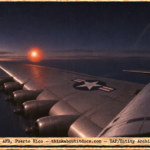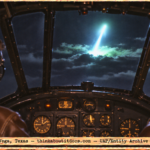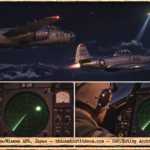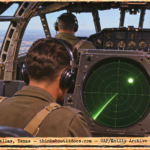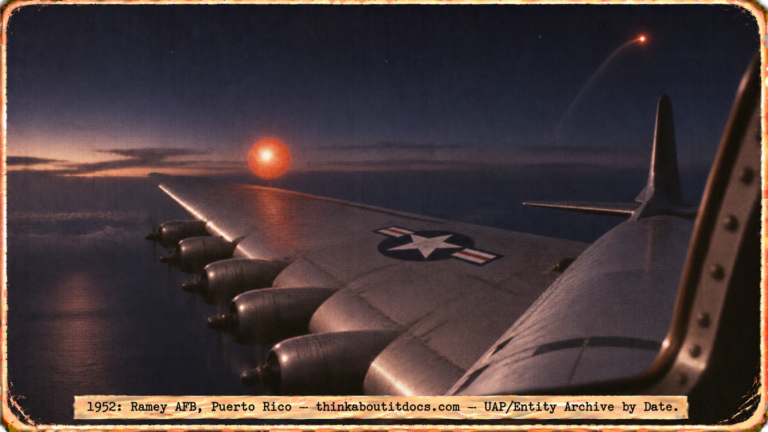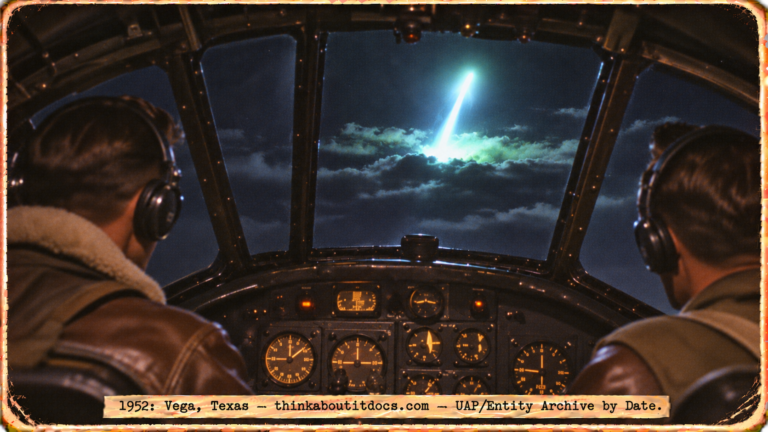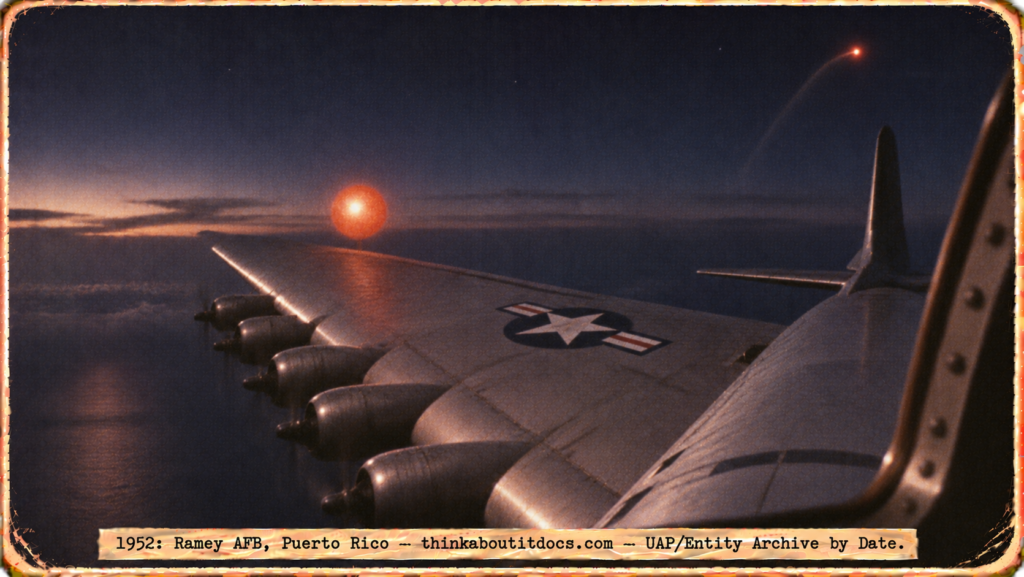
Northeast of Ramey AFB, Puerto Rico, December 31, 1952: the RB-36's close pass.
THINK ABOUTIT UFO|UAP SIGHTINGS REPORT
1952: Northeast of Ramey AFB, Puerto Rico, an RB-36 Crew’s Close Pass
In the last hours of 1952, before dawn on New Year’s Eve, the crew of an RB-36 reconnaissance bomber flying northeast of Ramey Air Force Base, Puerto Rico watched a small reddish-orange sphere approach from the horizon, pass directly over their left wing at close range, and then accelerate away from the tail, climbing out of sight. Three crew members, watching from two different positions on the aircraft, independently described the same object.
Date: December 31, 1952
Sighting Time: 4:45 a.m. local time
Day/Night: Night (pre-dawn)
Location: Northeast of Ramey Air Force Base, Puerto Rico
Urban or Rural: Not applicable — airborne over open water
No. of Entity(‘s): None
Entity Type: Not applicable
Entity Description: Not applicable
Hynek Classification: NL (Nocturnal Light) with a close-approach component; no radar confirmation is recorded and no structure beyond a sphere was described
Duration: Not recorded precisely; a continuous observation from first sighting on the horizon through departure past the tail
No. of Object(s): 1
Description of the Object(s): A spherical, reddish-orange object roughly 8 feet in diameter
Shape of Object(s): Spherical
Size of Object(s): Roughly 8 ft in diameter
Color of Object(s): Reddish-orange
Distance to Object(s): Passed over the left wing at an estimated 300+ ft distance
Height & Speed: The RB-36 was flying level at 8,000 ft on a 73° course; the object approached from the horizon, passed over the wing, then departed from the tail at high speed, climbing out of sight
Number of Witnesses: 3 (Aircraft Commander Capt. Robert P. Gennrich, First Pilot 1st Lt. John C. Moore, and left scanner A/1C Anthony A. Eakovich, all aboard RB-36 #2007)
Special Features/Characteristics: A small, well-defined spherical shape with a consistent reddish-orange color throughout the approach, passage, and departure; independent observation from two different crew positions (a scanner station and, separately, the commander/pilot) describing the same object and flight path; a close approach of roughly 300 feet past the wing without any apparent evasive or reactive maneuvering until the final high-speed departure
Case Status: Unexplained
Source: Weinstein; FUFOR Index
Summary/Description: At 4:45 a.m. local time on December 31, 1952, Aircraft Commander Capt. Robert P. Gennrich, First Pilot 1st Lt. John C. Moore, and left scanner A/1C Anthony A. Eakovich, all aboard RB-36 #2007 flying level at 8,000 ft on a 73° course northeast of Ramey AFB, Puerto Rico, sighted a spherical, reddish-orange object roughly 8 ft in diameter approaching from the horizon. It passed over the left wing at an estimated 300-plus feet, then departed from the tail at high speed, climbing out of sight. Eakovich, watching independently from the tail scanner position, separately reported the object directly behind the aircraft before it veered right and climbed sharply away. The case remains unexplained.
Related Cases: December 1952 archive, 16th–31st | the Gulf of Mexico B-29 radar-visual case, December 6, 1952
DETAILED REPORT
In the pre-dawn hours of December 31, 1952 — the final day of the year — an RB-36 reconnaissance bomber, tail number 2007, was flying level at 8,000 feet on a course of 73 degrees, northeast of Ramey Air Force Base on the island of Puerto Rico. At 4:45 a.m. local time, the aircraft commander, Capt. Robert P. Gennrich, and his first pilot, 1st Lt. John C. Moore, both noticed a small object first appearing on the horizon ahead of them, approaching the aircraft.
As it closed the distance, the object resolved into a clearly spherical shape, consistently reddish-orange in color, and estimated at roughly eight feet in diameter — a small, well-defined object rather than a diffuse glow or an indistinct light. It passed directly over the RB-36’s left wing at an estimated distance of just over 300 feet, close enough for both the commander and the first pilot to get a sustained, clear look at its shape and color.
After passing the wing, the object did not simply continue on its original path; it departed from the tail of the aircraft at high speed, climbing until it was lost from sight. Separately, and apparently without prior coordination of their accounts, A/1C Anthony A. Eakovich, stationed as left scanner, reported watching the same object from his own position: he described it as appearing directly behind the aircraft before it veered to the right and climbed sharply out of view — a description consistent with the commander’s and first pilot’s account of its departure, observed from a different vantage point on the aircraft.
The case is documented through Larry Weinstein’s compilation and the Fund for UFO Research Index. No radar confirmation is recorded for the encounter, and no conventional explanation for the object’s appearance, close approach, or high-speed departure is noted in the material reviewed.
RESEARCHER’S NOTES
Three Crew Positions, One Consistent Sphere
- Classification and its limits: NL is used here because the object, while clearly defined in shape (spherical) and color, was observed only visually with no radar component in the source material; the close-approach element distinguishes it from a distant point-light sighting, which is noted in the fields above rather than folded into a classification tag that does not capture it.
- Multiple independent vantage points strengthen the account: Rather than a single observer’s impression, this case has the aircraft commander and first pilot describing the approach and wing passage from the cockpit, and the left scanner independently describing the object’s position and departure from his own separate station toward the tail. The two descriptions are consistent with a single continuous flight path rather than contradicting each other.
- A notably small, well-resolved object: At roughly eight feet across and passing within a few hundred feet of the aircraft, this object was close and small enough for its crew to describe a definite shape and consistent coloration, rather than the vague, distant light sources more typical of many 1952 nocturnal reports — a level of resolution that makes simple misidentification of a star, planet, or distant aircraft light less likely.
- No radar correlation: Unlike several other December 1952 cases in this archive, no radar confirmation for this sighting is recorded, whether from the RB-36’s own equipment or from a ground station near Ramey AFB. The case rests entirely on the consistent visual accounts of three crew members.
Three crew members aboard an RB-36, watching from two different positions on the aircraft, independently described the same small reddish-orange sphere as it passed close over the wing and departed at high speed from the tail in the last hours of 1952. No radar confirmation and no conventional explanation accompany the account. It stands as Unexplained.
“Eakovich, watching from the tail position, separately reported the object directly behind the aircraft before it veered right and climbed sharply out of sight.”
— Weinstein, summarizing the RB-36 crew’s report, northeast of Ramey AFB, Puerto Rico, December 31, 1952