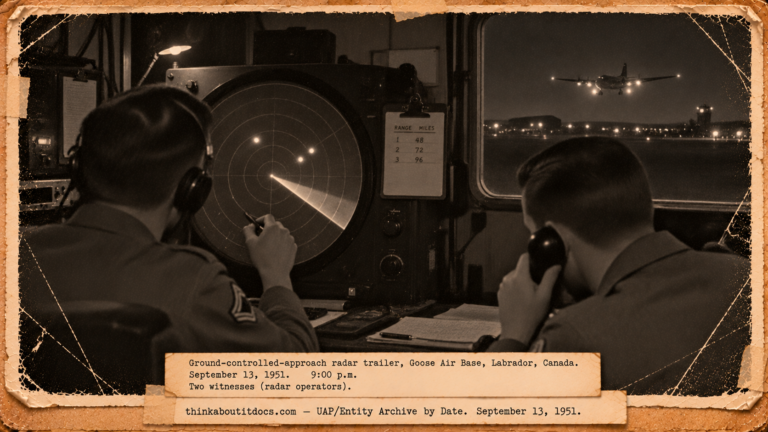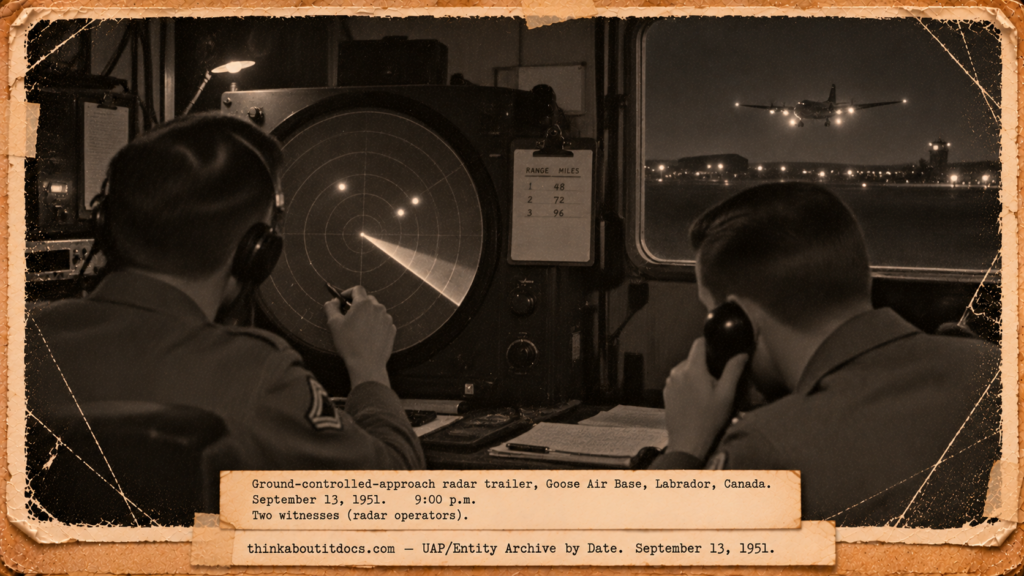
Goose Air Base, Labrador, September 13, 1951: two GCA operators track three unexplained targets on a collision course.
THINK ABOUTIT UFO|UAP SIGHTINGS REPORT
1951: GCA Radar Operators Track Three Targets on a Collision Course at Goose Bay, Labrador
On the night of September 13, 1951, two Air Force radar operators sat in the ground-controlled-approach trailer at Goose Air Base, Labrador, waiting to guide an inbound C-54 transport down, when a strong, steady radar return appeared six miles east of the field and began to cross it. A few minutes later a second return showed up two miles south of the base, and the two blips were heading for the same point in the sky. The operators called the control tower and told it to order both aircraft over the field to turn right at once, because they were on a collision course.
The tower answered that there were no aircraft in the area. Nobody saw anything and nobody heard anything, yet the targets turned and then vanished. A third return followed about fifteen minutes later. The Goose Bay UFO radar case is one of the few September 1951 reports that Project Blue Book rated Unknown, and the card says why: even if the scope was still warming up, “Targets (blips) would not have followed such a definite course.”
Date: September 13, 1951 (0100Z, September 14)
Sighting Time: About 9:00 p.m. AST (0100Z); some catalogs give 9:30 p.m.
Day/Night: Night
Location: Goose Air Base, Labrador, Canada (ground-controlled-approach radar trailer)
Urban or Rural: Rural (remote military air base)
No. of Entity(‘s): Not Applicable
Entity Type: Not Applicable
Entity Description: Not Applicable
Hynek Classification: Radar only (three ground-radar targets, no visual confirmation; not a Radar-Visual case)
Duration: About 15 minutes or more (Target A at 0100Z, Target C at about 0115Z)
No. of Object(s): 3 radar targets (A, B and C)
Description of the Object(s): Target A was a strong, steady return like that of an aircraft; Targets B and C were weak, intermittent returns similar to aircraft flying above 5,000 feet. The tower saw nothing and heard nothing at any time.
Shape/Size/Color of Object(s): Not applicable (radar returns only; no visual contact)
Distance to Object(s): Target A first appeared about 6 miles east of the base and passed south of it; Target B appeared about 2 miles south; Target C about 2 miles east-southeast
Height & Speed: Target A about 4,000 feet and about 150 mph per the GCA operators; Targets B and C above 5,000 feet, no speed estimate but both at about the same speed
Number of Witnesses: 2 (two GCA radar operators of the 1932nd AACS Squadron; names redacted in the file), plus the control tower operator, who saw and heard nothing
Special Features/Characteristics: Two targets converged on a collision course until the GCA operators ordered a turn; Target A made a 45-degree right turn and both targets vanished; a C-54 in the pattern stayed in good radar contact and landed normally; the pilot saw no other aircraft
Case Status: Unknown (Project Blue Book record card)
Source: Project Blue Book record card; Air Intelligence Information Report IR-18-51 (Headquarters, Northeast Air Command, October 11, 1951) with PPI scope photograph and track overlay; Air Force status report extracts; Berliner; McDonald files; Jan Aldrich
Summary/Description: Two GCA radar operators tracked three targets near Goose Air Base that behaved like aircraft, flew a collision course, and disappeared, while the tower reported no aircraft in the area; Blue Book rated the case Unknown.
Related Cases: The September 17, 1951 B-36 radar-visual encounter over Hudson Strait (also reported by Goose-based aircraft); the September 18, 1951 Michigan-Wisconsin radar tracks
Detailed Report
The Radar Sequence
The Air Intelligence Information Report written by Northeast Air Command’s intelligence division gives the sequence step by step. A technical sergeant and a corporal of the 1932nd Airways and Air Communications Service Squadron were on duty in the local GCA trailer at the request of the pilot of a C-54, number 5527, inbound from Westover AFB, Massachusetts. They had turned the equipment on and were waiting for instructions from the pilot or the tower when the first target appeared.
At 0100Z, September 14 (about 9:00 p.m. local time on the 13th), Target A showed up on the plan position indicator scope about six miles east of the base. It traveled west, passed south of the field, and made a left turn of about 160 degrees. About three minutes later, Target B appeared about two miles south of the base and proceeded on a course of its own. Both targets were approaching the same point on the scope photograph when the sergeant notified the control tower and asked it to tell both aircraft over the field to make right turns immediately, because they were flying a collision course. Target A made a 45-degree right turn, Target B continued on its course, and both targets vanished at the ends of their tracks.
The control tower told the operators that there were no aircraft in the immediate area, that no visual contact could be made with either target, and that no sound indicated the presence of an aircraft of any type. At about 0115Z a third return, Target C, appeared about two miles east-southeast of the base and moved on a course of roughly 050 degrees to a marked point. By then the C-54 pilot had called for landing instructions. The sergeant turned his attention to the C-54, identified it by normal procedure, and asked the pilot to look for other aircraft. The pilot saw none. The corporal kept watching Target C, saw it turn right, travel west, and disappear. The C-54 remained in good radar contact until it landed.
The Radar Characteristics and the Air Force Verdict
The report describes Target A as a strong, steady target similar to that of an aircraft at about 4,000 feet, with a speed the GCA operators estimated at 150 mph. Targets B and C were weak, intermittent targets, again similar to aircraft flying above 5,000 feet, with no speed estimate but both at about the same speed. A photograph of the scope with the three tracks marked is attached to the file.
Blue Book’s record card lists the source as radar operators, the observation as ground-radar, and the number of objects as three, and it checks the Unknown box with the line “Other: UNIDENTIFIED.” The comment reads: “Even if Radar scope was in warm up stage Targets (blips) would not have followed such a definite course. Therefore case is UNIDENTIFIED.”
RESEARCHER’S NOTES
What the Goose Bay Radar Case Does and Does Not Show
- Radar only: No one saw anything. The tower and the C-54 pilot both looked and found nothing, so the case rests entirely on the GCA scope and on two operators’ reading of it.
- Definite courses: The targets turned, converged and separated in ways the operators described as aircraft-like. Blue Book’s own card argues that a warming-up scope would not have produced blips that followed such a definite course.
- No aircraft in the area: The tower reported no known traffic, and the only aircraft on the scope, the C-54, tracked cleanly and was identified normally.
- Weak points: Targets B and C were weak and intermittent, no radar weather data appears in the file, and ducting or anomalous propagation was not analyzed in the papers Blue Book kept.
- Dates that differ: The report’s narrative says September 14 (the Greenwich date), the Blue Book card says September 13 (local), and one status report extract says September 10; the local evening of September 13 is used here.
The evidence is a radar track set that the Air Force itself could not explain and an unusual detail, the collision-course warning, that the operators acted on at the time. It does not identify anything, and it cannot rule out an equipment or propagation effect. The case stays Unknown because the one explanation the Air Force considered, a radar scope still warming up, did not fit the blips’ behavior.
“Even if Radar scope was in warm up stage Targets (blips) would not have followed such a definite course.”
— Project Blue Book record card, Goose AFB, Labrador, September 13, 1951