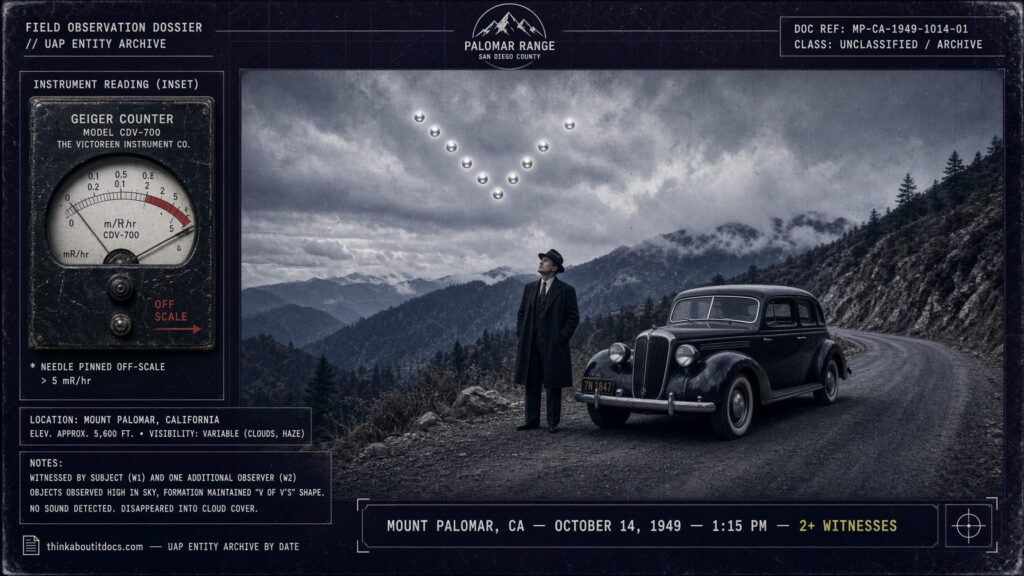
October 14, 1949 — a UFO formation over Mount Palomar coincided with an unexplained cosmic-ray detector spike, sparking a years-long secret follow-up investigation.
THINK ABOUTIT UFO|UAP SIGHTINGS REPORT
1949: The Palomar Observatory “Astronomers Incident”
A Mount Palomar Observatory public relations manager watched a silver V-formation of 16-18 objects vanish into the clouds — and minutes later, an unrelated Geiger counter monitoring background cosmic radiation jumped off the scale for no explainable reason. Over the following decade, a small, secretive group of Atomic Energy Commission physicists, working under cover of a fictitious “mineral club,” tried to determine whether the two kinds of event were connected. They never reached a conclusion.
Date: October 14, 1949 (with a related follow-on incident October 17, 1949)
Sighting Time: 1:15-1:20 p.m. (October 14); 7:20 a.m. (October 17)
Day/Night: Day
Location: Mount Palomar Observatory, California
Urban or Rural: Rural
No. of Entity(‘s): Not Applicable
Entity Type: Not Applicable
Entity Description: Not Applicable
Hynek Classification: DD (Daylight Disc)
Duration: Under one minute for each visual sighting; instrument anomalies lasted several seconds each, recurring intermittently for about ten days
No. of Object(s): 16-18 (October 14 sighting); 1 (October 17 sighting)
Description of the Object(s): Silver, round objects with no visible tails or wings, arranged in a “V of V’s” formation; the October 17 object was small, dark, and without apparent projections
Shape of Object(s): Round/disc-like
Size of Object(s): Not specified
Color of Object(s): Silver (October 14); dark/black (October 17)
Distance to Object(s): Not specified; the formation’s sound lagged its visual position by roughly 35-40°, and the objects disappeared behind cloud cover extending from the horizon to about 45° elevation
Height & Speed: High altitude, high speed; the October 17 object moved at high speed to the southwest
Number of Witnesses: At least 2 named Observatory staff for the visual sightings (Harley C. Marshall, B. B. Traxler), plus an undisclosed number of Atomic Energy Commission physicists involved in the later instrumented follow-up investigation
Special Features/Characteristics: Concurrent Instrument Anomaly (Cosmic-Ray Geiger Counter), Sound Lag Behind Visual Position, Multi-Day Recurring Pattern, Multi-Year Independent Follow-Up Investigation, Source Misidentification Corrected (see Detailed Report), Secretive Research Group (“Mineral Club” Cover Story)
Case Status: Unexplained
Source: Jan Aldrich; McDonald list; Blue Book project card; later corrective research identifying Dr. Albert B. Focke
Summary/Description: On October 14, 1949, Mount Palomar Observatory’s Manager of Public Relations, Harley C. Marshall, was driving away from the Observatory when he saw a “V of V’s” formation of 16-18 silver, round objects passing overhead at high speed toward the northwest, emitting a jet-like sound that noticeably lagged behind their visual position by 35-40°. He stopped his car and watched until the formation disappeared behind cloud cover. Marshall returned to the Observatory and phoned Assistant Superintendent-Electrical B. B. Traxler, who was on duty monitoring a cosmic-ray Geiger counter; at about the same time, Traxler independently saw a dark object heading southwest while noticing that the counter’s needle had jumped off-scale for several seconds. Over the following ten days, 21 more off-scale readings occurred on a roughly 1.5-hour periodic schedule — a pattern never observed before or after, and not attributable to equipment failure or aircraft radio interference despite later test flights by Navy aircraft attempting to reproduce the effect. On October 17, Traxler again saw a small, dark, projection-free object moving fast to the southwest at the same moment the counter went off-scale again. The Blue Book project card’s listed witness name, “Focke,” was later identified as a research error: the actual figure was Dr. Albert B. Focke, the scientist who ran the cosmic-ray detection experiment at the site (later chief scientist at the Naval Electronics Laboratory and Point Mugu Naval Missile Test Center), not a UFO witness himself.
Related Cases: 1949: George Adamski’s Palomar Sighting
Detailed Report
This case’s documentary trail is unusually long for a 1949 sighting, because it did not end in 1949. According to an account later relayed by a former Project Blue Book officer, a persistent rumor circulated for years afterward describing an unnamed research laboratory where staff monitoring background radiation witnessed a brief, unexplained spike at the same time a colleague, arriving separately by car, saw a silver V-formation of objects overhead. The rumor could not initially be pinned to a specific lab or confirmed by any named source, despite inquiries across multiple similar research projects.
The story was eventually substantiated roughly a year later, when the former Blue Book officer was put in contact with two physicists working for the Atomic Energy Commission who had firsthand knowledge of the events and were willing to talk off the record. According to their account, after the initial 1949 sighting-and-radiation-spike coincidence, laboratory staff agreed that any future unexplained radiation spike should prompt an immediate visual search of the sky. A second such coincidence did occur a few weeks later — a dark object was seen crossing the sky at the same moment the instruments spiked again — prompting a period of internal investigation, including test flights of various aircraft with radar operating, intended to rule out an aviation-related cause. No such cause was found, and the incident was quietly filed as an unexplained equipment anomaly; because the associated report explicitly ruled out “flying saucers” as a cause, it reportedly never reached Blue Book’s own files.
The physicists who related this account had themselves gone on to conduct an independent, off-the-books, multi-year follow-up: assembling more sensitive radiation-detection equipment in an abandoned mountaintop building, operated continuously, under the cover story that the group was a recreational “mineral club” pursuing rockhounding as a hobby. Relying on informal word-of-mouth networks among UFO-interested colleagues for visual sighting reports, they eventually recorded a very large spike in radiation readings — about 100 times normal background — at a moment matching a reported nearby sighting of a silvery, circular object seen by multiple people. Several more matching instrument-and-sighting coincidences followed over the next two months, including one visual sighting reportedly also confirmed by radar, before activity of both kinds dropped off entirely and the equipment recorded nothing further through mid-1951. Extensive follow-up analysis by the group — checking for sunspot activity, cross-referencing other research projects’ possible stray radiation sources, and having outside scientists review their data — found no conventional explanation for the correlation they had recorded.
RESEARCHER’S NOTES
The Palomar Radiation Correlation — California 1949 and the Limits of Anonymous Testimony
- Classification issues/corrections: The visual sightings are filed as DD (Daylight Disc); the instrument anomalies themselves fall outside Hynek’s sighting-based taxonomy entirely, since they are physical measurements rather than an observed craft. A genuine research error is corrected here: the Blue Book project card’s witness name “Focke” was not a UFO witness but the cosmic-ray experiment’s own lead scientist, Dr. Albert B. Focke — a distinction later researchers confirmed but which the original card did not make clear.
- Source chain assessment: The 1949 visual sightings are attributed to two named Observatory staff (Marshall, Traxler). The far more elaborate multi-year radiation correlation narrative rests on anonymous, off-the-record testimony from two self-described AEC physicists, relayed secondhand by a former Blue Book officer roughly two years after the fact — a substantially weaker chain than the initial sightings, and one this archive flags plainly rather than treats as equally well-established.
- Pattern context/comparative cases: Concurrent instrument anomalies tied to visual UFO sightings are rare in this archive; most cases rely on visual testimony alone. This case’s closest comparison is the August 1949 Fort Hood radio-interference reports, though those involve communications equipment rather than radiation detection.
- Physical evidence/evidentiary weight: The 1949 Geiger counter readings themselves are the strongest physical evidence in this case — a recorded instrument anomaly, not merely a claim. The subsequent “mineral club” data, while reportedly extensive, is described only secondhand and was never independently reviewed by Blue Book or any source consulted for this report; its existence cannot be verified beyond the anonymous account.
- Geographic/historical context: This sighting occurred the same month as George Adamski’s own Palomar-area sighting (October 21, this same year, see Related Cases) — a case with no established connection to this one beyond shared location and calendar proximity.
The 1949 instrument readings are real and recorded; everything that followed — the years-long secret follow-up investigation, its equipment, its data — survives only as an anonymous account relayed at second hand. This archive preserves both halves of the story, clearly distinguishing the documented from the merely reported, rather than treating a compelling narrative as equivalent evidence to a logged measurement.
“The needle had jumped off scale for several seconds.”
From the account of B. B. Traxler’s October 14, 1949 observation at Mount Palomar Observatory.