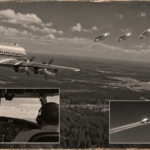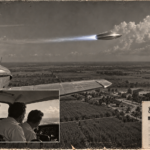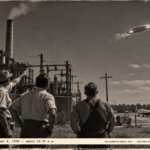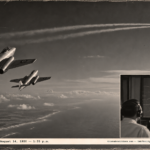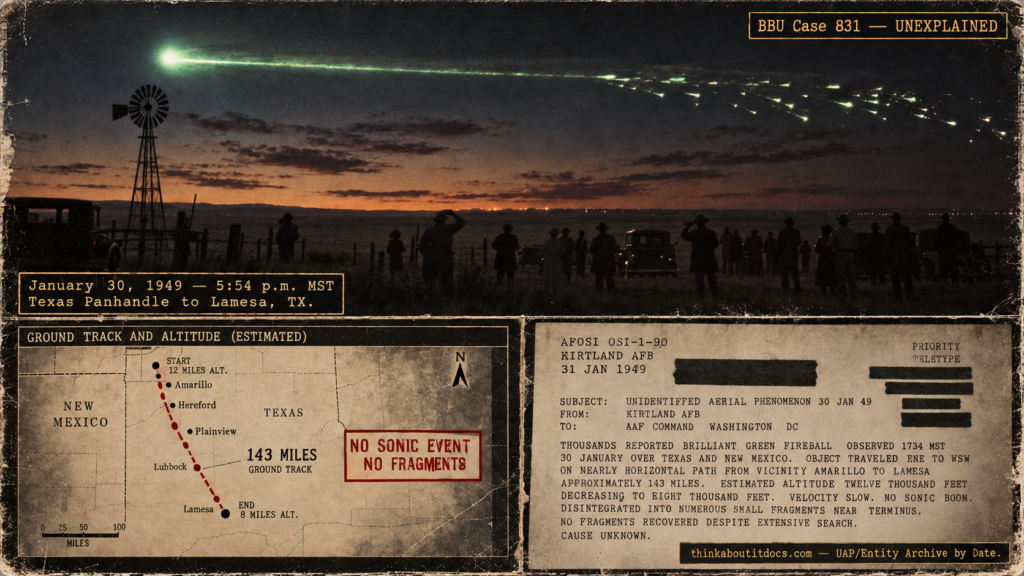
January 30, 1949 — Texas Panhandle to Lamesa, TX — a green fireball traversed 143 miles on a nearly horizontal path with no sonic event and no recoverable fragments; triangulated by Dr. Lincoln La Paz; thousands of witnesses across New Mexico and Texas. Blue Book Unknown #831. Classified Unexplained.
THINK ABOUTIT UFO | UAP SIGHTING REPORT
1949: The January 30 Green Fireball — La Paz Triangulation, New Mexico & Texas
At 5:54 p.m. on January 30, 1949, a brilliant green object appeared in the sky over the Texas Panhandle and glided southward for 143 miles on a nearly horizontal path before breaking apart into a shower of lighted fragments. It made no sound — no sonic boom, no hiss, none of the noise that marks a fast-moving object in the atmosphere. Thousands of people across Texas and New Mexico saw it. In Roswell, approximately 200 observers watched it cross the sky moving slowly west to east. At Holloman AFB, a Weather Detachment soldier described “a green ball of flame with a trail of some kind.” In Amarillo, in Fort Worth, in cities across the region, witnesses stepped outside and looked up at something they had never seen before.
Dr. Lincoln La Paz, the world’s leading investigator of aerial phenomena and the University of New Mexico meteoriticist who had spent months tracking the green fireball wave over the atomic installations of New Mexico, worked the case from the ground. His triangulation placed the beginning of the path at roughly 12 miles altitude over the Amarillo area and the ending point at about 8 miles altitude near Lamesa, Texas — a descent of 4 miles over a 143-mile ground track, a trajectory so nearly flat that no natural meteor could follow it. He interviewed over 100 witnesses. He found no meteorite fragments. He found no sonic event of any kind. Seventeen days later, his findings — along with two years of accumulated green fireball documentation — went into a secret conference at Los Alamos attended by Edward Teller, the FBI, the AEC, and the AFSWP. The January 30 fireball was the case that made the conference necessary.
Date: January 30, 1949
Sighting Time: 5:54 p.m. (MST) — Amarillo-Lamesa track; 5:55 p.m. — Roswell/Alamogordo/Fort Worth
Day/Night: Dusk (sun below horizon in much of the observation area)
Location: Near Amarillo, Texas to near Lamesa, Texas (La Paz triangulated ground track); also observed from Roswell NM, Alamogordo/Holloman AFB NM, and Fort Worth TX
Urban or Rural: Both — cross-region event observed from cities, military installations, and open country
No. of Entity(‘s): Not Applicable
Entity Type: Not Applicable
Entity Description: Not Applicable
Hynek Classification: NL (Nocturnal Lights) — brilliant luminous object observed at dusk/night, no structure discernible; classified within the Sandia/Los Alamos green fireball series
Duration: 10–20 seconds of primary visibility; fragments visible briefly after breakup
No. of Object(s): 1, breaking into multiple luminous fragments at the end of its path
Description of Object(s): A brilliant green, ball-like or disc-like object (described variously as a ball of flame, a green meteor, a blue-green object) traveling on a nearly horizontal trajectory. In Roswell, witnesses described it moving slowly west to east at approximately 2,000 ft, disappearing in a shower of lighted fragments. At Holloman AFB, PFC Vail described “a green ball of flame with a trail of some kind.” The Amarillo-area observations provided the primary data for La Paz’s triangulation.
Shape/Size/Color: Brilliant green (some observers said blue-green); spherical or ball-like in appearance; no structural detail recovered from witness descriptions
Distance to Object(s): La Paz triangulated the object’s path at 12 miles altitude at the beginning (over Amarillo area) descending to approximately 8 miles altitude at the endpoint near Lamesa — ground track of 143 miles
Height & Speed: Altitude: 8–12 miles (64,000–105,000 ft). Speed: consistent with near-orbital velocity along a 143-mile ground track in 10–20 seconds; estimated in the range of tens of thousands of mph if the triangulated altitude is correct — but La Paz’s concern was the anomalously flat trajectory, not the raw speed
Number of Witnesses: Thousands — across several states; over 100 witnesses formally interviewed by La Paz and the AFOSI; approximately 200 in Roswell alone
Special Features/Characteristics: No sonic boom and no sound of any kind reported by any witness; nearly horizontal trajectory over 143 miles (inconsistent with a natural meteor at those altitudes); no meteorite fragments recovered despite La Paz’s search; brilliant green coloration matching the broader Sandia/Los Alamos green fireball series; the Commanding Officer of Kirtland AFB filed an official report (Nr. OSI-1-90) the following day; this case directly drove the February 16, 1949 Los Alamos conference on aerial phenomena; Commanding Officer’s report from Kirtland AFB confirmed in the Department of War’s PURSUE Release 02 (DOW-UAP-D017, May 22, 2026)
Case Status: Unexplained — classified by La Paz as inconsistent with any known natural meteor; filed as Blue Book Unknown (Sparks BBU Case 831)
Source: Sparks, Brad. Comprehensive Catalog of Project Blue Book Unknowns (BBU Case 831, p. 49); Gross, Loren E. UFOs, a History: 1949 January–June, 1988, pp. 15–16; Clark, Jerome. The UFO Encyclopedia, 3rd ed. p. 540 and 4th ed. pp. 598–599; NICAP, “AFOSI Case 18: Green Fireball Event Witnessed in New Mexico”; Commanding Officer, Kirtland AFB, Nr. OSI-1-90, January 31, 1949; Carpenter, Joel. “Green Fireball Chronology,” October 6, 2011; Department of War PURSUE Release 02, DOW-UAP-D017 (General Correspondence of Sandia Base), declassified May 22, 2026; FOIA Project Blue Book files
Summary/Description: At 5:54 p.m. on January 30, 1949, a spectacular green fireball traversed the sky over Texas and New Mexico on a nearly horizontal path. Dr. Lincoln La Paz triangulated a ground track of approximately 143 miles beginning at about 12 miles altitude over the Amarillo area and ending at about 8 miles altitude near Lamesa, Texas. No sound was reported by any witness, including over 100 formally interviewed. Approximately 200 observers watched it from Roswell, New Mexico. At Holloman AFB/Alamogordo, PFC Ira W. Vail of the Weather Detachment described “a green ball of flame with a trail of some kind.” The object fragmented into luminous pieces at the end of its path. No sonic event was recorded, and no meteorite material was recovered. The Commanding Officer of Kirtland AFB filed a formal report (OSI-1-90) the following day. This event was the largest multi-state green fireball event of the series and directly prompted the secret February 16, 1949 conference at Los Alamos — attended by Edward Teller, the FBI, the AEC, and the AFSWP — that produced the most detailed government documentation of the phenomenon.
Related Cases: December 12, 1948 — Starvation Peak, New Mexico: La Paz triangulation of a green fireball at 39,000–43,000 mph | February 17, 1949 — Grants/Sandia, New Mexico: AFOSI Cases 23 & 24, ~103 witnesses | The February 16, 1949 Los Alamos Conference on Aerial Phenomena (AEC transcript) | Project Twinkle (established December 1949 as direct result of the fireball series)
Detailed Report
The January 30, 1949 fireball did not arrive in isolation. It came at the tail end of two months of accelerating green fireball reports over the atomic installations of New Mexico — a wave that had begun on December 5, 1948 over Las Vegas, New Mexico, and had prompted the Fourth Army’s Director of Intelligence, on January 13, 1949, to formally propose a scientific board to investigate, warning that the objects might be foreign radiological-warfare experiments. By January 30, Dr. Lincoln La Paz had already triangulated the December 12, 1948 Starvation Peak fireball and calculated its velocity at 39,000 to 43,000 mph on a nearly horizontal path — figures no meteor could produce without immediately disintegrating. The phenomenon was not behaving like anything natural.
At 5:54 p.m. on January 30, a green object of great brilliance appeared over the Texas Panhandle and moved southward. In Amarillo, in towns across the Panhandle region and eastern New Mexico, thousands of witnesses looked up. At Roswell, New Mexico, approximately 200 people watched it. PFC Ira W. Vail, attached to the Holloman AFB Weather Detachment at Alamogordo, stepped outside and saw what he described as “a green ball of flame with a trail of some kind.” Fort Worth, to the east, reported it one minute later at 5:55 p.m. The compiled record numbers these reports as AFOSI Cases 19, 20, and 21 for the Roswell, Alamogordo, and Fort Worth observations, though NICAP files the Roswell report as AFOSI Case 18. The Commanding Officer of Kirtland AFB submitted an official report to AFOSI the following morning: Nr. OSI-1-90, dated January 31, 1949.
La Paz went to work. He traveled the region, interviewed witnesses, and triangulated the path. His results: the fireball began at approximately 12 miles altitude somewhere over the Amarillo area, traveled southward along a nearly horizontal path 143 miles to near Lamesa, Texas, and ended at approximately 8 miles altitude. It had descended 4 miles over a 143-mile ground track — an inclination angle so shallow that no conventional meteor could maintain it at those velocities without instantly burning up. A meteor at 12 miles altitude traveling fast enough to cover 143 miles in 10 to 20 seconds would be experiencing atmospheric drag sufficient to destroy it in fractions of a second; yet the January 30 object survived its entire path and broke apart only at the end. And no sonic event was recorded anywhere along the track. Thousands of witnesses, none of them reported any sound.
La Paz searched for meteorite fragments. He found none. This was not unusual for green fireballs — no meteorite material was ever recovered from any event in the series, despite multiple searches by La Paz and others. Conventional meteors of sufficient size to produce a visible fireball over such a distance would have produced recoverable fragments. The absence of fragments, combined with the absence of sound and the anomalous trajectory, were the three physical facts that put the January 30 fireball outside any natural explanation La Paz was willing to offer.
Seventeen days later, on February 16, 1949, a secret conference was convened at the Los Alamos Scientific Laboratory. The attendees included Dr. Edward Teller, Dr. Joseph Kaplan, FBI representatives, officers of the Armed Forces Special Weapons Project (AFSWP), AEC security personnel, Project Sign military officers, and La Paz himself. The minutes of that conference, released as part of the Department of War’s PURSUE initiative in 2026 (and available through earlier FOIA channels), show La Paz presenting the accumulated data — including the January 30 event — to a room that included some of the most technically capable people in the United States government. The conference could not identify the phenomenon. It produced recommendations for expanded observation, which eventually led, in December 1949, to the establishment of Project Twinkle.
The January 30 fireball is also indexed in the Department of War’s PURSUE Release 02 (DOW-UAP-D017, General Correspondence of Sandia Base), declassified May 22, 2026, which provided additional corroboration for the Holloman/Alamogordo and Roswell observations and confirmed PFC Vail’s account as a contemporaneous witness statement.
RESEARCHER’S NOTES
The January 30, 1949 Fireball and the Green Fireball Series
- La Paz’s three anomalies. The features that placed this event outside natural explanation in La Paz’s analysis were the same three features he identified across the entire green fireball series: (1) the nearly horizontal trajectory at altitudes where atmospheric drag would destroy any fast-moving solid object instantly; (2) the complete absence of any sonic event — no boom, no hiss — despite a path length of 143 miles traversed in 10–20 seconds; and (3) the absence of any recovered meteorite material despite searches. Any one of these, taken alone, might be explainable. All three together, repeatedly, across two years of events, was what led La Paz to describe the green fireballs as unlike any meteor type known to science.
- AFOSI case numbering. The compiled secondary record numbers the Roswell, Alamogordo, and Fort Worth January 30 reports as AFOSI Cases 19, 20, and 21 respectively. NICAP’s own file header titles the Roswell event “AFOSI Case 18.” Both references are preserved in the archive. The DOW-UAP-D017 PURSUE release may clarify the actual case assignment; that document was not fully indexed at the time of this writing.
- Relationship to the broader series. The January 30 fireball is the largest multi-state event in the 1948–1951 green fireball series and the one most directly linked to institutional action. The February 16, 1949 Los Alamos conference was convened explicitly because of the accumulation of reports through January 30. Project Twinkle, established in December 1949, was the direct operational result of that conference. The December 5, 1948 Starvation Peak event (La Paz’s first successful triangulation) and the February 17, 1949 Grants/Sandia event (AFOSI Cases 23 and 24, ~103 witnesses) are the immediate bracketing cases in the series.
- PURSUE DOW-UAP-D017. The Department of War’s May 22, 2026 declassification of the General Correspondence of Sandia Base (PURSUE Release 02, DOW-UAP-D017) is the first primary-source release to directly index the Holloman/Roswell January 30 reports alongside La Paz’s contemporaneous correspondence. The 116-page release confirmed the Kirtland CO’s OSI-1-90 report of January 31, 1949 as genuine and added PFC Vail’s Holloman statement as a named contemporaneous witness not previously in the compiled secondary literature.
- Why no explanation was offered. The February 16 conference produced no conclusion. Teller suggested plasma phenomena; La Paz rejected the explanation on physical grounds. The FBI representatives were interested in the foreign-origin hypothesis — whether the objects might be Soviet radiological probes or surveillance devices — but no evidence for that appeared either. Project Twinkle’s eventual official conclusion, in 1951, was “natural origin, probably meteors,” but La Paz disputed that conclusion publicly and the Twinkle observation network had never been fully implemented. The honest disposition of the January 30 event, sixty-five years later, remains Unexplained.
The January 30, 1949 fireball is the defining event of the American green fireball wave. La Paz’s triangulation gave the phenomenon its most precise physical measurement. The complete absence of sound gave it its most troubling physical anomaly. And the conference it generated — with Teller, the FBI, the AEC and the AFSWP in the same room — gave it its most consequential institutional echo. Whatever the January 30 object was, it was taken seriously by the people best positioned to judge such things, and it was never explained.
“A green ball of flame with a trail of some kind…”
PFC Ira W. Vail, Weather Detachment, Holloman AFB — January 30, 1949. From the Department of War PURSUE Release 02 (DOW-UAP-D017), declassified May 22, 2026.