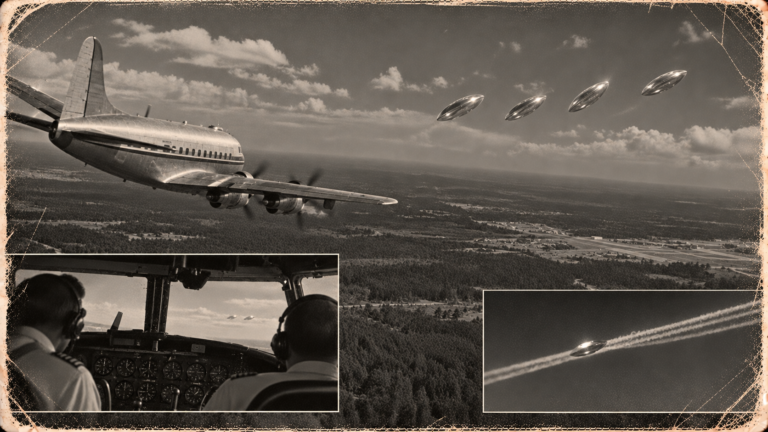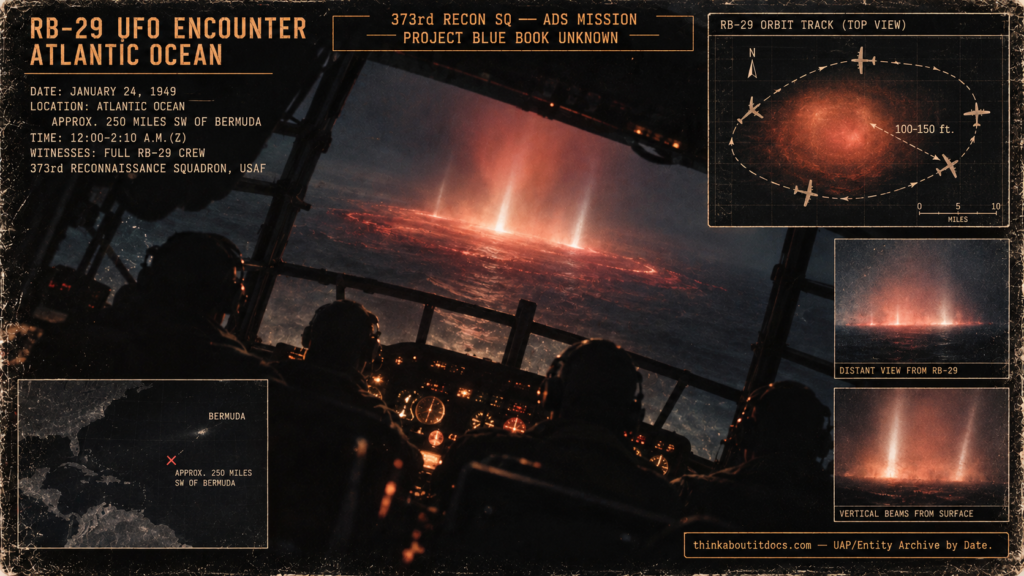
The Bermuda Atlantic red glow, January 24, 1949 — a USAF RB-29 atomic-detection crew of the 373rd Reconnaissance Squadron orbited this mile-wide phenomenon for 44 minutes, closing to an estimated 100 feet; Project Blue Book Unknown, 67-page investigative file.
THINK ABOUTIT UFO | UAP SIGHTING REPORT
1949: The Bermuda Atlantic Red Glow — RB-29 Atomic Detection Crew
Shortly after midnight on January 24, 1949, a U.S. Air Force RB-29 of the 373rd Reconnaissance Squadron lifted from Kindley AFB, Bermuda on one of the most classified missions the early Cold War had produced: armed with the Atomic Detection System, it was flying the ocean in search of evidence of Soviet nuclear tests. The crew were not looking for UFOs. They were looking for the telltale residue of a foreign bomb. What they found instead was a mass of dull red light lying on the surface of the Atlantic, roughly a mile across and reaching as high as 6,000 feet, with two to four white searchlight-like beams burning inside it. For 44 minutes the crew orbited this thing from every compass heading — closing to an estimated 100 to 150 feet at one point before banking sharply to avoid collision. The glow was still visible when they landed back in Bermuda. The Air Force could not explain it. Project Blue Book placed it in the Unknowns file. The full documentation runs to 67 pages on Maxwell Microfilm Roll 5.
This is not a misidentified ship’s wake, a phosphorescent bloom, or a flare. Those explanations collapse against the 44-minute duration, the 1-1.5 mile diameter, the vertical extent of thousands of feet, and the crew’s close-approach maneuver. It is one of the most thoroughly documented and physically unusual cases of the entire early UAP record — made the more notable by the classified context in which it occurred and the complete silence that followed.
Date: January 24, 1949
Sighting Time: 12:00-2:10 a.m. (Z/GMT/UT); approximately 8:00 p.m.-10:10 p.m. local (AST)
Day/Night: Night
Location: About 250 miles SW of Bermuda, Atlantic Ocean (approximately 29°30′ N, 67°29′ W)
Urban or Rural: Open ocean
No. of Entity(‘s): Not Applicable
Entity Type: Not Applicable
Entity Description: Not Applicable
Hynek Classification: NL (Nocturnal Lights) — luminous aerial/surface phenomenon observed at night; no structure discerned beyond the glow and internal beams
Duration: Approximately 44 minutes of sustained observation (plus the glow visible on landing back at Bermuda)
No. of Object(s): 1 (a single coherent mass of light with internal structure)
Description of Object(s): A dull red or reddish-orange glow lying on the ocean surface, 1 to 1.5 miles across in horizontal extent and rising to between 2,500 and 6,000 feet in vertical extent. Within the mass, 2 to 4 white searchlight-like beams were visible. The phenomenon remained coherent and stationary throughout the 44-minute orbit.
Shape/Size/Color: Mass or column — no defined geometric shape; dull red exterior, white vertical beam(s) inside; approximately 1-1.5 miles in diameter at the base, 2,500-6,000 ft in height
Distance to Object(s): Closest approach estimated at 100-150 feet (crew banked to avoid collision)
Height & Speed: Height: surface-to-approximately 6,000 feet. Speed: stationary throughout
Number of Witnesses: Multiple — full crew of a USAF RB-29 (standard reconnaissance crew: pilot, copilot, navigator, bombardier/radioman, and additional mission specialists on an ADS-configured aircraft; exact crew count not in the declassified summary)
Special Features/Characteristics: Stationary position on the ocean surface; 1-1.5 mile horizontal diameter; 2,500-6,000 ft vertical extent; 2-4 internal white beam(s) resembling searchlights; 44-minute sustained presence; crew close approach to estimated 100-150 ft with evasive bank; phenomenon still visible on return to Bermuda; classified mission context (Atomic Detection System); full documentation covers 67 pages on BB Maxwell Microfilm Roll 5
Case Status: Unexplained — carried as a Project Blue Book Unknown
Source: Blue Book Maxwell Microfilm Roll 5, pp. 167-233; Project 1947; Saunders/FUFOR Index; Sparks Comprehensive Catalog of BB Unknowns
Summary/Description: In the early hours of January 24, 1949, a USAF RB-29 crew of the 373rd Reconnaissance Squadron, operating from Kindley AFB, Bermuda on classified Atomic Detection System duty, was searching for a lost BOAC aircraft when they encountered a large red glow on the ocean surface approximately 250 miles SW of Bermuda. The glow extended 1 to 1.5 miles across and reached between 2,500 and 6,000 feet in height, with 2 to 4 white searchlight-like beams visible within it. The crew orbited the phenomenon for approximately 44 minutes, approaching as close as an estimated 100-150 feet before banking to avoid collision. The glow remained stationary and coherent throughout and was still visible as the crew returned to Bermuda. The Air Force investigated and could not explain the observation; it is carried as a Project Blue Book Unknown.
Related Cases: December 5, 1948 — Green Fireballs Begin, Los Alamos/Las Vegas NM (same investigative period); January 27, 1949 — Cortez-Bradenton, Florida (BBU #284); January 30, 1949 — Green Fireball, Amarillo-Lamesa TX / Roswell NM (same month; same investigative framework)
Detailed Report
The mission context is important. By January 1949, the USAF had been operating the Atomic Detection System — a covert program of modified reconnaissance aircraft designed to sniff out evidence of Soviet nuclear testing — for less than a year. The 373rd Reconnaissance Squadron, flying from Kindley AFB in Bermuda, was one of the units assigned to the Atlantic leg of this network. The RB-29 was not a combat aircraft on a routine patrol; it was a classified sensor platform, its crew trained and cleared for some of the most sensitive aerial intelligence work the early Cold War produced. When they encountered something they could not identify, they did not turn away from it. They orbited it for 44 minutes.
The encounter began shortly after midnight, Zulu time, on January 24. The crew was already airborne on a secondary task — searching for a lost BOAC aircraft in the Atlantic — when they spotted the glow on the ocean surface. At first impression it might have suggested a ship fire or an oil slick burning on the water, but the dimensions ruled both out within moments. The phenomenon was 1 to 1.5 miles across. It rose between 2,500 and 6,000 feet into the air above the surface — a vertical extent no ship fire approaches. And within the reddish-orange mass, the crew observed 2 to 4 distinct white beams oriented upward, resembling searchlights emanating from inside the glow rather than shining into it from outside.
The RB-29 circled the phenomenon from every direction for the better part of an hour, closing progressively. At the nearest point of approach, crew members estimated they were 100 to 150 feet from the edge of the glow. At that range they executed a sharp bank to avoid what they judged to be a collision risk. The glow did not react, did not move, did not diminish. It simply sat on the surface of the ocean. Throughout the entire 44-minute observation it remained stationary and coherent. When the crew finally departed and flew back to Bermuda, the glow was still visible behind them. They did not see it go out.
The physical description rules out the obvious conventional candidates one by one. A ship fire is eliminated by scale: no vessel produces a stationary luminous mass 1 to 1.5 miles in diameter. Phosphorescent bioluminescence — dinoflagellate blooms that can produce dull reddish or blue-green ocean surface glows — is eliminated by the vertical extent (bioluminescence is a surface phenomenon, not a column reaching thousands of feet), by the internal white beams, and by the 44-minute persistence under observation by an aircraft circling overhead. A controlled burn or military exercise is possible in principle, but nothing in the declassified record indicates such an exercise was scheduled in that area on that date, and the full 67-page case file produced no conventional identification. The Air Force’s own investigation ended without a conclusion. The case was carried as an Unknown.
The documentation burden is unusually high for a 1949 case. The report runs to 67 pages in Blue Book Maxwell Microfilm Roll 5, pages 167 through 233 — evidence that the Air Force took the report seriously enough to generate a significant investigative file. This is not a one-page incident summary; it is a sustained case investigation. The FUFOR Index and Project 1947 researchers independently flagged it. Brad Sparks included it in his Comprehensive Catalog of Blue Book Unknowns. Despite all of this, the case is almost unknown in the popular literature, probably because it occurred over open water, has no named individual witness in the public record, and involves a classified mission context that limited disclosure at the time.
RESEARCHER’S NOTES
The Bermuda Atlantic Red Glow — What the Evidence Actually Says
- The ADS context matters. The 373rd Recon Squadron was not on a routine patrol when this occurred. The Atomic Detection System mission placed these crews at the cutting edge of Cold War intelligence — flying classified sensor runs designed to catch Soviet nuclear tests in the act. That operational context argues against misreporting or hoax: ADS crews were carefully selected, their logs were classified, and an anomalous report generated exactly the kind of investigative attention the 67-page case file reflects. These were not men who would casually invent or dramatically embellish an encounter; they were professional military aviators with clearances and careers on the line.
- The physical description is anomalous on every axis. A 1-1.5 mile diameter, a 2,500-6,000 ft vertical column, and internal white beams inside a red glow do not correspond to any natural or man-made phenomenon that a 1949 Atlantic crew would be likely to encounter. Natural sources of ocean surface luminescence — bioluminescent blooms, burning wreckage — produce no vertical column of thousands of feet. A military flare or pyrotechnic does not persist stationary for 44 minutes while being orbited by an aircraft. The combination of scale, vertical extent, internal beams, and persistence is what makes the physical description so difficult to reconcile with conventional candidates.
- The 100-150 foot close approach is the detail that anchors this case. At that range, in a military aircraft with trained observers, the crew would have resolved any conventional source — a burning vessel, a flare platform, a natural phenomenon with an identifiable surface structure. The fact that they did not, and that they executed a sharp bank to avoid what they perceived as a collision risk, suggests the phenomenon had no visible boundary structure that would allow the crew to determine what they were approaching. This is consistent with the description of a coherent luminous mass rather than an object with a defined surface.
- Source limitations. The primary record is the BB Maxwell Microfilm Roll 5, pp. 167-233. The summary available in secondary sources (Saunders/FUFOR Index; Sparks’ catalog) is compressed; the full 67-page case file is the authority on precise crew size, individual witness statements, and the Air Force’s investigation reasoning. The crew’s unit designation (373rd Recon Sq) and their home station (Kindley AFB, Bermuda) are established; no individual names appear in the declassified summary. For the purposes of this archive entry the case is presented as documented, with the acknowledgment that some dimensions (particularly the 2,500-6,000 ft vertical extent range) reflect the crew’s estimates under nighttime ocean conditions and should be read as order-of-magnitude rather than precise measurements.
- Why this case has not received the attention it deserves. Three structural factors have kept the Bermuda RB-29 case out of the popular canon: (1) its classified mission context delayed and suppressed public disclosure; (2) it has no named individual witness in the available record, making it harder for researchers to build a narrative around; (3) it occurred over open water with no corroborating ground witnesses. Against those limitations, what remains is a 67-page investigative file, a Blue Book Unknown designation, and a physical description that has not been satisfactorily explained in the 75 years since it occurred.
The Bermuda RB-29 case is not the most dramatic entry in the 1949 record, but it may be the most physically unusual. A crew of trained USAF observers on a classified mission spent 44 minutes orbiting a mile-wide red glow on the open Atlantic, closed to within a football field’s length of it, and came home with a report the Air Force filed as Unexplained. The 67-page investigative record — rare documentation weight for any 1949 case — reflects the seriousness with which it was taken at the time. It remains that serious now.
“…a red glow on the ocean 1 mile in size emitting beams of light…”
Blue Book Maxwell Microfilm Roll 5, pp. 167-233 — summary of the January 24, 1949 RB-29 encounter report, 373rd Reconnaissance Squadron, Kindley AFB, Bermuda.