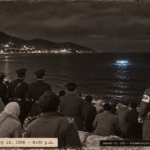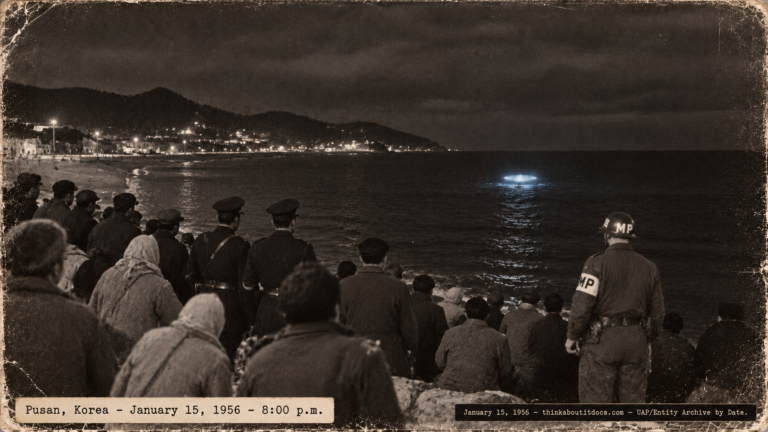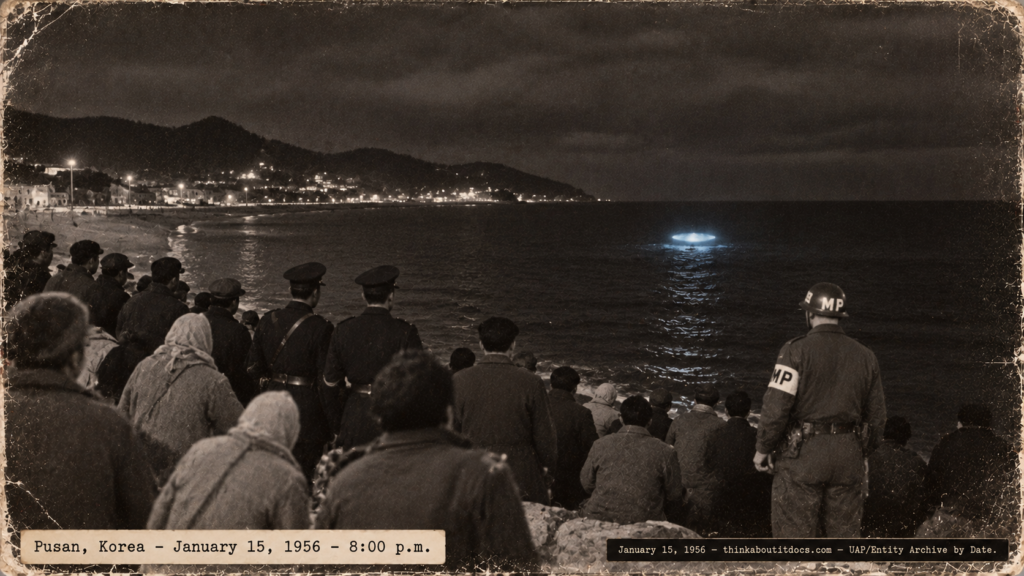
Pusan, Korea, January 15, 1956: a glowing object burned on the sea for about 90 minutes before it sank, and it was never recovered.
THINK ABOUTIT UFO|UAP ENCOUNTER REPORT
1956: Pusan, Korea: The Glowing Object That Sank Into the Sea
For an hour and a half on the night of January 15, 1956, an object burned on the sea off Pusan, Korea, and nobody went out to it. Witnesses said it had fallen into the water about fifty yards offshore near Heunde. They described it as about the size of a large washtub, glowing blue-gray. Crowds of Korean townspeople gathered on the shore to watch, Korean National Police arrived, and then the U.S. Military Police. One MP, Cpl. Ben Elliot, watched the light float on the surface for almost an hour. He compared the glow to flames from burning alcohol or benzine, but he could not see the object itself.
Then it sank. No boat was launched, no diver went down and no wreckage was recovered. The Pusan glowing object is one of the earliest well-witnessed unidentified submerged object (USO) reports in the Korean record. It was seen by civilians, police and American military personnel at close range, and its fate has never been explained.
Date: January 15, 1956
Sighting Time: About 8:00 p.m. (local)
Day/Night: Night
Location: Offshore near Heunde, Pusan (Busan), Korea
Urban or Rural: Urban (coastal town shoreline)
No. of Entity(‘s): Not Applicable
Entity Type: Not Applicable
Entity Description: Not Applicable
Hynek Classification: CE-I (close-range observation, about 50 yards)
Duration: About 90 minutes
No. of Object(s): 1
Description of the Object(s): A glowing object seen falling into the sea, then glowing on the water’s surface until it sank. The object itself could not be seen, only its glow.
Shape/Size/Color of Object(s): Shape unknown. The glow was about the size of a large washtub and blue-gray, likened to flames from burning alcohol or benzine.
Distance to Object(s): About 50 yards offshore
Height & Speed: Seen falling into the sea, height and speed not recorded, then stationary on the surface
Number of Witnesses: Many. A large number of Korean townspeople, Korean National Police and U.S. Military Police including Cpl. Ben Elliot
Special Features/Characteristics: Fell from the air into the sea, glowed on the water for about 90 minutes, then sank (trans-medium behavior). No recovery was ever reported.
Case Status: Unexplained (object never recovered)
Source: Samuel Norman, “Recent UFOs Over Japan,” Fate Magazine, June 1956, pp. 22-24
Summary/Description: A washtub-sized, blue-gray glowing object fell into the sea about 50 yards off Heunde, Pusan. Townspeople, Korean National Police and U.S. MPs watched it glow on the surface for about an hour and a half before it sank. It was never recovered.
Related Cases: 1956: January UFO|UAP & Entity Sightings Archive; Komatsu, Japan (about January 8, 1956, referenced in the same source article)
Detailed Report
The incident began at about 8:00 p.m. on January 15, 1956, at Pusan, on Korea’s southeastern coast. According to the account later published in Fate Magazine, an object was seen falling into the sea about 50 yards off the shore near Heunde. The description given to military authorities put it at about the size of a large washtub, glowing blue-gray.
It came down early enough in the evening that many people in the town were still out, and a large crowd of Korean townspeople gathered to watch. They reported that the glow continued on the water for about an hour and a half. Korean National Police arrived and alerted the U.S. Military Police.
Cpl. Ben Elliot, an American MP on patrol duty that night, reached the scene quickly enough to watch the object floating on the water for almost an hour. He said the glow looked like the flames from burning alcohol or benzine and appeared to be about the size of a large washtub, but the object itself could not be seen on the surface.
No witness was willing to row out for a closer look. The object eventually sank out of sight without being inspected. At the time of writing, the article’s author noted that no further reports about the object had come in, and that Pusan University staff might arrange for divers to try to recover whatever remained. No recovery was ever reported.
The Fate article presents Pusan as the second of two linked Far East incidents. It places this event about a week after a sighting at Komatsu, Japan, roughly 1,000 miles away. The author singled out Pusan as unusual on two counts: the large number of civilian and American witnesses, and the fact that the object stayed under direct, relatively close observation for about ninety minutes.
RESEARCHER’S NOTES
A Well-Witnessed Glow With a Thin Paper Trail
- Witness strength: The case is unusual for the number and mix of witnesses: a large civilian crowd, Korean National Police and U.S. Military Police. It also has one named American serviceman, Cpl. Ben Elliot, who watched for almost an hour.
- Single published source: Everything known about this case comes from one secondary article, Samuel Norman’s “Recent UFOs Over Japan” in Fate Magazine (June 1956). No Project Blue Book file or U.S. military report on the Pusan event has been located, even though MPs were on scene.
- Conventional possibilities: A long-burning glow on water could come from a marine flare, a burning fuel slick, or debris from an aircraft or vessel. Elliot’s own comparison to burning alcohol or benzine points in that direction. A meteorite would not normally keep glowing on the surface for ninety minutes. No aircraft loss or ship incident for that night has been matched to the event.
- The unseen object: Witnesses saw the glow, not the object. Any description of the object’s shape or structure would go beyond the record.
- Location note: “Heunde” is the source’s spelling. It most likely refers to the Haeundae beach area of Busan, then romanized as Pusan.
- Unrecovered: The mention of Pusan University divers is the case’s loose end. No record of a dive, or of any findings, has surfaced.
The Pusan case sits in an uncomfortable middle ground. It has more witnesses than most USO reports and fewer documents than it should. Something fell into the sea near Heunde and glowed there long enough for a town, its police and an American MP to gather and watch. What it was went down with it. Until a U.S. Army provost report or a Korean police record turns up, the Pusan glowing object remains unexplained, and it stands as an early, credible example of an object entering the sea in front of many witnesses.
“It was seen falling into the water about 50 yards off-shore near Heunde.”
Report to U.S. military authorities, Pusan, Korea, January 15, 1956, as published in Fate Magazine, June 1956