January 1956: a glow sinks into the sea off Pusan, Korea, while radar tracks unknowns from Michigan to Libya.
1956: January UFO|UAP & Entity Sightings Archive
On the night of January 15, 1956, crowds gathered on the shoreline at Pusan, Korea, to watch something that had fallen into the sea burn with a blue-gray glow about fifty yards offshore. Korean National Police called in U.S. Military Police, and one American MP watched the light float on the water for almost an hour before it sank out of sight. Nobody rowed out to it. The Pusan glowing object is the anchor of the January 1956 UFO sightings archive, and one of the era’s more unusual unidentified submerged object reports.
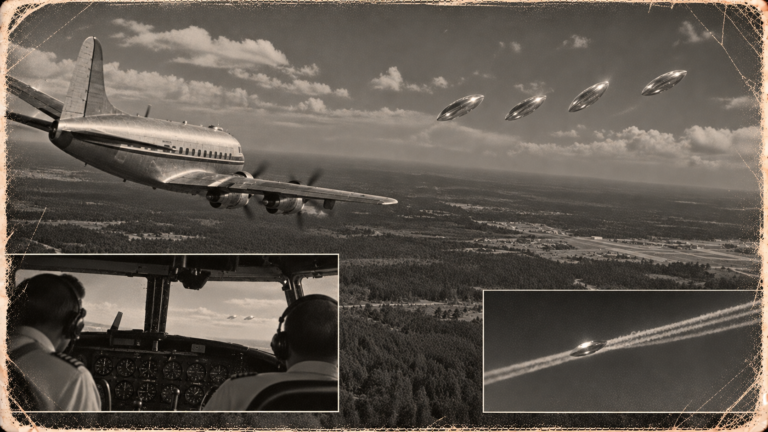
The rest of the month belongs to radar scopes and cockpits. At Wurtsmith AFB, Michigan, tower operators watched a reddish light while an F-89D interceptor locked onto it by radar, until the object broke the lock and outclimbed the jet. Radar at Wheelus AFB in Libya tracked an unknown target for twelve minutes before it faded. Over Pasadena, three orange discs circled a Cessna at an estimated 1,200 mph. The strangest claim comes from Antarctica, where a Chilean field party at Robertson Island reported two giant cigar-shaped craft hanging vertically in the sky for two days. From a disc with rings of light over Orangeville, Canada, to a big-eyed figure at a bedroom window near Hesperia, California, January 1956 covers the full range of the mid-fifties record.
Date: January 1956
Location: Near Hesperia, California
Time: Night
Summary: The witness woke to see a small, bald-headed man with large eyes looking at her through the back picture window of her bedroom. She woke her husband, who went outside to check and found no footprints in the snow.
Source: Patricia Lee, Shadowmag
Source Status: Single-witness account from a general-interest website, with no period documentation. The lack of footprints in fresh snow is the only physical detail and cuts both ways.
Date: January 3, 1956
Location: Over Pasadena, California
Time: Unknown
Summary: A pilot and a cameraman flying a Cessna 180 saw three orange discs, each estimated at 50 feet across, circle their airplane at about 1,200 mph. The discs left no vapor trail.
Source: Flying Saucer Review, March 1956, p. 5; NICAP 1956 UFO Chronology
Date: January 8-9, 1956
Location: Robertson Island, near the Antarctic Peninsula
Time: Before 7:00 a.m., continuing into the next day
Summary: A Chilean field party of four reported two cigar-shaped craft of similar size hanging motionless with their long axes vertical. Through binoculars they looked smooth, polished and metallic. At 9:00 a.m. one object turned horizontal, flashed through a spectrum of colors and made silent, rapid stops, turns and accelerations for about 5 minutes, then returned to vertical. The second object then did the same for about 3 minutes. The party reported that a Geiger counter read 40 times normal background radiation and that they took many color and black-and-white photographs. The next day, with both objects still in place, they used a theodolite to put them at about 8 km altitude, about 150 m long and 25 m across. A beam of polarized light aimed at one object reportedly made it drop lower and then rise back. The objects stayed in view until the sky clouded over at 11:00 p.m. on the second day, when the radiation level also fell. The details were reportedly passed to the U.S. Air Technical Intelligence Center (ATIC). [Full Report]
Source: Flying Saucer Review, March 1968, p. 20; NICAP 1956 UFO Chronology
Source Status: This account first appeared in print twelve years after the event. The four party members are unnamed, and none of the photographs, theodolite readings or Geiger data have ever been published. No Chilean expedition record or ATIC file confirming the report has been located. The case is widely cited but unverified.
Date: January 11, 1956
Location: Wurtsmith AFB, Michigan
Time: 6:40 p.m. (EST)
Summary: Wurtsmith control tower operators S/Sgt. Compeau and A/3C Kenneth James Seger, along with GCA radar operator S/Sgt. Paul D. Porter, saw a reddish, not-quite-round light like a jet exhaust seen from behind. They estimated it at 6,500 to 7,000 feet, at 240 degrees azimuth and 15 to 20 degrees elevation. An F-89D flown by 1st Lt. Culpepper, with radar observer 1st Lt. William H. Freeland, tracked the object on its airborne radar. At 6:50 p.m. Freeland held a radar lock-on for about 2 minutes at 11 miles range, dead level and slightly to the right, with the F-89D closing at about 50 knots, which put the object’s speed near 400 knots. At 6:52 p.m. the object broke the lock with a rapid 40-degree climb and outclimbed the F-89D, even though the jet was climbing at 450 knots to 11,000 feet. The crew never saw it; the only visual sighting came from the ground, through 7×50 binoculars. [Full Report]
Source: Brad Sparks; Project Blue Book files; McDonald list; Saunders/FUFOR Index; NICAP 1956 UFO Chronology (BBU)
Source Status: Venus was near that part of the sky at about 235 degrees azimuth and 11 degrees elevation, though it would not normally look reddish. Venus cannot account for the F-89D’s airborne radar lock or the object’s climb away from the interceptor.
Date: January 15, 1956
Location: Pusan, Korea (offshore near Heunde)
Time: About 8:00 p.m.
Summary: An object described to military authorities as about the size of a large washtub and giving off a blue-gray glow was seen falling into the sea about 50 yards offshore near Heunde. A large number of Korean townspeople watched the glow on the water for about an hour and a half. Korean National Police arrived and alerted U.S. Military Police. MP Cpl. Ben Elliot reached the scene in time to watch the light floating on the surface for almost an hour. He compared the glow to flames from burning alcohol or benzine, though the object itself could not be seen. No one attempted to reach it by boat, and it eventually sank. Pusan University staff reportedly considered sending divers, but no recovery was ever reported. The source article places this event about a week after a separate sighting at Komatsu, Japan. [Full Report]
Source: Samuel Norman, “Recent UFOs Over Japan,” Fate Magazine, June 1956, pp. 22-24
Date: January 16, 1956
Location: The Moon (western darkened side)
Time: Unknown
Summary: Observers reported a light flashing continuously on the Moon’s darkened western side for about an hour and a half. Eight days later, flashes were reported on the wall of the crater Cavendish.
Source: Saucers, Space and Science, No. 35 (1964), p. 5; NICAP 1956 UFO Chronology
Source Status: This is a reported transient lunar phenomenon (TLP), a class of brief lights or color changes on the Moon’s surface that astronomers still debate.
Date: January 17, 1956
Location: Orangeville, Canada
Time: Unknown
Summary: A disc-shaped UFO was seen at close range, with rings of light visible on its underside.
Source: The UFO Evidence (NICAP), Section XII
Date: January 18, 1956
Location: Itazuke AFB, Japan
Time: 10:00 a.m.
Summary: An air crew saw a white, round, balloon-shaped object moving at high speed and leaving no trail.
Source: Project 1947; FUFOR Index; BBU Files (BBU)
Date: January 22, 1956
Location: Gulf of Mexico, near New Orleans
Time: Unknown
Summary: A Pan American Airways flight engineer saw a large, elongated object giving off a yellow flame or light. It passed the aircraft, travelling from the horizon to behind a weather front.
Source: The UFO Evidence (NICAP), Section V
Date: January 24, 1956
Location: Wheelus AFB, Tripoli, Libya
Time: 2:52 p.m. local time
Summary: Radar picked up an unidentified target at 99 degrees azimuth, 75 miles out. It tracked on a heading of 330 degrees at 75 knots and 1,000 feet altitude. Operators followed it for 12 minutes before it faded from the scope.
Source: McDonald list; FUFOR Index; BBU Files (BBU)
Date: January 30, 1956
Location: Lake Andes, South Dakota
Time: Morning; still in view at 9:30 a.m. when reported
Summary: A civilian observer reported a single bright, silver object about the size of a half dollar held at arm’s length. It stayed stationary for more than an hour, showing no flight path or maneuvers, and was still visible when the report was made. The record card notes that photographs were taken. The Air Force agreed with the reporting officer that it was most likely a weather balloon, probably a radiosonde.
Source: U.S. National Archives, Project Blue Book case file, NAID 28964692 (T1206, Roll 24), Project 10073 Record Card
Source Status: Primary-source government document. Blue Book’s conclusion was “Probably Balloon.” The record card’s GMT time group (30/2330Z) does not match the 9:30 a.m. report time given in the file.
Date: June 16, 1956 (see Source Status)
Location: São Sebastião, São Paulo, Brazil
Time: About 7:10 to 7:15 p.m.
Summary: João de Freitas Guimarães was a Santos lawyer and professor at the Catholic Faculty of Law. While in São Sebastião on legal business, he took an evening walk on the beach. He saw a jet of water rise from the sea between Ilhabela and São Sebastião, and a bulky craft emerged and headed for the shore. It landed in front of him on a landing gear fitted with balls. Two tall, fair-skinned, blond men in green coveralls stepped out. Guimarães said they communicated telepathically and invited him aboard, where he met a third crew member. The craft then took off, and he was returned to the beach after about an hour. English-language compilations describe the craft as roughly 60 feet across and 18 feet high.
Source: SBEDV (Sociedade Brasileira de Estudos sobre Discos Voadores) Bulletins; Brazilian National Archive (Arquivo Nacional), OVNI collection
Source Status: Some compilations file this case under January 1956. The SBEDV investigation and the Brazilian National Archive record both date it June 16, 1956, and the full entry appears in the June 1956 archive. Guimarães first told his story publicly on Rio de Janeiro’s Channel 13 television in August 1957. English-language versions differ from the SBEDV account on some details, including the crew’s clothing.
EXECUTIVE SUMMARY
Radar Locks, Airline Crews and a Glow That Sank Off Pusan
January 1956 is a military-and-aviation month, and its strongest case is Wurtsmith AFB. Tower operators and a GCA radar operator watched a reddish light while an F-89D crew locked onto it at 11 miles, until the object broke the lock with a steep climb and outclimbed the interceptor. Venus was in that part of the sky, but it cannot explain an airborne radar lock or a climb away from a pursuing jet. Radar at Wheelus AFB in Libya tracked a slow, low target for twelve minutes, and aircrews over Itazuke AFB, Japan, and the Gulf of Mexico reported fast unknowns. Over Pasadena, a pilot and a cameraman described three orange discs circling their Cessna. At Lake Andes, South Dakota, a stationary silver object watched for over an hour shows the other side of the Blue Book record: it was closed as a probable radiosonde balloon.
The month’s most dramatic surface report is Pusan, Korea. A glowing object fell into the sea near Heunde and burned on the surface for about ninety minutes in front of Korean townspeople, police and U.S. Military Police before it sank. The most extraordinary claim is Robertson Island in Antarctica, where a Chilean field party described two vertical cigar-shaped craft with radiation readings and theodolite measurements. That account surfaced only in 1968, and none of its photographs or data have ever appeared. January also saw Doubleday publish Edward J. Ruppelt’s The Report on Unidentified Flying Objects on January 28, the first inside account by a former Project Blue Book chief. The month carries a cross-reference to the São Sebastião, Brazil landing, which primary Brazilian records date to June 1956.
“About the size of a large washtub and emitting a blue-gray glow.”
Description given to U.S. military authorities, Pusan, Korea, January 15, 1956, as reported in Fate Magazine, June 1956