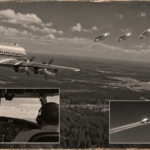
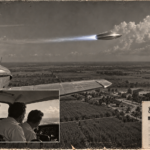
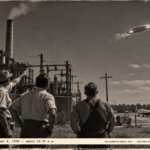
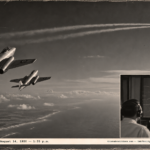
Wurtsmith AFB, Michigan, January 11, 1956: the F-89D held a radar lock for two minutes, then the target climbed away.
THINK ABOUTIT UFO|UAP SIGHTINGS REPORT
1956: Wurtsmith AFB, Michigan: The Light That Broke an F-89D Radar Lock
Just after dark on January 11, 1956, the control tower at Wurtsmith Air Force Base, Michigan, spotted a reddish light in the southwest sky. It looked like a jet’s exhaust seen from behind, but not quite round. An F-89D Scorpion interceptor already in the air was sent after it. At 6:50 p.m. the radar observer, 1st Lt. William H. Freeland, locked his airborne radar onto the target 11 miles ahead, dead level and slightly to the right. For two minutes the F-89D closed on it.
Then the target broke away. At 6:52 p.m. it went into a steep 40-degree climb that snapped the radar lock and left the interceptor behind, even though the F-89D was climbing hard at 450 knots. The jet crew never saw the object with their own eyes. Tower operators and a GCA radar controller on the ground watched it through binoculars. Project Blue Book listed the Wurtsmith AFB F-89D radar lock as an unknown.
Date: January 11, 1956
Sighting Time: 6:40 p.m. (EST); radar lock at 6:50 p.m.; lock broken at 6:52 p.m.
Day/Night: Night (early evening)
Location: Wurtsmith AFB, Oscoda, Michigan, and the airspace to its southwest
Urban or Rural: Rural (military air base)
No. of Entity(‘s): Not Applicable
Entity Type: Not Applicable
Entity Description: Not Applicable
Hynek Classification: RV (Radar-Visual): visual from the ground, airborne radar lock-on by the F-89D
Duration: About 12 minutes from first sighting to the broken lock; radar lock held about 2 minutes
No. of Object(s): 1
Description of the Object(s): A reddish light, not quite round, resembling a jet aircraft’s exhaust seen from behind
Shape/Size/Color of Object(s): Roughly round light; size not recorded; reddish
Distance to Object(s): 11 miles from the F-89D at radar lock-on
Height & Speed: Estimated from the ground at 6,500 to 7,000 feet, at 240 degrees azimuth and 15 to 20 degrees elevation. From the F-89D’s 50-knot closing rate, the object’s speed works out to about 400 knots true airspeed. It then climbed at about 40 degrees fast enough to outclimb the F-89D, which was climbing at 450 knots to 11,000 feet.
Number of Witnesses: At least 5: F-89D pilot 1st Lt. Culpepper and radar observer 1st Lt. William H. Freeland (radar only); Wurtsmith tower operators S/Sgt. Compeau and A/3C Kenneth James Seger (visual); GCA radar operator S/Sgt. Paul D. Porter (visual)
Special Features/Characteristics: An airborne radar lock-on of about 2 minutes at 11 miles. The lock was broken by the object’s rapid 40-degree climb, which outclimbed the pursuing interceptor. The ground observers watched through 7×50 binoculars.
Case Status: Unexplained (Project Blue Book unknown)
Source: Project Blue Book files; Brad Sparks; James E. McDonald list; Saunders/FUFOR Index; NICAP, “The 1956 UFO Chronology” (BBU)
Summary/Description: Wurtsmith tower and GCA personnel watched a reddish light southwest of the base while an F-89D locked onto it by radar at 11 miles. After two minutes the object broke the lock with a steep climb and outclimbed the interceptor.
Related Cases: 1956: January UFO|UAP & Entity Sightings Archive; Goose Bay, Labrador F-89D radar-visual (February 12, 1956)
Detailed Report
At about 6:40 p.m. EST on January 11, 1956, control tower operators at Wurtsmith Air Force Base, S/Sgt. Compeau and A/3C Kenneth James Seger, noticed a reddish light to the southwest. GCA (ground-controlled approach) radar operator S/Sgt. Paul D. Porter also watched it. They described it as looking like a jet’s exhaust seen from behind, though not quite round. They placed it at about 240 degrees azimuth and 15 to 20 degrees above the horizon, and estimated its height at 6,500 to 7,000 feet. They followed it through 7×50 binoculars.
An F-89D Scorpion all-weather interceptor, flown by 1st Lt. Culpepper with 1st Lt. William H. Freeland as radar observer, went after it. Flying at about 7,000 feet on a heading of 230 degrees, the F-89D’s radar picked up the target. At 6:50 p.m. Freeland got a lock-on at 11 miles, 5 degrees to the right and level with the fighter. For about two minutes the lock held steady while the F-89D closed at about 50 knots, which put the object’s own speed at roughly 400 knots.
At 6:52 p.m. the target broke the lock with a rapid climb at about 40 degrees. The F-89D pulled up after it at 450 knots true airspeed and climbed to 11,000 feet, but the object outclimbed it. Neither crew member saw the object. The only visual observations came from the tower and GCA personnel on the ground. Blue Book later listed the case as an unknown.
RESEARCHER’S NOTES
Venus in the Sky, a Target on the Scope
- The Venus question: Venus sat at about 235 degrees azimuth and 11 degrees elevation that evening, close to where the ground observers placed the light, so the tower sighting may well have included Venus. But Venus is rarely reddish at that height, and it cannot produce an airborne radar lock-on at 11 miles, or climb away from a jet.
- Two separate observations: A possible reading is that the ground observers saw one thing (perhaps Venus) while the F-89D’s radar locked onto another. Even so, the radar target’s behavior, holding level at about 400 knots and then climbing steeply away from a hard-climbing interceptor, still needs its own explanation.
- Witness quality: Every witness was trained military personnel: two tower operators, a GCA radar controller and a two-man interceptor crew. All are named in the Blue Book-derived record.
- Correcting old listings: Older indexes gave the time as “5:40 p.m. MST” and the crew as “Culpepper and Complaer.” The fuller Blue Book-based record gives 6:40 p.m. EST and shows that “Complaer” was really tower operator S/Sgt. Compeau.
- No airborne visual: The interceptor crew had radar contact only. A radar-only lock can come from a spurious return, but a clean two-minute lock that closed at a steady rate and then broke because the target climbed is hard to square with clutter or anomalous propagation.
The Wurtsmith case is a textbook 1950s Air Defense Command intercept that didn’t end the way intercepts were supposed to. Ground observers watched a light, an interceptor locked onto a target, and the target climbed away from the jet. Venus may account for part of what the tower saw. It doesn’t account for what Freeland’s radar recorded, and Blue Book left the case unexplained.
Lock-on broken by the object’s rapid 40-degree climb.
Summary of the F-89D radar record, Wurtsmith AFB, Michigan, January 11, 1956 (Project Blue Book files, via NICAP)