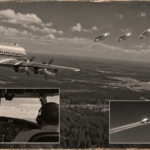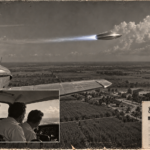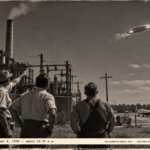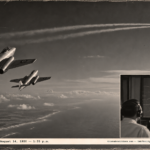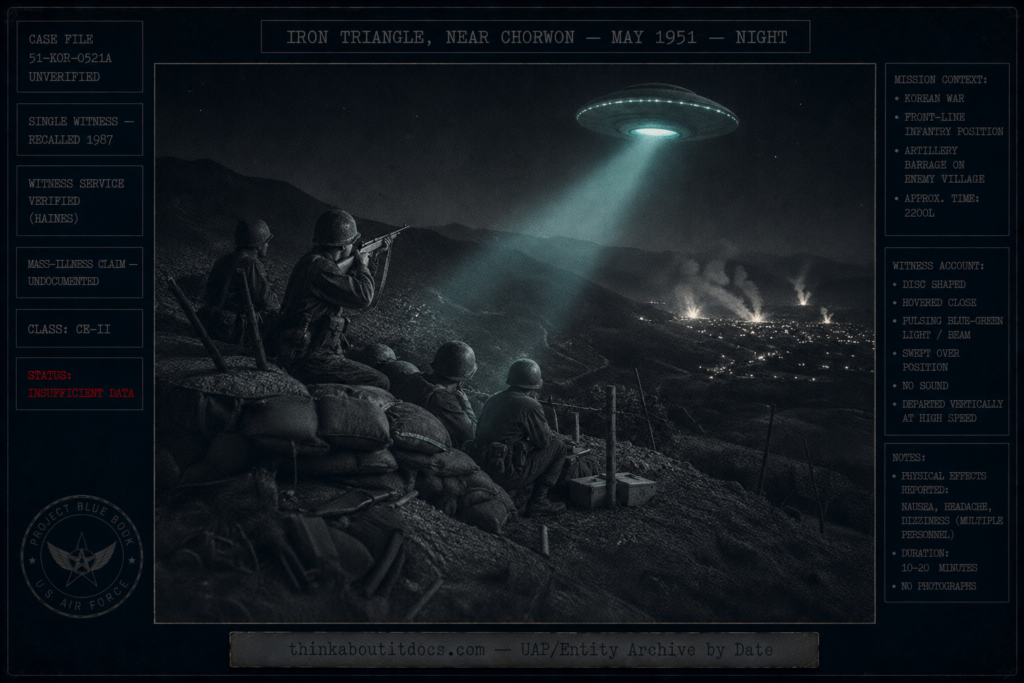
The May 1951 Iron Triangle encounter — PFC Francis Wall said his company shot a craft that survived artillery and swept them with a beam. Witness service verified; event single-source. Logged Insufficient Data. (thinkaboutitdocs.com — UAP/Entity Archive by Date)
THINK ABOUTIT UFO | UAP SIGHTING REPORT
1951: Korean War Battlefield UFO Encounter (Iron Triangle / Francis P. Wall)
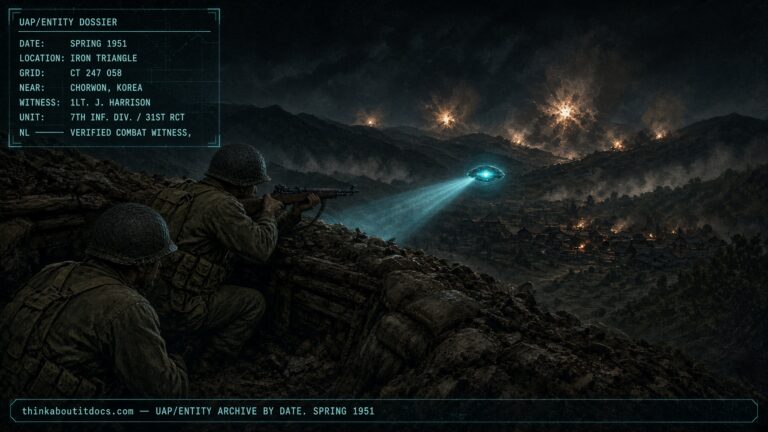
It is one of the few UFO reports to come from an active battlefield, told by a named American combat soldier whose service in the unit he describes was later verified. In May 1951, dug in on a mountain slope in the Iron Triangle near Chorwon as his company shelled a village below, PFC Francis P. Wall watched what he likened to a jack-o-lantern drift down through the bursting artillery, glow orange, then turn a pulsing blue-green and approach his position. He says he fired armor-piercing rounds at it and heard them strike metal; the object lurched, its light flickering, then swept the men with a pulsed beam that left a burning, tingling sensation before it shot away at a sharp angle. Days later, by his account, much of the company was evacuated, too weak to walk, with dysentery and unexplained high white-cell counts. Wall told the story to CUFOS researcher John Timmerman in 1987, and Richard Haines confirmed his service record. The archive keeps it as a serious, service-verified veteran account — and tells it straight: vivid and sincere, but single-source for the object itself, recalled decades later, and with its dramatic medical aftermath undocumented.
Date: May 1951 (Wall described it as early spring)
Sighting Time: Night
Day/Night: Night
Location: Near Chorwon, in the “Iron Triangle,” Korea (a contested front-line zone in 1951; the Chorwon area is in present-day South Korea)
Urban or Rural: Battlefield (mountain slope above a village)
No. of Entity(‘s): None reported
Entity Type: Not applicable
Entity Description: Not applicable
Hynek Classification: CE-II (Close Encounter II) — a structured object at close range associated with claimed physical and physiological effects (corrected from the prior “NL,” which did not fit a shot, maneuvering, beam-emitting craft)
Duration: Roughly 45 minutes to an hour overall, by Wall’s estimate
No. of Object(s): 1
Description of the Object(s): A luminous object first resembling a glowing “jack-o-lantern,” orange at first, that moved through exploding artillery airbursts unharmed, then turned a pulsing brilliant blue-green; reported as apparently metallic (rounds were heard to strike it), able to maneuver erratically, emitting a pulsed, visible directed beam, and accompanied at one point by a sound like diesel locomotives revving; it departed at high speed on a sharp angle
Shape of Object(s): Disc (Wall’s later drawing depicted a classic saucer)
Size of Object(s): Difficult to gauge; by some retellings comparable to a large fighter aircraft, hovering relatively low overhead
Color of Object(s): Orange initially, then pulsing blue-green
Distance to Object(s): Close — hovered over the unit’s position, within rifle range
Height & Speed: Low hover over the position; departed very rapidly on a roughly 45-degree angle
Number of Witnesses: Multiple — Wall’s infantry company (named as 25th Division, 27th Regiment, 2nd Battalion, “Easy” Company), though only Wall is on record describing it
Special Features/Characteristics: Object reportedly unharmed by artillery airbursts; apparently struck by rifle fire with an audible metallic impact; emission of a pulsed directed beam producing a burning, tingling sensation; reported mass illness days later — much of the company evacuated, too weak to walk, with dysentery and unexplained elevated white-blood-cell counts; the encounter was deliberately omitted from the unit’s daily report; Wall reported long-term disorientation, memory loss, and severe weight loss afterward
Case Status: Insufficient Data
Source: Francis P. Wall, interviewed by John Timmerman (J. Allen Hynek Center for UFO Studies) in January 1987; service record checked by Richard F. Haines; distributed via CNI News
Summary/Description: In May 1951, PFC Francis P. Wall and his infantry company, dug in on a mountain slope in the Iron Triangle near Chorwon during an artillery bombardment, reportedly watched a glowing object descend through the airbursts, change from orange to a pulsing blue-green, and approach. Wall said he fired armor-piercing rounds that struck the object with a metallic sound, after which it moved erratically and swept the men with a pulsed beam causing a burning sensation before departing at speed. He stated that days later much of the company was evacuated with debilitating illness and unexplained high white-cell counts. Recounted to CUFOS in 1987 and service-verified by Haines, the account is single-source for the object and recalled decades later; it is logged as Insufficient Data.
Related Cases: 1949: White Sands Proving Ground Sighting | 1979: Silvertown, Korea Encounter | the broader corpus of military close encounters with claimed physiological effects
DETAILED REPORT
By Wall’s account, given to CUFOS researcher John Timmerman in January 1987, the encounter took place in May 1951, when he was a private first class in the U.S. Army’s 25th Infantry Division, 27th Regiment, 2nd Battalion, “Easy” Company, positioned in the Iron Triangle near Chorwon — one of the most violently contested sectors of the Korean War. It was night, and the company was on a mountain slope above a Korean village it had warned and was now bombarding with aerial artillery bursts. To one side, the men noticed a glowing object, like a jack-o-lantern, drifting down across the mountain toward the village. It glowed orange, and what first drew comment was that it could move through the center of an exploding airburst and emerge unharmed.
The object then approached the company’s position and changed to a pulsing, brilliant blue-green. Wall said he obtained permission from his company commander to fire on it and hit it with armor-piercing rounds from an M-1 rifle, hearing the metallic sound of the projectiles striking. The object reacted: its light flickered and briefly went out, and it moved erratically from side to side as if it might come down, accompanied now by a sound he compared to diesel locomotives revving. Then, he said, the men were swept by a pulsed beam — visible, like a searchlight sweeping toward them — that produced a burning, tingling sensation as though something were penetrating the body. The commander ordered the men into their bunkers; the object hovered for a time, lit the area, and then shot away at a sharp angle and was gone. Wall put the whole episode at roughly forty-five minutes to an hour.
The aftermath is the part that makes the case more than a light in the sky. Wall stated that about three days later much of the company had to be evacuated by ambulance, too weak to walk, suffering from dysentery, and that examining doctors found extremely high white-blood-cell counts they could not explain. He added that the unit, after discussion, chose not to record the encounter in the daily company report for fear of being thought crazy, and that he personally suffered long-term disorientation, memory loss, and a drop from 180 to 138 pounds, leaving him disabled.
What gives the account standing is the witness himself. Wall is named, he gave a first-person account on the record, he supplied a drawing of the object (a conventional saucer shape), and the researcher Richard Haines checked military records and confirmed that Wall served as a Korean combatant in the unit he named. That is real verification of the man and his presence — more than most single-witness cases offer. What it does not verify is the event. No second member of “Easy” Company has corroborated the UFO on record; the decision Wall describes, to keep it out of the daily report, means there is by his own account no contemporaneous documentation; and crucially, no unit medical records have surfaced to confirm a mass evacuation, dysentery outbreak, or anomalous blood counts. The single most dramatic and potentially checkable claim — that an entire company fell ill — remains undocumented.
The honest reading holds several possibilities open. If the account is accurate, it describes a structured craft impervious to artillery yet apparently dented by rifle fire, emitting a directed beam with delayed physiological effects — extraordinary, and unexplained. But there are mundane and semi-mundane alternatives that the record cannot exclude: a Soviet or Chinese searchlight or experimental device on a fiercely contested front; misperception of flares, tracer, or ordnance under extreme combat stress at night; and an illness outbreak — dysentery was endemic in Korean field conditions — that ordinary causes would amply explain, later linked in memory to the frightening sighting. A single recollection given thirty-six years afterward cannot adjudicate among these. It can only be recorded for what it is.
RESEARCHER’S NOTES
The Iron Triangle Encounter — Korea 1951 and a Verified Soldier, an Unverified Event
- Classification correction (NL to CE-II): The prior page filed this as NL, a nocturnal light, while its own shape field said “Disc.” NL does not fit. Wall described a structured object that was fired upon and rang metallically, maneuvered erratically, emitted a directed beam, and was associated with claimed physical effects on the witnesses and lasting physiological harm. An object at close range tied to physical and physiological effects is the definition of CE-II, and that is the corrected class. There were no occupants, so it does not rise to CE-III; the effects are what lift it above a simple light.
- Source-chain assessment — verified man, unverified event: The distinction that should govern this case is between the witness and the occurrence. The witness is well-attested: named, first-person, with a drawing, and with his Korean service in the cited unit confirmed by Richard Haines. The occurrence is not: it rests on Wall’s single 1987 telling, thirty-six years after the fact, with no corroborating witness, no contemporaneous report (by his own account suppressed), and — most importantly — no surviving medical documentation of the mass illness that would be the case’s hardest evidence. The prior page reproduced Wall’s full transcript verbatim; this treatment paraphrases it and foregrounds that the strongest, most checkable claim is precisely the one that has never been checked.
- Alternative explanations, held open: Mainstream coverage of the case, including HISTORY’s, lists the live possibilities, and a fair archive records them: a Soviet or Chinese directed-energy or searchlight device on a hotly contested front; combat-stress misperception of flares, tracers, or airburst ordnance at night; and a conventional illness outbreak — dysentery was rife in Korean field conditions — retrospectively bound to the sighting. None of these is established either, and the “impervious to artillery but dented by rifle fire” detail fits no ordinary craft. The point is not to debunk but to mark that several explanations, prosaic and exotic, remain equally unproven.
- Geographic and historical correction: The prior page placed the event in “Chorwon, North Korea.” In May 1951 the Iron Triangle (Chorwon–Kumhwa–Pyonggang) was a savagely contested front-line battleground, not DPRK rear area, and the Chorwon township itself lies in present-day South Korea. Labeling it “North Korea” is wrong on both counts and has been corrected to locate it accurately within the front-line Iron Triangle. The setting matters: an active artillery engagement at night is both why the sighting is striking and why misperception and conventional military technology cannot be dismissed.
The Korean War battlefield encounter is among the most arresting military UFO accounts on record, and it comes from a real, identifiable combat veteran whose service has been confirmed — which is exactly why it must be handled with discipline rather than awe. Told straight, it is a sincere, vivid, single-source recollection given decades later: the man is verified, the event is not, and its most testable element, the company-wide illness, has no surviving documentation. Reclassified from a nocturnal light to the close encounter with physical effects it actually describes, relocated to the front-line Iron Triangle where it belongs, and stripped of false certainty in either direction, it stands as Insufficient Data — neither dismissed nor inflated.
Source

Korean War Battlefield UFO Encounter
Bizarre Craft Hit Soldiers With Debilitating Light Beam
Courtesy John Timmerman, J. Allen Hynek Center For UFO Studies
Courtesy CNI News
This text is an edited transcript of an interview between Mr. Francis P. Wall, a private first class (PFC) in the U.S. Army during the Korean War, and John Timmerman, an associate of the J. Allen Hynek Center for UFO Studies (CUFOS) in Chicago, Illinois. The interview took place in January, 1987. Noted UFO researcher Richard F. Haines checked military records and found Mr. Wall listed as a Korean combatant in the infantry unit he names below. Haines also requested and received from Mr. Wall a drawing of the aerial object he claims to have seen. The drawing depicts a very typical “flying saucer.” CNI News thanks John Timmerman for permission to reprint this text. Mr. Wall recounts his experience as follows:
“This event that I am about to relate to you is the truth, so help me God. It happened in the early Spring of 1951 in Korea. We were in the Army infantry, 25th Division, 27th Regiment, 2nd Battalion, ‘Easy’ Company. We were in what is known on the military maps as the Iron Triangle, near Chorwon.
“It is night. We are located on the slopes of a mountain, below [which] there is a Korean village. Previously we have sent our men into this village to warn the populace that we are going to bombard it with artillery. On this night, we were doing just that. We had aerial artillery bursts coming in.
“We suddenly noticed on our right-hand side what appeared to be a jack-o-lantern come wafting down across the mountain. And at first no one thought anything about it. So we noticed that this thing continued on down to the village to where, indeed, the artillery air bursts were exploding. It had an orange glow in the beginning. We further noticed that this object was [so] quick that it could get into the center of an airburst of artillery and yet remain unharmed.
“[The] time element on this, I would say, [was] anywhere from, oh, forty-five minutes to an hour all told.
“But then this object approached us. And it turned a blue-green brilliant light. It’s hard to distinguish the size of it; there’s no way to compare it. The light was pulsating. This object approached us.
“I asked for and received permission from Lt. Evans, our company commander at that time, to fire upon this object, which I did with an M-1 rifle with armor-piercing bullets. And I did hit it. It must have been metallic because you could hear when the projectile slammed into it.
“Now why would that bullet damage this craft if the artillery rounds didn’t? I don’t know, unless they had dropped their protective field around them, or whatever. But the object went wild, and the light was going on and off. It went off completely once, briefly. And it was moving erratically from side to side as though it might crash to the ground. Then, a sound — we had heard no sound previous to this — the sound of, like, diesel locomotives revving up. That’s the way this thing sounded.
“And then, we were attacked. We were swept by some form of a ray that was emitted in pulses, in waves that you could visually see only when it was aiming directly at you. That is to say, like a searchlight sweeps around and… you would see it coming at you. Now you would feel a burning, tingling sensation all over your body, as though something were penetrating you.
“So the company commander, Lt. Evans, hauled us into our bunkers. We didn’t know what was going to happen. We were scared. These are underground dugouts where you have peep holes to look out to fire at the enemy. So, I’m in my bunker with another man. We’re peeping out at this thing. It hovered over us for a while, lit up the whole area with its light, and then I saw it shoot off at a 45 degree angle, that quick, just there and gone. That quick. And it was as though that was the end of it.
“But, three days later the entire company of men had to be evacuated by ambulance. They had to cut roads in there and haul them out. They were too weak to walk. They had dysentery. Then subsequently, when the doctors did see them, they had an extremely high white blood cell count which the doctors could not account for.
“Now in the military, especially the Army, each day you file a company report. We had a confab about that. Do we file it in the report or not? And the consensus was ‘No.’ Because they’d lock every one of us up and think we were crazy. At that time, no such thing as a UFO had ever been heard of, and we didn’t know what it was.
“I still don’t know what it was. But I do know that since that time I have periods of disorientation, memory loss, and I dropped from 180 pounds to 138 pounds after I got back to this country. And I’ve had great difficulty keeping my weight up. Indeed, I’m retired and disabled today.”