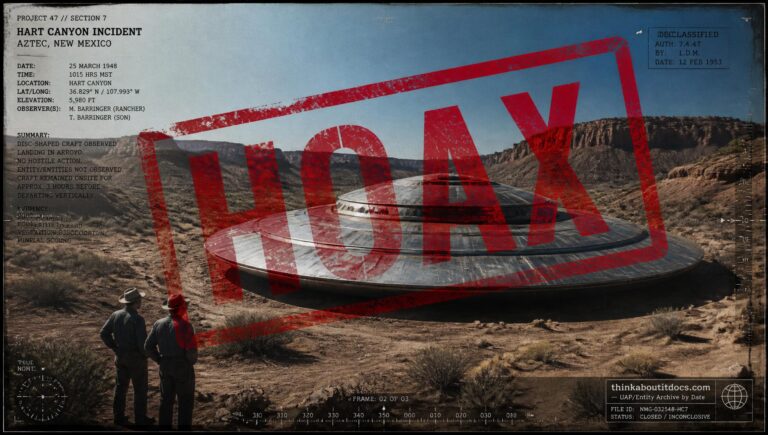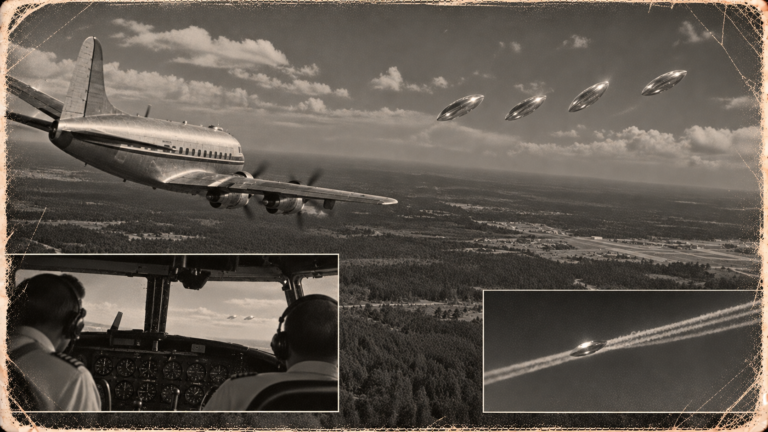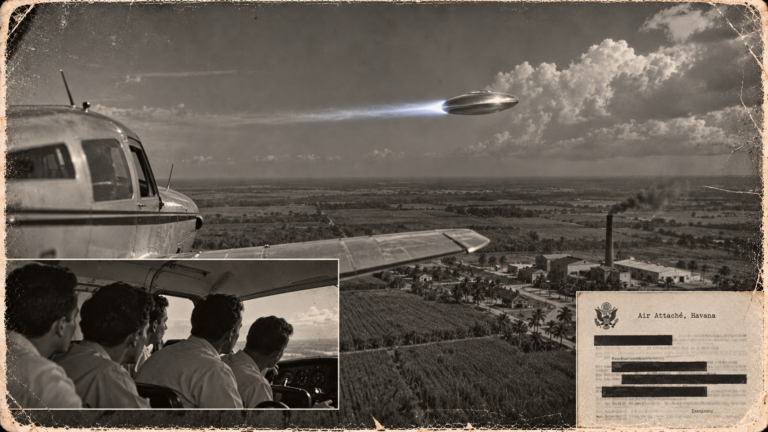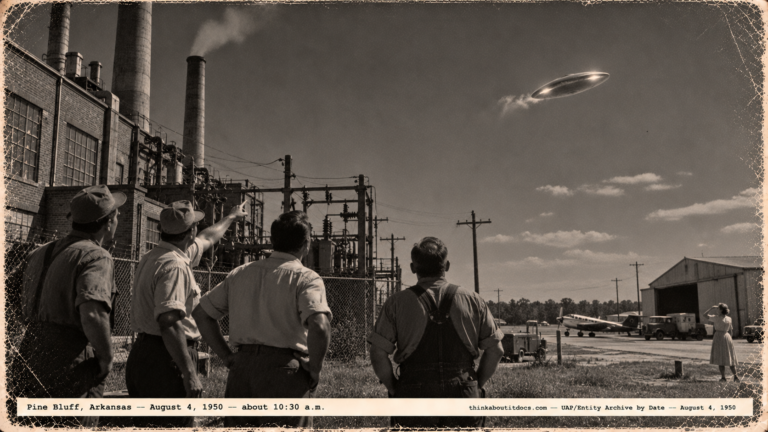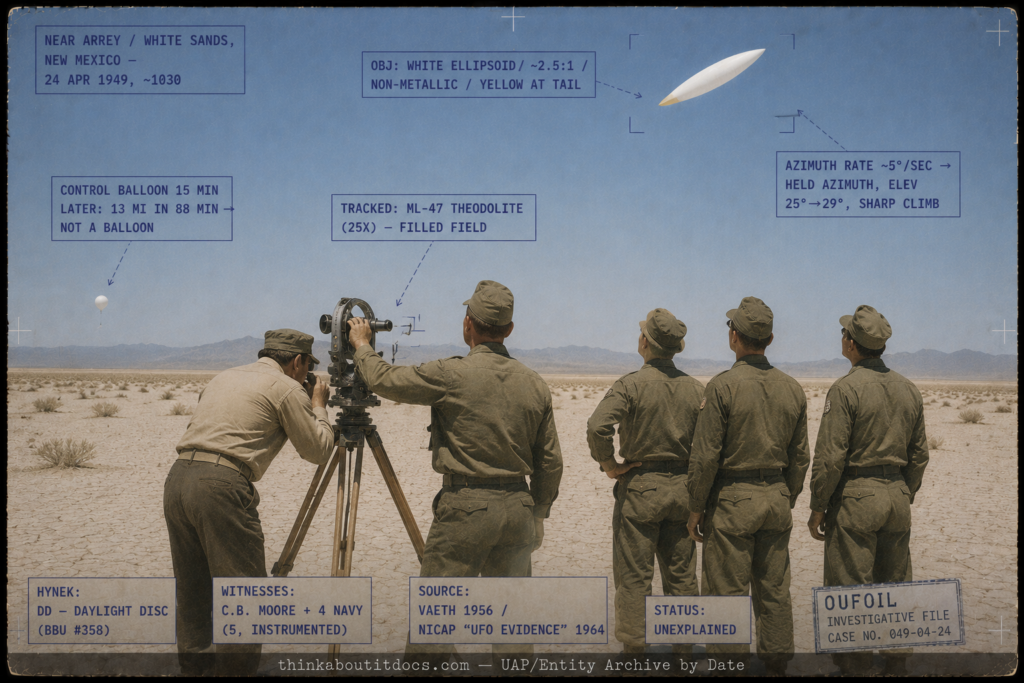
Balloon expert Charles Moore tracks a white ellipsoid through a theodolite at White Sands, April 24, 1949 — then proves with a control balloon that it was nothing of the kind.
THINK ABOUTIT UFO | UAP SIGHTING REPORT
1949: UFO seen by observers at White Sands Proving Ground
The balloon men didn’t believe in flying saucers. The General Mills crews who launched and chased the great plastic research balloons across the Southwest had heard every breathless report and dismissed them — until the morning of April 24, 1949, when one of their own, aerologist Charles B. Moore, was tracking a weather balloon through a theodolite at White Sands and looked up to find it with his naked eye. What he caught instead, sliding out of the sun, was a gleaming white ellipsoid, two and a half times as long as it was wide, crossing the desert sky far too fast for any balloon. He swung the 25-power scope onto it; it filled the field. For about a minute he and four Navy enlisted men watched it track north, then suddenly climb and vanish in a sharp ascent. Fifteen minutes later Moore sent up another balloon to settle the question — it crawled thirteen miles in 88 minutes. Whatever he’d tracked was no balloon. The man whose own Skyhook flights would explain away other people’s saucers had logged one he could not explain himself.
Date: April 24, 1949 (Project Blue Book Unknown — BBU #358)
Sighting Time: ~10:30 AM
Day/Night: Day
Location: Near Arrey / White Sands Proving Ground, New Mexico (balloon-launch site ~3 miles north of Arrey)
Urban or Rural: Rural (isolated desert mud flat)
No. of Entity(‘s): None reported
Entity Type: Not applicable — no occupants or entities
Entity Description: Not applicable
Hynek Classification: DD (Daylight Disc) — a structured, whitish object observed and instrument-tracked in daytime. (Not CE-I: the object was high overhead and optically tracked, far beyond the ~500-ft close-encounter threshold.)
Duration: ~60 seconds
No. of Object(s): 1
Description of the Object(s): An ellipsoid roughly 2½ times as long as it was wide, subtending about 0.02 degrees, gleaming white but without metallic or reflected shine, shading to light yellow toward the underside near the tail. It moved at roughly 5 degrees of azimuth change per second, tracked north, then abruptly climbed in elevation and vanished in a sharp ascent. No vapor trail, no exhaust, no sound.
Shape of Object(s): Ellipsoid / oval (elongated, ~2.5:1)
Size of Object(s): ~0.02° subtended angle (true size indeterminate without range); filled the field of a 25-power theodolite scope
Color of Object(s): Gleaming white (non-metallic, non-reflective), shading to light yellow near the tail underside
Distance to Object(s): Not directly measured; established as not a balloon below 90,000 ft by comparison flight
Height & Speed: Angular rate ~5°/sec azimuth change; tracked from ~45° elevation/210° azimuth, moving to ~20–25° azimuth where azimuth held constant while elevation rose sharply (25° → 29°) before disappearing in a steep climb; a comparison balloon released 15 min later traveled only 13 miles in 88 min to 93,000 ft, proving the object’s angular speed was impossible for a balloon below 90,000 ft
Number of Witnesses: 5 — Charles B. Moore Jr. (aerologist/engineer/balloonist, observing through the theodolite) and four U.S. Navy enlisted personnel; object visible to the naked eye and seen by all
Special Features/Characteristics: Instrumented tracking (ML-47/David White theodolite, 25-power; stop watch); trained, technical observers; immediate same-site control experiment (a second balloon) ruling out a balloon explanation; cloudless, haze-free sky; no sound in an extremely quiet desert setting; abrupt sharp climb-out; the lead witness was a balloon expert predisposed to skepticism; one of the best instrumentally-substantiated early sightings on record
Case Status: Unexplained
Source: J. Gordon Vaeth, “200 Miles Up: The Conquest of the Upper Air” (Ronald Press, 1956), pp. 113–116, reproduced via Richard Hall (ed.), “The UFO Evidence,” NICAP, 1964; Project Blue Book Unknown #358
Summary/Description: On the morning of April 24, 1949, during a Navy Office of Naval Research Skyhook operation near Arrey/White Sands, New Mexico, aerologist Charles B. Moore Jr. and four Navy enlisted men were tracking a small weather balloon with a 25-power theodolite. At about 10:30 AM, looking for the balloon, Moore spotted a gleaming white ellipsoid — about 2½ times as long as wide, non-metallic, shading to light yellow at the tail — moving east/north at roughly 5° of azimuth per second. He tracked it through the theodolite (with a colleague pointing the instrument because of its speed) as it filled the 25-power field, then watched it hold azimuth while sharply increasing elevation and vanishing in a steep climb after about 60 seconds. A control balloon released 15 minutes later traveled only 13 miles in 88 minutes to 93,000 ft, demonstrating the object could not have been a balloon. The cloudless sky was haze-free; the object made no sound and left no trail. The case is logged as a Project Blue Book Unknown (#358) and is among the best instrumentally-substantiated early sightings.
Related Cases: 1948 Thomas Mantell incident (Skyhook-balloon explanation — same balloon program/expert Charles Moore) | 1947 Roswell incident (Project Mogul / Moore’s balloon work as leading debris explanation) | 1950 UFO Crash near Albuquerque | other White Sands / Project Blue Book “Unknowns” | the broader instrumented-observer corpus (Section V/VI, The UFO Evidence)
DETAILED REPORT
This is one of the strongest instrumented sightings of the early era, and its weight derives almost entirely from the quality of the observers and the presence of tracking equipment. The account comes from J. Gordon Vaeth, the Navy representative in charge of the ground-handling and balloon phases of an Office of Naval Research Skyhook operation, who was present that day and published the full account in his 1956 book “200 Miles Up.” It is reproduced in NICAP’s “The UFO Evidence” (Richard Hall, ed., 1964) and carried in Project Blue Book as Unknown #358.
The principal observer was Charles B. Moore Jr. — an aerologist, graduate engineer, and balloonist, and a figure of considerable later significance to UFO history, as it was Moore’s expertise on high-altitude balloons that would underpin both the Skyhook explanation of the Mantell case and the Project Mogul explanation of the Roswell debris. On April 24, 1949, Moore and four Navy enlisted men had set up a balloon-observation site about three miles north of Arrey, New Mexico, with a stop watch and an ML-47 (David White) theodolite — a tracking instrument built around a 25-power telescope giving precise elevation and azimuth readings. At 10:20 AM they released a small 350-gram weather balloon to measure upper winds. Moore tracked it with the theodolite until just after the 10:30 reading, when he relinquished the instrument to find the balloon by naked eye.
Searching the sky, he saw a whitish object along the direction the theodolite had been pointing — at about 45° elevation and 210° azimuth — and at first took it for his balloon. But it was moving east at roughly 5 degrees of azimuth per second, far too fast, and when the angular discrepancy became obvious Moore swung the theodolite back, confirmed the real balloon was still in place, abandoned it, and picked up the unknown object as it came out of the sun. It was moving too fast to track by cranking the theodolite, so one of the men pointed the instrument while Moore observed through the scope. He described an ellipsoid about 2½ times as long as it was wide, subtending roughly 0.02 degrees, gleaming white but without metallic or reflected shine, shading to light yellow toward the underside near the tail. Readily visible to the naked eye and seen by all five men, it filled the field of the 25-power scope; its speed prevented a hard focus, so no fine detail was resolved. As it continued north the azimuth decreased to 20–25° and then held constant — and at that moment the elevation suddenly rose from about 25° to 29°, the object disappearing in a sharp climb after roughly 60 seconds of observation.
What makes the case exceptional is the built-in control experiment. Fifteen minutes after the object vanished, Moore launched another pibal balloon to check winds; it rose for 88 minutes to 93,000 feet and drifted only 13 miles southward. This was, as Vaeth put it, positive proof that the object could not have been a balloon moving at such an angular speed below 90,000 feet — the winds simply did not support it, and a balloon could not climb in the way observed. The sky was cloudless and haze-free; the desert was extremely quiet, with no cars, aircraft, or other noise to mask any sound, and the object made none; it left no vapor trail or exhaust. Later that day, when aircraft passed near the site, Moore’s group identified each by appearance and engine noise and saw nothing resembling the white ellipsoid again.
Vaeth, notably cautious, made clear that neither he nor Moore claimed the object was a “flying saucer,” and invited readers to evaluate it for themselves — while flatly stating it was authentic, instrumented, and one of the best-substantiated unidentified sightings on record. The honest assessment matches his restraint and his confidence at once: this is a daytime, multiple-trained-witness, instrument-tracked observation of a structured object, with the most obvious prosaic candidate (a balloon, including the very Skyhook balloons Moore himself flew) specifically excluded by a same-site control flight, no aircraft match, and behavior — a 5°/sec azimuth rate and an abrupt elevation climb — that no balloon or conventional 1949 aircraft fits cleanly. It is genuinely unexplained.
RESEARCHER’S NOTES
The Skeptic’s Own Unknown — Charles Moore, White Sands 1949, and the Balloon That Wasn’t
- Classification Basis: DD (Daylight Disc) is correct: a structured, elliptical, whitish object observed and instrument-tracked in full daylight, with no occupants and no close approach. The live page’s CE-I is a misclassification — a CE-I requires the object within roughly 500 feet, whereas this object was high overhead, its size known only as a subtended angle and its range never directly measured. No close-encounter category applies; this is a high-quality DD.
- Source Assessment (Strong): The provenance is excellent for the period. The account is a first-person technical narrative by the Navy officer in charge of the operation (J. Gordon Vaeth), published in a mainstream 1956 book, reproduced in NICAP’s authoritative “The UFO Evidence” (1964), and carried in Project Blue Book as Unknown #358. The observers are named and credentialed (an aerologist/engineer plus four Navy personnel), and crucially the lead witness, Charles B. Moore, was a balloon expert — precisely the person least likely to mistake a balloon for something exotic, and predisposed to skepticism. This sits firmly in the primary/strong tier.
- The Control Experiment — Why the Balloon Explanation Fails: The decisive element is methodological. Most early cases can only argue against a balloon by inference; here, Moore ran an actual same-site control. The unknown moved at ~5°/sec of azimuth change and then climbed sharply in elevation; the comparison balloon released 15 minutes later took 88 minutes to reach 93,000 feet and drifted just 13 miles. The local winds and balloon performance simply could not produce the observed angular motion below 90,000 feet, and no balloon climbs as the object did. This is the rare case where the most likely prosaic explanation is excluded by direct measurement rather than dismissed by assertion — and excluded by the very expert whose balloons explain other famous cases.
- The Historical Irony and Cross-Links: Charles B. Moore is a pivotal figure in the conventional-explanation side of UFO history: his Skyhook balloons are the standard explanation for the 1948 Mantell death, and his Project Mogul work is the leading explanation for the 1947 Roswell debris. That the same man — skeptical, technically expert, instrument-equipped — personally tracked an object he could not explain, and specifically ruled out his own balloons, gives this case unusual evidentiary force. It cannot be waved away as naïve-observer error or balloon misidentification, the two explanations Moore himself spent a career applying to others.
- Physical Evidence and Evidentiary Weight: There is no recovered physical evidence — no photograph (the object’s speed prevented hard focus), no radar, no material. But the case carries something rarer: instrument-grade angular measurements, multiple trained witnesses, a control experiment excluding the leading prosaic candidate, and exclusion of aircraft by direct comparison later the same day. The only true limitation is that range (and therefore absolute size and speed) was never fixed, leaving the object’s nature open. On weight of evidence — credentialed instrumented observation, balloon and aircraft excluded, no conventional fit — Unexplained is firmly warranted, and the case ranks among the best-substantiated of the early record.
The White Sands sighting of April 24, 1949 is the early era’s instrumented benchmark: a gleaming white ellipsoid tracked through a 25-power theodolite by a skeptical balloon engineer and four Navy men, moving at an angular rate and climbing in a way no balloon could manage — a conclusion Charles Moore proved on the spot by launching a control balloon that crawled thirteen miles while his unknown had crossed the sky and climbed out of sight in a minute. There is no photograph and the range was never fixed, so the object’s true size, speed, and nature remain open. But the witnesses were trained, the tracking was instrumental, the leading prosaic explanation was excluded by direct experiment, and aircraft were ruled out the same day. The archive logs the case as DD (Daylight Disc), Case Status Unexplained — and notes the deep irony that the man whose balloons explain Mantell and Roswell once tracked, and could not explain, a saucer of his own.