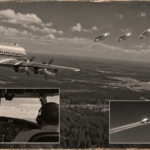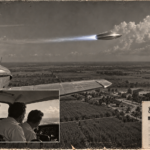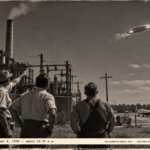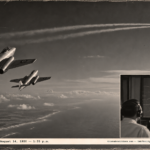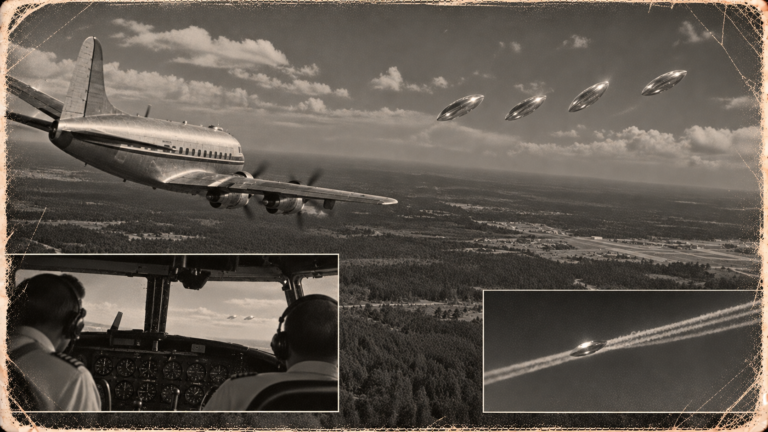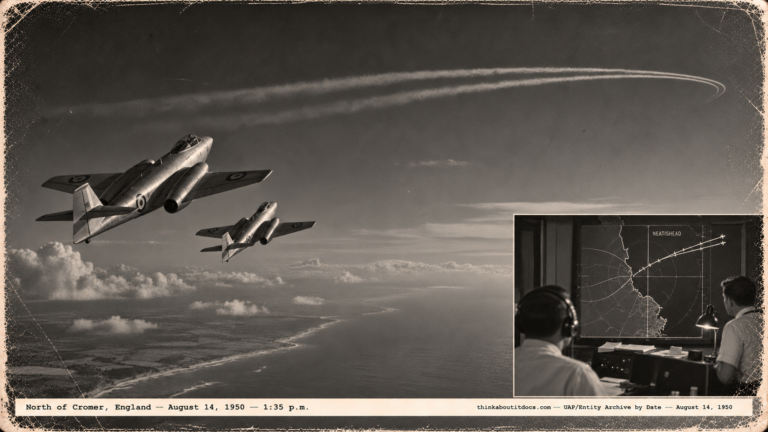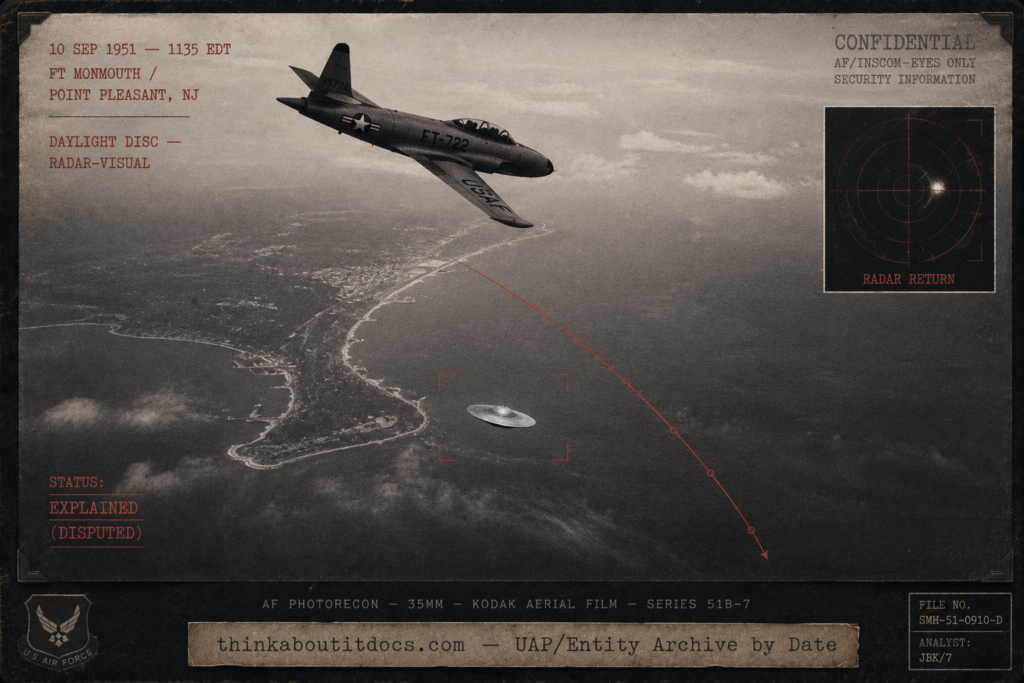
: September 10, 1951 — Lt. Wilbert Rogers spirals his T-33 down 3,000 feet to keep a silver disc in sight off Sandy Hook. The Air Force called it a balloon; the pilots never agreed.
THINK ABOUTIT UFO | UAP SIGHTING REPORT
1951: The Fort Monmouth UFO Case
The Cold War’s most consequential balloon may never have been a balloon at all. On a clear Monday morning over the New Jersey coast, a student radar operator at Fort Monmouth painted a target moving faster than his set could automatically plot — with a roomful of visiting Army brass watching over his shoulder — and seventeen minutes later two veteran Air Force pilots in a T-33 trainer threw their jet into a hair-raising 360-degree, 3,000-foot descending spiral just to keep a dull silver disc in sight as it banked beneath them and out-paced them out to sea. The Air Force closed it as a weather balloon. The pilots said the investigators were nuts. And the case that should have been a footnote instead became the spark that burned Project Grudge to the ground and rebuilt it as Blue Book.
Date: September 10, 1951
Sighting Time: 11:18 A.M. EDT (radar) / 11:35 A.M. EDT (T-33 visual)
Day/Night: Day
Location: Fort Monmouth, New Jersey (radar) / over Point Pleasant–Sandy Hook, New Jersey (visual)
Urban or Rural: Rural / coastal
No. of Entity(‘s): 0
Entity Type: None reported
Entity Description: N/A — no occupants or figures observed
Hynek Classification: DD (Daylight Disc) — radar-visual concurrence
Duration: Approximately two minutes (T-33 visual); radar contact moments
No. of Object(s): 1 discrete daylight disc (additional anomalous radar targets logged separately over September 10–11)
Description of the Object(s): A dull, silvery body, perfectly round and flat with a slightly raised center; no exhaust trail, wings, control surfaces, or visible propulsion
Shape of Object(s): Discus-like / disc
Size of Object(s): Estimated 30 to 50 feet in diameter
Color of Object(s): Dull silver / metallic, non-reflective
Distance to Object(s): Object passed roughly 12,000 feet below the T-33 at the moment of acquisition (aircraft at 20,000 ft)
Height & Speed: Descended through approximately 5,000 feet in a banking arc, then leveled and accelerated out over the Atlantic near the speed of sound; estimated speed ~700 mph, out-pacing the T-33 even after pilot throttled from 450 to 550 mph; covered roughly 35 miles during the two-minute sighting. Initial Fort Monmouth radar target tracked at no less than 700 mph.
Number of Witnesses: Multiple — radar operator PFC Eugene A. Clark plus several visiting Army officers at the radar facility; airborne, pilot Lt. Wilbert S. Rogers and observer Major Edward Ballard Jr.
Special Features/Characteristics: Concurrent radar and visual events on the same morning; object out-flew a jet trainer; executed a descending arc-like turn and 90-degree heading change; no propulsion signature; round-flat profile with raised center; ground control captured the pilots’ open-mike exchange during the encounter
Case Status: Explained (Air Force official disposition: balloon and radar operator error — contested by witnesses)
Source: Michael Hall & Wendy Connors, “Captain Edward J. Ruppelt” (NICAP / nicap.com); corroborated by Edward J. Ruppelt, The Report on Unidentified Flying Objects (1956) and his unedited manuscript; Project Grudge Status Report, November 30, 1951; U.S. Army historical archive
Summary/Description: A radar-tracked high-speed target at Fort Monmouth and a near-simultaneous daylight disc observed by two T-33 aircrew over the New Jersey coast. The Air Force attributed the radar contact to operator error and the visual object to two balloons released minutes earlier from the Evans Signal Laboratory. The pilots rejected the balloon explanation outright. The institutional fallout — a furious Major General Cabell, an Operational Immediate investigation, and a top-secret Pentagon meeting whose wire recording was deliberately destroyed — directly precipitated the reorganization of Grudge into Project Blue Book.
Related Cases: 1948 Mantell Incident (raised at the same Pentagon meeting) | 1951 Lubbock Lights and 1952 Washington National radar-visual cases (Blue Book era radar-visuals) | 1946 Scandinavian “ghost rocket” reports (cited as the lineage of military interest in unidentified aerial objects)
Full Report
The Fort Monmouth case is built from two events on the morning of September 10, 1951, knotted together by timing and geography. At 11:18 A.M. EDT, PFC Eugene A. Clark, a student operator on an AN/MPG-1 set at the Army Signal Corps radar school near the New Jersey coast, picked up a low-flying target moving too fast for the set’s automatic tracking mode. A group of visiting Army officers happened to be standing behind him, and so the anomaly was witnessed by experienced military personnel rather than a lone trainee. The target crossed toward the Sandy Hook peninsula at an estimated speed of at least 700 miles per hour before fading from the scope — a velocity that, in 1951, no operational aircraft sustained in routine flight.
Seventeen minutes later, at 11:35 A.M., the second event unfolded south of Sandy Hook. A T-33 jet trainer flying north at 20,000 feet over Point Pleasant carried Lieutenant Wilbert S. Rogers at the controls and Major Edward Ballard Jr. in the rear seat. Rogers — an experienced WWII fighter pilot — spotted a dull silver object far below on an opposing parallel course, roughly 12,000 feet beneath them. He delayed his Mitchel AFB approach and turned left to keep it in view while Ballard finished a radio call. As both men watched, the object banked, showing a discus-like silhouette, and dropped into a descending arc that threatened to pass under their flight path. Rogers nosed the T-33 into a 360-degree, 3,000-foot descending spiral to hold contact. Both pilots estimated the craft at 30 to 50 feet across, perfectly round and flat with a raised center, showing no exhaust or propulsion. It out-paced the jet even as Rogers pushed his speed from 450 to 550 mph, then leveled near 5,000 feet, completed a 90-degree turn, and accelerated out to sea near the speed of sound — covering an estimated 35 miles in the roughly two minutes the sighting lasted. Ground control captured part of the pilots’ excited exchange over an open microphone.
The witness credibility here is the case’s center of gravity. These were not panicked civilians but a decorated combat aviator, a major acting as observer, and a radar crew under the eyes of visiting officers. Asked later what he had seen, Rogers said only that it was something he had never encountered, and that it was emphatically not a balloon — it was descending and moving at great speed. That insistence never wavered, even after the official analysis landed.
That analysis came from within the Air Force’s own reorganizing UFO effort. When Edward Ruppelt took the reins of the moribund Grudge project that fall, he treated the case seriously and respected the aircrew — but he leaned on the engineering judgment of his trusted associate Henry “Hank” Metscher. Metscher plotted the path of a balloon released from the Evans Signal Laboratory, the path of the T-33, and the reported path of the object, and argued the balloon sat consistently along the line of sight between the jet and where the pilots placed the UFO. He contended that every reported motion could be explained by the relative movement of jet and balloon combined with the crew’s inability to judge distance to an object of unknown size. The November 30 status report to the Pentagon stated that two balloons had been released from Evans Signal Laboratory at approximately 11:12 EDST and would have moved into a position nearly in line with Point Pleasant. The radar contacts were attributed to operator error and, in some accounts, thermal inversion; a separate slow-moving high target that same afternoon was conclusively tied to a balloon launch.
The friction in the record is real and worth preserving. Air Force documents do confirm balloons were aloft in the area at the time — but those same records place the balloons near 18,000 feet, against the roughly 5,000-foot ceiling Rogers estimated for the object, with the balloons bursting at 104,000 feet shortly after. Ruppelt himself recorded that when the balloon conclusion was presented to them, the two officers said the investigators were “nuts” and found holes in the analysis. Colonel Rosengarten, who personally interviewed the pilots, told later researchers they would have come to blows over the balloon verdict.
The institutional aftermath is what makes this a watershed rather than a closed file. The pilots’ sighting leaked to the press through a Mitchel AFB public information officer before Major General Charles Cabell, the director of Air Force Intelligence, had even been briefed. Cabell — who had already demanded personal notification of significant UFO activity and who later called the Grudge report a poorly written, unscientific piece of work — learned of the affair from a press circular eighteen days after the fact and erupted. An Operational Immediate order sent Lieutenant Colonel Rosengarten and Lieutenant Jerry Cummings to New Jersey, and the resulting Pentagon conference (with a Republic Aircraft representative present) was so sensitive that its wire recording was deliberately destroyed afterward. Out of that meeting came Cabell’s order for an open-minded, properly resourced investigation — the reorganization that became “New Grudge” and, by 1952, Project Blue Book under Ruppelt.
Researcher’s Notes
The Balloon That Outran a Jet — Fort Monmouth 1951 and the Catalyst Case
- Classification — DD with a radar-visual spine, RV defensible: The page’s existing DD (Daylight Disc) label is correct for the primary classifiable event: a silver disc observed in daylight by two aircrew. Because the morning also produced concurrent radar contact, the case sits squarely in Hynek’s radar-visual territory and could legitimately be logged RV. We retain DD as the lead classification — the discrete, described daylight object is the strongest evidentiary element — while flagging the radar concurrence as the feature that elevates it above an ordinary visual. No entities were reported; no close-encounter class applies. The Air Force’s “Explained” disposition is recorded faithfully here as the official status, but it is precisely the disposition the primary witnesses rejected, and the archive notes that contest rather than laundering it.
- Source chain — strong and converging: The standing source on the page is the Hall & Connors NICAP biography of Ruppelt, which draws on Ruppelt’s published book, his unedited manuscript, his private papers, and 1999 interviews with Colonel Rosengarten and Henry Metscher. This is a high-tier chain: participant testimony, contemporaneous status reports, and declassified Blue Book material, cross-checked against one another. Independent corroboration is robust — the U.S. Army’s own historical archive confirms the date, the 40–50-foot estimate, the 700-mph speed, and the balloon disposition. This is one of the better-documented early-1950s military cases in the record, and the documentation includes the dissent, not just the verdict.
- Pattern context — the institutional inflection point: Fort Monmouth’s significance is less in the object than in what it triggered. It is the hinge between the dismissive Grudge era and the comparatively rigorous Blue Book era, and it belongs in a thread with the 1948 Mantell case (literally re-litigated at the Cabell meeting) and the radar-visual wave that followed in 1952 — Washington National chief among them. It also sits inside the documented “signal buried in noise” dynamic this archive tracks: a credible, hard-to-explain core event, an official explanation the witnesses found inadequate, and a deliberate institutional preference for keeping the matter quiet — here literalized by the destruction of the meeting’s wire recording.
- Physical evidence and the altitude problem: No instrumented physical trace survives — no film, no recovered hardware, no preserved radar tape. The evidentiary weight rests on multiple-witness testimony plus radar, and on the internal tension within the Air Force’s own balloon reconstruction. The decisive unresolved detail is altitude: the official balloons are placed near 18,000 feet and burst at 104,000, while Rogers tracked his object descending through and leveling near 5,000 feet before accelerating out to sea. Metscher’s line-of-sight model can absorb a great deal of apparent motion as parallax — but parallax does not by itself explain an object the aircrew watched out-accelerate a throttled-up jet. The honest evidentiary position is that the balloon hypothesis is plausible and officially adopted, but not demonstrated to the satisfaction of the best-placed witnesses.
Fort Monmouth is filed as Explained, and the archive lets that stand because it is what the Air Force concluded and what the surviving documents support on paper — two balloons, a line of sight, an inexperienced radar crew. But the record’s honest final position is that this is an explanation under protest. The men with the best vantage, a combat-tested pilot and his observer, never accepted it, and the physical particulars they reported — the low altitude, the acceleration, the disc that out-ran their jet — were never reconciled with the balloon track, only argued around. Whatever crossed the New Jersey coast that morning, its lasting effect is not in dispute: it shamed an indifferent project into becoming a real one. Fort Monmouth is the case that made the United States Air Force decide, however reluctantly, that the question deserved a serious answer.