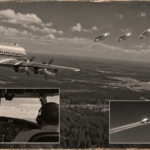
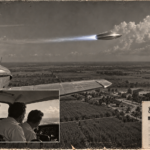
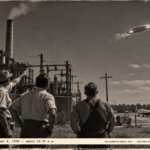
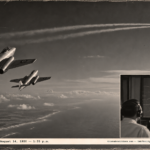
Lubbock, Texas, August 1951 — the night formation later photographed by Carl Hart Jr.
THINK ABOUTIT UFO|UAP SIGHTINGS REPORT
1951: The Lubbock Lights — Texas Tech’s Most Photographed UFO Case
On a clear August night in 1951, three Texas Tech professors watched thirty starlike lights race silently across the sky in a crescent — and within a week, one teenager’s five photographs of the same phenomenon would become some of the most scrutinized UFO images the Air Force ever examined, and never fully explained.
Date: August 25–31, 1951 (initial flap); additional sightings reported intermittently through November 1951
Sighting Time: Approximately 9:10–9:20 p.m. (August 25); approximately 10:37 p.m. (August 30, the night Carl Hart Jr. photographed the lights)
Day/Night: Night
Location: Lubbock, Texas, with additional reports from surrounding Lubbock County, including Brownfield and Matador
Urban or Rural: Urban core sightings (Texas Tech campus and residential backyards) with additional rural reports across the surrounding county
Hynek Classification: NL (Nocturnal Light) — point or extended luminous source observed at night
Duration: Each individual flight crossed the sky in a matter of seconds; the wider phenomenon recurred across multiple nights over roughly two weeks, with Professor Ducker alone reporting twelve separate flights between August and November
No. of Object(s): Reports ranged from 8–9 up to 20–30 lights per flight
Size of Object(s): Individually estimated at roughly the apparent size of a dinner plate or small Frisbee at altitude; in Hart’s photographs, each light appeared more intense than the planet Venus
Distance to Object(s): Unknown — altitude and range were never established; the professors calculated only angular speed (roughly 30 degrees of arc per second)
Shape of Object(s): Individual point lights, collectively arranged in crescent, “U”, or “V” formations
Color of Object(s): Described variably across witnesses as star-like but brighter, blue-white with a faint yellow tinge, or a soft glowing bluish-green
Number of Witnesses: At least five named Texas Technological College faculty — Dr. W.I. Robinson (geology), Dr. A.G. Oberg (chemical engineering), Professor W.L. Ducker (petroleum engineering), Professor E. Richard Heineman (mathematics), and Grayson Mead, plus German-department professor Carl Hemminger — along with student photographer Carl Hart Jr., three unnamed women witnesses, Lubbock residents Joe Bryant and his wife, an elderly rancher near Brownfield, and hundreds of additional nonscientific observers across the region
Special Features/Characteristics: Formation flight with no sound reported by most witnesses (one witness, Roger Dods, described a faint rustling or whooshing as the objects passed overhead); five surviving photographs analyzed in detail by the Wright-Patterson Air Force Base physics laboratory, which could neither confirm nor disprove their authenticity; Texas Tech professors who witnessed the lights firsthand disputed that Hart’s photographed “V” formation matched the “U” formation they had personally observed
Case Status: Unexplained — the Air Force’s working theory attributed the lights to migrating plovers reflecting Lubbock’s newly installed vapor streetlights, an explanation game wardens and several witnesses directly disputed, since plovers do not flock in the numbers reported; Hart’s photographs were never proven either genuine or fraudulent
Source: Capt. Edward J. Ruppelt, “The Report on Unidentified Flying Objects” (1956); contemporary Lubbock Avalanche-Journal coverage; Life magazine, April 1952; U.S. Air Force Project Blue Book case files
Summary/Description: On the night of August 25, 1951, three Texas Technological College professors sitting in a backyard in Lubbock watched two successive formations of 20–30 silent, star-bright lights race across the sky in a crescent shape. Over the following days and weeks, hundreds of other Lubbock-area residents reported similar formations, and on August 30 a Texas Tech freshman, Carl Hart Jr., managed to photograph the phenomenon directly, capturing five exposures showing 18–20 lights arranged in V-shaped formations. The photographs were published nationally and in Life magazine, and were extensively analyzed by Air Force investigators without a firm conclusion. Capt. Edward Ruppelt, later the first head of Project Blue Book, personally investigated the case and floated a migrating-plover explanation that was disputed by both the original witnesses and outside experts. The case remains one of the best-witnessed and most photographically documented UFO events of the early Cold War era.
Related Cases: Not Applicable
Detailed Report
The Lubbock Lights began not as a single dramatic event but as a quiet backyard conversation. At roughly 9:10 p.m. on August 25, 1951, Dr. W.I. Robinson, a geology professor at Texas Technological College, was talking with two colleagues, chemical engineering professor Dr. A.G. Oberg and petroleum engineering department head Professor W.L. Ducker, in the yard behind Robinson’s home. All three were credentialed scientists with no apparent motive to fabricate a story, and all three independently described the same thing: a formation of roughly thirty luminous points racing from horizon to horizon in a matter of seconds, arranged in a rough crescent, followed minutes later by a second, similar formation. The men were composed enough in the moment to time the objects’ angular speed at about thirty degrees of arc per second — fast enough that they ruled out birds or balloons on the spot, though a check with the Air Force the next day confirmed no aircraft had been over the area at the time.
What distinguishes Lubbock from countless other 1950s light-in-the-sky reports is what happened next: the sightings did not stop. Ducker alone would go on to observe twelve separate flights of the lights between August and November, and hundreds of ordinary residents across Lubbock and the surrounding county reported the same phenomenon, some describing as many as three flights in a single night. The formations were seen in “U” and “V” shapes as well as crescents, moving from the northeast to the southwest in two- to three-second intervals, with individual light counts reported anywhere from eight or nine up to thirty.
The case entered a new phase on August 30, when eighteen-year-old Texas Tech freshman Carl Hart Jr., working quickly with a Kodak 35mm camera set to f/3.5 at a tenth of a second, managed five exposures of a passing formation from his parents’ backyard. His photographs showed eighteen to twenty lights, each brighter than Venus, arranged in one or two crescent or V-shaped groupings — and in several frames, a larger, separate luminosity appeared off to one side of the main formation. The Texas Tech professors who examined Hart’s photographs afterward could offer no conventional explanation for them, though they noted a discrepancy: the professors’ own sighting had shown a “U” formation, while Hart’s photographs showed a “V.” Hart has maintained the authenticity of his photographs for the rest of his life, and declassified interrogation records later obtained by regional media confirm investigators pressed him repeatedly for inconsistencies without success.
By late September the case had reached the Air Force, and Capt. Edward J. Ruppelt — who would shortly become the first head of Project Blue Book — traveled to Lubbock to investigate personally. Ruppelt interviewed the professors, Hart, and other witnesses directly, and sent the Hart photographs to the Wright-Patterson Air Force Base physics laboratory for detailed analysis; the lab’s conclusion, as Ruppelt later summarized it in his 1956 book, was that the photographs were never proven to be a hoax, but neither were they proven to be genuine. Ruppelt also interviewed an elderly rancher near Brownfield who described hearing the distinctive call of the plover, a small water bird with a pale underside capable of reflecting ground lighting — and floated the theory that migrating plovers, reflecting Lubbock’s newly installed vapor streetlights, might account for the sightings. Game wardens pushed back directly on this explanation, noting that plovers do not flock in groups larger than three, far short of the eighteen to thirty lights consistently reported. A separate theory involving ducks illuminated by a nearby drive-in theater’s lighting was floated by at least one witness but likewise failed to account for the reported speed of the formations.
The photographs were reprinted nationally through the Lubbock Avalanche-Journal and later ran in Life magazine in April 1952, cementing the case’s place as one of the most visible UFO stories of the early 1950s.
RESEARCHER’S NOTES
The Lubbock Lights — Lubbock, Texas, 1951 and the Limits of Credible-Witness Evidence
- Witness quality without conclusive resolution: Few 1950s cases combine this many credentialed, named scientific witnesses with independent lay corroboration — yet even ideal witness quality did not produce a settled explanation, illustrating that credibility and certainty are not the same thing.
- Photographic evidence that resolved nothing: Hart’s photographs are unusually well-documented and were subjected to real institutional analysis (Wright-Patterson’s physics lab), yet the official finding was a genuine non-conclusion rather than either confirmation or debunking — a rare case where the Air Force declined to force a verdict either way.
- The professors’ own dispute with the photographic record: The witnesses who saw the lights firsthand explicitly said Hart’s photographed formation shape didn’t match what they’d observed. This internal inconsistency is preserved here rather than smoothed over, since it’s a genuine complicating detail in the case’s own primary sourcing.
- The plover explanation’s own evidentiary problem: The Air Force’s leading natural explanation was directly contradicted by wildlife officials on a basic factual point — plover flocking behavior — and this contradiction was never resolved in the official record, not just by later skeptics.
- Institutional pedigree: This is one of the relatively small number of cases personally investigated by Ruppelt himself in the field prior to Blue Book’s formal reorganization, giving it a documentation trail through his own 1956 book that few other cases from this period can match.
Seven decades on, no version of the Lubbock Lights — official or otherwise — has managed to fully account for what thirty stationary residents, five named professors, and one careful teenager with a Kodak camera all reported watching cross the same August sky.
“The photos were never proven to be a hoax, but neither were they proven to be genuine.”
— Capt. Edward J. Ruppelt, Project Blue Book, on the Carl Hart Jr. photographs
Photographs


 — Professors at Texas Tech who saw the Lubbock Lights (left to right): Dr. Oberg, Prof. Ducker, and Dr. Robinson, discussing them with Dr. E. L. George.
 (click for readable size)
 — Project Blue Book file photograph