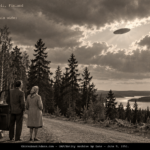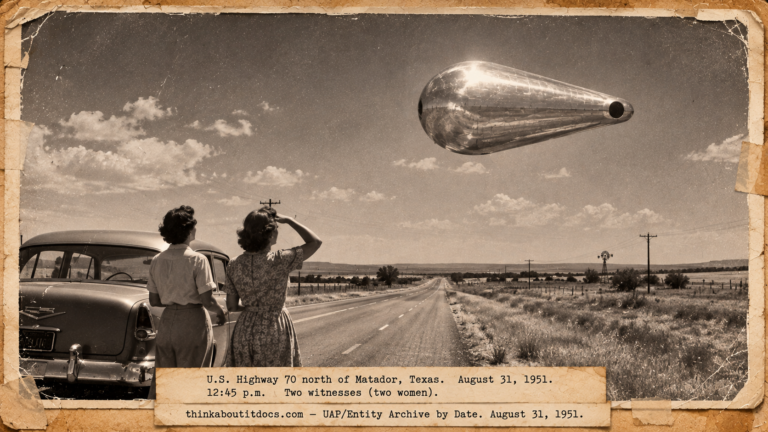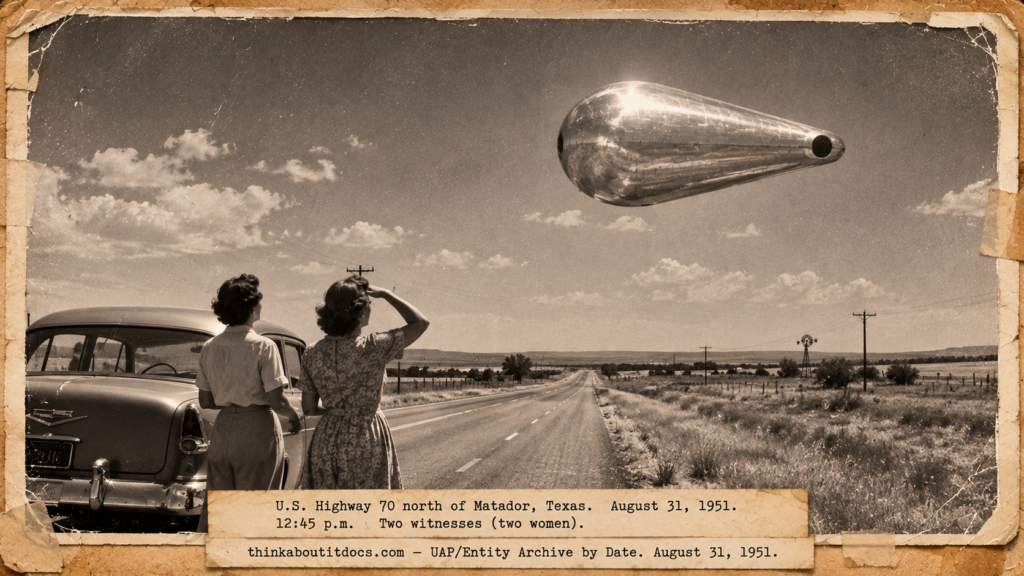
Matador, Texas, August 31, 1951: two women watch a pear-shaped object drift 150 feet above U.S. Highway 70.
THINK ABOUTIT UFO|UAP ENCOUNTER REPORT
1951: Two Women See a Pear-Shaped Object With a Porthole Near Matador, Texas
At 12:45 p.m. on August 31, 1951, two women driving north on U.S. Highway 70 near Matador, Texas, saw a pear-shaped object drifting slowly across the road, “like a yellow pear shaped tomato,” as the driver later told Air Force investigators. It was aluminum or silver in color, flashing in the bright noon sun, with what looked like a port, window, or door where its body began to taper toward the small end, which pointed forward. It hung about 150 feet above the ground and some 200 feet ahead of their car, with no sound, no exhaust, no smoke, and no visible means of propulsion.
After a few seconds the object rose rapidly and curved away to the east in a circular ascent. Project Blue Book rated the Matador UFO Unknown, noting that the duration was “much too short for a balloon” and that the object disappeared too quickly. The sighting came to the Air Force because it was folded into the investigation of the Lubbock Lights, and the agents who interviewed the witnesses found them reputable, straightforward, and certain that what they saw was not a balloon.
Date: August 31, 1951
Sighting Time: 12:45 p.m. CST (1845Z)
Day/Night: Day
Location: U.S. Highway 70 north of Matador, Motley County, Texas (the Air Force report variously places it 2½ and 5 miles north of town, near the witness’s ranch)
Urban or Rural: Rural
No. of Entity(‘s): Not Applicable
Entity Type: Not Applicable
Entity Description: Not Applicable
Hynek Classification: Close Encounter of the First Kind (CE-I); object seen within about 200 feet of the witnesses, with no interaction or physical effect reported
Duration: A few seconds (the drift and the rapid ascent together)
No. of Object(s): 1
Description of the Object(s): A pear-shaped object with a port, window, door, or similar aperture on its side at the point where the body began to taper toward the smaller end. It moved smaller end forward. There was no noise, exhaust, smoke, wind disturbance, or visible means of propulsion.
Shape/Size/Color of Object(s): Pear-shaped; Blue Book card estimate about 40 feet long and 16 feet in diameter; one witness compared it to a B-29 fuselage without wings; Berliner and NICAP give about 100 feet; aluminum or silver (silver-yellow in Berliner’s catalog) and strongly reflecting sunlight
Distance to Object(s): About 200 feet ahead of the car in the driver’s first interview; 125 to 150 yards in the later interviews
Height & Speed: About 150 feet above the ground, drifting slowly east, then a rapid, curving ascent to the east out of sight in a few seconds; speed not estimated
Number of Witnesses: 2 (the driver, identified by Berliner as Mrs. Tom Tilson, and her daughter, visiting from Lawton, Oklahoma)
Special Features/Characteristics: Aperture on the side near the taper; moved smaller end forward; no sound or exhaust; bright reflective surface; appeared to be landing or taking off from an area used by crop-dusting aircraft; investigated as part of the Air Force Lubbock inquiry
Case Status: Unknown (Project Blue Book record card: duration much too short for a balloon; disappearance too quick; case unidentified)
Source: Project Blue Book case file (record card; Office of Special Investigations reports of October 8, 25, and 26, 1951); Lubbock Morning Avalanche, September 1, 1951; Don Berliner; McDonald files; Jan Aldrich
Summary/Description: Two women on U.S. Highway 70 watched a silent, shiny, pear-shaped object with a side aperture drift slowly 150 feet above the ground ahead of their car, then shoot upward in a circular curve and vanish.
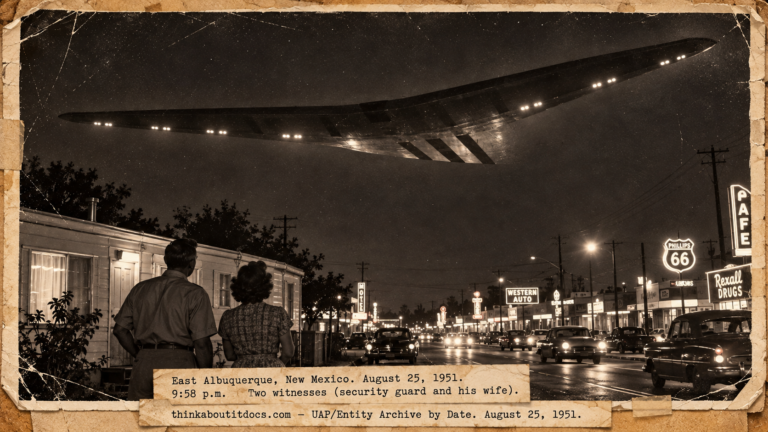
Related Cases: The Lubbock Lights (August 25 to September 1951); the Albuquerque flying wing (August 25, 1951); Lubbock, August 2, 1951 (five men and a hovering metallic sphere)
Detailed Report
The Sighting
The driver lived on a ranch north of Matador on U.S. Highway 70. At about 12:45 p.m. on August 31, 1951, she and her daughter, who was visiting from Lawton, Oklahoma, were driving north on that highway toward the ranch when she noticed an object drifting across the road. A few seconds passed before she drew her daughter’s attention to it. The object was pear-shaped, “like a yellow pear shaped tomato,” aluminum or silver in color, and it reflected the bright sun readily. Where the body began to taper toward the smaller end there was a port, window, door, or similar aperture. Only one object was seen, and it moved through the air small end forward.
It was drifting slowly east at about 150 feet above the terrain and, in her first interview, about 200 feet in front of the car. The driver stopped, got out, and both women realized there was no noise, no sign of exhaust or smoke, no wind disturbance, and no visible means of propulsion. The sun was shining brightly with little or no wind. Then the object began a rapid ascent and moved away to the east in a circular ascent, out of sight in a few seconds. The driver could not estimate its speed except that it climbed rapidly on a curving path. Her daughter stayed in the car and lost sight of it as it rose because her view from inside was limited. The driver was certain it was not a balloon. She had judged its height by comparison with a well-known Matador landmark, an oil derrick with an advertising sign on top beside a filling station inside the town limits, and she compared the object’s size to a local railway freight building.
The sighting was reported to the Matador newspaper that day and reprinted in the Lubbock Morning Avalanche on September 1, 1951, under the headline “Strange Aircraft Seen at Matador.”
How the Air Force Got the Case
Air Materiel Command at Wright-Patterson AFB had sent a classified teletype through the 23rd OSI District at Carswell AFB asking the Reese AFB intelligence section to investigate reported unidentified objects over Lubbock in late August 1951. Special Agent Howard N. Bossert and Lt. John A. Farley, Reese AFB’s assistant wing intelligence officer, worked the inquiry on September 17, 18, 20, and 21, and the Matador sighting was folded into it. They interviewed the driver on September 18 and examined the location. The terrain west of the highway is rolling land for 10 to 12 miles, and the land east is fairly flat and sparsely covered for 20 to 30 miles. Local inquiry found both women to be reputable citizens of excellent character and credit reputation. Bossert described the driver as a mature, educated, courteous woman in full possession of her faculties who was straightforward in all her answers. Reese AFB weather for 12:30 p.m. showed a 6,000-foot broken ceiling, 15-mile visibility, and an east-northeast wind of 3 knots.
The daughter was not available in September. On October 16, 1951, the OSI office at Tinker AFB interviewed her at Lawton, Oklahoma. She said the object entered her view from the left rear, 125 to 150 yards from the car, and looked about the same size as a B-29 aircraft without wings. It appeared to be taking off or landing in an area to her left used by aircraft engaged in crop dusting. The local inquiry at Lawton also found her to be a reputable citizen.
The Blue Book Evaluation
The Blue Book record card summarizes the case as an object “like a yellow pear-shaped tomato,” aluminum or silver, with a door, window or similar opening where it began to taper, moving small end forward with no noise, exhaust, wind or visible propulsion, estimated at 40 feet long and 16 feet in diameter, drifting east about 150 feet above ground before a rapid ascent. Its comments read that the duration was “much too short for a balloon,” that the disappearance was too quick, and that the case was unidentified. The Air Force investigation was marked as continuing, with a lead being developed by the 11th OSI District at Lawton, Oklahoma.
RESEARCHER’S NOTES
What Makes the Matador Case Stand Out
- Two independent witnesses: The driver and her daughter each gave interviews weeks apart, to different OSI offices. Both place the object ahead of the car in the same way, though they give different distances.
- Credibility checks: Agents made discreet inquiries at Matador and at Lawton, and both women came back as reputable, with a good community standing. The driver was judged lucid and straightforward.
- The size problem: The Blue Book card gives 40 feet by 16 feet, the driver compared it to a freight building, her daughter to a B-29 without wings, and Berliner’s catalog gives about 100 feet. The sources agree on shape and not on size.
- Why not a balloon: The card says the duration was much too short for a balloon, and the witnesses describe a rapid curving climb after a slow drift, in little or no wind, with a defined aperture on the side.
- The crop-duster detail: The daughter said the object seemed to be landing or taking off at an area used by crop dusters. The file records the statement and does not follow it up with a named aircraft or operator.
- Naming: The Air Force file redacts the witnesses’ names. “Mrs. Tom Tilson” comes from Berliner’s catalog of the Blue Book unknowns.
The Matador case is a daylight, close-range sighting by two witnesses who were interviewed separately by Air Force investigators and found credible, and Blue Book left it Unknown. No aircraft, balloon, or test is identified in the file, and the one question left open by the investigators, the crop-duster area, was never answered. The size estimates vary widely, but the description of shape, silence, and the abrupt departure is consistent between both witnesses.
“like a yellow pear shaped tomato”
— The Matador, Texas driver, quoted in an Air Force Office of Special Investigations report, 1951