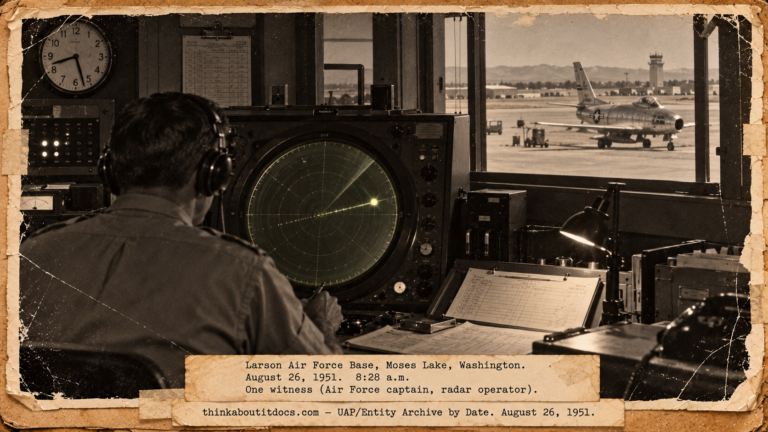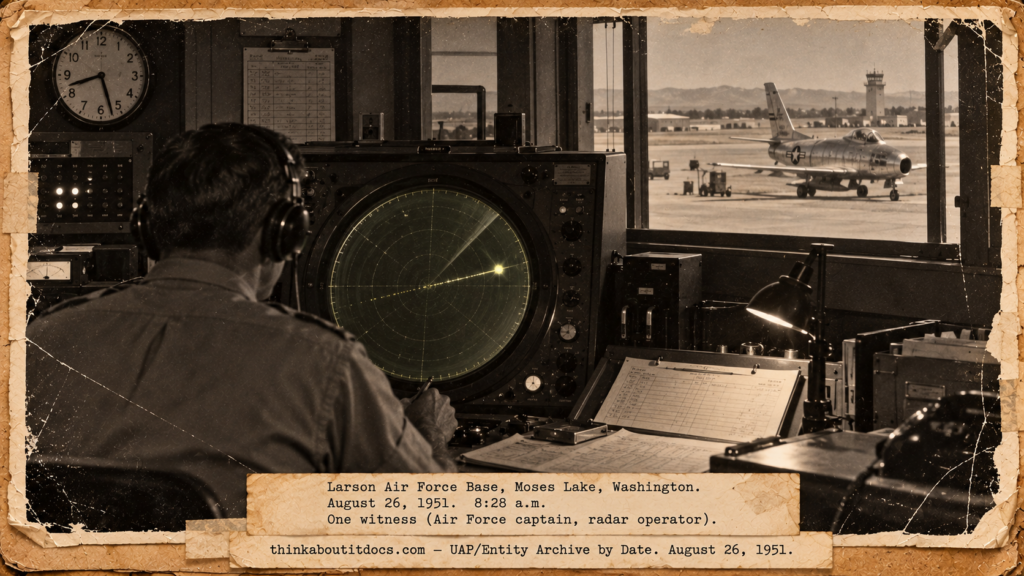
Larson AFB, Washington, August 26, 1951: radar operators track an unidentified target at about 950 mph.
THINK ABOUTIT UFO|UAP SIGHTINGS REPORT
1951: Larson AFB Radar Tracks an Unidentified Target at 950 MPH Over Washington State
On the morning of August 26, 1951, two radar sets at Larson Air Force Base near Moses Lake, Washington, locked onto an unidentified target and followed it for six minutes. It was coming in on a course of 340 degrees, covering roughly 95 miles at an average ground speed of about 950 miles per hour. An F-86 was scrambled, but the target vanished from the scopes before the jet got off the ground, and a visual search from 17,900 to 25,000 feet found nothing.
The radar operator, an Air Force captain, was rated an expert, and the base weather was not favorable for the false echoes known as anomalous propagation. Even so, the Air Technical Intelligence Center concluded that the return was “possibly due to interference,” and the Blue Book record card lists it as “Other: Elec Interference” rather than as an unknown. The Larson AFB radar case stands as one of the clearest Cold War radar UFO reports of 1951, and a case where the Air Force and the radar crew drew opposite conclusions.
Date: August 26, 1951
Sighting Time: 8:28 a.m. PST (1628Z on the Blue Book card); the Air Force report text gives 8:36 a.m.
Day/Night: Day
Location: Larson Air Force Base, Moses Lake, Washington (radar station of Detachment 1, 637th Aircraft Control and Warning Squadron)
Urban or Rural: Rural
No. of Entity(‘s): Not Applicable
Entity Type: Not Applicable
Entity Description: Not Applicable
Hynek Classification: Radar only (a ground-radar contact with no visual confirmation; not a Radar-Visual case)
Duration: Six minutes of continuous tracking (the card lists eight minutes of observation)
No. of Object(s): 1
Description of the Object(s): An unidentified radar target, described in the base’s reply to the Air Technical Intelligence Center as a rather large, irregularly shaped blip, not round or elongated. Size and composition could not be determined and no photograph of the radar return was available.
Shape/Size/Color of Object(s): Radar return only; rather large and irregular in shape; size and color not determined
Distance to Object(s): Tracked over about 95 miles, approaching the radar station directly; McDonald and Ruppelt add two transponder-type responses at about 115 and 80 miles from the station
Height & Speed: About 12,000 to 13,000 feet (measurement questionable because of the short track); about 946 to 950 mph on a course of 340 degrees with only slight deviations
Number of Witnesses: 1 radar operator identified (an Air Force captain described as an expert operator) on two radar sets, an AN/CPS-4 and an AN/CPS-1
Special Features/Characteristics: Tracked on two radar sets; F-86 scrambled but contact lost before takeoff; no temperature inversion and low moisture content at the time; reported transponder-type response (McDonald/Ruppelt)
Case Status: Other: electronic interference (Project Blue Book record card); Air Technical Intelligence Center electronics specialists judged the return “possibly due to interference”; the reporting officer’s view was that Air Defense equipment of the time could not cope with targets of this kind
Source: Project Blue Book case file (record card; Air Force Form 112 from Detachment 1, 637th AC&W Squadron, August 30, 1951; Air Technical Intelligence Center query of September 5, 1951 and Larson AFB reply); McDonald list; FUFOR Index; cf. Ruppelt, pp. 96-98, 108-109
Summary/Description: Two radar sets at Larson AFB tracked a fast, approaching target for six minutes at about 950 mph; jets were scrambled too late, and the Air Technical Intelligence Center attributed the return to possible interference.
Related Cases: The Sea of Japan radar contact (August 21, 1951); the Lubbock Lights (August 25 onward, 1951); the Albuquerque flying wing (August 25, 1951)
Detailed Report
The Radar Track
Larson Air Force Base, at Moses Lake in eastern Washington, was home to Detachment 1 of the 637th Aircraft Control and Warning Squadron, part of the 162nd Aircraft Control and Warning Group. On the morning of August 26, 1951, its radar crew picked up an unidentified target on an AN/CPS-4 and an AN/CPS-1 radar set. The Blue Book card lists the time as 1628Z, which is 8:28 a.m. Pacific Standard Time; the Air Force Form 112 text gives 8:36 a.m. The target was tracked continuously for six minutes, and the report says it covered approximately 95 miles in that time, an average ground speed of 946 miles per hour, which the card rounds to 950.
The target held a course of 340 degrees with only slight deviations. An altitude reading of about 12,000 feet was obtained (the card says 13,000), but the report says the accuracy of the measurement was questionable because the object was detected for such a short time. F-86 fighters were scrambled, but radar contact with the object was lost before they were airborne. A visual search was conducted from 17,900 to 25,000 feet with negative results. The operator of the radar set, an Air Force captain, was considered an expert operator.
The reporting officer added his own assessment: in his opinion, present active Air Defense equipment was not capable of coping with targets of this nature.
The Air Technical Intelligence Center Inquiry
Detachment 1 sent the report to Air Materiel Command at Wright-Patterson AFB on August 30, 1951, under Air Defense Command Letter 200-1. On September 5, the Air Technical Intelligence Center wrote back, addressing Captain William W. Sharp of the detachment, and asked three things: whether the weather favored anomalous microwave propagation, which produces spurious radar targets, and in particular whether there was a temperature inversion or moisture change with altitude; the approximate shape of the radar return; and whether photographs of the return were available.
The base replied that the weather at the time did not favor anomalous propagation, that no temperature inversion was recorded and the moisture content was low, that the target was a rather large, irregularly shaped blip, not round or elongated, and that no photograph of the return was available.
The Conclusion
The Electronics Section of the Air Technical Intelligence Center reviewed the incident and concluded that the return was possibly due to interference. It gave two reasons: the apparent path of the object, directly approaching the station, and the fact that the target was observed only on the low beam of the AN/CPS-1 radar set. The Blue Book record card reflects this by listing the conclusion as “Other: Elec Interference.”
The McDonald list and Ruppelt’s account add a detail that does not appear in the Blue Book file reviewed here: a signal received twice from the object, at approximately 115 and 80 miles from the radar station, resembled a Mode One response from an AN/APX-6 transponder. NICAP’s 1951 chronology carries that detail under the same date.
RESEARCHER’S NOTES
Radar Evidence Versus the Interference Explanation
- The speed: About 950 mph in 1951 meant a target faster than the service’s fighters. It is also the kind of figure that interference or a misread plot can produce from a short track.
- The Air Force’s reasoning: ATIC judged the return interference because the target came directly at the station and showed up only on the AN/CPS-1’s low beam. The report says two radar sets tracked it, and the file does not say how the CPS-4 track fits that explanation.
- The weather checks: The base told ATIC there was no temperature inversion and the moisture content was low, which argues against anomalous propagation, the usual cause of false radar targets in 1951.
- Numbers that do not agree: The card gives 8:28 a.m., the report text 8:36; the card gives 13,000 feet, the report 12,000; the card lists eight minutes of observation, the report six minutes of tracking; 946 and 950 mph are the same figure rounded.
- The transponder-type response: The reported Mode One signal is the single most interesting detail in popular accounts, and it comes from the McDonald list and Ruppelt rather than from the Blue Book file. The file does not contain it.
Larson AFB is a radar-only case with an official explanation that does not fully answer the radar crew’s own report. The Air Force attributed the return to possible interference, and the base’s weather checks did not support anomalous propagation, but there was no visual sighting to settle it. The honest position is that this is a well-documented, unresolved radar contact that Blue Book chose not to count as an unknown.
“Present active Air Defense equipment is not capable of coping with targets of this nature.”
— Reporting officer, Detachment 1, 637th Aircraft Control and Warning Squadron, Larson AFB, August 30, 1951