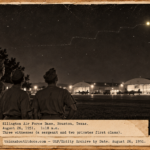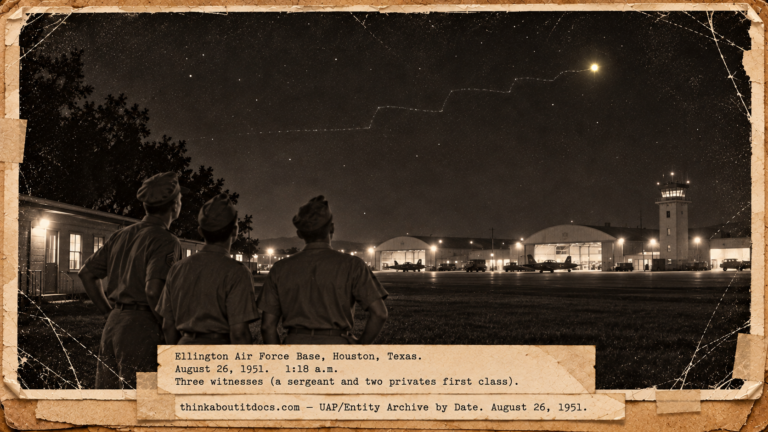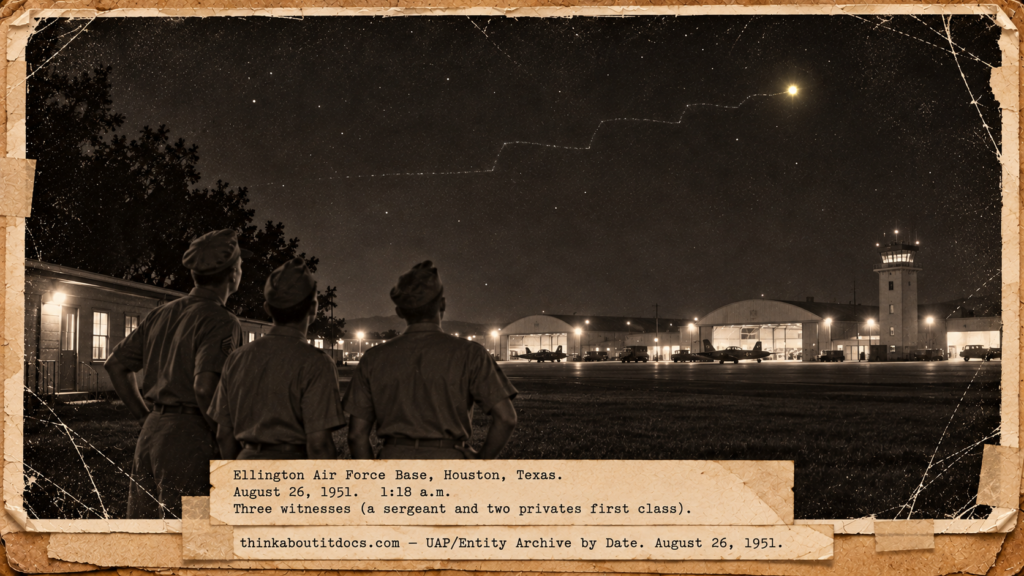
Ellington AFB, Houston, August 26, 1951: three airmen watch an erratic yellow light.
THINK ABOUTIT UFO|UAP SIGHTINGS REPORT
1951: Ellington AFB Airmen Watch an Erratic Yellow Light Over Houston, Texas
In the early hours of August 26, 1951, a sergeant on charge-of-quarters duty at Ellington Air Force Base near Houston, Texas, was woken by a private who told him to come outside and see “this strange thing.” Overhead was a bright yellow light, as bright as the brightest star, that kept making sharp angular turns off its course and then swinging back to the north. After three or four minutes it rose out of sight, blinking on and off just before it faded, without a sound.
A second set of observers on the base described a yellow light that traced a triangle among three stars, sat motionless for minutes at a time, and then suddenly moved again for as long as an hour. Project Blue Book called the first report a balloon and the second a possible balloon or star with insufficient data for a firm answer. The Ellington UFO reports matter for what happened afterward: weeks later, the Air Technical Intelligence Center was still asking pointed questions, and the base’s replies show how reports of “celestial phenomena” were being handled in 1951.
Date: August 26, 1951
Sighting Time: 1:18 a.m. CST (0718Z) for the first report; about 2:30 a.m. (0830Z) for the second
Day/Night: Night
Location: Ellington Air Force Base, Houston, Texas
Urban or Rural: Urban (air base on the edge of Houston)
No. of Entity(‘s): Not Applicable
Entity Type: Not Applicable
Entity Description: Not Applicable
Hynek Classification: Nocturnal Light (NL); two separate reports of erratic yellow lights, no structure observed
Duration: Three to four minutes (first report); 30 minutes to over an hour (second report)
No. of Object(s): 1 per report
Description of the Object(s): A bright yellow light with no definite shape and no trail. In the first report it made definite angular turns but always returned to a northerly course, then rose out of sight, blinking on and off. In the second it traced roughly a triangle among three stars, remained motionless for minutes at a time, and then suddenly began moving again.
Shape/Size/Color of Object(s): Shapeless point of light; as bright as the brightest star; yellow rather than blue-white; size not determined
Distance to Object(s): Unknown (could not be approximated)
Height & Speed: First report: over 25,000 feet (estimated), course north; second report: height and speed not recorded
Number of Witnesses: First report: 3 (a sergeant on charge-of-quarters duty and two privates first class of the 149th AC&W Squadron); second report: at least 2, military and civilian
Special Features/Characteristics: Silent; angular turns and returns to course; blinking before fading; stationary periods and sudden restarts (second report); no radar in operation at the base
Case Status: First report: balloon (Project Blue Book record card); second report: possible balloon or star, Insufficient Data for a firm evaluation
Source: Project Blue Book case file (record cards; Air Force Form 112 report IR-4-51 dated October 7, 1951, and related Form 112 reports; Air Technical Intelligence Center queries; Ellington Wing Intelligence reply of October 27, 1951)
Summary/Description: Airmen at Ellington AFB reported erratic bright yellow lights on the night of August 25 to 26, 1951; Blue Book called them balloons or an unresolved balloon or star, and the follow-up file records how the base handled such reports.
Related Cases: The Lubbock Lights (August 25 onward, 1951); Houston-area and Texas reports of the same weekend
Detailed Report
The First Report: 1:18 a.m.
The report, Air Force Form 112 number IR-4-51, was prepared by Ellington’s Wing Intelligence office on October 7, 1951. It covers a sergeant and two privates first class of the 149th Aircraft Control and Warning Squadron. The sergeant was on charge-of-quarters duty when one of the privates woke him and told him to come outside. He went out and saw the object passing overhead. He noticed how bright it was, as bright as the brightest star in the sky at that time. It had no definite shape and looked like a bright light crossing the sky. Its color was not the blue-white of a star but more of a yellow light, and it left no trail that he could see. He judged its altitude at over 25,000 feet. He also noticed it making definite angular turns from its course but always returning in the same general direction, north. When it disappeared it was going up instead of dropping toward the horizon. He followed it until it was completely out of sight, and just before fading it seemed to blink on and off. He heard no sound.
The reporting officer, Captain William F. Hester Jr., wrote that the reliability of the informants could not be judged, but that the fact the sergeant on duty was made a witness would add weight to the statements of the other two. The Blue Book record card lists three to four minutes of observation and a course of north, rising, and the comment “Case evaluated as balloon.”
The Second Report: About 2:30 a.m.
A second Ellington card for the same date carries a Greenwich time of 0830Z, about 2:30 a.m. local, with military and civilian observers and a duration of 30 minutes (the status extract says an hour or more). The observer described a light “more yellow than a star would” be. He traced its movements roughly in a triangle: from near the middle of three stars to above the third star, and from there in a straight line to several degrees left of the lowest star. When a sergeant returned, the observer pointed it out, and it had come back near the point where he first saw it and began the same movements again. The observer could not approximate its distance. It would stay motionless for minutes at a time and then suddenly start moving again, with no sound, and it was still there when the observers returned to the base. Blue Book judged it a possible balloon or star, but because its position and manner of disappearance were not recorded, it rated the case Insufficient Data “for a firm evaluation.” The status extract reads “Very probably a weather balloon.”
The Follow-Up
On October 16, 1951, the Air Technical Intelligence Center transmitted the Ellington Form 112 reports and then sent the base a list of questions. Was the date of August 26 correct, and when had the sources first reported the incident to Wing Intelligence? Had any unidentified radar contacts been made? What did the sergeant at Base Operations mean when he referred to experiments by Wright-Patterson? Had a local astronomer been consulted, and had anyone else, military or civilian, seen the phenomena?
Ellington replied by teletype on October 27, 1951. The first report had been given to the Wing Public Information Office on August 27, with Wing Intelligence present at the interview. Wing Intelligence’s instructions on the subject dated from September 8, 1950, and the local Office of Special Investigation had told it that it held more recent instructions not to handle future reports of astronomical phenomena, so the interview report was filed without action until a revision received in late September made the reporting instructions clear. No radar was operating in the area during either report. Checks with the wing officer of the day, the wing headquarters charge of quarters, the airdrome officer, base operations duty airmen, two tower operators, and the base telephone operator failed to reveal other witnesses or to identify a sergeant at Base Operations whom one informant said he had spoken to.
RESEARCHER’S NOTES
A Small Case With a Revealing Paper Trail
- Reliability: The reporting officer could not judge the informants, but he gave weight to the sergeant on duty. The base’s own checks found no other witnesses.
- Behavior of the light: Angular turns followed by returns to course are not how a drifting balloon or a star behaves, and Blue Book’s comment does not address them. Atmospheric effects on a bright star or planet can also produce apparent motion, and the file has no astronomer’s opinion.
- The reporting problem: The reply shows an office uncertain whether astronomical-looking reports belonged in the system at all, which probably cost the reports their early follow-up.
- Two reports, one night: The 1:18 a.m. report and the 2:30 a.m. report involve different observers and different behavior. They are kept separate here and cross-referenced, not merged.
- Evaluations differ: Blue Book called the first report a balloon and the second Insufficient Data, even though the status extract calls the second “very probably a weather balloon.”
The honest position is that these are minor night-sky reports by military witnesses that Blue Book assigned to balloons and insufficient data, and that the case is best read as a window into 1951 reporting practice at an Air Force base. The lights may have been balloons or celestial objects, but the file does not prove it, and it contains no astronomer’s analysis.
“It had no definite shape, but appeared to be a bright light passing across the sky. The color was not blue white as a star, but more of a yellow light.”
— Sergeant on charge-of-quarters duty, 149th AC&W Squadron, Ellington AFB, in an Air Force Form 112 statement, 1951