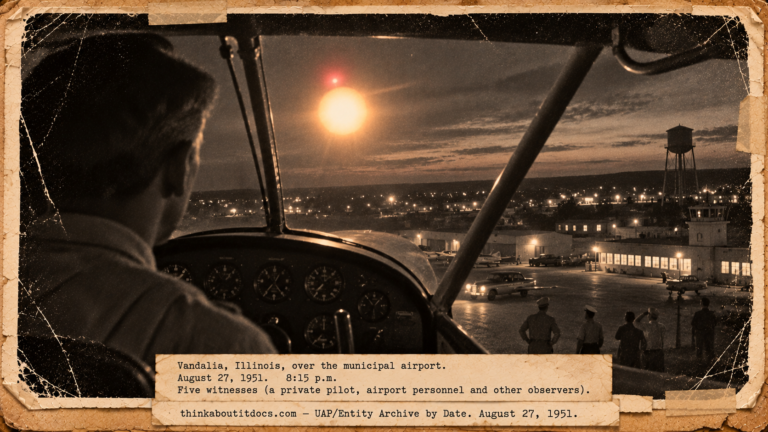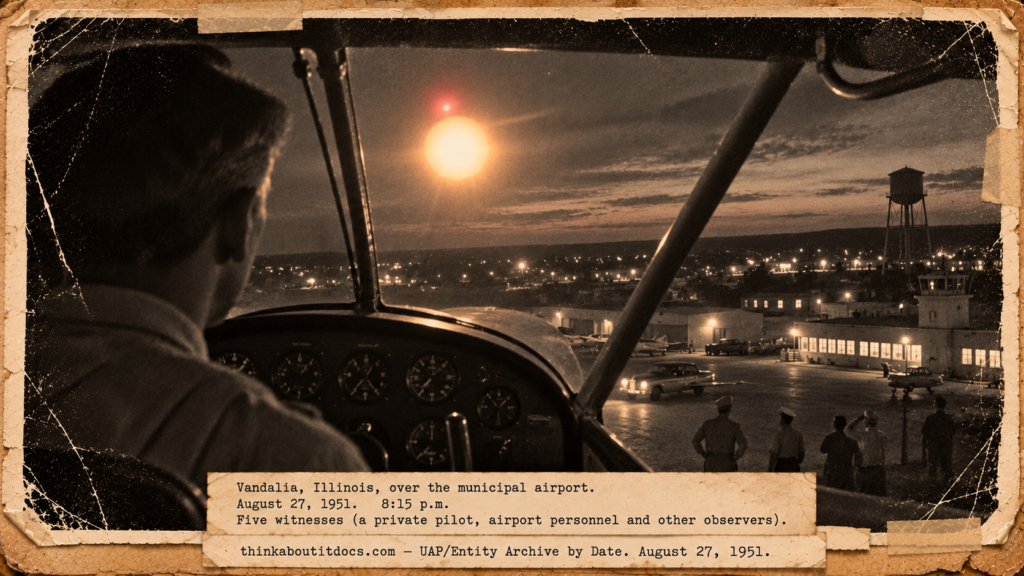
Vandalia, Illinois, August 27, 1951: a pilot is circled by a blinding orange light.
THINK ABOUTIT UFO|UAP SIGHTINGS REPORT
1951: Pilot Ray Williams Is Circled by a Blinding Orange Light Over Vandalia, Illinois
On the evening of August 27, 1951, private pilot Ray Williams was taxiing out for a flight over Vandalia, Illinois, when he saw a blinding orange light over the southwest corner of the airport. He radioed the CAA, but the light went out. After he took off it came back, flew straight at his plane, circled it twice, and led him on a chase to Greenville and back, while a transport pilot overhead and a witness in nearby St. Elmo saw it too.
“It wasn’t a flying saucer! Nor was it a conventional type airplane!” the Vandalia Leader reported three days later. Project Blue Book had only that newspaper article and a letter from a local resident to go on, and rated the case Insufficient Data. The Vandalia UFO chase is one of the few August 1951 reports in which a pilot airborne at the time describes an unknown light closing in on his aircraft.
Date: August 27, 1951
Sighting Time: Between 8:00 p.m. and 8:30 p.m. CST (2000 to 2030 local on the Blue Book card; 0200Z August 28)
Day/Night: Night
Location: Vandalia, Illinois, over the municipal airport and toward Greenville and the country club
Urban or Rural: Rural (small town and airfield)
No. of Entity(‘s): Not Applicable
Entity Type: Not Applicable
Entity Description: Not Applicable
Hynek Classification: Nocturnal Light (NL) with a close approach to an aircraft; distance not stated
Duration: Unknown (the sighting spanned a ground observation and an airborne chase)
No. of Object(s): 1
Description of the Object(s): A big orange light of blinding intensity, with a light at one end (on the “tail”) and a small red light on top. In the St. Elmo report it appeared to have a lens 10 to 12 inches across. It approached the plane directly, circled it twice, circled Greenville, and returned toward Vandalia.
Shape/Size/Color of Object(s): Orange light with a small red light on top; shape and size not determined
Distance to Object(s): Close enough to circle the pilot’s aircraft twice; exact distance not given
Height & Speed: Not given; the object kept pace with a light aircraft on a round trip to Greenville
Number of Witnesses: At least 5 (the pilot, the CAA personnel he called, a transport pilot overhead, and a witness in St. Elmo)
Special Features/Characteristics: Light went out, then returned; circled the aircraft twice; seen from both the air and the ground; the pilot guessed a military craft from Scott Field
Case Status: Insufficient Data (Project Blue Book record card); no further investigation
Source: Project Blue Book case file (record card; Vandalia Leader article of August 30, 1951; Status Report 2; letter of September 10, 1951 from Ramsey, Illinois and Air Materiel Command reply); NARCAP; FUFOR Index
Summary/Description: A private pilot taking off at Vandalia was approached and circled by a blinding orange light with a red light on top, and led it on a chase to Greenville and back; others saw it, and Blue Book rated the case Insufficient Data.
Related Cases: Other August 1951 reports of lights approaching aircraft; the Lubbock Lights (August 25 onward, 1951)
Detailed Report
The Chase
The Blue Book file’s only information on the case is a Vandalia Leader article of August 30, 1951, headed by the observation that the object was neither a flying saucer nor a conventional airplane, and that it “aroused the curiosity of at least five persons who saw it soaring through the air Monday night.” Ray Williams told the paper that it was “a big orange light with blinding intensity” when he first noticed it over the southwest corner of the airport. He had just taxied onto the runway to take a flight around the city. It was between 8:00 and 8:30 p.m. He called over the radio to the CAA official on duty and another man and asked them to take a look. The lighted object disappeared into the west, and they decided maybe there was nothing to it, so Williams continued with his flight plans.
Shortly after takeoff he noticed the light again, approaching his plane. “It came directly at me and then circled my plane twice before heading toward Greenville.” He followed it, and it made a circle around that town and came back toward Vandalia, and he last saw it near the country club. The CAA radioed a transport pilot who was passing over Vandalia at the time, and he also saw the object. “It was all very spooky,” Williams said. “It wasn’t an airplane but whatever it was the light was on the tail of it, and there was a small red light on top. Probably it was some military craft from Scott Field making a test run.” The article adds that the lighted object, which appeared to have a lens 10 to 12 inches across, was also seen by a witness in St. Elmo the same evening.
What Blue Book Did
The case reached Air Materiel Command through a letter from Ramsey, Illinois, dated September 10, 1951, which enclosed the clipping, noted that it was not known whether a military craft from Scott Field was involved, and asked to be advised if reports of this kind were wanted. The command acknowledged the letter and said it would be forwarded to the office concerned. The Blue Book record card shows ground-visual and air-visual observation, a newspaper report as the source, a westward course, and the comment that duration, speed, and other data were unknown, so the case was evaluated as Insufficient Data. The status extract adds “No further investigation. No conclusions.” The file notes that an attempt would be made to obtain further information.
The covering letter states that the incident occurred on the evening of August 26, while the newspaper’s “Monday night” and the Blue Book card both point to August 27, 1951, which was a Monday.
RESEARCHER’S NOTES
A Pilot’s Close Encounter With No Investigation
- Why it matters: This is an airborne witness reporting that an unknown light approached and circled his aircraft, with ground confirmation from the CAA and a second pilot. It is a better-supported report than many Blue Book Unknowns.
- What is missing: There is no interview by Air Force personnel, no names beyond the pilot’s, no distances, and no weather data. Blue Book relied on a newspaper clipping.
- Possible explanations: Williams himself suggested a military test aircraft from Scott Field. A light aircraft or helicopter with landing lights could explain some of it, and the file shows no check of military flights.
- Date: The covering letter gives August 26; the newspaper and card give August 27.
- Altitude of the transport pilot: Some compilations say 20,000 feet. The copy of the article in the file is too degraded to confirm the figure, so it is not used here.
The Vandalia report is unresolved because it was never properly investigated, not because it was tested and found inexplicable. What survives is a credible pilot’s account, a second pilot’s corroboration, and a rating of Insufficient Data.
“It was a big orange light with blinding intensity when I first noticed it over the southwest corner of the airport.”
— Pilot Ray Williams, in the Vandalia Leader, August 30, 1951