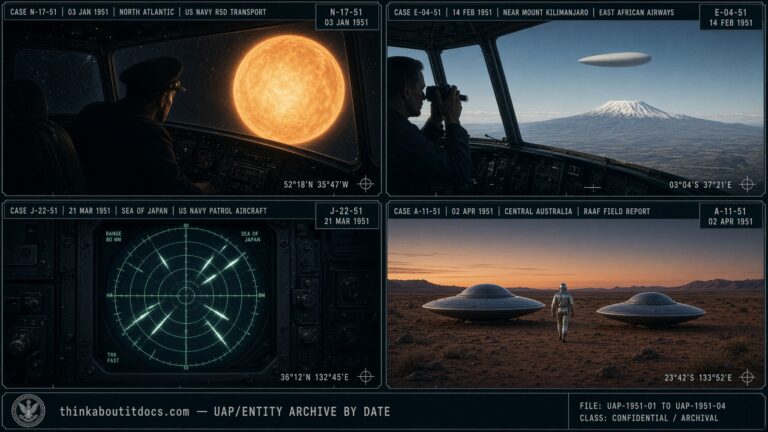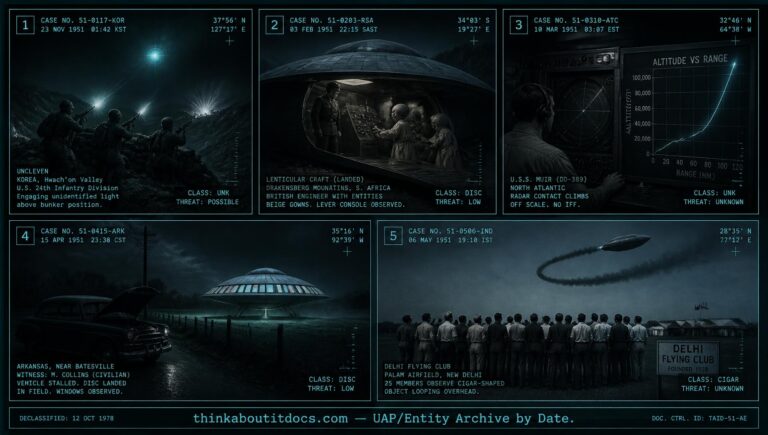
August 1951: from a Ferrara cemetery road to the skies over Lubbock, Albuquerque and Matador.
1951: August UFO|UAP & Entity Sightings Archive
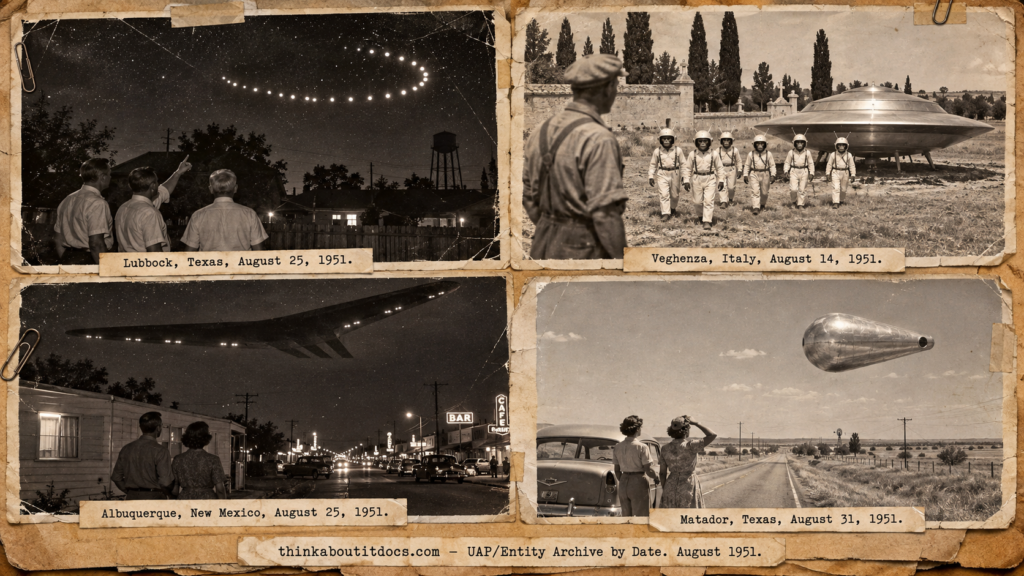
August 1951 opens with one of the most richly detailed entity encounters in this archive’s collection: a farmer on a cemetery road near Veghenza, Ferrara, Italy, who watched six four-foot-tall beings climb out of a landed double-saucer, and who was met by a flash of light from a weapon that did nothing. It closes with the famous Lubbock Lights, fast, silent formations of lights that three Texas Tech professors saw on August 25 and a college freshman photographed five nights later, remembered as one of the best-documented “unknowns” in the entire Blue Book record.
Between those two anchor cases, the same night as the first Lubbock Lights, a Sandia Base security guard and his wife watched a silent, wing-shaped object 1.5 times the span of a B-36 glide over Albuquerque, with rows of soft white lights along its trailing edge, while the next morning radar at Larson AFB in Washington tracked an unidentified target at 950 mph. On August 31 two women on U.S. Highway 70 watched a pear-shaped object with a porthole drift 150 feet above the Texas plains near Matador. The month also brings a Navy lieutenant’s frosty football in the sky over Alexandria, a private pilot chased by an orange light over Vandalia, Illinois, and a strange, unresolved night intrusion at a Romanian pioneer camp.
Date: August 1951
Location: Mount Semenicului, Romania
Time: Night
Summary: The young witness was staying at a solitary, two-level elm cabin at an isolated pioneer camp, with a front balcony used for evening games and singing. One night, the children were awakened by alarmed cries from professors, coaches, and staff, who shouted that the camp was under attack by “bandits.” A thorough search found nothing and no explanation for who would target a cabin full of children. Later, examining a cabin where the commotion seemed to have centered, the witness and others found strange tracks resembling cleated shoes on the wooden walls, along with tracks on the ground and roof suggesting very long strides, as if made using climbing equipment. No explanation was ever found for who had made the tracks or how they had disappeared so quickly.
Source: Calin N. Turcu, OZN 1517-1994, Romania
Date: August 1951
Location: Central, New Mexico
Time: Unknown
Summary: A mining engineer sighted two discs with visible “portholes.”
Source: NICAP, The UFO Evidence (1964), Section VI
Date: August 1951
Location: Navasota, Texas
Time: 4:00 p.m.
Summary: A civilian witness saw a single large, round object moving in an up-and-down motion for a short time. The object reflected sunlight and disappeared quickly, rising toward the east. Distance, height, and duration were not recorded.
Source: Project Blue Book record card (listed as “Navosta, Texas”); Air Force Form 112 report
Source Status: The report was not filed until April 1952, and the exact day in August was never recorded. Blue Book rated it Insufficient Data, noting that the description pointed to a possible balloon.
Date: August 2, 1951
Location: Lubbock, Texas
Time: 8:57 a.m. to 9:03 a.m.
Summary: Five civilian men watched a metallic, spherical object hover and quiver slightly. After about six minutes it moved straight east and disappeared into a cloud bank. Witness Mr. Gibbs, who was very familiar with weather balloons, was certain it was not a balloon of any type. Reese AFB lies just west of Lubbock.
Source: NICAP 1951 chronology (Fran Ridge, Dan Wilson, Bill Schroeder; Blue Book files MAXW-PBB14-90-97)
Source Status: The Blue Book scans uploaded for August 1951 do not include this case; the details come from the NICAP chronology and the compilers it cites.
Date: August 3, 1951
Location: Near Pinckney, Michigan
Time: Unknown
Summary: A NICAP adviser saw a glowing, yellowish UFO moving on an undulating course.
Source: NICAP, The UFO Evidence (1964), Section VI
Date: August 5, 1951
Location: Herkimer, New York
Time: 11:30 p.m.
Summary: A civilian witness saw a single object that appeared solid, flickered, and looked two to three times longer than it was wide, described as a spherical red object with a green tail. It made no sound, kept a constant intensity with a fuzzy, blurred outline, and flew straight and level on a southerly course, disappearing behind trees in the southwest after a 60-degree arc of movement lasting three to five seconds. The witness assumed low speed and low altitude.
Source: Project Blue Book record card (evaluated as a meteor); witness questionnaire
Source Status: The witness did not file the report until 1953. An accompanying note in the file observes that single, non-shower (“spurious”) meteors are often seen, that some move slowly, and that a witness’s height and distance judgments are unreliable.
Date: August 8, 1951
Location: Lake Erie, about two miles north-northwest of the Port Clinton, Ohio, lakeshore
Time: 2:10 p.m.
Summary: A pilot flying at 5,500 feet en route to Jamestown, New York, reported a dark, cigar-shaped object 18 to 20 feet long, “resembling a buzz bomb,” passing him at a very high rate of speed at about 6,000 feet on a heading of 290 degrees. He reported it to Cleveland radio, and his aircraft was then 15 miles east of Cleveland, continuing to Jamestown. The Air Force relayed the report as a CIRVIS message the next day, and the Air Technical Intelligence Center asked Chicago-area intelligence whether any unidentified aircraft had been in the area during that period. See the Detailed Report.
Source: Project Blue Book record card (listed as “Cleveland, Ohio”; evaluated as aircraft); CIRVIS message of August 9, 1951; Project 1947; FUFOR Index
Source Status: Earlier compilations describe a USAF pilot and additional ground witnesses. The Blue Book file describes a single pilot’s report, with his name redacted, relayed through the Olmsted AFB flight service center.
Date: August 11, 1951
Location: Portland, Oregon
Time: Unknown
Summary: A former Air Force fighter pilot observed a formation of three discs.
Source: NICAP, The UFO Evidence (1964), Section V
Date: August 12, 1951
Location: Indianapolis, Indiana
Time: 7:00 p.m. CST
Summary: Military and civilian witnesses, first reported by personnel at Camp Atterbury, saw a silver object moving west at an undetermined altitude. A CIRVIS message of August 14 described it as appearing to be a plastic balloon. Wright-Patterson’s flight service duty officer coordinated the report with the Cambridge air research center, whose balloon project had a research balloon over Indianapolis at the time.
Source: Project Blue Book record card (evaluated as a balloon); CIRVIS message of August 14, 1951
Date: August 14, 1951
Location: Veghenza, Ferrara, Italy
Time: 13:00
Summary: An unnamed farmer saw an object resembling the planet Saturn descend beside the town cemetery, then approached a landed, double-saucer craft roughly 20 feet across. Six four-foot-tall, monkey-faced entities in white overalls and antenna’d helmets emerged and approached him with apparent curiosity; one fired a Tommy-gun-style weapon at him, producing a dazzling flash with no visible effect. The beings then boarded the craft, which departed at high speed toward Venice, leaving a roughly 25-foot patch of burnt soil behind. See the Full Report.
Source: Maurizio Verga, Flying Saucer Review Vol. 24 #6
Date: August 14, 1951
Location: Rhein Main Air Base, Germany
Time: 2020Z (local time not recorded)
Summary: A military pilot on the ground saw a round, white light that seemed to fall slowly as if suspended from a parachute, then leveled off onto a southerly course, turned west, then turned east at extreme speed. Duration was not recorded.
Source: Project Blue Book record card
Source Status: Blue Book rated the case Insufficient Data, commenting that the description sounds like aircraft but that the witness reported it as an astronomical phenomenon.
Date: August 19, 1951
Location: Alexandria, Virginia
Time: 6:05 p.m. EDT
Summary: A Navy lieutenant and his wife, driving through Alexandria, saw a “frosty” silvery, football-shaped object about three to four miles away and roughly two miles southeast of the Masonic Memorial. The lieutenant estimated it at 50 feet long and 20 feet high, flying level at an apparent 2,000 to 4,000 feet and moving away on a course of about 155 degrees true. It showed no wings, tail surfaces, vapor trail, smoke, or noise, and its reflection did not change as it crossed the sunlight. They lost sight of it at 6:07 p.m. when they turned off King Street to climb Masonic Memorial hill for a better view. The lieutenant reported it to the Pentagon command post and stated that it did not behave like a balloon and did not look like any aircraft he knew. Lt. Col. M. D. Willis of Air Force intelligence interviewed him and concluded it was most likely the sun’s reflection off an aircraft at 6,000 to 15,000 feet. See the Detailed Report.
Source: Project Blue Book record card (evaluated as aircraft); CSAF Item 7 and ATIC teleconference 220
Source Status: The lieutenant’s name is redacted in the file.
Date: August 20, 1951
Location: Near Geiger Field, Spokane, Washington
Time: About 11:10 a.m. PST
Summary: Two witnesses about seven and a half miles southeast of Geiger Field saw an elliptical, apparently flat, white or aluminum-colored object about two feet long and eight to ten inches wide rise slowly from sparse trees at the foot of a 200-to-300-foot hill roughly half a mile away. At 50 to 75 feet up it climbed past the hilltop, then turned south and rose at a steady 30 to 40 degrees with no weaving or jerking until it vanished like a star, which the witness judged to be about two miles away. It left no trail or exhaust, and no sound was heard over a busy nearby highway. The base weather officer judged that neither convective activity nor the weather pattern could have lifted an object that size, the air was dry and stable, the wind calm, and a search on foot found no physical evidence.
Source: Project Blue Book record card (evaluated as a balloon); Air Intelligence Information Report from Geiger Field, August 22, 1951
Source Status: The base report gives the duration as about two minutes; the Blue Book card lists 20 minutes.
Date: August 21, 1951
Location: Northern Sea of Japan
Time: 12:05 a.m.
Summary: A USN P2V-3W patrol plane, at position 41°55’N, 133°52’E, picked up a target on its AN/APS-20 radar; the squadron electronics officer confirmed the target as authentic and distinct from sea return, with a strong scope presentation throughout the 45-minute contact.
Source: Jan Aldrich; Dan Wilson (BBU)
Source Status: The Blue Book scans uploaded for August 1951 do not include this case; the Blue Book designation is carried over from the earlier version of this page and has not been checked against a case file.
Date: August 25, 1951
Location: Lubbock, Texas
Time: 9:10 p.m.
Summary: Three Texas Technological College professors, Dr. W. I. Robinson (geology), Dr. A. G. Oberg (chemical engineering), and Professor W. L. Ducker (petroleum engineering), saw roughly 30 luminous, star-bright lights race silently across the sky in a crescent formation in a matter of seconds, followed shortly by a second similar formation. The sightings continued over the following weeks, involving hundreds of witnesses across the city; on August 30, college freshman Carl Hart Jr. photographed a V-formation of 18 to 20 lights, producing the case’s best-known image. Officially, per Capt. Edward J. Ruppelt, all of the Lubbock sightings except the radar-tracked one remain classified as unknowns; the case was later named among the ten most puzzling in a 1952 LIFE magazine feature. Air Force investigators in Albuquerque showed the Hart photographs to the couple in the same night’s Sandia Base sighting below. See the Full Report.
Source: Edward J. Ruppelt; Air Force Office of Special Investigations reports on Lubbock, 1951; multiple period newspaper and later compiled sources
Date: August 25, 1951
Location: Albuquerque, New Mexico
Time: 9:58 p.m. MST
Summary: Sandia Base security guard Hugh Young and his wife, standing in front of their trailer in east Albuquerque while waiting for his ride to work, saw a silent, wing-shaped craft pass over from the north at 800 to 1,000 feet and 300 to 400 mph on a course of about 160 to 170 degrees, estimated at one and a half times the wingspan of a B-36 (about 350 feet). It had no fuselage, swept-back wings, dark chordwise stripes on its underside, and six to eight pairs of soft, glowing white lights along the trailing edge, which went out just after it crossed U.S. Highway 66. Kirtland AFB radar saw nothing, and neither Strategic Air Command nor Northrop had any B-36 or flying wing in the area. When investigators showed the couple the Lubbock photographs in November, they said the light pattern matched what they had seen. See the Detailed Report.
Source: Project Blue Book record card (BBU #955); Air Force Office of Special Investigations spot report of August 27, 1951; Berliner; Wilson; Schroeder
Source Status: Blue Book rated the case Unknown. The Blue Book case number is carried over from the earlier version of this page. The file names the witness as H. R. Young; “Hugh” is the first name used in Berliner’s catalog.
Date: August 26, 1951
Location: Ellington AFB, Houston, Texas
Time: 1:18 a.m.
Summary: Three airmen of the 149th Aircraft Control and Warning Squadron, a sergeant on charge-of-quarters duty and two privates first class, watched a bright yellow light, as bright as the brightest star, pass overhead with no definite shape and no trail. It made definite angular turns off its course but always returned to a northerly heading, and after three to four minutes it disappeared by rising instead of dropping toward the horizon, appearing to blink on and off just before it faded. They heard no sound and judged its altitude at over 25,000 feet. See also the second Ellington report below. See the Detailed Report.
Source: Project Blue Book record card (evaluated as a balloon); Air Force Form 112 report IR-4-51
Source Status: The reporting officer wrote that the informants’ reliability could not be judged but that the sergeant on duty as a witness added weight to the other two statements. Ellington’s Wing Intelligence office answered the Air Technical Intelligence Center’s follow-up questions in October 1951: no radar was operating in the area, and checks of the wing officer of the day, tower, base operations, and telephone operator found no other witnesses. Wing Intelligence also could not identify a sergeant at Base Operations whom one informant said he had spoken to.
Date: August 26, 1951
Location: Ellington AFB, Houston, Texas
Time: About 2:30 a.m. (0830Z)
Summary: Military and civilian witnesses watched a yellow light, more yellow than a star, trace movements roughly in a triangle among three stars. It stayed motionless for minutes at a time, then suddenly began moving again, with no sound. One observer left and returned with a sergeant, and the light had returned near its starting point and repeated the same movements; it was still there when they went back to the base after about 30 minutes to an hour.
Source: Project Blue Book record card; Air Force Form 112 report
Source Status: Blue Book called it a possible balloon or star but rated it Insufficient Data because the object’s position and manner of disappearance were not recorded. See also the first Ellington report above, whose Source Status covers Wing Intelligence’s follow-up.
Date: August 26, 1951
Location: Larson AFB, Moses Lake, Washington
Time: 8:28 a.m. PST
Summary: Two radar sets (an AN/CPS-1 and an AN/CPS-4) tracked an object continuously for six minutes on a course of 340 degrees at an estimated 950 mph, covering about 95 miles, with an altitude reading of roughly 12,000 to 13,000 feet that the report calls questionable given the brief track. An F-86 was scrambled but radar contact was lost before it became airborne, and a visual search from 17,900 to 25,000 feet found nothing. The radar operator, an Air Force captain, was considered reliable, and the weather was not favorable for anomalous propagation, with no temperature inversion. A signal received from the object twice, at approximately 115 and 80 miles from the radar station, resembled a Mode One response from an AN/APX-6 transponder. Air Technical Intelligence Center electronics specialists concluded the return was possibly interference, because the target approached the station directly and appeared only on the low beam of the AN/CPS-1. See the Detailed Report.
Source: Project Blue Book record card (listed as “Other: Elec Interference”); Detachment 1, 637th Aircraft Control and Warning Squadron report; McDonald list; FUFOR Index; cf. Ruppelt, pp. 96-98, 108-109
Source Status: The transponder-response detail comes from the McDonald list and Ruppelt and does not appear in the Blue Book file. The card lists observation time as eight minutes; the report text says the track lasted six.
Date: August 26, 1951
Location: San Antonio, Texas
Time: 4:58 p.m.
Summary: A retired Army officer, formerly the intelligence officer of the 28th Infantry Division, was reclining in his back yard when he saw a single, very large, dark object at very high altitude cross the clear sky from south toward the north in about ten seconds. It moved at high speed with no sound, odor, trail, or deviation from course, and he judged it too fast to be a conventional aircraft. Fourth Army intelligence forwarded his interview to the Air Force on August 28.
Source: Project Blue Book record card (evaluated as a meteor); Fourth Army “Guide to Investigation” form
Source Status: The witness’s name is redacted in the file.
Date: August 27, 1951
Location: Vandalia, Illinois
Time: 8:00 p.m. to 8:30 p.m.
Summary: Private pilot Raymond Williams, on the runway preparing to take off, saw a large, blinding orange light over the southwest corner of the airport and radioed the CAA tower, but the light went out. After takeoff he saw it again, a light at one end with a small red light on top, approaching him directly and circling his plane twice before heading west toward Greenville, where it circled the town and came back toward Vandalia. A transport pilot passing overhead, alerted by the CAA, also saw it, and a second witness in St. Elmo saw what appeared to be the same object. At least five people reported it. Williams guessed it was a military craft from Scott Field on a test run. See the Detailed Report.
Source: Project Blue Book record card; Vandalia Leader, August 30, 1951; NARCAP; FUFOR Index
Source Status: Blue Book rated the case Insufficient Data and took no further action; its only information was the newspaper article. A covering letter in the file gives the date as August 26, while the newspaper’s “Monday night” and the card give August 27.
Date: August 29, 1951
Location: Grenier AFB, Manchester, New Hampshire
Time: 3:15 p.m. to 3:30 p.m. EDT
Summary: Four airmen saw two silvery, spherical objects connected by a dark, unidentified body, one end larger than the other. First seen descending slowly about eight miles away, it dropped to about 10,000 feet, halfway between two cloud layers, then rose at roughly 1,000 to 2,000 feet a minute until it disappeared into the cirrus layer. The sky had 2/10 cumulus at 4,500 feet and 8/10 cirrostratus at 20,000 feet, with 12-mile visibility in haze.
Source: Project Blue Book record card; 133d Fighter-Interceptor Squadron report forwarded by the 33d Fighter-Interceptor Wing, Otis AFB
Source Status: Blue Book called it a possible balloon with a payload attached but rated it Insufficient Data because speed, size, and course were unknown.
Date: August 31, 1951
Location: Matador, Texas
Time: 12:45 p.m.
Summary: Mrs. Tom Tilson and her daughter, who was visiting from Lawton, Oklahoma, were driving north on U.S. Highway 70 when they saw a pear-shaped object, “like a yellow pear-shaped tomato,” aluminum or silver in color and reflecting the sunlight, with a port, window, or door-like aperture where it began to taper. It drifted slowly east about 150 feet above the ground, roughly 200 feet ahead of the car and smaller end forward, with no noise, exhaust, smoke, or visible means of propulsion. After a few seconds it rose rapidly and curved away to the east in a circular ascent. The Blue Book card estimates it at 40 feet long and 16 feet in diameter, while the witness compared it to a B-29 fuselage without wings. Air Force and Office of Special Investigations agents interviewed the women and found them reputable, and the object had appeared to be landing or taking off near an area used by crop dusters. See the Detailed Report.
Source: Project Blue Book record card (BBU #962); Office of Special Investigations report of October 1951; Berliner; McDonald files; Jan Aldrich
Source Status: Blue Book rated the case Unknown, commenting that the duration was much too short for a balloon. The Blue Book case number is carried over from the earlier version of this page. The file redacts the witnesses’ names, so the name Tilson comes from Berliner’s catalog; Berliner and NICAP give the object’s length as about 100 feet and mention “one or two other women.” In a later interview the driver placed the object 125 to 150 yards from the car.
EXECUTIVE SUMMARY
From the Veghenza Cemetery to the Skies Over Lubbock
August 1951 pairs two of the era’s most enduring cases. The Veghenza, Ferrara, Italy landing, with its density of occupant detail and its documented burn trace, is one of the best-preserved entity encounters of the year, while the Lubbock Lights, with their credible scientist-witnesses, their weeks-long duration, and their continued official “unknown” status, are among the most frequently cited UFO cases in American history. The Albuquerque flying wing was seen the same night as the first Lubbock formation, and the Air Force linked the two when the Lubbock photographs matched the pattern of lights the Sandia Base couple described.
The month’s Project Blue Book files show how most reports resolved: the Albuquerque and Matador cases carry the Unknown rating; the Larson AFB radar track was attributed to electronic interference; Vandalia, Grenier AFB, Rhein Main, and Navasota were rated Insufficient Data; the Indianapolis and Spokane reports and the first Ellington report were balloons, Alexandria and Port Clinton were aircraft, and Herkimer and San Antonio were meteors. Set against that, the Albuquerque and Matador files stand out for their credible witnesses and for the Air Force’s own inability to place a known aircraft or balloon at either scene. This archive also preserves, without speculation as to cause, an unresolved night intrusion at a Romanian children’s camp.
“There was a flash which was dazzling but seemingly had no effect on the man.”
— Maurizio Verga, on the August 14, 1951 Veghenza, Ferrara, Italy landing