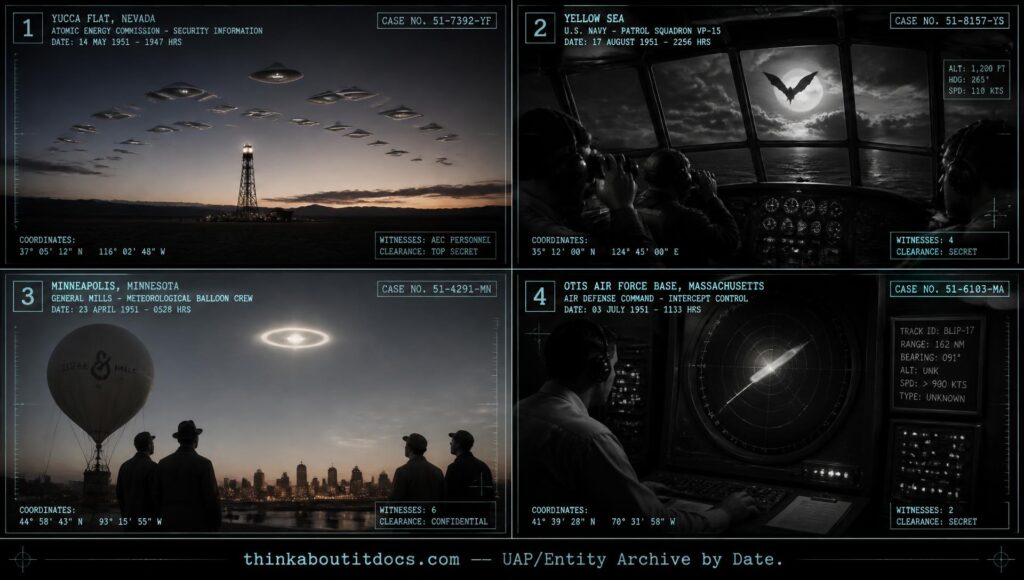
Four cases from October 1951, headlined by the Squadron of Discs over the Nevada atomic test site and the Yellow Sea pursuit.
1951: October UFO|UAP & Entity Sightings Archive
October 1951 pairs two of the archive’s most institutionally and evidentially significant cases: the striking, if secondhand, “Squadron of Discs” account of eighteen rotating discs hovering over the Nevada atomic proving ground just before a nuclear test, and the Yellow Sea pursuit, a Navy patrol crew’s thoroughly corroborated 22-minute tracking of a large, swept-wing object off the coast of Tsingtao, China, now documented in full via the standalone report linked below. The month also brought General Mills Skyhook balloon researchers a set of unexpected close visitors over Minneapolis and a dense run of radar cases across the Pacific and Atlantic theaters.
Date: October 2, 1951 (BBU 980)
Location: Columbus, Ohio
Time: 6:00 p.m.
Summary: Battelle Memorial Institute physicist Howard Cross saw a bright oval with a clipped tail fly straight and level, fading into the distance.
Source: Berliner
Date: October 3, 1951 (BBU 984)
Location: Kadena AFB, Okinawa
Time: Approximately 10:27 p.m. (possibly 8:27 p.m.)
Summary: Radar operators Sgt. M. W. Watson, Pvt. Gonzales, and another sergeant saw a large, sausage- or arc-shaped blip tracked at approximately 4,800 mph.
Source: Berliner; FUFOR Index
Date: October 7, 1951 (BBU)
Location: Near the coast, Honshu, Japan
Time: 7:37 p.m. local time
Summary: Site 6 of the 621st Aircraft Control and Warning Squadron at Niigata Air Base established radar contact with an unidentified object at 37°37’N, 137°15’E, heading 260°, detected on a CPS-5 radar modified with an AN/GPA-7. No friendly aircraft were in the area at the time of the initial sighting.
Source: Dan Wilson; Jan Aldrich
Date: October 1951 (exact date uncertain; recalled by the witness as “probably 1951”)
Location: Nellis AFB, Yucca Flat, Nevada
Time: Shortly before a scheduled nuclear test
Summary: An Air Force corporal, identified only as “Mr. M.” when investigator Walter Webb tracked him down in 1964 through an unrelated case, described a formation of 18 silvery, rotating, disc-shaped objects, each with a dome, descending over the Yucca Flat test site, hovering for 10-15 minutes, then departing at an angle and vanishing from sight within seconds. Webb noted the witness was reluctant to be interviewed in person, having faced ridicule over an unrelated 1964 sighting report, and gave the account only by phone; the exact date and year rest on the witness’s own uncertain recollection thirteen years after the event. See the Full Report.
Source: Walter Webb, NICAP
Date: October 9, 1951
Location: East of Paris, Illinois
Time: 1:45 p.m. CST
Summary: Pilot Charles Warren, flying west from Greencastle, Indiana to Paris, Illinois at 5,000 feet, saw a silvery, “flattened orange” object appearing stationary to his left rear for several seconds. When Warren banked into a tight left turn to pursue, the object suddenly accelerated and headed northeast toward the south of Newport, Indiana.
Source: Berliner; cf. Ruppelt, pp. 112-113; Grudge Report 1
Date: October 10, 1951 (BBU)
Location: 10 miles east of St. Croix Falls, Wisconsin
Time: 10:10 a.m.
Summary: A private pilot, likely General Mills Aeronautical Laboratories engineer Kaliszewski, saw a cigar-shaped object cross the sky, dive slightly, level off, then accelerate.
Source: Project 1947; FUFOR Index
Date: October 11, 1951 (BBU 989)
Location: Minneapolis, Minnesota
Time: 6:30 a.m.
Summary: A team of General Mills Aeronautical Laboratories Skyhook balloon researchers — aeronautical engineer J. J. Kaliszewski, aerologist C. B. Moore, pilot Dick Reilly airborne, and Doug Smith on the ground, along with Dorian and Zuckert — saw a brightly glowing object with a dark underside and a surrounding halo arrive high and fast, slow into slow climbing circles for about two minutes, then speed away to the east. A second object, seen around 8:30 a.m., was independently confirmed by ground observers using a theodolite as it sped across the sky.
Source: Berliner; FUFOR Index
Date: October 16, 1951 (BBU)
Location: West of Whidbey Island NAS, Washington (possibly south of Port Angeles)
Time: 11:01 a.m.
Summary: USAF pilots flying three F-94 fighters and Navy ground personnel saw a round, medium-gray object traveling at high speed and high altitude with no sound.
Source: Project 1947; FUFOR Index
Date: October 18, 1951 (BBU)
Location: Over the Yellow Sea, 140 miles from Tsingtao, China
Time: 3:33 a.m. local time
Summary: A U.S. Navy PBY patrol crew, commanded by Ensign George Gregory, tracked an unidentified object with a 60-foot hull and swept-back, dihedral-tipped wings for 22 minutes. Radar confirmed the object at 12, 16, and finally 22 miles as it staged its withdrawal after the crew closed to within 3-4 miles and confirmed its hull shape by binoculars. See the Full Report.
Source: Project 1947; FUFOR Index
Date: October 21, 1951 (BBU)
Location: 20 miles east of Battle Creek, Michigan
Time: 12:50 p.m. (possibly 10:25 a.m. CST)
Summary: Private pilot N. Manteris, flying a Navion aircraft at 4,000 feet, saw a silver, oval, domed, highly polished disc-shaped object close on a collision course at roughly 3,000 feet, pass beneath his plane, then vanish before he could complete a 180-degree turn to pursue. No trail or vents were visible; the object’s upper surface had a crown- or dome-shaped indentation.
Source: Project 1947; McDonald list; Grudge Report 1; NARCAP
Date: October 21, 1951 (BBU)
Location: North Truro, Massachusetts
Time: 11:18-11:22 p.m. local time
Summary: A CPS-6B Plan Position Indicator radar set picked up a “sausage-shaped” unidentified target moving on an east-southeast course at approximately 1,800 knots. Air Intelligence Information Report IR-47-51E stated the possibility remained that the object was an unconventional flying object.
Source: Dan Wilson; McDonald files; Jan Aldrich; FUFOR Index
Date: October 22, 1951 (BBU)
Location: North Truro, Massachusetts
Time: 7:30-7:32 a.m. local time
Summary: Radar operators detected an object first heading west, then turning south, at a speed of 2,400 knots over a two-minute observation. A message from the 32nd Air Division stated that the individual echo returns and the appearance of the track substantiated the probability that the pickups reflected a genuine flying object rather than radar interference or malfunction.
Source: Dan Wilson; McDonald files; Jan Aldrich; FUFOR Index
EXECUTIVE SUMMARY
From a Nevada Test Site to the Coast of China
October 1951’s two headline cases sit at nearly opposite ends of this archive’s evidentiary spectrum. The Squadron of Discs account — eighteen rotating objects reportedly hovering over the Yucca Flat nuclear test site just before a detonation — is a genuinely extraordinary claim, but it survives only through a single reluctant witness’s phone-only recollection, gathered thirteen years after the fact by an investigator who happened to be looking into an unrelated case. The Yellow Sea pursuit, by contrast, is about as thoroughly corroborated as a single nighttime sighting gets: an entire patrol crew’s visual confirmation, three independently logged radar ranges, and a deliberate, tactically sound identification maneuver by the aircraft commander. Both are presented in full, with their very different evidentiary footing made plain rather than left for the reader to sort out.
“All hands on board observed the hull shape.”
— Account of the October 18, 1951 Yellow Sea pursuit, off the coast of Tsingtao, China