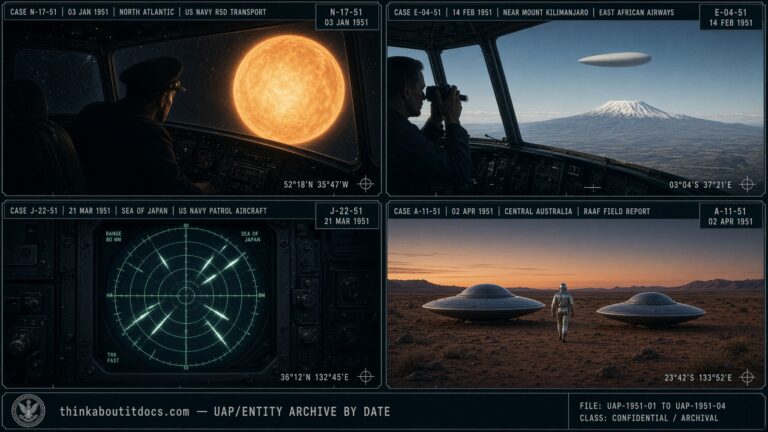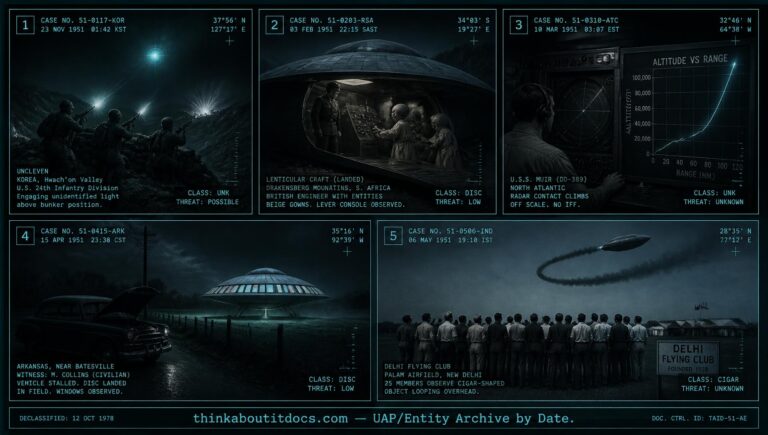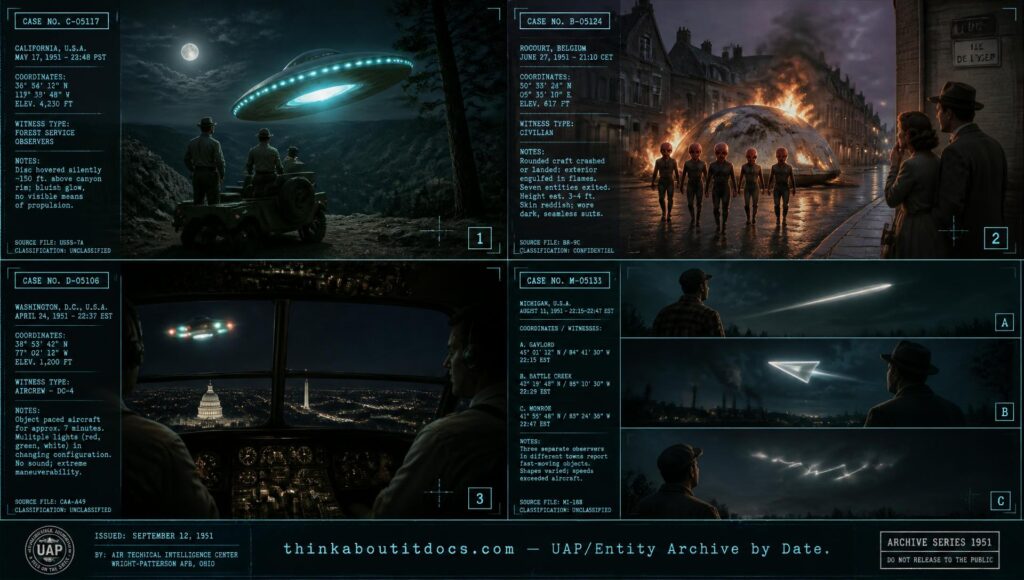
Four cases from November 1951, headlined by the playful Mojave, California disc encounter and the Terest-Houthulst, Belgium landing.
1951: November UFO|UAP & Entity Sightings Archive
The UFO sightings of November 1951 include two Unidentified military and aviation cases. On November 18, a Capital Airlines crew and an Andrews Air Force Base controller reported an object near Washington, D.C., while radar and an F-94 found nothing. On November 24, an F-51 pilot at 25,000 feet near Mankato, Minnesota watched a small white flying-wing-shaped object pass 100 feet from his aircraft for five seconds. That same evening, six observers at four points across lower Michigan reported a fast bright object while the Selfridge Air Force Base radar stopped working.
The month also holds a close-encounter report from two Forest Service lookouts north of Mojave, California, who said a blue-green disc approached within a dozen feet after they signaled it and then vanished like a magician’s trick. Around those cases sit a Riverside photograph exposed as a hoax, a run of green fireballs and meteors from the Atlantic to Kansas and Wisconsin, a contrail in New York, and a handful of cryptid and landing reports from England, Canada, Belgium and New Jersey.
Date: Late October or early November 1951
Location: Montreal, Quebec, Canada (the intersection of Decarie Boulevard and Sherbrooke Street)
Time: About 11:00 p.m.
Summary: An amateur astronomer waiting for a bus saw a green spot come over Decarie Boulevard that faded to a mauve color as the outline of a huge disc-shaped craft formed against the lit sky. An orange-red crescent appeared beneath it and became a bright halo. He described it as passing silently overhead, taking about 20 seconds to turn left and vanish with a flame-like exhaust as long as its diameter, after which a second fireball crossed on the same course from the southwest. He wrote the account up under the title “The Sphereanno Plane.” Blue Book evaluated the case as a meteor, noting that the description made a meteor probable.
Source: Project Blue Book record card and the witness’s typed report
Source Status: Blue Book rated the case Astronomical (meteor). The card gives only “November 1951”; the witness’s own report says the end of October or the beginning of November. His name is redacted in the file.
Date: November 1951
Location: Los Angeles, California
Time: Not reported
Summary: A civilian reported a spaceship directly overhead for three minutes, 400 feet long, 60 feet high and covered on the outside with metal plates. The report was a letter written in September 1961, ten years after the sighting, and included an explanation of how such a craft could be constructed. Blue Book attributed the report to psychological causes.
Source: Project Blue Book record card
Source Status: Blue Book rated the case Other (Psychological). The card gives no day, and the witness’s name is not on it.
Date: November 1951
Location: Garston, Liverpool, England
Time: Night
Summary: Two witnesses (a third person present could not see anything) were driving through a ship-breaking yard when their headlights caught a humanoid creature about six feet six inches tall, wearing tight-fitting plum-colored trousers, with hair standing up in a brush four to five inches high. It moved with an ape-like gait and was quickly lost from sight.
Source: Janet & Colin Bord, Modern Mysteries of Britain
Source Status: Carried over from earlier page; I could not find an independent source for the Garston account.
Date: October 1951 or November 1952 (the source records both as possible)
Location: Terest-Houthulst, Belgium
Time: 20:15
Summary: Mr. and Mrs. H.C., returning from visiting family, saw a flaming, rounded object land at the corner of the Sleepstraat and Kleine Sleepstraat. Before it landed, its upper side opened and seven small, red-skinned beings appeared, with large heads and ears, tiny eye-holes and short legs. Three came to the ground, and one walked around the object as if checking its four-legged landing gear. At a signal from one being, the others returned inside and it took off. Mr. H.C. tried to approach but was driven back by a hot beam of light aimed just ahead of his feet. Numerous people leaving a nearby cinema also saw the light from a distance. See the Detailed Report.
Source: Luis R. González Manso, First HUMCAT catalogue
Source Status: The source gives the year as 1951 or 1952, so this entry may belong on another month’s page; it is kept here as on your earlier page.
Date: November 2, 1951
Location: On a canyon road about 35 miles north of Mojave, California
Time: 11:00 p.m. PST
Summary: Two Forest Service fire lookouts in a jeep saw a vivid blue-green circular object, about 30 feet across and 8 feet thick, appear from the southeast, with a glow of the same color and a darker green band around it that stayed horizontal. They stopped, turned out the lights and waved and shouted. The Air Force report says the object approached to within about a dozen feet and backed off to less than three miles at least three times. It then moved off over three ridges and finally moved sideways and disappeared as though a light had been put out, which the men said was like a magician’s trick. They reported it in August 1952, and Blue Book attributed the case to psychological causes. See the Detailed Report.
Source: Project Blue Book record card; Air Force intelligence report to the Director of Intelligence, Fifteenth Air Force, August 11, 1952; Jacques Vallée, Magonia catalog; FUFOR Index
Source Status: Blue Book rated the case Other (Psychological). The Air Force officer who took the report called the two men steady and dependable. Their names are redacted in the file.
Date: November 2, 1951
Location: Rolla, Kansas
Time: 2400Z (about 6:00 p.m. CST)
Summary: An object seen over Rolla moved west to east in a straight line parallel to the earth, with no variation from its course. It was a shade of green seldom seen, teardrop-shaped, and moved at terrific speed with a complete lack of sound and no visible means of propulsion. The witness put it above 50,000 feet. Blue Book evaluated it as a meteor.
Source: Project Blue Book record card; Air Force flying-object report message
Source Status: Blue Book rated the case Astronomical (meteor). The time on the original message is hard to read, so the card’s 2400Z is used.
Date: November 2, 1951
Location: Atlantic Ocean, 47° N, 57.35° W (near St. Pierre and Miquelon)
Time: 2304Z
Summary: A military aircraft crew at 8,000 feet saw a brilliant white flare come up through an undercast. An aircraft sent to investigate an hour later found four surface vessels and a powerful rotating white beacon at St. Pierre on the Nova Scotia coast. The crew reported on landing that the flare was a rocket type with a tail, traveling from east to west and descending through the overcast, and believed it was more than 40 miles away. The investigating pilot suggested the St. Pierre beacon might have been mistaken for a flare, but noted there was insufficient data to support that, since the witness said the flare came up through the undercast. Blue Book evaluated the case as a meteor.
Source: Project Blue Book record card
Source Status: Blue Book rated the case Astronomical (meteor). The card prints the date as November 2 with a Greenwich time of 2304Z.
Date: November 2 to 3, 1951
Location: Atlantic Ocean, 49.25° N, 53.30° W
Time: 0114Z and 0154Z, November 3
Summary: The crew of a Pan American flight reported descending green flares, and saw a second flare during their descent while circling the area in search of its source. A military aircraft diverted to the area arrived three hours later and observed only a small flashing green beacon and one small fishing vessel. The investigating pilot doubted that the airline pilot could have mistaken a light from 15,000 feet for a flare, and also doubted he could have mistaken it for a weather light. Blue Book recorded insufficient data for evaluation.
Source: Project Blue Book record card
Source Status: Blue Book rated the case Insufficient Data. The file holds two identical copies of this card.
Date: November 2 or 7, 1951
Location: Arizona, New Mexico, Texas and Oklahoma
Time: Unknown
Summary: A green fireball was widely reported across the four-state region.
Source: LIFE magazine, Incident 10
Source Status: Carried over from your earlier page; the November 7 report from Arkansas, Oklahoma, San Antonio and New Mexico (next entry) is a separate Blue Book card.
Date: November 7, 1951
Location: Arkansas, Oklahoma, San Antonio, Texas, and New Mexico
Time: 1315Z (about 7:15 a.m. CST)
Summary: A civilian watched a bright object that reflected light as if it were the sun’s rays reflected off an aircraft, traveling at tremendous speed, about the speed of a shooting star, west to east. It lasted two seconds and went out of sight over the horizon, appearing to travel with the contour of the earth, with no trail or fire. Blue Book carried it as a meteor, evaluated by Dr. Lincoln LaPaz.
Source: Project Blue Book record card
Source Status: Blue Book rated the case Astronomical (meteor). The Texas Tech professors told Ruppelt of a very bright meteor seen the morning of November 7 over Oklahoma.
Date: November 7, 1951
Location: Lake Superior
Time: Unknown
Summary: A steamship captain and crew watched an elongated orange object with six glowing portholes speed toward Ontario.
Source: Unknown
Source Status: Carried over from your earlier page; I could not confirm the source.
Date: November 10, 1951
Location: Albuquerque, New Mexico
Time: Unknown
Summary: The eighth fireball reported in 13 days was seen here and as far away as Wyoming.
Source: United Press
Source Status: Carried over from your earlier page; I did not locate the original wire story.
Date: November 11, 1951
Location: South Wales, New York
Time: 10:30 a.m. EST (1530Z)
Summary: An observer noticed a sudden streak of white vapor trail across the sky moving from southwest to northeast. No object could be seen, though the observer thought he saw a brief reflection on it. The trail widened as though dispersed by the wind after the object had passed from sight. The card notes that the fact the object could not be seen indicates an extreme altitude. Blue Book evaluated the report as a vapor trail from an aircraft, since weather conditions indicated trails formed below 45,000 feet and the trail showed no dispersion.
Source: Project Blue Book record card
Source Status: Blue Book rated the case Other (Contrails).
Date: November 18, 1951
Location: Washington, D.C. area, east of Andrews Air Force Base, Maryland
Time: 3:20 a.m. EST
Summary: A Capital Airlines pilot on Flight 610 reported an object with a brilliant light and several other lights following his DC-4 for about 20 miles at 8,000 feet before it turned back. The Andrews senior controller, called by the Washington tower, saw an object east of the base moving very slowly, if at all, and later saw it disappear to the south. An F-94 sent south saw nothing, and Washington radar could not pick it up. Base operations suggested Venus, but the controller wrote that what he saw passed under Venus, heading south. See the Detailed Report.
Source: Project Blue Book record card; Andrews Air Force Base controller’s statement; Berliner’s Blue Book Unknowns list
Source Status: Blue Book rated the case Unidentified. The controller’s name is redacted in his statement, and the card incorrectly says the object was reported to be a star; the statement says the pilot reported it was not.
Date: November 22, 1951
Location: Queens County, New Brunswick, Canada
Time: 18:00
Summary: Herman Belyea, returning home, struck a pole fence with his axe before crossing it, then heard five loud yells from the woods. Walking on, he heard several more before seeing something leap toward him. The creature closed the distance, reared up on its hind legs with its mouth open and forepaws waving, and charged. Belyea swung his axe and missed, then ran, with the creature repeatedly retreating into the woods and charging again before finally leaving. He described it as black or gray, about six feet tall, with a two-foot tail.
Source: Jerome Clark & Loren Coleman, Creatures of the Goblin World
Source Status: Carried over from your earlier page; I could not find an independent source for this account.
Date: November 22, 1951
Location: Gibbstown, New Jersey
Time: Night
Summary: A group of youngsters gathered at the Dupont Clubhouse. One boy glanced out a window to see a “thing” staring at him, with blood oozing from its face. The chaperone called police, but the creature had disappeared by the time officers arrived.
Source: Michael Norman & Beth Scott, Haunted America
Source Status: Carried over from your earlier page; Patrick Gross’s catalog also lists a Gibbstown case for this date.
Date: November 23, 1951
Location: Riverside, California
Time: Not reported
Summary: A Riverside man’s photograph of an alleged flying saucer, sold to newspapers, drew an Air Force Office of Special Investigations inquiry in March 1952. Photo interpretation suggested the object was an automobile hubcap, though the findings were not conclusive. The photographer, whom the inquiry described as of questioned reliability with a reputation as a prankster, told investigators the picture was “phony,” that it started as a gag that mushroomed beyond his control, and that the object was a tire cover from about a 1937 Ford, buried at the site where he took the picture. Blue Book recorded the case as a hoax.
Source: Project Blue Book record card; Office of Special Investigations Report of Investigation 24-168, March 28, 1952; Air Force disposition form of April 22, 1952
Source Status: Blue Book rated the case Other (Hoax). The photographer’s name is redacted in the file. A second file holds four photographs, each showing a small disc above a ridge. This replaces the earlier placeholder entry, and your photograph is kept.
Date: November 24, 1951
Location: Near Mankato, Minnesota (about 40 miles southwest of Minneapolis, per the Air Force report)
Time: 3:53 p.m. CST (2153Z)
Summary: Capt. William H. Fairbrother, leading a flight of two F-51 fighters on combat air patrol at 25,000 feet and 210 knots, saw a small, milky-white object shaped like a Northrop flying wing, about 8 feet across, apparently hanging in the air. It passed about 100 feet above and 100 feet to the left of his aircraft, heading east in level flight, with no trail, sound or exhaust. His wingman on the left wing did not see it, and the ground radar controller had only the two F-51s on his scope. A 180-degree turn to find it failed. See the Detailed Report.
Source: Project Blue Book record card; AF Form 112 report of December 1, 1951; Berliner’s Blue Book Unknowns list; Brad Sparks, Blue Book Unknowns Catalogue; NICAP
Source Status: Blue Book rated the case Unidentified. The only balloon released from Minneapolis that day had landed hours earlier, and no classified flights were on file.
Date: November 24, 1951
Location: Lower Michigan: Selfridge Air Force Base, Battle Creek, Kent County Airport at Grand Rapids and Coopersville
Time: 2320Z to 2325Z (6:20 to 6:25 p.m. EST)
Summary: Six observers at four points across lower Michigan, two airmen at Selfridge, an airman at Battle Creek, two tower operators at Grand Rapids and a Capital Airlines pilot at Coopersville, reported a bright object in the southeast sky moving west or southwest parallel to the ground. It was variously described as round, football-shaped, egg-shaped and bullet-shaped, and speed estimates ran from about jet speed to 1,000 mph or more. The Selfridge radar ceased operation at 2320Z, and the University of Michigan observatory reported no meteors or aurora. See the Detailed Report.
Source: Project Blue Book record card; Eastern Air Defense Force and Selfridge teletypes; 30th Air Division reports; Dan Wilson; FUFOR Index
Source Status: Blue Book rated the case Astronomical (meteor), though the Air Force’s own checks in the file found no meteors, aircraft or balloons. See also the Coopersville and Selfridge entries below.
Date: November 24, 1951
Location: Coopersville, Michigan
Time: 2325Z (6:25 p.m. EST)
Summary: The pilot of Capital Airlines Flight 94, flying from Muskegon to Grand Rapids at 1,900 feet, saw a bright, dullish blue light with no tail or trail cross his course on a flat trajectory and disappear after four or five seconds. He put its speed at about 1,000 mph, which he called a rough guess. His co-pilot also saw it but was not interviewed. See also the Lower Michigan entry above.
Source: Project Blue Book case file; 30th Air Division report; Project 1947; FUFOR Index
Source Status: Part of the Lower Michigan case, rated Astronomical (meteor) by Blue Book. The pilot’s name is omitted.
Date: November 24, 1951
Location: Selfridge Air Force Base, Michigan
Time: 2320Z (6:20 p.m. EST)
Summary: Two men at Selfridge reported a large, oblong, brightly lit object moving at a rapid rate with no noise. At 2320Z the base radar ceased operation, with its antenna reported moving in the opposite direction. The Air Defense Command checked other stations and found no flight plan that could correspond, and the weather was CAVU. See also the Lower Michigan entry above.
Source: Selfridge Air Force Base and Eastern Air Defense Force teletypes; Dan Wilson
Source Status: Part of the Lower Michigan case, rated Astronomical (meteor) by Blue Book.
Date: November 25, 1951
Location: Twenty miles east of Bimini, Bahamas (reported to Key West)
Time: 1835Z
Summary: Five objects were reported moving south 20 miles east of Bimini, still trailing smoke. The original message was not received, and Blue Book recorded insufficient data.
Source: Project Blue Book record card; Air Defense Command message
Source Status: Blue Book rated the case Other (Insufficient Data). The card is the only record of the first message.
Date: November 26, 1951
Location: Milwaukee, Wisconsin (25 miles due east of the city)
Time: 1025Z (4:25 a.m. CST)
Summary: Two Capital Airlines pilots, about 75 miles apart, reported an orange ball of fire with a long tapered tail, about 200 feet long on the card, approaching head-on from 260 degrees in level flight with no sound, for 10 seconds by one pilot and 35 by the other. One saw a blue exhaust flame behind it. The second pilot put its speed at 2,000 mph and thought it slower than a meteor. The 30th Air Division found no radar record, no jet activity and an overcast of 1,400 feet, and called both pilots stable, sincere observers. Blue Book evaluated it as a meteor.
Source: Project Blue Book record card; 30th Air Division Air Intelligence Information Report IR-63-51E
Source Status: Blue Book rated the case Astronomical (meteor). The pilots’ names are redacted.
Date: November 26, 1951
Location: Greenland
Time: 2138Z
Summary: Military observers saw an object in the northwest sky that went through a gradual lighting from black to bluish to red and faded in 10 seconds. The sound of an explosion and a rattling of windows followed five to six minutes later. The initial message was not received, and Blue Book recorded insufficient data.
Source: Project Blue Book record card
Source Status: Blue Book rated the case Insufficient Data.
Date: November 28, 1951
Location: Highway 91 between Colton and Riverside, California
Time: 3:00 a.m. PST (1100Z)
Summary: An illustrator at Northrop watched an oval object with a greenish halo, like cigar smoke around a luminous core, for 30 minutes from his car. It appeared stationary at 4,000 to 5,000 feet, dilated to five times its size for about half a minute, then shrank to less than the nearest star, Vega. When he drove east it moved off slowly in the same direction, rising and falling vertically like a rubber ball bouncing in slow motion, and finally climbed and gained speed until it disappeared. The report appeared in the Northrop News on May 21, 1952.
Source: Project Blue Book record card; The Northrop News, May 21, 1952
Source Status: Blue Book rated the case Other (Conflicting Data): Vega and Venus were not visible at that hour, Jupiter was on the horizon to the west and Mars was below the eastern horizon.
EXECUTIVE SUMMARY
Near Passes, Meteors and a Paper Trail
November 1951 is a month of near passes. The Mankato pilot put his object 100 feet away, and the Andrews controller and a DC-4 crew both reported lights near Washington, yet neither case had radar support, and in the Mankato case the wingman saw nothing. Blue Book left both Unidentified. The Michigan evening shows the opposite problem: six observers at four points agreed on direction and course within five minutes, and the Selfridge radar stopped, but the case card says meteor even though the Air Force’s own checks found none.
The rest of the month shows how much of the year’s reporting was sky and paper. Green fireballs, a Milwaukee fireball seen by two airline pilots, a Greenland light with a delayed sound, and flares over the Atlantic all fill the files, along with a contrail, a Riverside hubcap photograph, and a letter written ten years after the fact. Mojave is the outlier, a detailed, credible-sounding account that reached the Air Force nine months late and was filed under psychological causes with no further explanation.
“It just blinked from sight like a magician’s trick.”
— Air Force intelligence report on the November 2, 1951 sighting north of Mojave, California, August 11, 1952