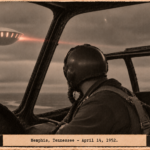
Near Mankato, Minnesota, November 24, 1951: an F-51 pilot sees a small white flying-wing object pass 100 feet away.
THINK ABOUTIT UFO|UAP SIGHTINGS REPORT
1951: F-51 Pilot Near Mankato, Minnesota Sees a Small White Flying-Wing Object Pass 100 Feet Away at 25,000 Feet
At 3:53 p.m. on November 24, 1951, a flight of two Air Force F-51 fighters was flying a combat air patrol south of Minneapolis at 25,000 feet under ground-controlled intercept control. The flight leader, Capt. William H. Fairbrother, saw a small, milky-white object shaped like a Northrop flying wing, about 8 feet across, apparently hanging in the air ahead of him. It then passed about 100 feet above and 100 feet to the left of his aircraft, heading east in level flight.
The whole sighting lasted about five seconds. His wingman, flying on his left wing, did not see it, and the ground controller had nothing on the scope but the two fighters. Fairbrother turned 180 degrees to find it and could not. Project Blue Book rated this daylight sighting Unidentified.
Date: November 24, 1951
Sighting Time: 3:53 p.m. CST (2153Z)
Day/Night: Day (weather CAVU, visibility about 50 miles at 25,000 feet)
Location: Near Mankato, Minnesota, per the Blue Book card; the Air Force report places it about 40 miles southwest of Minneapolis (grid reference FJMQ 1720)
Urban or Rural: Rural (in the air over farmland)
No. of Entity(‘s): Not Applicable
Entity Type: Not Applicable
Entity Description: Not Applicable
Hynek Classification: Daylight Disc (DD); the object was wing-shaped, so this is the nearest category
Duration: About 5 seconds
No. of Object(s): 1
Description of the Object(s): A small, milky-white object shaped like a Northrop flying wing. It appeared to be hanging in the air, then passed the aircraft in level flight. It left no trail or exhaust, made no sound, and made no maneuvers.
Shape/Size/Color of Object(s): Flying-wing shape; about 8 feet across; milky white
Distance to Object(s): Passed about 100 feet above and about 100 feet to the left of the flight leader’s aircraft
Height & Speed: The observer was at 25,000 feet at 210 knots indicated airspeed, heading west; the object was heading east in level flight at an undetermined speed
Number of Witnesses: 1 (the flight leader; the wingman on his left wing did not see the object)
Special Features/Characteristics: A single witness in a two-ship flight; no pickup on the ground-controlled intercept scope; no trail, exhaust or sound; the object seemed to hang before passing; a 180-degree turn failed to find it again
Case Status: Unidentified (Project Blue Book record card: Other, “Unidentified”; listed in Berliner’s Blue Book Unknowns)
Source: Project Blue Book record card (Project 10073); AF Form 112 Air Intelligence Information Report, December 1, 1951, with Part II; 31st Air Division message traffic; Air Technical Intelligence Center message of December 7, 1951; Berliner’s Blue Book Unknowns list; Brad Sparks, Blue Book Unknowns Catalogue; NICAP
Summary/Description: An F-51 flight leader on combat air patrol at 25,000 feet saw a small white flying-wing-shaped object pass 100 feet from his aircraft for about five seconds. His wingman saw nothing, the ground radar showed nothing, and Blue Book left the case Unidentified.
Related Cases: The other Midwest daylight and balloon-crew cases of autumn 1951, including Minneapolis, October 11, 1951; the Michigan sightings of the evening of the same day, November 24, 1951
Detailed Report
The Sighting
The flight of two F-51s was flying a combat air patrol south of Minneapolis under ground-controlled intercept control. The weather was clear and visibility was about 50 miles at 25,000 feet. At 2153Z on November 24, 1951, which is 3:53 p.m. CST, the flight leader saw a small white object ahead. His report gives its shape as the same as the Northrop Flying Wing, its color as milky white and its wingspan as about 8 feet. It was heading east in level flight and appeared to be hanging in the air.
The object passed about 100 feet above and about 100 feet to the left of the flight leader’s aircraft. His wingman was on the left wing and did not see it. The report states that there was no trail, no exhaust, no sound and no maneuvering, that the speed was undetermined and that the object disappeared in the distance. The pilot made a 180-degree turn in an effort to catch or see it again, without success.
The Checks the Air Force Made
The ground-controlled intercept controller reported nothing other than the two F-51s on his scope. The Minneapolis air route traffic control center was asked about balloon flights and answered that the last balloon had been released from the University of Minnesota airport at 1446Z and had landed at 1901Z, 250 miles east-southeast of Minneapolis-St. Paul, some three hours before the sighting. The Air Force flight service at Lowry was asked whether any classified flight plans had been received in the previous 24 hours, and the answer was negative.
The Part II report records the flight leader as fairly reliable and states that no meteorological or other activity or condition was present that might account for the sighting. It records no physical evidence and gives the number and type of local aircraft airborne as unknown. On December 7, 1951, the Air Technical Intelligence Center asked the 31st Air Division for the names and home station of the F-51 pilots, and the division answered with both names.
Blue Book’s Evaluation
The record card carries the case as Unidentified, with the comment “UNIDENTIFIED.” Berliner’s list of Blue Book Unknowns includes it, and the Project Grudge status reports carried it among the cases without an explanation.
RESEARCHER’S NOTES
Why the Mankato Sighting Still Matters
- An experienced observer, a close pass: The pilot was flying a fighter at 25,000 feet in clear air with 50 miles of visibility and put the object 100 feet away. That distance is a pilot’s estimate, but it makes the report a close encounter rather than a distant light.
- The wingman saw nothing: The wingman on the left wing did not see the object, even though it passed on that side. The Air Force report records this without comment, and it is the main weakness in the case.
- No radar return: The ground controller had only the two F-51s on the scope. An 8-foot object would be unlikely to appear on a 1951 search radar, so the missing return neither supports nor weakens the report.
- The balloon was ruled out in the file: The only balloon released from the Minneapolis area that day had landed about three hours earlier, and no classified flight plans were on file at Lowry.
- Location differs between documents: The record card says Mankato, Minnesota, while the Air Force report says about 40 miles southwest of Minneapolis, with a grid reference. Mankato is farther from Minneapolis than 40 miles, so the two cannot both be precise. The card’s location is used for the title and the report’s wording is quoted in the Location field.
The file shows a trained pilot, a clear sky, a five-second pass at a distance of about 100 feet, and a wingman who did not see it. The Air Force checked balloons and classified flights and found nothing to match, and Blue Book left the case Unidentified.
“Made 180 deg turn in effort to catch or see object proved negative.”
— Project Blue Book record card, Mankato, Minnesota, November 24, 1951