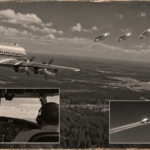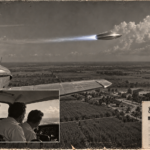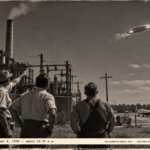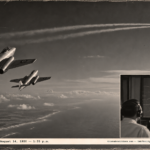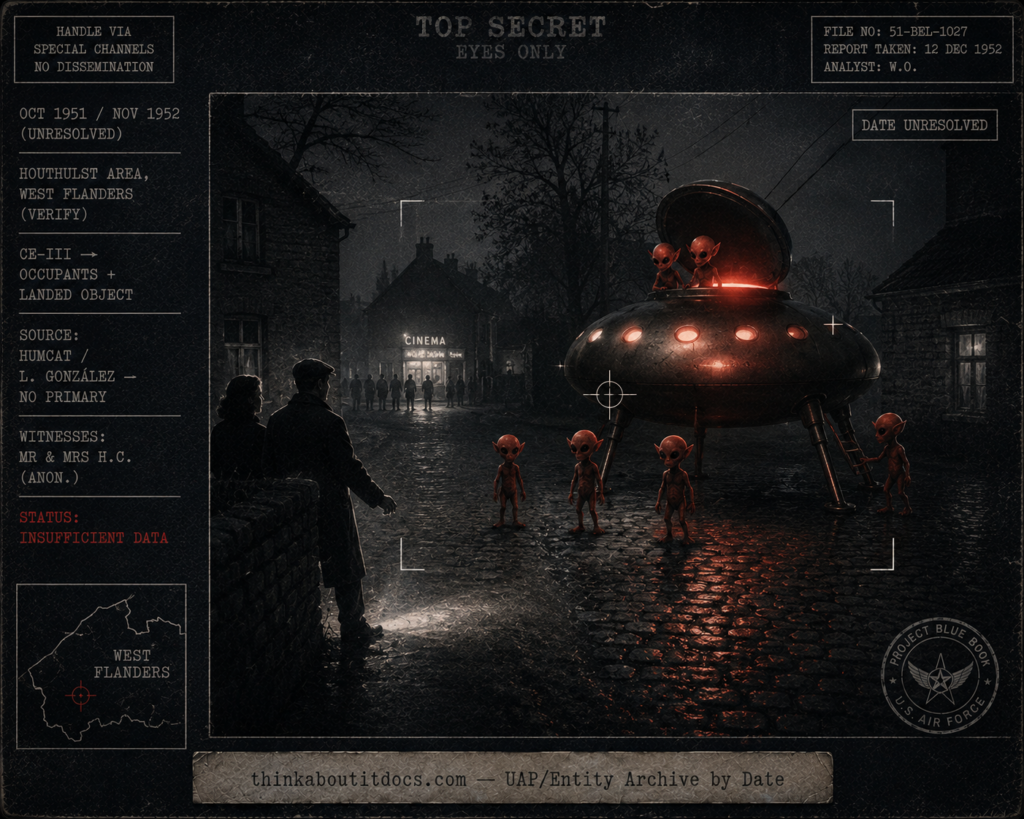
A vivid scene from a thin source — seven red beings and a craft on four legs at a Houthulst crossroads, c. 1951 or 1952. The account survives only as a terse humanoid-catalogue line; logged Insufficient Data, pending verification.
THINK ABOUTIT UFO | UAP SIGHTING REPORT
1951 or 1952: Houthulst, Belgium Sighting
A flaming round craft settling onto four legs at a Flemish street corner after dark, its top hatch opening to release seven small red beings — one of which circles the machine to inspect its landing gear like a mechanic checking a tire — is among the more vivid little-occupant vignettes in the early European record. It is also among the thinnest. The entire case survives as a terse entry in a humanoid catalogue: a year of uncertainty in the date, witnesses reduced to the initials “H.C.,” a place name that doesn’t quite resolve on a map, and no identifiable original source behind it. The scene is striking; the documentation is a single catalogue line. The archive can record what was catalogued without pretending it amounts to a verified event.
Date: October 1951 or November 1952 (unresolved in the source — the year itself is uncertain)
Sighting Time: 8:15 p.m.
Day/Night: Night
Location: Houthulst area, West Flanders, Belgium (given as “Terest-Houthulst”; “Terest/Terrest” appears to be a corrupted or hamlet name and should be verified — Houthulst is the established municipality)
Urban or Rural: Rural (a village street corner — the junction of Sleepstraat and Kleine Sleepstraat)
No. of Entity(‘s): 7
Entity Type: Humanoid (small)
Entity Description: Seven small beings, red in color, with large heads and ears, small holes in place of eyes, and short legs. Three descended to the ground; one walked around the craft and appeared to inspect its four-legged landing gear
Hynek Classification: CE-III (Close Encounter of the Third Kind — animate beings associated with a landed object). Note a physical-effect element is also present (a hot beam directed at the witness’s feet); with occupants observed, CE-III remains the encompassing class
Duration: Brief (not specified; long enough to watch the beings emerge, inspect the craft, and re-board)
No. of Object(s): 1
Description of the Object(s): A flaming, rounded object that descended and landed on four-legged gear; its upper side opened to release the occupants; before departing it directed a hot beam of light at the approaching witness’s feet
Shape of Object(s): Rounded
Size of Object(s): Not specified
Color of Object(s): “Flaming” (glowing/luminous)
Distance to Object(s): Close (the witnesses were at the street corner; the husband attempted to approach on foot)
Height & Speed: Not specified (descended, landed, then took off)
Number of Witnesses: 2 primary (Mr. and Mrs. “H.C.”) plus several distant witnesses — people leaving a cinema who reported seeing the light from afar
Special Features/Characteristics: Landing on four-legged gear; occupant emergence; one being inspecting the craft’s landing gear; a hot beam of light directed at the witness’s feet when he tried to approach; distant corroboration of the light only (not the craft or beings)
Case Status: Insufficient Data (terse, uncorroborated catalogue entry; date and locality unresolved; no identifiable primary source — see notes)
Source: Luis R. González (Manso), notes in his HumCat (Humanoid Catalogue) compilation. HumCat is the humanoid-report catalogue originated by David Webb and Ted Bloecher and extended by later researchers; entries are compilations of reports of widely varying reliability, frequently second- or third-hand and collected years after the event. No primary source (newspaper, contemporaneous report, or named investigator) is identified for this case
Summary/Description: A catalogued report that, on an autumn evening in 1951 or 1952, a married couple at a street corner near Houthulst, Belgium, watched a luminous rounded craft land on four legs and release seven small red beings, one of which inspected the landing gear before all re-boarded and the craft departed — directing a hot beam at the husband’s feet as he tried to approach. Distant cinema-goers reportedly saw the light. The account exists only as a terse humanoid-catalogue entry with no identifiable primary source.
Related Cases: The 1954 European (especially French and Belgian) wave of landing-and-occupant reports, which this case predates | other terse HumCat/Rosales-catalogue entries from 1950s Europe | the broader “small luminous occupants inspecting a landed craft” motif common to the 1954 flap
Full Report
What can be said about this case is bounded entirely by what the catalogue says, and that is little. The report, as preserved in Luis R. González’s HumCat notes, places a married couple — identified only as Mr. and Mrs. H.C. — at the junction of the Sleepstraat and Kleine Sleepstraat on an evening at a quarter past eight, returning from a visit to their parents. They are said to have watched a flaming, rounded object descend and land; before it touched down, its upper surface opened and seven small beings emerged. The beings are described as red, with large heads and ears, mere holes for eyes, and short legs. Three came down to the ground; one circled the craft and appeared to examine its four-legged landing gear. At a signal from one of them, the beings re-entered, and the craft lifted off. When the husband tried to approach, a hot beam of light was directed at the ground before his feet. From a distance, people leaving a cinema are said to have seen the light of the event.
The difficulty is not that the account is outlandish by the standards of the genre — it is, in fact, a fairly typical 1950s European landing-and-occupants report — but that it is almost entirely unanchored. Three problems stand out. First, the date is not merely vague but genuinely unresolved: the source offers October 1951 or November 1952, a spread of more than a year, which is the signature of a report reconstructed from memory rather than from any contemporaneous record. Second, the witnesses are anonymized to initials, and no investigator, newspaper, or named primary source is attached; the chain of custody runs back into the catalogue and stops. Third, the locality does not cleanly resolve: Houthulst is a real municipality in West Flanders, but “Terest” (rendered elsewhere on the page as “Terrest”) does not correspond to a well-known place there and is most likely a corrupted hamlet name or transcription error that should be verified rather than reproduced as fact.
A point of chronological context sharpens the caution. Landing reports featuring small occupants are overwhelmingly a feature of the great 1954 wave that swept France and Belgium, when such accounts numbered in the dozens. A 1951-or-1952 occupant-landing case is comparatively early, and an early case that surfaces only later, in a catalogue, with a year of date-slippage, fits the familiar pattern of a memory collected after the 1954 wave had made such narratives culturally available. That does not make the report false — people did report strange things before 1954 — but it counsels against treating a late-catalogued, fuzzily-dated account as firm early evidence.
None of this is to flag fabrication. There is no indication the witnesses invented anything, no contradictory prior version, no hoaxer in the chain; the distant cinema-goers, if real, lend the light (though not the beings) a measure of independent notice. But sincerity and vividness are not documentation. With the date unresolved, the witnesses anonymous, the locality uncertain, and the primary source missing, the case cannot be verified, dated, or located with confidence. It is a genuine catalogue entry describing a genuine type of report — and that is the most the record can responsibly say.
Researcher’s Notes
The Seven at the Sleepstraat — Houthulst c.1951–52 and the Limits of a Catalogue Line
- Classification — CE-III stands, with a noted physical element: The page’s CE-III is correct and is retained. Animate beings were observed in association with a landed craft, which is the definition of a Close Encounter of the Third Kind. The account also contains a CE-II-type physical element — a hot beam directed at the witness’s feet — but under the Hynek scheme the presence of occupants makes CE-III the encompassing classification, so no change is needed; the heat-beam detail is simply logged as an additional feature. No CE-IV (no abduction) and no higher class applies.
- Source chain — a catalogue entry, not a primary record: The honest characterization of the source is the central correction. “Luis R. González notes in his HumCat catalogue” is a real and respectable secondary compilation, but it is exactly that — a catalogue. HumCat, begun by Webb and Bloecher and extended by later cataloguers, aggregates humanoid reports of every reliability grade, many of them second- or third-hand and gathered long after the fact. No primary source — no newspaper, no contemporaneous report, no named local investigator — is identified here. The entry should be presented as a catalogued report of unverified provenance, not as an established event.
- Pattern context — early outlier to the 1954 wave: The case’s descriptive content sits comfortably inside the European landing-and-occupants tradition, but its dating places it as an outlier ahead of the 1954 French-Belgian occupant wave that produced the bulk of such reports. Combined with the late catalogue appearance and the year of date-slippage, this is consistent with a post-1954 memory rather than a firmly fixed early sighting. The “small beings inspecting the landing gear” motif in particular is a recurring image of the 1954 flap, which is worth noting when it appears in a case nominally dated two or three years earlier.
- Evidentiary weight — vivid but unanchored: The balance is straightforward. On the credible side: two named-to-initials witnesses, a plausible local geography (a real West Flanders municipality, named streets), and distant corroboration of a light. On the limiting side: an unresolved date spanning two years, anonymized witnesses, an unverified or corrupted place name, no identifiable primary source, and no investigation. There is no physical evidence and no way to test the account. This is neither a hoax to be dismissed nor a documented event to be relied upon; it is an unconfirmable catalogue entry. The honest disposition is Insufficient Data, with a recommendation that the locality and date be verified against Belgian sources before any firmer claim is attached.
The record’s honest final position is that this is a real catalogue entry describing an unverifiable event. The image it preserves — seven small red beings at a Flemish crossroads, one of them circling a landed craft to check its footing while a couple watches and distant cinema-goers glimpse the glow — is evocative and entirely in keeping with the era’s occupant reports. But evocative is not the same as documented, and a single humanoid-catalogue line with a year of doubt in its date, initials for witnesses, a place name that won’t resolve, and no source beneath it cannot be carried as established history. The archive keeps it as what it is: a thinly-sourced report of a recognizable type, classed CE-III, logged Insufficient Data, and flagged for verification rather than dressed up as a firm early European landing. The honest entry, here, is the one that says plainly how little stands behind a vivid scene.