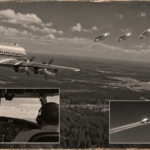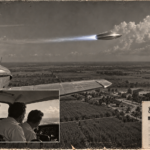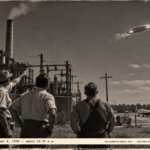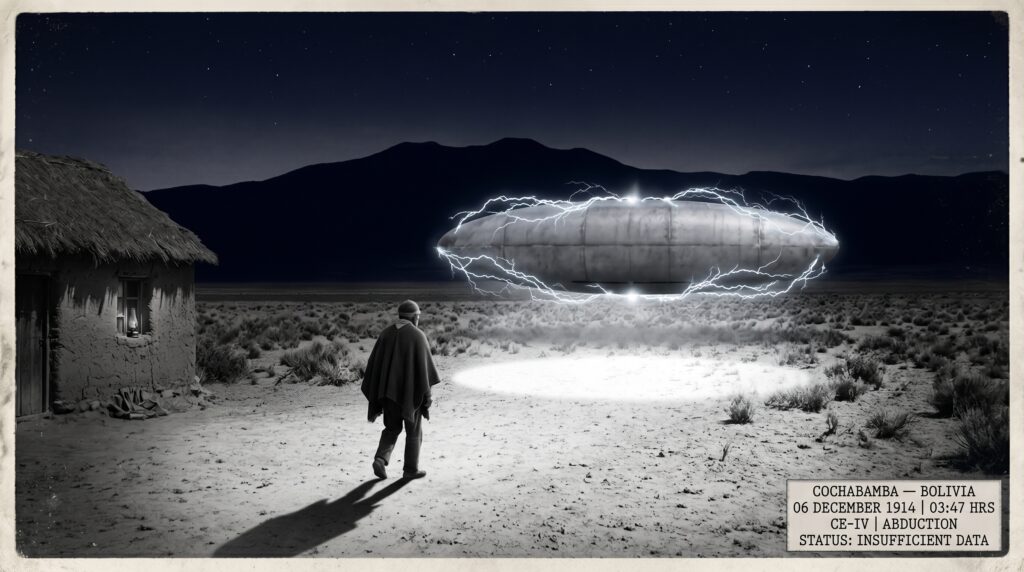
Cochabamba, Bolivia, December 6, 1914, 3:47 AM — David Mendiola Vilchez was awakened by a turbine-like sound and went outside to find a gray metallic cigar craft encircled in electricity landing in a nearby field. A white light took him inside. Monstrous tall beings with octopus-like legs examined him. He passed the account to his children. They passed it to theirs. Source: Lucy Guzman, cited by Albert Rosales. Case status: Insufficient Data.
THINK ABOUTIT ABDUCTION REPORT
1914: Alien Abduction in Cochabamba, Bolivia
At 3:47 in the morning of December 6th, 1914, an elderly man named David Mendiola Vilchez was woken in his isolated home near a cemetery outside Cochabamba, Bolivia by a sound he would later compare to an airplane turbine engine. He went outside. A large gray metallic cigar-shaped craft encircled in what appeared to be electricity was descending onto a nearby field. He approached it. A white light surrounded him and he was inside. The beings around him were very tall, very thin, with huge eyes and skin covered in a disgusting mucous or cartilage-like substance. Their legs resembled those of an octopus. They examined him. He passed the account to his children. They passed it to his grandchildren. It reached Lucy Guzman. It reached Albert Rosales. It reached the archive. At 3:47 AM in Bolivia in 1914 something landed and took a man inside it, and the account survived exactly the way the oldest accounts survive — carried forward by people who could not let it go.
Date: December 6, 1914
Sighting Time: 3:47 AM
Day/Night: Pre-dawn night
Location: Near Cochabamba, Bolivia — isolated rural area adjacent to a cemetery
Urban or Rural: Rural — isolated dwelling near a cemetery outside Cochabamba
No. of Entity(‘s): Several — exact number not recorded
Entity Type: Humanoid and monstrous — witness’s own description uses the word monstrous; humanoid in overall body plan but radically non-human in specific morphology
Entity Description: Very tall and thin. Huge eyes. Skin covered in a disgusting mucous substance or cartilage-like material — the texture and appearance of the skin covering was a primary detail retained across three generations of oral transmission. Legs resembling those of an octopus — the most anatomically distinctive detail in the account, suggesting multiple appendages or a non-standard lower limb structure entirely unlike any known humanoid species. Conducted a physical examination of the witness. No verbal or telepathic communication recorded in available source. The witness does not recall additional details of the examination beyond the fact that it occurred.
Hynek Classification: CE-IV (Close Encounter IV) — abduction of the witness; transport inside the craft; physical examination by entities; loss of voluntary movement implied by the abduction sequence
Duration: Insufficient Data — not recorded; long enough for physical examination; the white light transition and return suggest a distinct abduction episode with a clear beginning and end
No. of Object(s): 1
Description of the Object(s): Large gray metallic cigar-shaped craft descending onto a nearby field; described as appearing to be encircled in electricity — suggesting a visible electromagnetic discharge or corona effect around the hull during descent; large enough to contain several tall entities and conduct an examination of a human witness
Shape of Object(s): Cigar
Size of Object(s): Large
Color of Object(s): Gray metallic
Distance to Object(s): The witness approached the craft in the field — close range; exact distance at approach not recorded; abduction transport eliminated distance entirely
Height & Speed: Descending onto field at time of first observation; altitude and approach speed not recorded
Number of Witnesses: 1 — David Mendiola Vilchez, elderly male, isolated rural dwelling near Cochabamba; account preserved through three-generation family oral transmission
Special Features/Characteristics: Precise timestamp — 3:47 AM is an unusually specific time for a 1914 rural Bolivia account and suggests the witness noted or was aware of the exact time before going outside; electromagnetic corona effect visible around the craft hull during descent — described as encircled in electricity; white light transport into the craft — the abduction transition used light rather than mechanical capture; the octopus-leg morphology of the entities is one of the most anatomically specific non-human descriptions in the pre-1950 abduction record; three-generation oral transmission chain — Vilchez to children, children to grandchildren, grandchildren to Lucy Guzman, Guzman to Albert Rosales — is the preservation mechanism for this case; the account was never written down by the witness himself
Case Status: Insufficient Data — single witness, account preserved through multi-generational oral transmission with no contemporaneous written record; specific details including exact timestamp, entity morphology, and craft description are internally consistent and specific enough to distinguish from casual embellishment; primary source verification is not possible
Source: Lucy Guzman, lucy@ovni.net, cited by Albert Rosales
Summary/Description: On December 6th, 1914 at 3:47 AM, David Mendiola Vilchez — an elderly man living in an isolated area near a cemetery outside Cochabamba, Bolivia — was awakened by a turbine-like sound and went outside to find a large gray metallic cigar-shaped craft encircled in electricity descending onto a nearby field. Approaching the craft he was enveloped in a white light and found himself inside, surrounded by several monstrous beings — very tall and thin, huge-eyed, with mucous or cartilage-covered skin and octopus-like legs. He was examined. He passed the account to his children, who passed it to their children. The account reached researcher Lucy Guzman and subsequently Albert Rosales. Case status: Insufficient Data.
Related Cases: 1914: Algeria, Blida — Helmeted Entities Sample Collection | 1957: Antonio Villas Boas Abduction, Brazil | South America Abduction Cases Archive
Detailed Report
The White Light at 3:47 — Near Cochabamba, Bolivia, December 6, 1914 Source: Lucy Guzman, cited by Albert Rosales
David Mendiola Vilchez was an elderly man living alone in an isolated area near a cemetery outside Cochabamba, Bolivia. On the night of December 6th, 1914, at 3:47 in the morning, he was woken by a noise he would later compare to that of an airplane turbine engine coming from outside.
He went out to investigate. In a nearby field a large gray metallic cigar-shaped craft was descending. It appeared to be encircled in electricity — a visible discharge or corona effect around the hull.
He approached the craft. As he drew near he was suddenly surrounded by a bright white light and found himself apparently inside the craft. Around him were several monstrous beings. They were very tall and thin. They had huge eyes. Their skin appeared to be covered in a sort of disgusting mucous substance or cartilage-like material. Their legs resembled those of an octopus.
He was examined by the beings. He does not recall any additional details of the examination.
Vilchez passed the account of his encounter to his children. They passed it to their grandchildren. The account eventually reached Bolivian researcher Lucy Guzman, who documented it and passed it to Albert Rosales for inclusion in the abduction case record.
RESEARCHER’S NOTES
The White Light at 3:47 — Cochabamba 1914 and the Oral Transmission Abduction Case in the Pre-War South American Record
- The Timestamp as Credibility Marker: The precise time of 3:47 AM is the first analytically significant detail in this case. Rural Bolivia in 1914 had limited access to precise timekeeping — clocks existed but were not ubiquitous in isolated dwellings near cemeteries. The specificity of 3:47 AM rather than approximately four in the morning or before dawn suggests either that the witness noted the exact time before going outside — checking a clock when awakened by the sound — or that the time was preserved with unusual precision through the oral transmission chain because it was regarded as important. Either way it is not the kind of detail that accumulates in embellishment. Fabricated accounts reach for drama. Oral transmissions preserve the details the original teller considered important. The fact that 3:47 survived three generations argues for its authenticity.
- Entity Morphology — The Octopus Leg Detail: The description of the entities’ legs as resembling those of an octopus is the most anatomically specific non-human morphological detail in the pre-1950 abduction record accessible to the archive. It is not a detail from any available science fiction of 1914 Bolivia. H.G. Wells’s Martians had tentacles, but they were not described as having octopus legs specifically, and it is unlikely an elderly Bolivian man in an isolated rural dwelling near Cochabamba in 1914 was reading The War of the Worlds. The mucous or cartilage skin covering is equally specific — disgusting is the word preserved, which is an emotional detail carrying the visceral physical reality of the encounter rather than a literary embellishment. These two morphological specifics — octopus legs and mucous-covered skin — survived three generations of oral transmission intact. Details that survive that transmission are details that the original witness impressed upon his listeners as important and real.
- Three-Generation Oral Transmission as Preservation Mechanism: The account of David Mendiola Vilchez reached the formal research record through Vilchez to children, children to grandchildren, grandchildren to Lucy Guzman. This is a three-generation oral chain spanning approximately sixty to seventy years before it was written down. Oral transmission over that span inevitably introduces some distortion — but it also filters out details that do not carry emotional weight or that family members could not reliably reproduce. What survived the chain — the turbine sound, the electricity around the craft, the white light abduction, the tall thin monstrous beings, the huge eyes, the mucous skin, the octopus legs, the examination — are the load-bearing elements of the account, the details that every generation considered essential to pass on faithfully. The archive treats multi-generational oral transmission as a legitimate preservation mechanism for pre-modern encounter accounts, consistent with how indigenous oral histories preserve factual events across centuries.
- Source Chain — Guzman to Rosales: The case entered the formal research record through Lucy Guzman of Bolivia passing it to Albert Rosales for inclusion in his humanoid encounter catalog. Both are documented researchers with established records in South American UAP and entity research. The source chain is secondary but credentialed within the research community. No primary document — written testimony by Vilchez or a family member — is recorded in available sources. The case is held at Insufficient Data status accordingly, while the internal consistency of the account and the specificity of the morphological details are noted as arguing toward a genuine transmitted encounter account rather than a fabricated one.
David Mendiola Vilchez went outside at 3:47 in the morning in Bolivia in 1914 and a white light took him into a gray ship and beings with octopus legs looked at him and he could not remember what they did. He told his children. They told their children. Sixty or seventy years later the account reached a researcher and the researcher put it in a catalog. The archive holds it here — not as proof, but as the record of something one man carried for the rest of his life and would not let die with him.