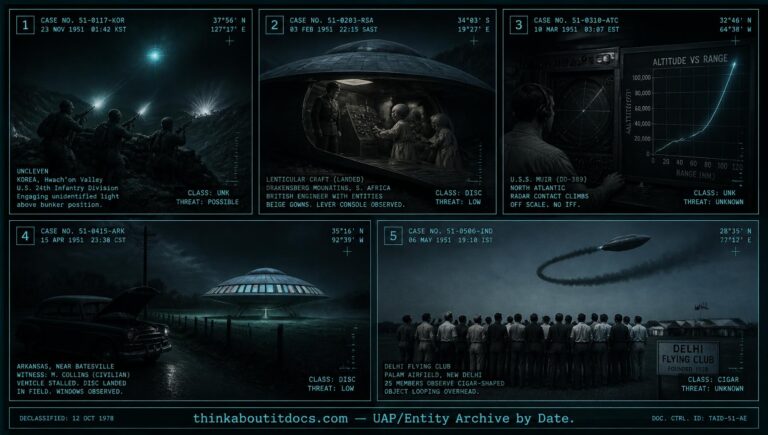
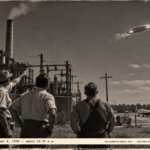
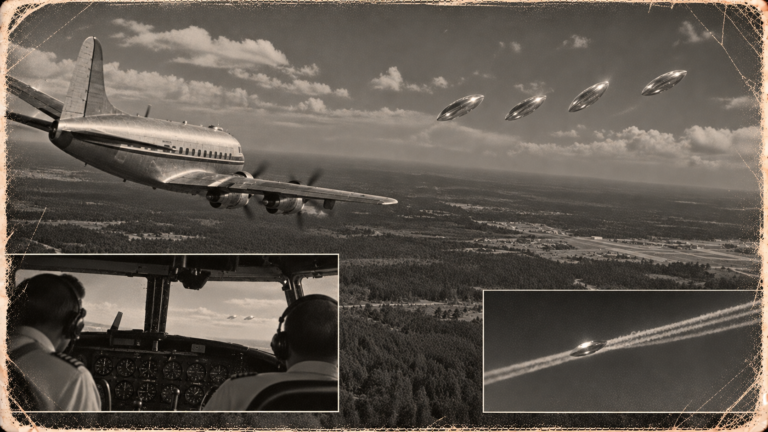
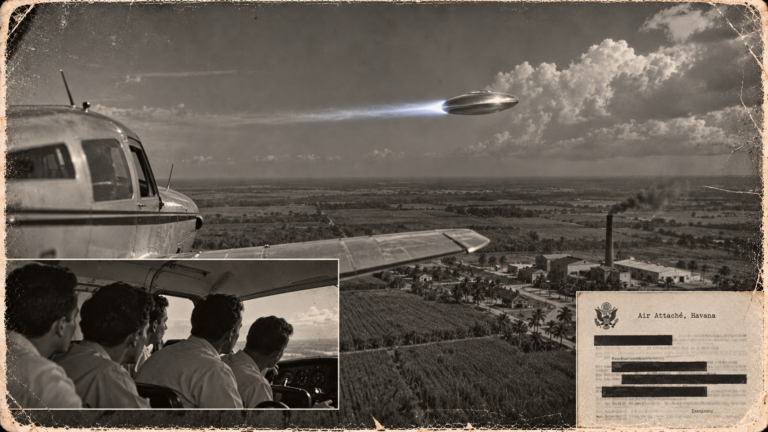
Four cases closing out 1951, headlined by the Okulov taiga encounter in Russia and future astronaut Deke Slayton's sighting near Hastings, Minnesota.
1951: December
UFO|UAP & Entity Sightings Archive
December 1951 closes the year with two exceptional cases now documented in full via standalone reports: the Okulov taiga encounter, a hunter’s detailed sighting of skull-headed occupants deep in the Russian wilderness, and the Deke Slayton sighting near Hastings, Minnesota — an unresolved fighter pursuit told candidly, decades later, by a man who would go on to become one of America’s first astronauts. The month also brought a further isolated sighting at Oak Ridge, Tennessee, well removed in time from the facility’s dense 1950-51 flap already documented on this site, and a notable case in Red Springs, North Carolina that reportedly shook a skeptical police chief’s confidence.
Date: Winter 1951
Location: Near Safonovo, Arkhangelsk region, northern Russia (USSR)
Time: Evening
Summary: Fifty-year-old hunter Semyen Stepanovich Okulov, camped alone in the taiga along the Pesha River, heard a strange buzzing sound and watched a bright cloud release a floating, inverted-plate-shaped craft. Extinguishing his fire and hiding, he watched it descend near the ground, project a misty column of light, and reveal several skull-shaped, hairless humanoid heads through its portholes. After roughly 30 minutes it departed in a burst of sparks; the next morning Okulov found a circular patch of melted snow at the site, and a fellow hunter independently confirmed seeing lights fly into a cloud the same night. See the Full Report.
Source: Georgiy Markovich Naumenko, personal investigation 1971, in Extraterrestrials and Earthlings: Testimonies of Contacts, Moscow, 2007
Date: December 1951
Location: Red Springs, North Carolina
Time: 21:00
Summary: At dusk, Sam Coley’s 12-year-old son called his father and 17-year-old sister outside to see a strange object descending from the sky — shaped like two saucers joined together with a cabin-like bulge at the center, nearly silent apart from a slight purring sound. It stopped roughly six feet above the ground about 300 yards from the house, giving off no light except from windows in its central cabin, where Coley reported seeing a man inside. After hovering about ten minutes it departed almost silently, “like a bolt of lightning.” The interviewing police chief reportedly lost his initial skepticism after speaking with the family.
Source: State Defense Director E. Z. Jones; Red Springs Police Chief
Date: December 1951 (BBU)
Location: Northwest of Peru, Nebraska
Time: 3:00 a.m.
Summary: A Mr. Barry, driving from Lincoln toward Indiana, saw a blue light in the northwest sky vanish to the southeast; after missing a turn and backtracking toward Auburn, he saw an orange glow northwest of Peru coming from a cauldron-shaped object resting on the ground about 40 feet from the road. Stopping to examine it, he found a roughly 30-foot-diameter, cast-iron-colored object with a row of 10-inch round windows glowing orange near its top and a blue flame-like glow on the opposite side; there was no noise, sign of activity, antenna, or protrusion. He drove away without further incident.
Source: Jacques Vallée, Magonia case 86; FUFOR Index
Date: December 7, 1951 (BBU 1021)
Location: Oak Ridge, Tennessee
Time: 8:15 a.m.
Summary: Atomic Energy Security Patrol guard J. H. Collins saw a 20-foot-square, white-gray, non-reflective object fly up above a ridge to the clouds and back down again twice, each pass taking 30-40 seconds. This sighting falls roughly ten months after the last documented incident in this site’s Oak Ridge/Knoxville Flap standalone (which runs October 1950 through January 1951) and is treated here as a separate, isolated later sighting at the same facility rather than an extension of that continuous pattern.
Source: Berliner; FUFOR Index
Date: December 7, 1951 (BBU 1023)
Location: Sunbury, Ohio
Time: 4:30 p.m.
Summary: Amateur astronomer Carl Loar saw a silvery sphere through his telescope, with two specks visible at its sides. The object then appeared to explode, replaced by a dark cloud and numerous specks.
Source: Berliner
Date: December 12, 1951
Location: Hastings, Minnesota
Time: Approximately 1:50 p.m. (possibly 3:50 p.m.) CST
Summary: USAF Minnesota Air National Guard pilot Donald “Deke” Slayton — later one of the original Mercury Seven astronauts — flying an F-51 at 10,000 feet, saw a white or gray object that resolved from a kite-like shape into what appeared to be two revolving discs as he closed in. He overflew it within about 1,000 feet, turned 180 degrees to pursue, and watched it pull away, make a sudden 45-degree climbing turn, and accelerate out of sight; ground personnel reportedly tracked it by theodolite at approximately 4,000 mph. Slayton did not share the account publicly until his 1995 autobiography. See the Full Report.
Source: Donald K. Slayton, Deke!, 1995; Project 1947; FUFOR Index; Richard Hall
Date: December 22, 1951
Location: 5 miles east of Columbus, Ohio
Time: 10:30 a.m. EST
Summary: Capt. Walter J. Koby, piloting an F-84C westbound at roughly 15,000 feet, saw a silver, tailless, airplane-like object traveling the opposite direction at an altitude of at least 20,000 feet, appearing to tumble or roll until it was lost in the sun’s glare. Its speed was estimated at more than 300 mph, over an observation lasting roughly one to one and a half minutes.
Source: Blue Book files; Dan Wilson
EXECUTIVE SUMMARY
Closing the Year with a Future Astronaut and a Siberian Hunter
December 1951, and with it the full year, closes on two cases that could hardly sit further apart geographically or culturally, yet share a common thread: both witnesses told their stories with real restraint. Semyen Okulov, a Russian hunter with no incentive toward embellishment, described exactly what he saw and no more, corroborated the next morning by a real trace in the snow. Deke Slayton, a decorated test pilot who would go on to fly to space himself, narrated his own confusion and failure to catch the object candidly, in his own published words, decades after any career incentive to shape the story either way had passed. Between them, this year’s record closes not with its loudest claims, but with two of its most carefully, honestly told.
“I realized I wasn’t closing on that son of a bitch.”
— Donald “Deke” Slayton, on the December 12, 1951 encounter near Hastings, Minnesota