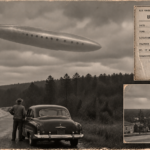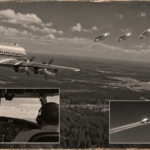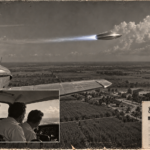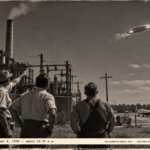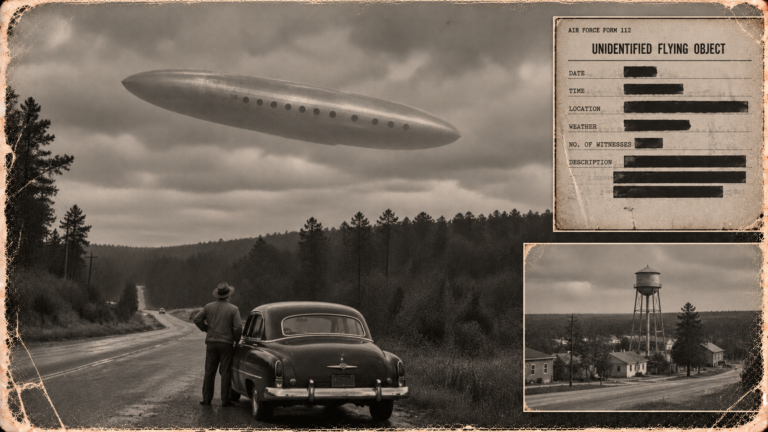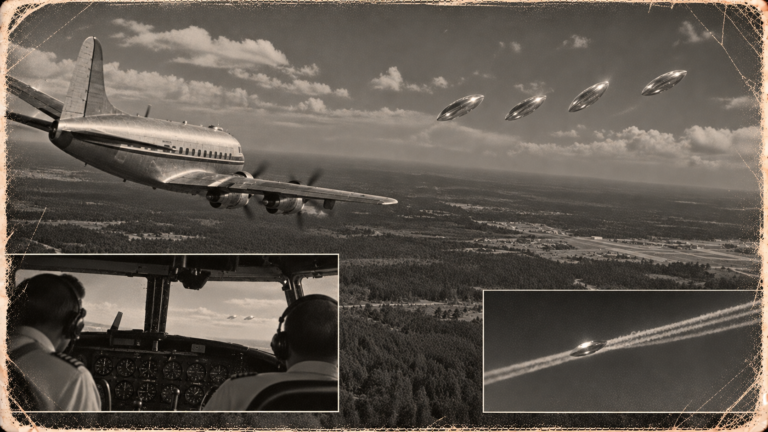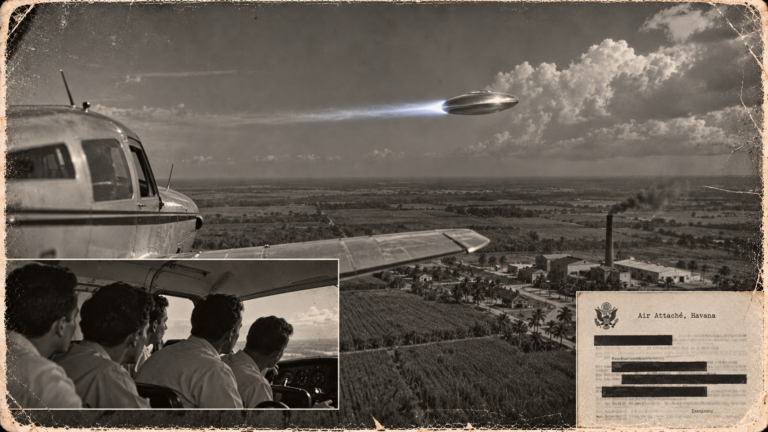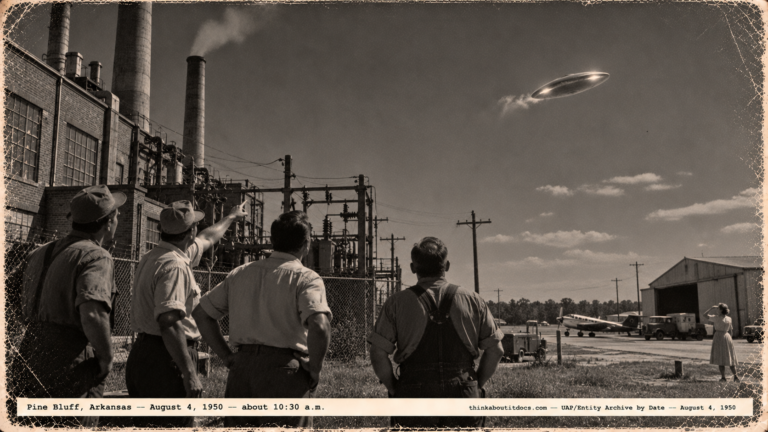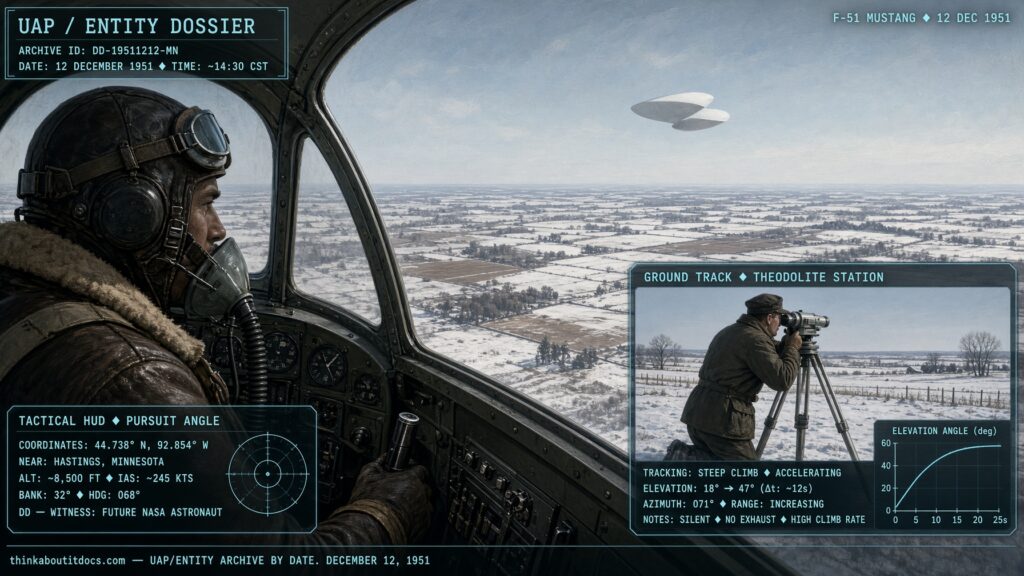
Future Mercury astronaut Deke Slayton's December 12, 1951 pursuit of an unidentified object near Hastings, Minnesota, which outclimbed and outran his P-51.
THINK ABOUTIT UFO SIGHTINGS REPORT
1951: The Deke Slayton Sighting — Hastings, Minnesota
On a bright winter afternoon in December 1951, an Air National Guard test pilot flying a routine hop back to Holman Field spotted something ahead that he first took for a kite, then a weather balloon, then a pair of revolving discs — and by the time he gave up trying to catch it, he knew it was none of those things. Donald “Deke” Slayton would go on, eight years later, to be selected as one of the seven original Mercury astronauts and would eventually fly to space himself; his account of this sighting, given candidly in his own 1995 autobiography rather than to a UFO investigator, makes this one of the most credibly sourced military pilot encounters in the entire early Cold War record.
Date: December 12, 1951
Sighting Time: Approximately 1:50 p.m. (possibly 3:50 p.m.) CST
Day/Night: Day
Location: Near Hastings, Minnesota, en route back to Holman Field, St. Paul
Urban or Rural: Airborne, over rural Minnesota
No. of Entity(‘s): Not applicable
Entity Type: Not applicable
Hynek Classification: DD (Daylight Disc)
Duration: Several minutes, from initial sighting through the pursuit and the object’s final departure
No. of Object(s): 1
Description of the Object(s): A white or gray object that resembled a kite at first glance, then a weather balloon as Slayton closed distance, and finally appeared to consist of two revolving discs; Slayton’s own later account emphasized that once he passed behind it for a closer look, it no longer resembled a balloon at all
Shape of Object(s): Initially kite-like or balloon-like in outline, resolving into what appeared to be two revolving discs at closer range
Size of Object(s): Estimated by the witness, decades later in 1980, as appearing about the angular size of a grapefruit held at arm’s length (roughly 11°); period size/distance calculations based on the reported closing data instead suggest a much smaller angular size of roughly 0.2°, a significant discrepancy this report preserves rather than resolves
Color of Object(s): White or gray
Distance to Object(s): Slayton overflew the object within an estimated 1,000 feet
Height & Speed: Slayton was flying his F-51/P-51 at 10,000 feet and 280-300 mph; the object was initially at his 1 o’clock position at roughly the same altitude. After he passed over and turned 180 degrees to pursue, the object was already moving away; it then made a sudden 45-degree climbing turn, accelerated, and disappeared. Ground personnel using a theodolite reportedly tracked and computed its speed at approximately 4,000 mph.
Number of Witnesses: 1 direct aerial witness (Donald “Deke” Slayton); unnamed ground personnel separately tracked the object by theodolite
Special Features/Characteristics: The object’s appearance changed progressively as Slayton closed distance — kite, then balloon, then two revolving discs — a sequence of misidentification-and-correction that Slayton himself narrated candidly rather than presenting as an immediately resolved sighting; its final departure combined a sudden climbing turn with an extreme acceleration, reportedly reaching a speed, per independent ground theodolite tracking, far beyond any aircraft of the period.
Case Status: Unexplained
Source: Donald K. Slayton (with Michael Cassutt), Deke! U.S. Manned Space: From Mercury to the Shuttle, 1995; Project 1947; FUFOR Index; Richard Hall; NICAP
Summary/Description: On December 12, 1951, Donald “Deke” Slayton, then a maintenance flight test officer with an F-51 squadron of the Minnesota Air National Guard, was flying at 10,000 feet and 280-300 mph, heading back toward Holman Field near St. Paul, when he spotted a white or gray object at his 1 o’clock position that at first looked like a kite. Recognizing his altitude made that impossible, and initially taking it instead for a weather balloon, he moved in for a closer look — and, by his own account, it stopped resembling a balloon entirely once he passed behind it, instead appearing to consist of two revolving discs. Slayton overflew the object at a range of roughly 1,000 feet, then banked into a 180-degree turn to pursue it, but found it already pulling away from him. The object then executed a sudden 45-degree climbing turn and accelerated dramatically, quickly outdistancing his fighter and disappearing. Ground personnel tracking the object with a theodolite reportedly computed its speed at approximately 4,000 mph. Slayton did not discuss the sighting publicly for decades, eventually describing it candidly in his 1995 autobiography, written with Michael Cassutt, recalling that he simply could not close the distance despite his aircraft’s performance. In a 1980 recollection, he estimated the object’s angular size as comparable to a grapefruit held at arm’s length, though period calculations based on the reported closing geometry suggest a considerably smaller apparent size — a discrepancy this report notes rather than resolves.
Related Cases: 1951: The Lt. George Kinmon Pursuit, Georgia | 1950: The Robert Haven Pursuit, Lakehurst, New Jersey (comparable military pilot pursuit-and-evasion cases)
Detailed Report
What sets the Slayton sighting apart from nearly every other case in this archive is not the encounter itself, dramatic as it is, but the witness’s subsequent career and the manner in which he chose to tell the story. Slayton was not a UFO enthusiast seeking attention, nor an anonymous witness relayed through a secondary compiler; he was a decorated World War II combat pilot, an aeronautical engineer, one of the seven men selected for America’s first astronaut corps, and eventually a spaceflight veteran who flew the Apollo-Soyuz mission in 1975. He told this story in his own voice, in his own autobiography, decades after any incentive toward embellishment for the sake of a UFO investigator’s report could plausibly apply — he had, by 1995, nothing to gain and arguably something to lose professionally by including it.
The account’s narrative honesty is also worth noting on its own terms. Slayton does not claim instant, unambiguous recognition of something extraordinary; he describes a witness’s normal cognitive process of misidentification and correction — kite, then balloon, then something else entirely — which is a far more psychologically plausible account of how an experienced pilot would actually process an anomalous sighting in real time than a story that opens with immediate certainty. His own blunt language recalling his failure to close the distance, preserved in his book, reads as an unembellished pilot’s frustration rather than a dramatized retelling.
The reported ground theodolite tracking, computing a speed of roughly 4,000 mph, is the case’s most extraordinary specific claim, and also its least independently verifiable detail from the sources available to this archive — no named theodolite operator, unit, or original tracking data has been located to corroborate the figure directly, meaning it rests on Slayton’s own secondhand knowledge of what ground personnel told him rather than a document this archive has independently examined. If accurate, a computed speed at that magnitude would place the object’s performance well beyond any aircraft — piloted or unpiloted — known to exist in 1951, and indeed considerably faster than record-setting aircraft that would not fly for another decade or more.
The discrepancy between Slayton’s 1980 recollection of the object’s angular size (comparable to a grapefruit at arm’s length) and the smaller size implied by contemporary closing-geometry calculations is a genuine complication worth flagging rather than glossing over. Memory of precise angular size, recalled nearly three decades after a brief, high-stress encounter, is inherently less reliable than memory of the encounter’s basic shape and sequence of events — this archive treats the core narrative as more evidentially solid than the specific late-recalled size estimate.
RESEARCHER’S NOTES
The Deke Slayton Sighting — Minnesota 1951 and the Weight of a Witness’s Later Career
- Classification issues: DD fits the case’s daytime, initially resolved-shape visual profile, though the object’s extreme final acceleration and reported theodolite-tracked speed push its performance well beyond a typical daylight disc case.
- Source chain assessment: The primary source is the witness’s own published, named, first-person autobiography — as strong a sourcing chain as exists for any single-witness case in this archive, though the specific 4,000 mph tracking figure remains secondhand and unverified against any surviving primary military record.
- Pattern context: Slayton’s account joins a small but notable group of credible military and later-prominent witnesses reporting anomalous aerial encounters during their service careers, a pattern that gives this specific case unusual weight within the broader “credible witness” category of UFO literature.
- Physical evidence and evidentiary weight: No photograph or film survives. The case’s evidentiary weight rests almost entirely on the exceptional credibility of its single witness and the reported, though unverified, independent ground radar/theodolite corroboration of an extraordinary closing speed.
- Geographic and historical context: The sighting occurred during Slayton’s service with the Minnesota Air National Guard, recalled to active duty that same year — a routine training and maintenance-testing assignment rather than any classified or sensitive mission context, making a “secret aircraft” explanation less immediately obvious than in cases occurring near major test facilities.
The Deke Slayton sighting endures as one of the most credibly sourced military pilot UFO encounters on record, not because of any unique physical evidence, but because of who told the story and how he told it: a future astronaut, describing in his own published words a candid, unresolved pursuit he simply could not explain. Its central claim — an object that outclimbed and outran a Korean War-era fighter before reportedly being tracked at an extraordinary speed by ground observers — remains impossible to verify against any surviving primary record, but the witness himself remains as solid as this archive’s evidence gets. It is catalogued here as Unexplained: a decorated test pilot’s own account of failing to catch something that, by every reasonable measure, should not have been able to outrun him.
“I realized I wasn’t closing on that son of a bitch.”
— Donald “Deke” Slayton, on the December 12, 1951 encounter near Hastings, Minnesota