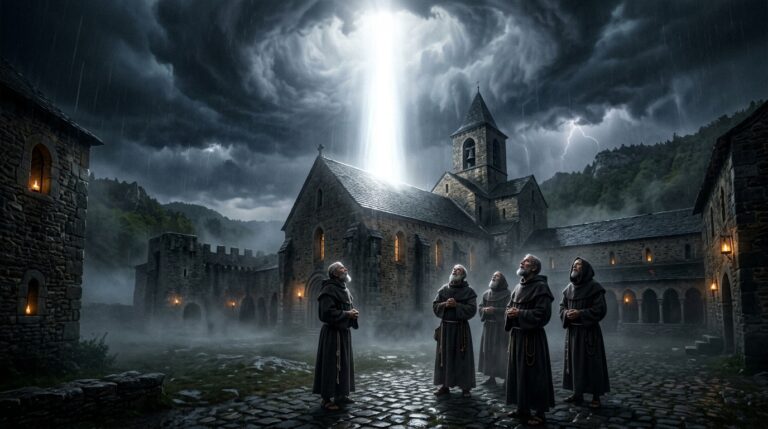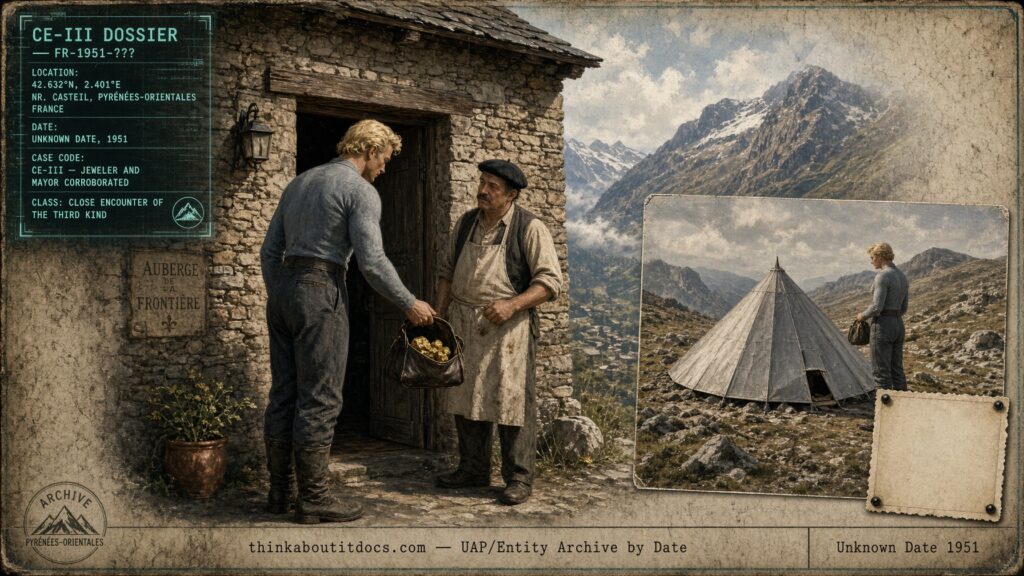
The 1951 Casteil, France contactee case, in which a mysterious stranger paid innkeeper Jacques Bley in gold nuggets later verified by the local jeweler and mayor.
THINK ABOUTIT ALIEN ENCOUNTER REPORT
1951: The Casteil, France Gold Nugget Case
Most 1950s contactee stories rest on nothing but the contactee’s own word. The Casteil case is rare in offering three independent points of outside verification: an innkeeper who supplied a strange stranger with bread and milk for weeks, a jeweler who bought the gold nuggets that stranger paid with, and the town’s own mayor, who separately confirmed that such a man had genuinely been present in the area. A camera that photographed him twice and came back blank both times, and a topographic survey of the local mountains completed alone in a fraction of the time it should have taken a full team, round out one of the more carefully corroborated contact accounts of the era’s “golden age” of French ufology.
Date: 1951 (exact date not recorded; encounters spanned several weeks)
Sighting Time: Daily, over several weeks
Day/Night: Day
Location: Casteil, Pyrénées-Orientales, France, and the surrounding mountain massif
Urban or Rural: Rural, mountainous
No. of Entity(‘s): 2 (the stranger and a female companion, seen only once)
Entity Type: Humanoid
Entity Description: The primary contact stood over 6 feet tall, athletically built, with blue, almond-shaped eyes and blond hair falling to his shoulders; long-fingered white hands; dressed in extremely tight-fitting trousers, black boots, and an ample shirt and jacket with tight sleeves. His female companion, glimpsed only once at their camp, appeared similar in general presentation.
Hynek Classification: CE-III (Close Encounter of the Third Kind)
Duration: Several weeks of daily contact, ending with a final farewell visit
No. of Object(s): 1 (a tent-like structure, not conclusively a craft)
Description of the Object(s): A strange, conical, metallic-gray tent-like structure, very low to the ground, seen once when Bley secretly followed the stranger to his camp
Shape of Object(s): Conical
Size of Object(s): Not specified beyond being described as very low-lying
Color of Object(s): Metallic gray
Distance to Object(s): Close enough for Bley to clearly observe both the structure and the second occupant while secretly following the stranger
Height & Speed: Not applicable — the structure was stationary; no departure by any aerial craft is described in the surviving account
Number of Witnesses: 1 primary witness (Jacques B. Bley), with independent third-party corroboration of the stranger’s existence from the local jeweler, the town mayor, and Bley’s own son, who photographed the stranger
Special Features/Characteristics: The stranger completed a full topographic survey of the local mountain massif alone in under 15 days — work Bley stated would normally require a team of surveyors roughly two months; when asked where he came from, the stranger replied only “From above”; he engaged Bley in complex discussions of “profound” social and political themes that Bley found difficult to follow; two separate photographs taken by Bley’s son, over the stranger’s objection, came back entirely unexposed when developed; the stranger paid for his weeks of bread and milk with gold nuggets gathered from a local stream, later independently verified as sold to a real jeweler; before departing, he stated it was time for him to “return up there.”
Case Status: Insufficient Data
Source: Antonio Ribera, Spanish ufologist and researcher, who separately interviewed the jeweler and the mayor of Casteil to corroborate the account
Summary/Description: In 1951, Jacques B. Bley, an Alpine guide and inn keeper in Casteil, in France’s Pyrénées-Orientales region, was approached by a striking stranger who bowed to him and politely asked to be supplied with two bottles of milk and some bread every day. The man stood over six feet tall, athletically built, with blue almond-shaped eyes, shoulder-length blond hair, long white fingers, and unusual, extremely tight-fitting clothing. He returned to the inn daily for several weeks, gradually engaging Bley in increasingly complex conversations on social and political themes that Bley found difficult to fully follow. Bley learned that the man was surveying the local mountain massif, and was shown the resulting topographic map — work that Bley judged would normally require a full survey team about two months, completed alone in under fifteen days. When asked where he came from, the man answered simply, “From above.” One day, Bley secretly followed him back to his camp and discovered a strange, low, conical, metallic-gray tent-like structure, beside which stood a second, similarly striking figure who appeared to be a woman. On another occasion, Bley’s son photographed the two men despite the stranger’s evident objection; when developed, both photographs were entirely unexposed. Eventually, the stranger told Bley it was time for him to “return up there,” and, having no money “like yours,” offered to settle his account with gold nuggets he said he had gathered from the local stream. Investigator Antonio Ribera later located and interviewed both the jeweler who had purchased the gold nuggets from Bley, who confirmed the transaction, and the mayor of Casteil, who independently verified that the strange man had indeed been present in the area during this period.
Related Cases: 1950: The Daniel Fry White Sands Incident, New Mexico | 1951: The Salzburg, Austria Encounter (same era, comparable contactee narrative structure)
Detailed Report
What distinguishes the Casteil case from the great majority of contactee accounts in this archive’s collection is not the strangeness of its central claim, which is in many ways typical of the genre, but the unusually deliberate corroboration effort undertaken by investigator Antonio Ribera. Rather than relying solely on Bley’s own account, Ribera tracked down and separately interviewed two independent third parties — the jeweler who purchased the gold nuggets and the mayor who could confirm the stranger’s presence in the town — neither of whom had any obvious motive to support a fabricated story on Bley’s behalf. This kind of active, multi-source verification is genuinely rare in 1950s contactee literature, where most accounts rest entirely on the primary witness’s own uncorroborated testimony.
The unexposed photographs are the case’s most tantalizing physical detail, and also its most ambiguous. A camera failing to capture an image is consistent with any number of mundane explanations — a fogged or defective roll of film, an error in loading or developing, simple bad luck — and this archive cannot rule those out. What makes the detail worth noting rather than dismissing outright is that it happened twice, on the same subject, specifically over that subject’s own objection to being photographed — a level of specific, repeated failure that shifts the odds somewhat, though not conclusively, away from ordinary camera malfunction.
The topographic survey detail is, in some ways, the case’s most quietly remarkable claim, precisely because it doesn’t rely on any exotic technology or supernatural ability — only an extraordinary claimed rate of ordinary surveying work. A team of professional topographers completing in two months what one man reportedly finished alone in under two weeks is, at minimum, an extraordinary feat of human effort and skill, if the account is accurate; it does not require accepting any alien origin to find the claim itself hard to credit, which is worth separating from the broader, more overtly fantastic elements of the story.
The stranger’s terse, evasive answer to Bley’s question about his origin — “From above” — is characteristic of the genre’s recurring pattern of contactees receiving cryptic, unfalsifiable non-answers rather than specific, checkable claims (compare, for instance, the more elaborate but equally unverifiable “planet Vega” and “planet Zutorn” origin claims documented elsewhere in this archive’s 1951 record). This vagueness is, on one hand, consistent with a genuinely reticent visitor; on the other, it is also exactly the kind of answer that requires no external verification and commits the storyteller to nothing specific enough to later be checked.
RESEARCHER’S NOTES
The Casteil Gold Nugget Case — France 1951 and the Rare Value of Third-Party Corroboration
- Classification issues: CE-III fits the extended, close-range interaction with the stranger, though the case’s structure — weeks of ordinary daily contact rather than a single dramatic encounter — is unusual within that category.
- Source chain assessment: This is one of the more actively investigated contactee cases in this archive’s collection — Antonio Ribera’s independent interviews with the jeweler and the mayor represent genuine third-party corroboration of the stranger’s real-world presence and the gold transaction, even though neither can verify the stranger’s claimed origin or nature.
- Pattern context: The case belongs to a wave of early-1950s European contactee narratives (compare Salzburg, Austria and the Drakensteen Mountain contact in South Africa, both also 1951) sharing a common structure of an unusually tall, physically striking stranger offering vague, unverifiable claims about an origin beyond Earth.
- Physical evidence and evidentiary weight: The gold nuggets, verified as sold to a real jeweler, and the twice-failed photographs are the case’s two physical anchors — genuine data points, though neither definitively establishes anything beyond a real, physically present, and camera-shy individual with access to gold.
- Geographic and historical context: The Pyrénées-Orientales region’s remote, mountainous terrain would have made a genuinely reclusive or secretive individual’s presence over several weeks plausible without wider public notice — a detail that supports the account’s basic setting without confirming its more extraordinary claims.
The Casteil case endures as one of the better-corroborated contactee accounts of the early 1950s, not because any of its individual details can be independently verified as extraordinary, but because investigator Antonio Ribera did the unusual work of checking the story’s mundane edges — the gold, the jeweler, the mayor’s own memory of the stranger — and found them holding up. What that stranger actually was remains entirely unresolved: a genuinely surveyed mountain map, twice-failed photographs, and gold nuggets from a local stream are consistent with an unusual, secretive human as easily as with anything more exotic. It is catalogued here as Insufficient Data: a rare contactee story with real third-party legs under it, and no way to say more than that.
“From above.”
— The stranger’s answer to Jacques Bley, when asked where he came from, Casteil, France, 1951