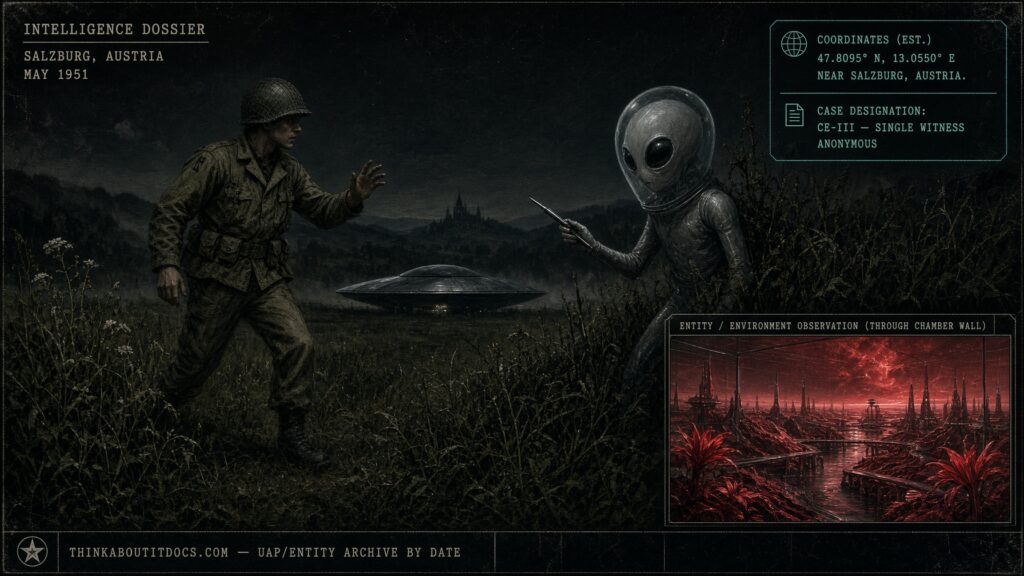
The May 1951 Salzburg, Austria encounter, in which an American soldier claimed to be paralyzed, floated aboard a craft, and taken past the moon to Mars and back within an hour.
THINK ABOUTIT ENTITY ENCOUNTER REPORT
1951: The Salzburg, Austria Encounter
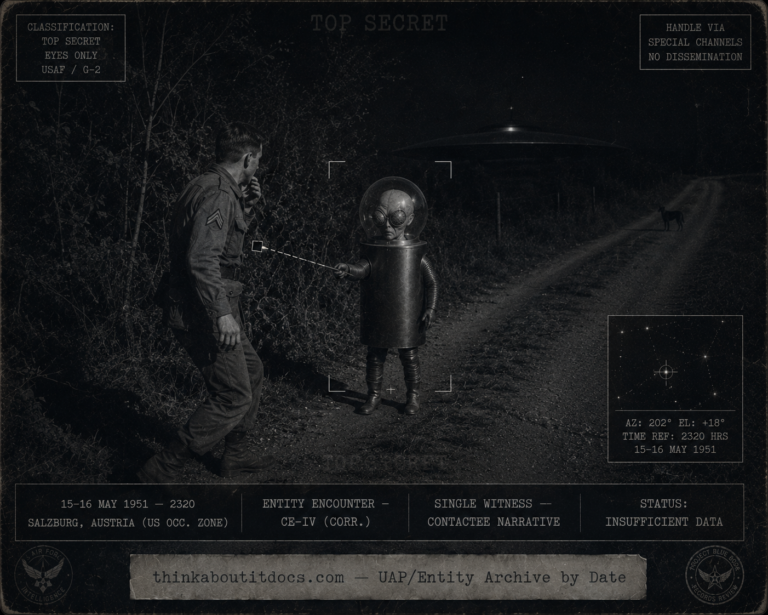
On a moonless night in May 1951, a young American soldier walking home through the brush outside Salzburg, Austria was paralyzed by a figure that stepped from the darkness and pointed a thin, pencil-like device at him. What followed, by his account, was not a brief roadside encounter but a journey of barely an hour that took him past the moon and briefly to the surface of Mars, in the company of a silent, cylindrical-headed being with compound insect-like eyes — before he was set back down at the exact spot where he had been taken, with no memory of how he got there. He told almost no one for six years, finally sharing the story anonymously with a Canadian newspaper reporter in 1957, saying only that he didn’t expect to live much longer and wanted the truth known.
Date: Night of May 15-16, 1951
Sighting Time: 11:20 p.m.
Day/Night: Night (no moon)
Location: An overgrown brush area roughly 5 miles outside Salzburg, Austria, near a U.S. Army occupation-force base
Urban or Rural: Rural, undeveloped land
No. of Entity(‘s): 1 (only one entity is described in detail; others reportedly seen aboard the craft or on the Martian surface)
Entity Type: Humanoid (non-human)
Entity Description: Roughly 5 feet tall, wearing a transparent, near-spherical helmet and a tight two-piece suit whose legs merged directly into its toes; a rigid, cylindrical torso “round like a tin can” with no visible neck; proportionate legs; short arms ending in long, graceful hands with three or four fingers; a slightly cylindrical, high, bald, white cranium extending up and back from a wide, heart-shaped face; large, compound, insect-like eyes; only small holes for a nose and ears; a very small, horizontal slit for a mouth. The entity never spoke or otherwise communicated.
Hynek Classification: CE-III (Close Encounter of the Third Kind), though the case’s extended abduction and off-world travel places it well beyond a typical CE-III in scope
Duration: Approximately one hour in total, by the witness’s own account, checked against a clock upon his return
No. of Object(s): 1 primary craft (with additional craft reportedly seen elsewhere during the account, including near Mars)
Description of the Object(s): A large disc or saucer resting in a field; the witness was floated aboard and placed inside a transparent chamber for the journey
Shape of Object(s): Disc/saucer-shaped
Size of Object(s): Approximately 150 feet in diameter (given as roughly 164 feet in one secondary retelling)
Color of Object(s): Not specified in surviving accounts
Distance to Object(s): The witness was floated directly to and aboard the craft after being paralyzed
Height & Speed: Not quantified; the witness reported passing close by the moon, then arriving at Mars, then passing a small Martian satellite described as looking “like a tin ball” before completing the return trip to Earth in a final ten minutes — implying, if taken literally, an enormous and physically implausible speed for the full round trip within roughly an hour
Number of Witnesses: 1 (the anonymous soldier); no second witness to the initial encounter or abduction is recorded
Special Features/Characteristics: Instant full-body paralysis triggered by a pencil-like handheld device and an audible “click”; the witness was then made to float through the air to and aboard the craft; placed in a transparent holding chamber for the journey; reported seeing, from the craft, fields of large red flowers and canal-like structures crossed by bridges on the Martian surface, along with other saucers reportedly holding human captives; returned to Earth and set down at the exact location of his abduction with no memory of the return process itself.
Case Status: Insufficient Data
Source: Unnamed witness, as told to a reporter for the Prince George Citizen (British Columbia, Canada), published December 11, 1957; Albert Rosales, URECAT catalogue (case URECAT-000244)
Summary/Description: On the night of May 15-16, 1951, an unnamed soldier serving with the U.S. Army occupation force in Austria — reportedly a driver for a Quartermaster Colonel — was walking home through an overgrown, moonless field roughly five miles outside Salzburg after finishing his shift, having left his vehicle at the base. At 11:20 p.m., a figure emerged from nearby bushes and approached him; before he could react, it pointed a long, thin, pencil-like device at him, producing an audible click, and he found himself instantly and completely paralyzed, able to move only his eyes. The figure placed something resembling a metal plate on his chest, and he began to float through the air. He was floated to a large disc-shaped craft resting in a nearby field, roughly 150 feet in diameter, and placed inside a transparent chamber. The witness reported the craft then departed Earth, passing close by the moon before arriving at Mars, where he observed fields of large red flowers and canal-like structures crossed by bridges, along with other similar craft that appeared to be holding additional human captives. The return journey passed what the witness described as a small Martian satellite resembling “a tin ball,” with the final approach to Earth completed in about ten minutes. He was delivered back to the exact spot where he had been taken, with no account of how the return process itself occurred; checking a clock afterward, he found the entire episode had lasted only about an hour, which struck him as impossible given everything he reported experiencing. He told no one, including his wife, fearing he would not be believed, until December 1957, when — by his own account, not expecting to live much longer — he related the story anonymously to a reporter for the Prince George Citizen in British Columbia, Canada.
Related Cases: 1951: The Drakensteen Mountain Contact, South Africa (same year, comparable close-range CE-III structure) | The Betty and Barney Hill Abduction, 1961 (the far more famous case this account predates by a decade)
Detailed Report
The Salzburg case occupies an unusual and historically important place in the abduction literature: told six years before Antonio Villas Boas’s 1957 Brazilian account and a full decade before the Hills’ far more famous 1961 New Hampshire abduction, it already contains nearly every element that would later become genre-defining — sudden paralysis by a directed device, involuntary transport aboard a craft, a period of captivity, and a return to the exact point of departure with a subjectively “missing” or compressed sense of time. Whether this reflects a genuine, consistent phenomenon recurring across decades and continents, or simply an early template that later accounts (consciously or not) drew upon as the genre developed, is a question this archive cannot resolve, but the case’s early date alone makes it a significant data point either way.
The entity description is unusually specific and, notably, does not match the “Grey” archetype that would come to dominate later abduction literature — a bald, cylindrical-headed, compound-eyed, three-or-four-fingered being in a form-fitting suit reads as its own distinct type, closer to some later “insectoid” reports than to the large-eyed, gray-skinned humanoid that becomes standard after the Hill case popularized it. This detail argues at least modestly against the idea that the witness was simply recycling a preexisting cultural image of “the alien,” since the dominant image had not yet been established in 1951 or even by the time the story was told in 1957.
The Mars destination is the account’s most scientifically difficult element to accept at face value. By 1951, and certainly by 1957, telescopic observation had already made the classical image of Mars — canals, vegetation, an atmosphere capable of supporting visible “fields” of flowers — a widely known, if by then increasingly contested, idea in popular science writing, largely traceable to Percival Lowell’s early 20th-century canal theories. The witness’s description of canals crossed by bridges and fields of red flowers maps closely onto this popular, pre-space-age conception of Mars rather than onto anything resembling the arid, cratered surface later confirmed by spacecraft observation beginning in the 1960s. This is one of the strongest reasons to treat the account with real skepticism regarding its literal content, even while preserving it as a documented and historically significant claim.
The witness’s total anonymity, maintained even in his one and only telling of the story, is a genuine limitation: there is no way to verify his claimed military assignment, cross-check base records, or assess his credibility as later researchers were able to do for witnesses like the Hills. The account survives entirely through secondhand newspaper reporting and later ufological compilation, with no primary interview, transcript, or hypnosis session on record.
RESEARCHER’S NOTES
The Salzburg Encounter — Austria 1951 and the Genre’s Earliest Template
- Classification issues: CE-III is applied here for consistency with this archive’s taxonomy, though the case’s extended captivity and interplanetary travel place it well outside the scope Hynek’s original scale was designed to describe — later, informal “CE-4” abduction-case extensions fit the material more precisely.
- Source chain assessment: The account survives only through a single 1957 newspaper telling by an anonymous witness, six years after the claimed event, with no primary documentation, no named source, and no subsequent interview or investigation on record. This is among the thinnest source chains for any major-profile case in this archive’s collection, notwithstanding its historical significance.
- Pattern context: This case predates and, in remarkable structural detail, anticipates the modern abduction narrative template popularized by the 1961 Hill case and the broader abduction literature that followed in the 1970s-80s — making it one of the earliest fully-formed “classic” abduction accounts on record, worth close comparison by anyone studying how the genre’s conventions developed over time.
- Physical evidence and evidentiary weight: None whatsoever — no photograph, no physical trace, no second witness, and no way to verify the witness’s identity or service record. The Martian surface details described align closely with pre-spaceflight popular conceptions of Mars (canals, vegetation) rather than with anything later confirmed by actual observation, which meaningfully weakens the account’s literal credibility.
- Geographic and historical context: Austria in 1951 was under joint Allied occupation following World War II, with active U.S. military presence in the Salzburg area — a historically accurate setting that lends the account’s framing plausibility even though it cannot verify the specific claims made within it.
The Salzburg encounter endures as one of the earliest fully developed abduction narratives on record, anticipating by a decade the structural elements that would come to define the genre — paralysis, involuntary transport, captivity, and a compressed or missing sense of time. Its Mars destination, however, maps too closely onto the popular, pre-spaceflight image of a canal-laced, vegetated Red Planet to be taken as literal fact, and the account’s total reliance on a single, anonymous, six-years-delayed telling leaves it with essentially no independent verification. It is catalogued here as Insufficient Data: a historically significant and strangely prescient story that this archive can neither confirm nor responsibly credit as documented history.
“I didn’t expect to live much longer, and people should know the truth as to what’s going on.”
— Unnamed witness, on why he finally told his story in 1957, six years after the Salzburg, Austria encounter