THINK ABOUTIT UFO|UAP & ENTITY ENCOUNTER REPORT
1951: The Cathie Connelly Contact — Coventry, England
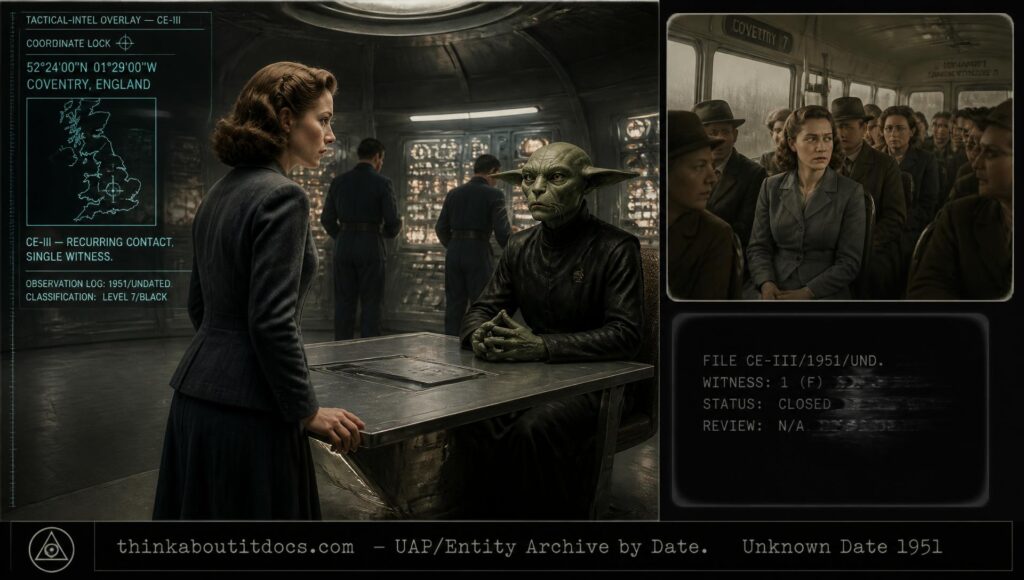
Of all the contactee accounts this archive has documented, few are as sprawling, strange, or difficult to categorize as Cathie Connelly’s. What began, by her account, with a visit from a “messenger” at her Coventry home in 1951 unfolded across repeated trips aboard a craft she could never quite predict or control — interrogations about pregnancy and skin color, a bewildering detour aboard an imaginary bus to Rhodesia, a scanner showing aerial combat and a voice insisting “this is your world,” and recovered childhood memories of a baptism at a small Salvation Army church. It reads less like a single event than like a fragmented, recurring relationship with something Connelly herself struggled to make coherent sense of — and this archive preserves that incoherence honestly rather than smoothing it into a tidier story than she actually told.
Date: 1951 (part of a longer series of encounters Connelly reported beginning in 1940)
Sighting Time: Afternoon (initial 1951 visit); subsequent encounters at unspecified times
Day/Night: Mixed (day and unspecified)
Location: Coventry, England; subsequent encounters aboard a craft typically described as parked on lonely grassland
Urban or Rural: Mixed (urban home visit; rural craft locations)
No. of Entity(‘s): Multiple (a full craft crew of unspecified size; several individuals described in detail)
Entity Type: Humanoid and non-humanoid (mixed crew)
Entity Description: Most of the crew appeared broadly human, 6-7 feet tall, with high foreheads and greased black hair cut just above the shoulders. A second group had blue-complexioned skin. The being who directly interrogated Connelly had a cat-like face with no whites to his eyes, which were set to the side of his head, mouth slits reaching nearly to his ears, long animal-like ears lying flat against his head, and long straight nostril-holes; his unblemished skin was later described by Connelly as green in color. The “messenger” who first visited her home is not physically described in detail.
Hynek Classification: CE-III (Close Encounter of the Third Kind), extending in later informal terminology toward a recurring “CE-4” abduction pattern given the repeated, non-consensual transport aboard the craft
Duration: Not specified per visit; the overall reported relationship spanned from an initial 1940 encounter through repeated later contacts including 1951
No. of Object(s): 1 recurring craft
Description of the Object(s): An interior roughly the size of four double bedrooms, well lit from no identifiable source, with one wall lined with rows of meters/instrumentation; a central fiberglass-like table that slid into the floor; a black screen displaying self-erasing white lettering; a scanner or viewing device capable of showing distant, real-time scenes
Shape of Object(s): Not specified from the exterior in the surviving account
Size of Object(s): Interior comparable to four double bedrooms
Color of Object(s): Not specified
Distance to Object(s): Connelly reported being taken aboard directly, with no memory of the transition from her home or the grassland site to the craft’s interior
Height & Speed: Not specified; Connelly reported viewing scenes of aerial combat and ships at sea through the craft’s scanner during at least one journey, implying movement, though no direct sensation of flight or specific altitude/speed is described
Number of Witnesses: 1 (Cathie Connelly)
Special Features/Characteristics: Connelly believed the crew possessed a memory-erasing capability associated with wristwatch-like devices they wore; she was examined on a table to determine whether she was pregnant; the crew reportedly told her the human-appearing members were “prisoners” while the blue-skinned members were free to come and go; she was shown a solar system map and a book with writing resembling Chinese or shorthand; a recurring voice insisted “this is your world” while showing her scenes of aircraft in combat, which she repeatedly denied were her world; in one especially disorienting episode, she was told to board a bus, found herself doing so, and experienced a confusing, dreamlike social interaction with the other (all dark-skinned) passengers before the bus was flagged down and she was returned to the craft — an episode this archive treats as likely an induced telepathic or imaginal experience rather than a literal bus ride, following the source’s own suggested reading; she was shown scenes from her own childhood, including a recovered memory of a baptism-like ceremony at a small Salvation Army church; the crew discussed human genetics, Rhesus factor, and a proposed “exchange of ideas”; her apparent color-blindness was reportedly treated by the crew during one visit.
Case Status: Insufficient Data
Source: Norman Oliver, Gemini Vol. 1, No. 2
Summary/Description: In 1951, Cathie Connelly — who reported an ongoing series of encounters dating back to an initial 1940 contact at her factory workplace — returned home in Coventry to find a visitor waiting, who identified himself as a messenger and instructed her not to think about or seek out the being she had met previously unless she genuinely wished to. Connelly reported being repeatedly taken to a recurring craft, typically parked on lonely grassland, with little to no memory of the transition between her ordinary surroundings and the craft’s interior — an amnesia she attributed to devices resembling wristwatches worn by the crew. Aboard, she was examined on a sliding table by beings who told her they only wished to determine whether she was pregnant; the interrogating being had a distinctly non-human, cat-like face, while most of the rest of the human-appearing crew stood 6-7 feet tall with high foreheads and dark, shoulder-length hair, alongside a separate blue-skinned contingent she was told were not “prisoners” like the human-appearing members. She was shown a star map, an unfamiliar written language, and — via a scanning device — real-time scenes of aircraft in combat and ships at sea, all while a voice insisted “this is your world,” a claim she consistently denied. In one especially disorienting episode, she was instructed to board a bus and found herself doing exactly that, engaging in a strange, socially fraught interaction with the other passengers (whom she perceived as dark-skinned, in a segregated Rhodesian setting) before the bus was flagged down by the craft’s crew and she was returned aboard — an episode this report treats, per the source’s own framing, as more likely an induced or imaginal experience than a literal excursion. On another visit, she was shown footage of herself as a young girl and recalled a childhood baptism ceremony at a small Salvation Army church, during which a voice questioned her about the meaning of religious allegiance. The crew discussed human genetics and a possible future “exchange of ideas,” and Connelly understood that an apparent color-blindness of hers was treated or corrected during the encounters, after which she reported being able to perceive color in the being’s skin that she had not noticed before.
Related Cases: 1951: The Casteil, France Gold Nugget Case | 1951: The Salzburg, Austria Encounter (same year, comparable extended-contact narrative structure)
Detailed Report
The Connelly account is, by a wide margin, one of the least internally structured contactee narratives in this archive’s collection, and that lack of structure is itself worth treating as a meaningful feature rather than a flaw to be edited away. Where many contactee accounts follow a clean arc — approach, message, departure — Connelly’s testimony reads as a series of loosely connected, often tangential episodes: a pregnancy examination, a philosophical discussion about “prisoners” aboard the craft, an oddly mundane argument about a bus fare, a childhood memory of a church baptism. This archive has preserved that structure faithfully rather than reorganizing it into a more conventional narrative, on the view that an authentic, if confused, testimony is more valuable to researchers than a cleaned-up version that imposes coherence the witness herself did not claim to have.
The bus episode is the single strangest and most analytically interesting element of the whole account, and the original source material itself proposes the most useful reading of it: not a literal excursion to a bus somewhere in the world, but a kind of induced, dreamlike, or telepathically constructed scenario — “an ideal process by which the alien power could teach their lessons,” as the source frames it. Read this way, the episode’s confused physics (an ordinary city bus with segregated Rhodesian social dynamics, encountered from inside a UFO) stops being a problem to explain away and becomes instead a data point about the nature of the experience itself: whatever Connelly underwent, it may have functioned more like a constructed lesson or simulation than a physical journey, which would also explain why the crew’s questions throughout (“Is this your world?”) read as a deliberate, if oblique, philosophical or moral exercise rather than straightforward information-gathering.
The recurring “prisoner” framework — human-appearing crew members held aboard against their will, blue-skinned members free to come and go — is a distinctive and rarely repeated detail within this archive’s broader contactee literature. Most accounts describe an undifferentiated, benevolent or at least purposeful crew; Connelly’s account instead describes an internally stratified, ethically complicated social structure aboard the craft, closer to the ambiguous morality of some later abduction literature than to the uniformly wise-teacher archetype common in 1950s contact narratives. Whether this reflects a genuine and unusually complex encounter, or simply a more imaginative or troubled narrative construction on Connelly’s part, cannot be determined from the source alone.
The genetics discussion — Rhesus factor, an “exchange of ideas,” the crew’s stated admiration for human knowledge in this specific area — sits oddly against the account’s more mystical and philosophical content, and is one of relatively few period-appropriate scientific references embedded in the story; Rhesus blood typing was a genuinely active area of medical research in the early 1950s, which lends this particular detail a grounding in contemporary scientific discourse that much of the rest of the account lacks.
RESEARCHER’S NOTES
The Cathie Connelly Contact — Coventry 1951 and the Value of an Unresolved Narrative
- Classification issues: CE-III captures the sustained close contact with occupants, though the recurring, non-consensual, memory-affected nature of the encounters gives the case much in common with later, more fully developed abduction narratives that would not become a named category until decades afterward.
- Source chain assessment: The account rests entirely on Connelly’s own testimony as relayed through Norman Oliver’s investigation and publication in Gemini magazine; no second witness, no independent corroboration of any specific episode, and no verification of Connelly’s own earlier claimed 1940 encounter exists in the material available to this archive.
- Pattern context: The case’s internally stratified crew, its recurring memory-loss theme, and its dreamlike, lesson-structured episodes place it closer in spirit to later, more psychologically complex abduction literature of the 1970s-80s than to the simpler, single-message contact narratives more typical of the early 1950s — making it a genuinely early example of a narrative structure that would not become common in the genre for decades.
- Physical evidence and evidentiary weight: None. No photograph, trace, or second witness corroborates any element of the account; its evidentiary weight rests entirely on the internal detail and consistency of Connelly’s own testimony as recorded by Oliver.
- Geographic and historical context: Coventry, heavily rebuilt following its devastating World War II bombing, and Britain’s broader early-1950s ufological scene (see also the Withdean, Sussex case from later that decade) place this account within an active and increasingly organized period of early British contactee reporting.
The Cathie Connelly contact endures as one of the most sprawling and difficult-to-categorize contactee accounts in this archive’s collection — not a single dramatic event but a fragmented, recurring, often confusing relationship with something Connelly herself never fully resolved into a coherent story. Its internally stratified crew, its dreamlike bus episode, and its recovered childhood memories give it more psychological texture than most contact narratives of its era, at the cost of any external corroboration whatsoever. It is catalogued here as Insufficient Data: an honestly preserved, genuinely strange testimony that resists tidy summary as much as it resists verification.
“This is your world.”
— Voice reported by Cathie Connelly, during her 1951 encounters, Coventry, England