Oak Ridge, Tennessee, December 7, 1951: a K-25 guard watches a square gray object rise into the clouds.
THINK ABOUTIT UFO|UAP SIGHTINGS REPORT
1951: A K-25 Guard at Oak Ridge, Tennessee Watches a Square Gray Object Rise Into the Clouds and Drop Back Three Times
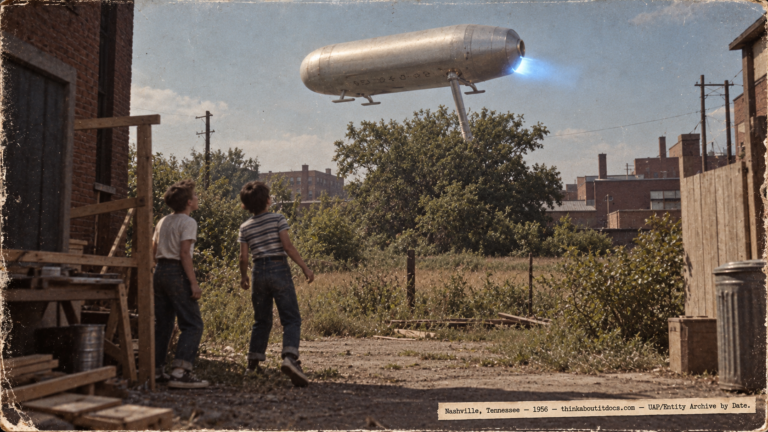
At 8:15 a.m. on December 7, 1951, a contractor guard in a security tower west of the K-25 gaseous diffusion plant at Oak Ridge, Tennessee saw a smooth, gray-white, square object about 20 feet across rise and fall above a ridge about a mile to the north-northwest. It looked like a square piece of canvas and always kept its flat side toward him. It rose straight up to the base of the clouds, dropped back to within about 300 feet of the ridge, climbed away at an angle into the clouds, came out again, circled slowly, and finally vanished into the clouds. The whole show lasted about two minutes.
Security patrols went out to look for ground intruders, and the guard’s report that the object was in the air was not understood until about 10:00 a.m. Two F-47s on combat air patrol were then sent over the area and found nothing. Project Blue Book carried the case as Unidentified, and the Air Force’s own analyst wrote that the guard saw something but was wrong about how far and how fast it moved.
Date: December 7, 1951
Sighting Time: 8:15 a.m. EST
Day/Night: Day (clouds 6,000 feet scattered, visibility 30 miles)
Location: West of the K-25 gaseous diffusion plant, Oak Ridge, Tennessee; the object was about one mile north-northwest of the observer, over a ridge of small hills north of Plant K-25
Urban or Rural: Rural (a restricted atomic plant area in the hills)
No. of Entity(‘s): Not Applicable
Entity Type: Not Applicable
Entity Description: Not Applicable
Hynek Classification: Daylight Disc (DD); the object was square, so this is the nearest category
Duration: About 2 minutes in total, with the object visible for 30 to 40 seconds each time it came out of the clouds
No. of Object(s): 1
Description of the Object(s): A square object about 20 feet wide, color between white and gray, smooth but not shiny, with no markings, protrusions or ridges. It resembled a square piece of canvas and always kept its broad side toward the observer. It made no sound, smoke or noise.
Shape/Size/Color of Object(s): Square; about 20 feet wide; between white and gray
Distance to Object(s): About one mile north-northwest of the observer, and about 300 feet from the top of a ridge at its closest point
Height & Speed: Altitude ranged from about 300 feet above the ridge up to the cloud base at about 6,000 feet. The guard described the speed as constant and about the same as conventional aircraft, and said it moved with and against the prevailing winds. The Air Force analyst calculated that the guard’s account implied about 10,000 to 14,000 feet per minute.
Number of Witnesses: 1 (a contractor guard employed at K-25 for seven years; his name is redacted in the file)
Special Features/Characteristics: Observed from a security tower at a restricted atomic plant; the object kept its flat side to the observer, rose straight up and came straight down, and moved with and against the wind; security patrols searched the ground first and the Ground Control Intercept (GCI) station was not notified for almost two hours; two F-47s sent over the area found nothing
Case Status: Unidentified (Project Blue Book record card; listed among Blue Book’s unexplained cases in Berliner’s list). The Air Force intelligence report concluded the guard saw something as stated but was in error about the amount and speed of travel.
Source: Project Blue Book record card; Air Intelligence Information Report IR-64-51E, 30th Air Division, prepared by Capt. Robert K. Hall, report dated December 24, 1951, with the 663d Aircraft Control and Warning Squadron, Maryville, Tennessee, as source; Air Force status report No. 3; Berliner’s Blue Book Unknowns list
Summary/Description: A K-25 guard watched a smooth, square, gray-white object about 20 feet wide rise into the clouds and drop back several times over a ridge for about two minutes. Fighters sent late found nothing. Blue Book left the case Unidentified.
Related Cases: The earlier Oak Ridge and Knoxville sightings of October 1950 to January 1951 on this site, which this case follows by about eleven months; the Sunbury, Ohio sighting of the same date, December 7, 1951
Detailed Report
The Sighting
The witness was a contractor guard employed by Union Carbon and Carbide at the K-25 plant for seven years. He had been on shift for 45 minutes and was in Tower No. 14, part of the security system around the plant, west of the gaseous diffusion plant. At 0815 EST on December 7, 1951, he saw an object about one mile north-northwest of him and about 300 feet from the top of a ridge of small hills running east and west north of Plant K-25.
The Air Force report describes the object as square, about 20 feet wide, between white and gray, with no markings, protrusions or ridges. It looked smooth but was not shiny and resembled a square piece of canvas. It always kept its broad side to the observer, made no sound, and left no smoke. It moved at a speed about the same as conventional aircraft, and the guard said it traveled both with and against the wind.
The Maneuvers
The report gives the sequence. The object was rising straight up into the air and went to the base of the cloud layer. It then came straight down until it was about 300 feet from the ridge again. It went back up at about a 45-degree angle to the left and into the clouds, came out of the clouds and straight down to about 300 feet from the ridge again, started to make a circle rising slowly, and then went up into the clouds at about a 20-degree angle, disappearing completely. No further sighting was made. The total time of observation was two minutes, with 30 to 40 seconds each time the object came out of the clouds. The guard used no optical or electronic equipment.
A Late Alert
The object was first reported at 0815 EST, but no mention was made that it was airborne. The GCI station was therefore not notified. The security section, thinking the object was ground forces, sent patrols to investigate. After they found nothing, the security section called the guard back at about 1000 EST, and only then was it learned that the object had been in the air at all times. GCI was notified at 1002 EST and two F-47s that were in the air on combat air patrol were sent over the area. By then the object had disappeared, and no interception was made. The Air Force status report adds that neither radar nor fighter aircraft could make contact.
The Witness and the Weather
The report says the guard’s eyesight was 20/70 and that he claimed no eye trouble, that his superiors held him in high respect, and that he appeared honest and conscientious. It adds that he was fully aware of the publicity restrictions. Weather at 0759 EST was 6,000 feet scattered clouds, 30 miles visibility and southwest winds of 17 mph. At 0928 the clouds were estimated at 6,500 feet broken and the temperature was 71, and at 1004 the winds were southwest at 20 mph.
The Air Force’s Analysis
The summary page prepared for the Director of Intelligence calculates that the guard’s account implies motion that is too fast to believe. It counts the object as rising three times and descending twice between a point 300 feet above the ridge and the cloud level of 6,000 feet, and at about 5,700 feet per ascent or descent that comes to roughly 28,500 feet in two minutes, or about 14,000 feet per minute. If the ridge top is taken as about 3,000 feet, the figure falls to about 10,000 feet per minute, which the report calls still extremely rapid. It concludes: “Suggest the observer saw something as stated in the report, but was in error as to the amount and speed of travel.” Blue Book’s record card carries the case as Unidentified.
RESEARCHER’S NOTES
Why the Oak Ridge Sighting Still Matters
- A restricted atomic site: The sighting took place at the K-25 plant, one of the most closely guarded sites in the country. It came about eleven months after the cluster of Oak Ridge and Knoxville reports that ended in January 1951.
- The Air Force believed the witness saw something: The intelligence analyst did not call the guard unreliable. He accepted that an object like the one described was seen and questioned only the distances and speeds.
- A slow response: Because the report did not say the object was airborne, the ground patrols searched and the air defense system was not alerted for about two hours. The fighters arrived too late.
- No instrument data: The sighting was visual only, with one witness, and no radar picked up the object.
- The speed is an Air Force calculation: The guard said the speed was about that of conventional aircraft. The very high speeds come from the analyst’s arithmetic, which depends on the cloud base and ridge height.
- The witness is not named here: His name and address are redacted in the file, so he is not named. Some published lists give a name, but the file does not.
A trained plant guard watched a square gray object rise and fall over a ridge beside a restricted atomic plant for two minutes in daylight. The Air Force thought he saw something real but exaggerated its speed, the fighters arrived too late, and Blue Book left the case Unidentified.
“Suggest the observer saw something as stated in the report, but was in error as to the amount and speed of travel.”
— Air Intelligence Information Report summary, Oak Ridge, Tennessee, December 24, 1951