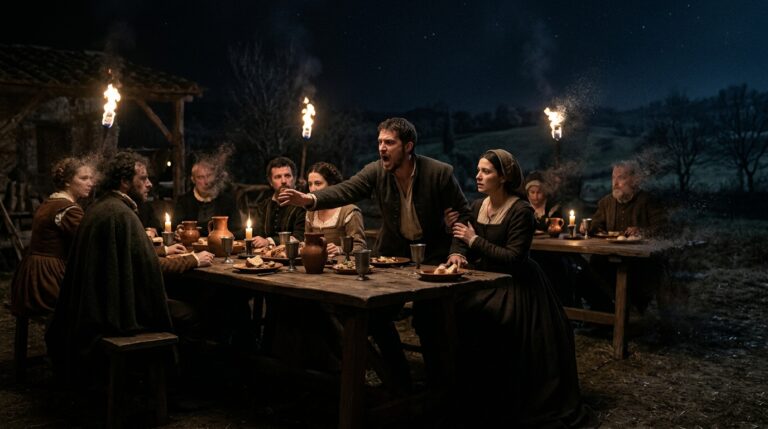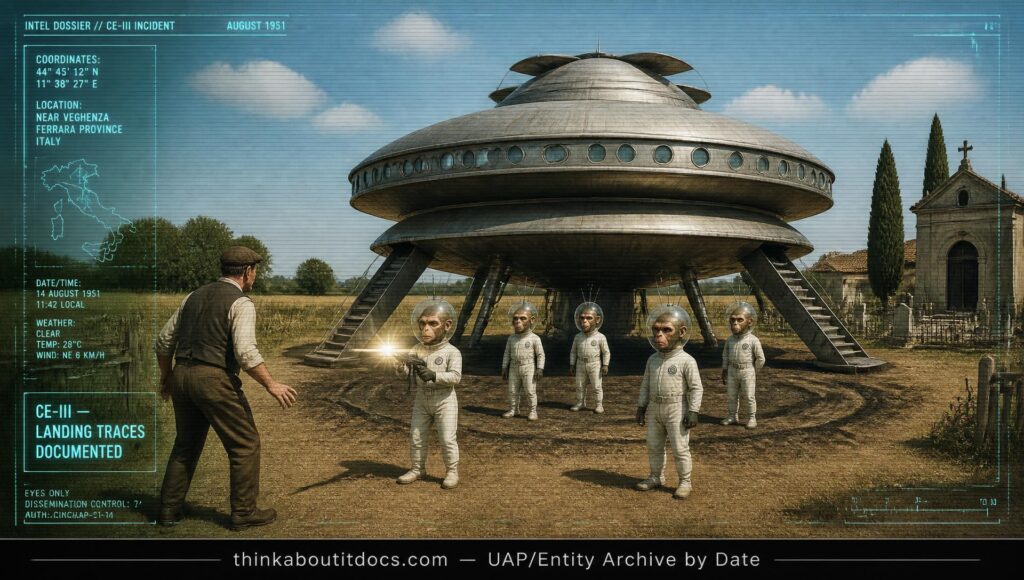
The August 14, 1951 Veghenza, Ferrara, Italy landing, in which a farmer encountered six small, monkey-faced entities beside their craft.
THINK ABOUTIT
UFO|UAP & ENTITY ENCOUNTER REPORT
1951: The Veghenza Landing — Ferrara, Italy
On an August afternoon in 1951, an unnamed farmer near the town of Veghenza, in Italy’s Ferrara province, watched what he first took for the planet Saturn descend out of the sky beside the town cemetery — and then watched six four-foot-tall, monkey-faced beings in shiny white overalls climb down from it, one of whom, after a moment of apparent curiosity, raised a Tommy-gun-style weapon and fired a dazzling flash directly at him. The farmer was unharmed. It remains one of the most richly detailed and specific entity descriptions in this archive’s early-1950s record, preserved through the careful documentation of Maurizio Verga, one of Italian ufology’s most methodical researchers.
Date: August 14, 1951
Sighting Time: 1:00 p.m.
Day/Night: Day
Location: Veghenza, Ferrara province, Italy, in open ground adjacent to the town cemetery
Urban or Rural: Rural
No. of Entity(‘s): 6
Entity Type: Humanoid
Entity Description: Approximately four feet tall (or just under); whitish-skinned faces resembling those of monkeys, with round, azure-blue eyes; arms longer than a human’s, extending below the knee; dressed in one-piece, shiny white overalls with white ankle-to-knee boots; five clean-shaven, one with a short red beard; each carried several cylinders (interpreted as oxygen bottles) strapped to the back, connected by tubes to the chin; wore roughly 8-inch-wide belts fitted with variously colored lenses; wore round, transparent helmets with three antennae (two from the sides, one from the top center); communicated with each other via hand signs
Hynek Classification: CE-III (Close Encounter of the Third Kind)
Duration: Several minutes, from the craft’s descent through the entities’ departure and takeoff
No. of Object(s): 1
Description of the Object(s): Resembled the planet Saturn while descending; on the ground, a double saucer placed rim to rim with a large dome on top bearing “aileron”-like structures whose center remained fixed while the outer surfaces rotated (noted especially on takeoff); white, aluminum-like metallic finish; rested on telescopic supports with a set of stairs descending from the middle of the object on each side; a ring of dull blue portholes set around the rim
Shape of Object(s): Double saucer (rim to rim) with a domed top
Size of Object(s): Approximately 20 feet in diameter
Color of Object(s): White, aluminum-like metal, with dull blue portholes
Distance to Object(s): The farmer approached to within roughly 150 feet
Height & Speed: Grounded throughout the main encounter; on departure, a nozzle on the central underside emitted a red/green flame (compared to burning kerosene), the object rose slowly, paused briefly at height, then shot sideways and departed at very high speed toward Venice
Number of Witnesses: 1 (unnamed farmer)
Special Features/Characteristics: Each entity carried a weapon resembling a Tommy gun with a round magazine; one was raised and fired at the witness, producing a dazzling flash with no apparent physical effect; the entities boarded the craft in pairs of three via the two stairways, with the red-bearded individual boarding last; a loud noise resembling a vacuum cleaner was heard as the craft’s protrusions retracted before departure; an area of burnt soil approximately 25 feet in diameter was left at the landing site.
Case Status: Insufficient Data
Source: Maurizio Verga, Flying Saucer Review Vol. 24 #6; Maurizio Verga, When Saucers Came to Earth: The Story of the Italian UFO Landings in the Golden Era of the Flying Saucers
Summary/Description: At around 1:00 p.m. on August 14, 1951, an unnamed farmer near Veghenza, in Italy’s Ferrara province, saw an object descending toward open ground adjacent to the town cemetery, resembling the planet Saturn as it came down. He cautiously approached to within about 150 feet and got a clear view of it on the ground: a double-saucer craft, rim to rim, roughly 20 feet across, white and aluminum-like in finish, topped with a large dome bearing rotating “aileron” structures, resting on telescopic supports with a stairway descending from each side and a ring of dull blue portholes around its rim. As he stood transfixed, six beings — about four feet tall, with whitish, monkey-like faces, round azure eyes, and arms reaching below the knee — emerged and approached him with apparent curiosity, laughing as they came. Five were clean-shaven and one had a short red beard; all wore shiny white one-piece overalls, tall white boots, backpack-mounted cylinders connected by tubes to the chin, wide belts fitted with colored lenses, and round transparent helmets each bearing three antennae. They communicated with one another using hand signs, and one made a hand gesture toward the farmer that he interpreted as a greeting. Each carried a weapon resembling a Tommy gun with a round magazine; at one point, one of the beings raised its weapon and fired, producing a dazzling flash that had no apparent effect on the witness. The beings then returned to their craft, boarding three at a time up the two stairways, with the red-bearded individual boarding last. The craft’s external protrusions retracted with a sound like a vacuum cleaner, a nozzle on its underside emitted a red-green flame, and it rose slowly, paused, then shot sideways and streaked away toward Venice at very high speed. An area of burnt soil roughly 25 feet across was left where the craft had stood.
Related Cases: 1951: The Drakensteen Mountain Contact, South Africa | 1951: The Sønderborg, Denmark Encounter (same year, comparable landed-craft/multiple-occupant structure)
Detailed Report
Few entity encounters from this era match the Veghenza case for sheer density of specific physical detail. Where many 1950s contact accounts describe occupants in general terms — “human-like,” “small,” “wearing suits” — this witness’s description carries a level of granular, internally consistent specificity that is unusual even within this archive’s most detailed cases: the exact placement of the antennae on the helmets, the belt-mounted lenses of varying colors, the precise mechanics of boarding (three at a time, red-bearded individual last), and the sequence of departure sounds and effects. Whether that specificity reflects the vividness of a genuinely extraordinary memory under stress, or simply a witness (or the compiling researcher) filling in narrative detail over repeated tellings, is impossible to determine at this remove — but the level of detail itself is a notable feature of the case worth flagging for any comparative study of entity-description consistency across the era’s literature.
The weapon-discharge detail is the case’s most dramatic single moment, and also one of its most analytically interesting. An armed being firing directly at an unarmed, non-threatening witness, with no apparent injury resulting, sits oddly against the otherwise curious, almost playful tone of the rest of the encounter (the beings “laughing” as they approached, a hand gesture read as a greeting). If the flash was intended as a warning, a test, or simply an unexplained action with no hostile intent behind it, the witness’s account does not say — he reports only the act and its absence of visible effect, which is itself a kind of restraint worth noting: a less careful or more embellished account might have supplied a dramatic explanation for the beam’s purpose that this witness apparently did not.
The physical trace evidence — a documented 25-foot area of burnt soil — is a meaningful, if modest, piece of corroborating physical evidence, of a kind many single-witness entity cases from this period entirely lack. Burnt or scorched ground at a reported landing site is not, by itself, proof of an extraordinary event (mundane sources of localized ground scorching exist), but it is at least a physically checkable claim, and its documentation by Verga — a researcher known for methodical, source-critical fieldwork rather than uncritical compilation — lends the detail somewhat more credibility than an undocumented assertion would carry.
Maurizio Verga’s own reputation within Italian ufology is worth noting as a source-quality factor in its own right. Verga has spent decades specifically cataloguing and critically assessing Italian close-encounter and landing-trace cases, publishing detailed source citations and critical commentary alongside the cases he documents, rather than presenting them uncritically. That does not make the underlying farmer’s testimony itself any more or less true, but it does mean this case reaches this archive through an unusually careful documentary chain by the standards of 1950s contactee literature.
RESEARCHER’S NOTES
The Veghenza Landing — Ferrara 1951 and the Value of a Careful Compiler
- Classification issues: CE-III is squarely correct — multiple occupants were observed and briefly interacted with at extremely close range beside their landed craft, with a physical trace left behind.
- Source chain assessment: The case is preserved through Maurizio Verga, one of the most respected and methodologically careful researchers in Italian ufology, whose decades of work specifically cataloguing Italian landing and close-encounter cases (including his English-language reference book on the subject) gives this case a stronger documentary pedigree than most similarly dramatic single-witness accounts from the same era.
- Pattern context: The case belongs to a wave of detailed European landing-and-occupant reports in the early 1950s — see also this archive’s Sønderborg, Denmark and Drakensteen Mountain, South Africa cases from the same year — suggesting either a genuinely shared phenomenon during this specific period or an emerging shared narrative vocabulary already circulating among witnesses and compilers by 1951.
- Physical evidence and evidentiary weight: A documented, roughly 25-foot area of burnt soil at the landing site is real physical-trace evidence, though this archive has not independently verified whether soil analysis or photographic documentation of the burn site survives. This still represents stronger evidentiary grounding than the great majority of single-witness entity cases from this period, which typically offer no physical corroboration at all.
- Geographic and historical context: Italy’s Ferrara province and the broader Po Valley region produced a number of notable close-encounter reports during ufology’s 1950s “golden age,” a period Verga has specifically documented in his research; Veghenza stands as one of the more detailed entries in that regional pattern.
The Veghenza landing endures as one of the most richly detailed entity encounters in this archive’s early-1950s European record, distinguished both by the sheer specificity of its occupant description and by the comparative care of its documentary source. A curious, almost playful approach by six unusual beings, an unexplained weapon discharge with no apparent harm, and a documented burn trace at the site combine into an account that is neither easily dismissed nor fully verifiable. It is catalogued here as Insufficient Data: a carefully preserved single-witness case whose physical trace evidence gives it more evidentiary weight than most, without crossing into confirmed fact.
“There was a flash which was dazzling but seemingly had no effect on the man.”
— Maurizio Verga, on the August 14, 1951 Veghenza, Ferrara, Italy landing