A Danish mechanic reported paralysis beside a landed craft and its repair crew near Sønderborg in June 1951.
THINK ABOUTIT UFO|UAP ENCOUNTER REPORT|ENTITY
1951: The Sønderborg, Denmark Encounter
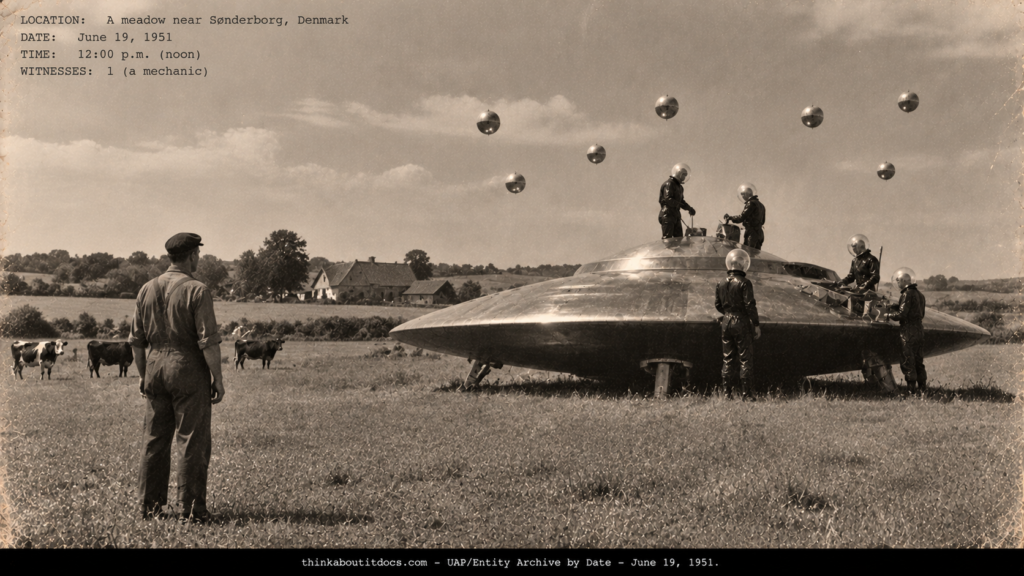
At midday on June 19, 1951, a mechanic named Josef Maliszewski heard a whistling sound and found a large craft resting in a meadow near Sønderborg, Denmark. As he approached to within about fifty meters, the birds stopped singing, the cattle in the field seemed frozen, and he found he could not move. Four handsome, brown-skinned men in shiny black suits and transparent helmets went about what looked like repairs while eight smaller objects hovered above, and when the work was done the craft rose and left, and his paralysis ended.
The account is catalogued in Jacques Vallée’s Passport to Magonia, but it first appeared in print about eight years after the event, in a 1959 German bulletin, and a catalogue review that traced it considers it a probable contactee-type tale. It is preserved here as a landing and entity report whose source chain is its main weakness.
Date: June 19, 1951 (one catalogue gives June 9)
Sighting Time: 12:00 p.m. (noon)
Day/Night: Day
Location: A meadow near Sønderborg, Denmark
Urban or Rural: Rural, agricultural
No. of Entity(‘s): 4 in the narratives checked (some later retellings give more)
Entity Type: Humanoid
Entity Description: “Handsome men” with brown skin, wearing shiny black suits and translucent helmets
Hynek Classification: CE-III (Close Encounter of the Third Kind)
Duration: Not recorded; long enough for the crew to finish apparent repairs before departure
No. of Object(s): 1 landed craft plus 8 smaller objects that hovered above it
Description of the Object(s): A craft on the ground in a meadow, with a deck on which men worked at apparent repairs; the eight smaller objects are described as small and circular
Shape of Object(s): Not described in the sources checked beyond a landed craft with a deck
Size of Object(s): Not recorded in the sources checked; one popular retelling gives about 100 meters
Color of Object(s): Not recorded in the sources checked
Distance to Object(s): About 50 meters when the witness was paralyzed
Height & Speed: Landed during the encounter; on departure the craft climbed to about 100 meters and then rose rapidly out of sight
Number of Witnesses: 1 (Josef Maliszewski, a mechanic aged 51; his name is spelled several ways)
Special Features/Characteristics: Paralysis of the witness at about 50 meters; birds stopped singing and cattle appeared frozen; a battery-acid taste in the mouth on departure, followed later by diarrhea; later retellings add telepathic messages, landing traces, a second meeting on May 18, 1954 and a home planet called “Zutorn”
Case Status: No official investigation known; catalogue case from a 1959 German bulletin; a catalogue review rates it a probable contactee-type tale
Source: Jacques Vallée, Passport to Magonia (Magonia catalogue, case 82); UFO Nachrichten (German bulletin, 1959, as cited by later compilers); Albert Rosales, humanoid reports catalogue; Gordon Creighton, Flying Saucer Review (1970); Patrick Gross, catalogue review
Summary/Description: At noon on June 19, 1951, mechanic Josef Maliszewski found a craft landed in a meadow near Sønderborg. Within about 50 meters he was paralyzed while birds fell silent and cattle froze. Four men in shiny black suits and translucent helmets worked at repairs, with eight small objects hovering above. When the craft left he could move again, and he reported a battery-acid taste and later diarrhea.
Related Cases: June 1951 UFO sightings archive | 1951: The Drakensteen Mountain Contact, South Africa | 1951: The Salzburg, Austria Encounter
Detailed Report
Vallée’s Passport to Magonia lists the case in its catalogue of landings (case 82, cited at page 195 by a later compiler). The catalogue entry is brief: the paralysis, the silent birds and cattle, the four men and the repairs. A review of the case’s source chain, by Patrick Gross, traces it back to the German bulletin UFO Nachrichten of 1959. Gross could not obtain that bulletin, calls its content usually sensationalistic and unverified, and says he does not consider it a reliable source. Gordon Creighton, Albert Rosales, John Schuessler and Willy Wegner also repeat the case in various forms.
By the account in the catalogues, Maliszewski, a 51-year-old mechanic, heard a whistling sound at about noon and saw a craft come down in a meadow. When he came within about 50 meters he could no longer move. The birds stopped singing and the cattle seemed unable to move. Four handsome men with brown skin, in black shiny suits and translucent helmets, emerged and appeared to make repairs on the craft’s deck, and eight small circular objects hovered above it.
When the work was finished the craft climbed to about 100 meters and rose rapidly out of sight, and the witness’s paralysis ended. He reported a taste in his mouth like battery acid as it left, and diarrhea afterward.
Later accounts add details that Vallée’s entry does not carry. They include a pair of telepathic messages, one of them reassuring the witness that the beings would not take any of the animals or people, a second meeting on May 18, 1954, and the name of a home planet, Zutorn. One popular retelling also describes a craft about 100 meters long with folding half-moon wings, portholes and horseshoe-shaped landing supports, and says landing traces were found. None of these details appears in the catalogue review’s account, which lists no physical evidence.
The date also varies. The June 19 date and the noon hour come with the 1959 bulletin as the catalogues repeat it, and Schuessler’s compilation gives June 9. The witness’s name appears as Maliszewski, Matiszewski, Matiszewsky and Matiszenski, and the Gross review says the witness drawing it shows has not been approved.
The Hynek classification is CE-III: occupants were seen at close range beside a landed craft. The witness was physically affected, but no instrument records or independent witnesses are known.
Researcher’s Notes
A Landing Catalogue Entry With a Late Source Chain
- Classification: CE-III fits the account as catalogued: occupants seen beside a landed craft. The paralysis is a reported effect on the witness, not a measured one.
- Source Chain: The earliest known publication is a 1959 German bulletin, about eight years after the event, and the catalogue review says it could not be examined. Vallée’s entry is the first confirmed catalogue record, and later catalogues copy it. The review says Vallée left out the telepathy, the home planet and the 1954 meeting, and that later compilers repeated the trimmed account without digging into it.
- The Date: June 19 at noon rests on the bulletin as repeated by the catalogues. Schuessler gives June 9. Without the bulletin, the day cannot be settled.
- Physical Evidence: The catalogue review lists no photographs or physical evidence. Landing traces appear in one retelling I could not open, with no description of who found them or when. This page therefore does not treat traces as documented.
- Animals: Animals reacting during close encounters is a recurring motif in the literature. Here the silent birds and still cattle are part of the witness’s report and have no second source.
- Review Verdict: Patrick Gross rates the case a probable contactee-type tall tale, with high certainty, because of the weak source and the added telepathy, planet name and second meeting. That is one reviewer’s assessment, not an official finding.
- Contactee Layer: The 1954 follow-up and the “Zutorn” planet fit the contactee stories of the period and appear only in later retellings. They are best weighed apart from the 1951 core account.
The Sønderborg case offers a dramatic landing scene, a witness with physical aftereffects and a place in Vallée’s catalogue. Its weak points are the single late source, the conflicting date, the absence of any documented physical evidence and the contactee-style additions in later retellings.
“Do not be afraid, we will not take any of them.”
— Telepathic message attributed to Josef Maliszewski in later retellings of the June 19, 1951 Sønderborg, Denmark encounter (not in Vallée’s catalogue entry)