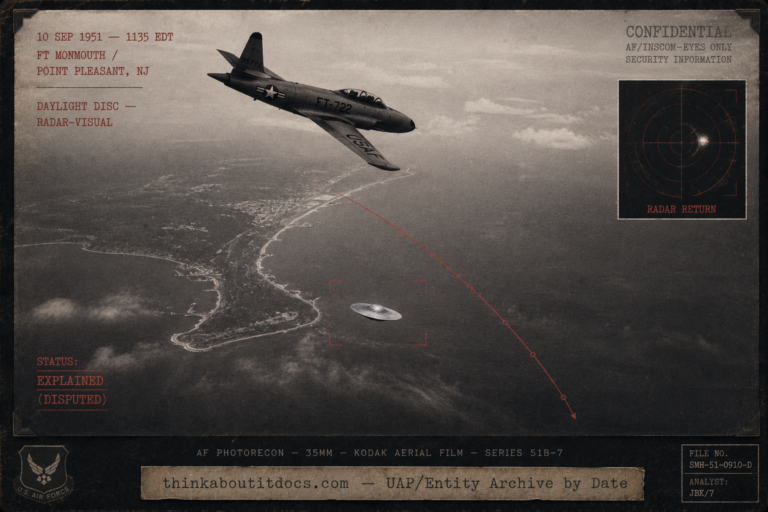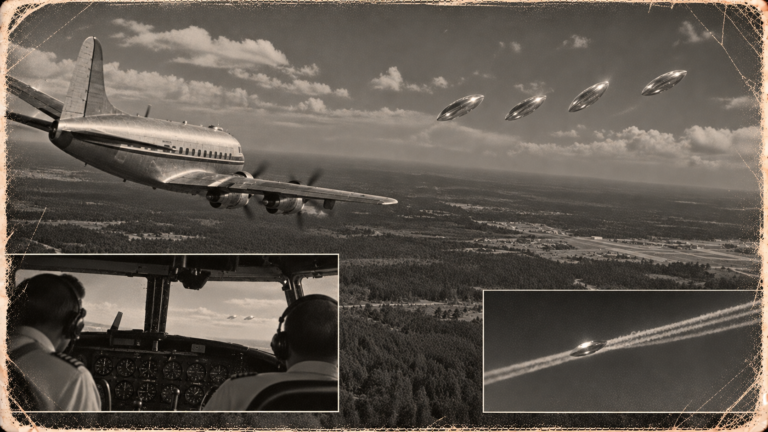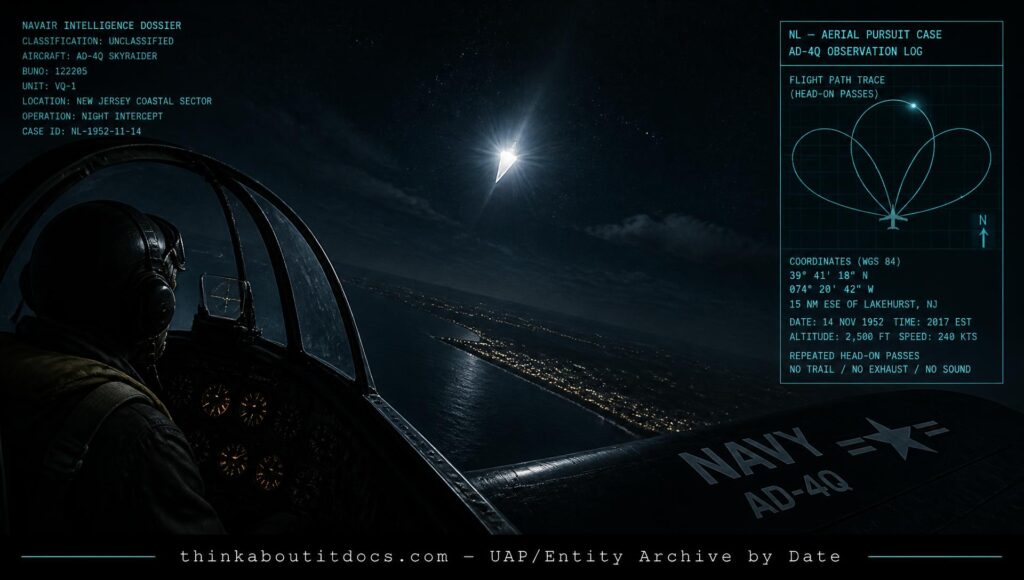
Lt. j.g. Robert Haven's November 7, 1950 encounter with a maneuvering light that made repeated head-on passes at his aircraft east of Lakehurst, New Jersey.
THINK ABOUTIT UFO|UAP SIGHTINGS REPORT
1950: The Robert Haven Pursuit — East of Lakehurst, New Jersey
On the evening of November 7, 1950, a Navy pilot flying an AD-4Q attack aircraft spotted what looked like a small, steady white light off to his side — and when he banked to get a closer look, the light turned the tables on him. Over the next several minutes, Lt. (j.g.) Robert Haven found his own aircraft repeatedly on the receiving end of high-speed head-on passes from an object that left no wash, no slipstream, and no visible means of propulsion, climbing faster than his own aircraft could match before finally outrunning him entirely to 25,000 feet. The case survives today largely through J. Allen Hynek’s own published account — the original letter Haven sent describing the encounter has since been lost — and it remains one of the more dramatic and best-documented aerial pursuit cases of the entire 1950 wave.
Date: November 7, 1950
Sighting Time: 7:15 p.m.
Day/Night: Night
Location: East of Lakehurst, New Jersey (BBU)
Urban or Rural: Airborne, over the New Jersey coastal region
No. of Entity(‘s): Not applicable
Entity Type: Not applicable
Hynek Classification: NL (Nocturnal Light) — a lit object observed at night, engaging in sustained maneuvering flight relative to the witness’s own aircraft
Duration: Several minutes, across the initial approach, six head-on passes, and the climbing chase to 11,500 feet
No. of Object(s): 1
Description of the Object(s): A steady, white light approximately 10-12 inches in apparent size, showing no wash, slipstream, or visible propulsion during its high-speed passes
Shape of Object(s): Not resolved beyond a point-source light
Size of Object(s): Not established (apparent angular size only, given as 10-12 inches at the witness’s estimated viewing distance)
Color of Object(s): Steady white
Distance to Object(s): Initially about 5 miles away at 4,000 feet; closed to within 100-200 feet during its head-on passes
Height & Speed: Haven’s AD-4Q was at 3,500 feet heading west; the object, initially at roughly 4,000 feet heading southeast, made a diving head-on pass at an estimated 900 mph, then repeated the maneuver five to six times while climbing at a rate exceeding 2,000 feet per minute, reaching approximately 25,000 feet by the time jet aircraft arrived on the scene
Number of Witnesses: 1 (Lt. j.g. Robert Haven)
Special Features/Characteristics: The object appeared to respond directly to Haven’s own maneuvers, reversing from a passive light into an aggressive head-on intercept pattern the moment he turned to approach it; it repeated this pass six times in total; it displayed no wash or slipstream despite its estimated speed, and it out-climbed and outmaneuvered Haven’s aircraft before disappearing at high altitude once jet aircraft were vectored to the area.
Case Status: Unexplained (Project Blue Book’s official file listed the case under a “balloon” explanation, which this archive notes does not obviously account for the reported head-on maneuvering and climb performance)
Source: Hynek, J. Allen, The UFO Report, pp. 68-70; NARCAP; Keyhoe, Donald E. (based on a “Special Delivery” letter from Lt. j.g. Robert Haven to Keyhoe, since lost); Project Blue Book files
Summary/Description: At 7:15 p.m. on November 7, 1950, Navy pilot Lt. j.g. Robert Haven was flying an AD-4Q at 3,500 feet heading west when he spotted a steady white light, roughly 10-12 inches in apparent size, about five miles away at 4,000 feet, heading southeast. Haven made a slight climbing turn to the left to get behind the object — which responded by making a head-on pass roughly 100-200 feet over his aircraft in a shallow, high-speed dive. Haven turned tightly to pursue, noting the object showed no wash or slipstream despite an estimated speed of around 900 mph. The object then made five or six more head-on passes at his aircraft while climbing at a rate exceeding 2,000 feet per minute; Haven abandoned the chase at 11,500 feet as the object continued to outmaneuver him. By the time jet aircraft were vectored to the area, the object had reached an estimated 25,000 feet and disappeared. The original letter Haven wrote describing the encounter to UFO investigator Donald Keyhoe has since been lost, and the case survives primarily through J. Allen Hynek’s published account.
Related Cases: 1950: The Oak Ridge/Knoxville Flap, Tennessee (same year, comparable military radar/visual density) | The Gorman Dogfight, 1948 (an earlier military pilot encounter with a maneuvering aerial light)
Detailed Report
The Haven case belongs to a small but significant category of 1950s military pilot encounters in which the object’s behavior appears directly responsive to the pilot’s own actions — not a passive light glimpsed and lost, but an object that seems to actively engage once approached. The sequence Haven described is specific and internally consistent: a passive sighting, followed immediately by an aggressive head-on pass the moment he turned toward it, followed by repeated passes as he continued to pursue, followed by a climb that outperformed his own aircraft. That structure — escalation in direct response to pilot action — is one of the details that makes military aviator encounters like this one difficult to explain as simple misidentification of a star, planet, or distant aircraft running lights, none of which would be expected to reverse course and close distance the moment an observing aircraft began to maneuver toward it.
The absence of wash or slipstream is the detail Haven himself apparently emphasized, and it is analytically significant: an object passing within 100-200 feet of an aircraft at an estimated 900 mph would ordinarily be expected to produce some detectable aerodynamic disturbance, particularly to a trained naval aviator specifically positioned to notice it. Its absence argues against a conventional propeller or jet aircraft matching that description, though it does not by itself rule out other prosaic explanations such as a lighted balloon, given Project Blue Book’s own eventual classification of the case.
That official “balloon” classification is worth examining critically rather than accepting at face value. A balloon, even a rapidly rising one, does not typically execute repeated head-on intercept passes against a maneuvering aircraft, nor does it climb at a controlled rate exceeding 2,000 feet per minute while outpacing a pursuing fighter-type aircraft. The Blue Book “balloon” designation may reflect either genuine unrecorded evidence not preserved in the summary available to this archive, or the kind of routine, under-justified mundane classification that later reviewers — including Hynek himself, who chose to include this case in his own published report rather than dismiss it — have flagged as a recurring pattern in the Air Force’s handling of its more difficult cases.
The loss of Haven’s original letter is a genuine gap in the documentary record. What survives is Hynek’s and Keyhoe’s secondhand accounts of its contents rather than the primary document itself, meaning some of the case’s more granular details (exact wording, any additional context Haven may have provided) cannot be independently verified against the source. This does not undermine the substance of the account, which multiple secondary compilers have transmitted consistently, but it is a limitation worth noting for any researcher seeking to examine the case’s primary sourcing further.
RESEARCHER’S NOTES
The Robert Haven Pursuit — New Jersey 1950 and the Question of a Responsive Object
- Classification issues: NL fits the case’s nighttime, light-only visual profile, though the object’s active, repeated maneuvering against the witness’s aircraft sets it apart from a typical passive nocturnal light and places it closer in character to a dogfight-style encounter such as the 1948 Gorman case.
- Source chain assessment: The case’s primary source — Haven’s own letter to Donald Keyhoe — no longer survives; the account is preserved through Hynek’s published summary and Keyhoe’s own writing, both several steps removed from Haven’s original words. This is a meaningfully thinner sourcing chain than a directly quoted witness statement, even though the secondary accounts are broadly consistent with one another.
- Pattern context: The case’s official “balloon” classification in Project Blue Book files is worth flagging as a recurring pattern this archive has noted elsewhere — a mundane explanation applied to a case whose described dynamic behavior (repeated head-on passes, sustained high climb rate, successful outmaneuvering of a pursuing aircraft) is difficult to reconcile with a passive, wind-driven object.
- Physical evidence and evidentiary weight: No photograph, radar corroboration, or second witness exists for this case — it rests entirely on one trained military pilot’s account, transmitted through secondary sources. The professional standing of the witness and the internal consistency of the account across multiple compilers give it some evidentiary weight despite the single-witness, secondhand-sourcing limitations.
- Geographic and historical context: Lakehurst, New Jersey was, by 1950, a well-established naval air station with a long aviation history (including its earlier role in airship operations); its coastal location and active naval air traffic made it a plausible site for both genuine anomalous encounters and misidentified conventional or experimental aircraft activity during this period.
The Robert Haven case stands as one of the more vividly described aerial pursuit encounters of 1950 — a trained naval aviator’s account of being repeatedly, aggressively approached by an object that outperformed his own aircraft in every respect that mattered, preserved only through secondhand retellings after the original letter describing it was lost. The Air Force’s own “balloon” classification sits uneasily against the described maneuvering, and no stronger explanation has been offered in its place. It is catalogued here as Unexplained: a serious pilot report whose primary source no longer exists to be re-examined.
“No wash or slipstream from the object traveling at about 900 mph.”
— Lt. j.g. Robert Haven, on the November 7, 1950 encounter east of Lakehurst, New Jersey